
Institutional crypto firms are moving beyond trading and market making. Increasingly, they are applying their infrastructure, risk systems, and liquidity expertise to onchain lending strategies that ordinary users can access through non-custodial vaults.
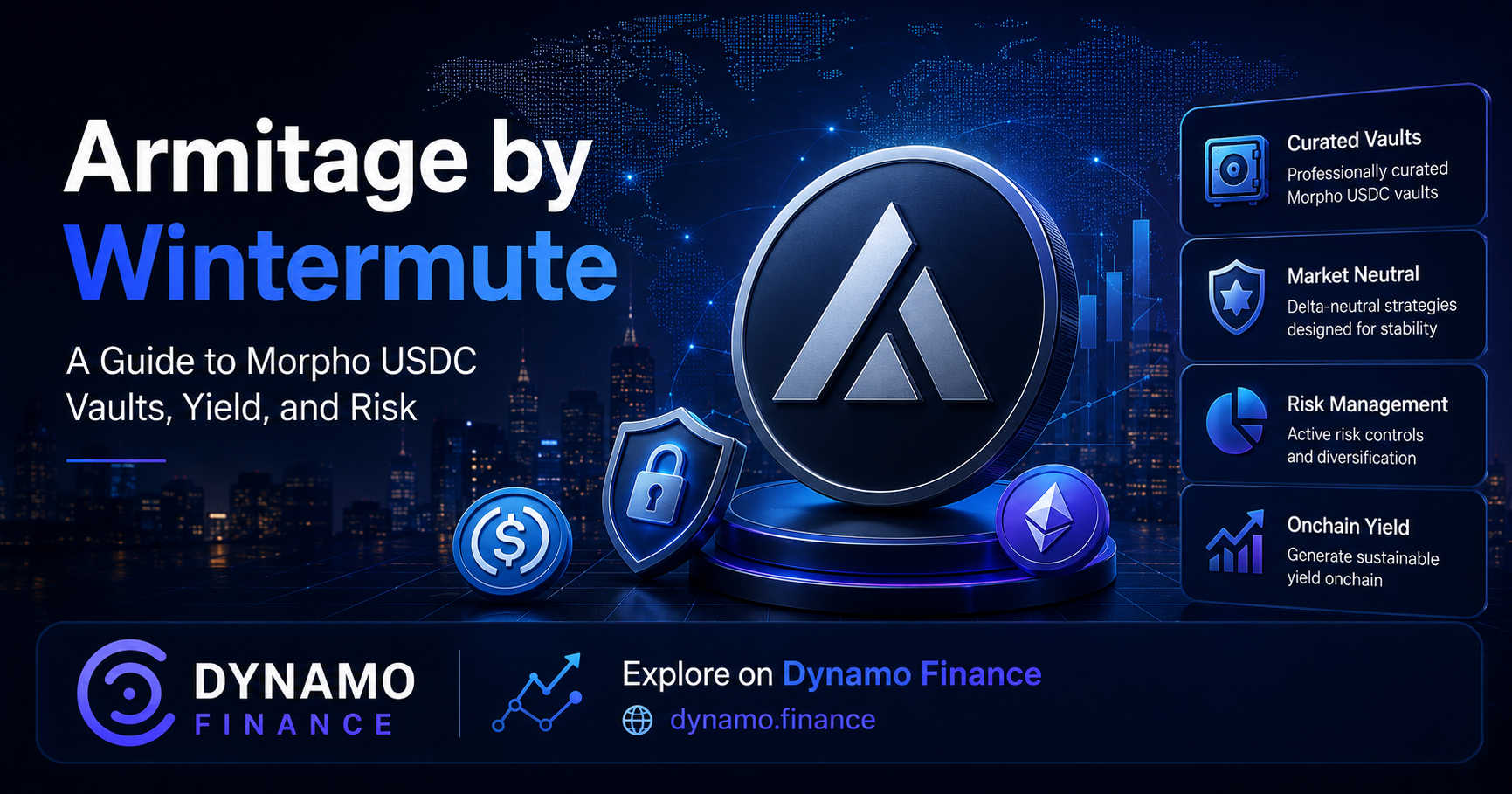
Armitage by Wintermute is one of the clearest examples of this shift. Launched as Wintermute’s specialized vault-curation arm, Armitage manages USDC strategies built on Morpho, allocating depositor capital across lending markets with different collateral types, risk parameters, and yield profiles.
Armitage by Wintermute is a non-custodial DeFi vault curator that selects, monitors, and rebalances Morpho lending-market exposure on behalf of depositors. Users deposit USDC into a vault, receive tokenized vault shares, and earn a blended yield generated by borrowers across the markets selected by Armitage.
This guide explains what Armitage does, how its Prime and Select vaults differ, where their yield comes from, and which risks depositors must evaluate. It also covers how Dynamo Finance can help users compare Morpho vaults, inspect underlying markets, and make more informed onchain lending decisions.
Key Takeaways
- Armitage is Wintermute’s vault-curation business, beginning with USDC vaults deployed through Morpho Vault V2 on Ethereum.
- The live Prime vault prioritizes established, liquid collateral markets, while Select adds more complex opportunities in pursuit of a higher target yield.
- Depositor returns come from borrower interest across the underlying Morpho markets, not from a guaranteed fixed-rate product.
- Curator experience can improve monitoring and execution, but it does not eliminate smart-contract, oracle, collateral, liquidity, bad-debt, or counterparty risk.
- Dynamo provides a Morpho-based interface for reviewing vault APY, TVL, curator identity, market allocations, fees, and risk signals before committing capital.
What Is Armitage by Wintermute?
Armitage is the dedicated onchain vault-curation arm of Wintermute, a digital-asset trading firm founded in 2017. Wintermute operates across centralized and decentralized markets, providing liquidity, executing algorithmic strategies, and managing exposure across multiple chains and trading venues.
Vault curation applies some of those capabilities to passive DeFi lending. Instead of asking each depositor to identify individual lending markets, evaluate every collateral asset, monitor utilization, and rebalance capital manually, a curator performs those functions at the vault level.
Armitage’s responsibilities include:
- Selecting the Morpho markets a vault may use
- Setting allocation caps and strategy parameters
- Rebalancing liquidity as rates and market conditions change
- Monitoring collateral, oracle, liquidity, and borrower risks
- Maintaining sufficient liquidity for ordinary withdrawals where possible
- Responding to stressed markets or emerging security events
The vault itself remains non-custodial. Deposits are held by the relevant Morpho vault contracts rather than in an account controlled directly by Wintermute or Armitage. The curator controls strategy decisions within the permissions and timelocks established by the vault architecture, but it cannot simply transfer depositor assets to an arbitrary external wallet.
This structure matters because Armitage is not a conventional savings account, hedge fund subscription, or unsecured deposit with Wintermute. It is an onchain strategy whose assets, allocations, roles, and contract interactions can be inspected publicly.
Why Wintermute Entered Vault Curation
DeFi lending has matured to the point where access alone is no longer the main challenge. Morpho makes it possible to create isolated lending markets permissionlessly, but the growing number of assets, oracles, wrappers, maturity structures, and yield-bearing collateral types makes market selection increasingly complex.
Professional curation attempts to solve that problem. A capable curator can combine onchain data with an understanding of offchain liquidity, exchange conditions, liquidation routes, collateral dependencies, and borrower behavior.
Armitage’s proposed advantage is execution. Wintermute is already active in digital-asset markets, so it can evaluate whether collateral can realistically be sold during stress rather than relying only on historical volatility or reported onchain liquidity.
The curator also states that it can execute liquidations in the markets it supports. That capability may expand the range of collateral a vault can consider, although broader collateral support should never be interpreted as proof that those assets are low risk.
For users researching morpho defi opportunities, Armitage is therefore best understood as a strategy and risk-management layer built on top of Morpho’s lending infrastructure.
How Armitage Vaults Generate Yield
Armitage vaults earn yield by supplying USDC to selected Morpho lending markets. Borrowers post collateral and borrow the available USDC, paying interest according to each market’s utilization and interest-rate model.
The process can be summarized in five steps:
- A user deposits USDC. The depositor approves the vault contract and contributes USDC to the selected Armitage vault.
- The vault issues shares. These shares represent the user’s proportional ownership of the vault’s assets and accumulated returns.
- Armitage allocates liquidity. Capital is distributed among approved Morpho markets according to the vault’s tier, risk limits, and current opportunities.
- Borrowers pay interest. Interest generated in the underlying markets increases the value of the vault’s assets.
- The strategy rebalances. Armitage can move available liquidity among approved markets as yields, utilization, liquidity, and risk conditions change.
The displayed vault APY is a blended annualized estimate based on the vault’s current allocations and market rates. It can rise or fall as borrowing demand changes. A target range communicates the curator’s intended return profile, but it is not a promise that depositors will receive that rate.
Why Utilization Matters
Utilization measures how much of a lending market’s supplied liquidity has been borrowed. For example, a market with $10 million supplied and $8 million borrowed has approximately 80% utilization.
Higher utilization often produces a higher supply APY because borrowers are competing for scarcer liquidity. However, it can also reduce the amount immediately available to withdrawing suppliers.
A vault curator must therefore balance two competing objectives: allocating enough capital to productive markets to generate yield while preserving enough accessible liquidity to support redemptions.
Why Vault APY Changes
A vault does not generate returns from a single static source. Its APY can change because borrowers repay, new borrowers enter, allocations shift, collateral markets mature, incentives end, or the curator reduces exposure to an opportunity.
This is why chasing the highest displayed rate without inspecting the underlying markets can be misleading. The most useful question is not simply, “What is the APY?” It is, “Which borrowers, collateral assets, or economic structures are producing that APY?”
Armitage Prime vs. Select vs. Apex
Armitage defines three strategy tiers. As of the product information updated on June 11, 2026, Prime and Select were live on Ethereum, while Apex remained a planned tier rather than a deployed vault.
| Feature | Prime | Select | Apex |
|---|---|---|---|
| Status | Live | Live | Planned; not deployed |
| Deposit asset | USDC | USDC | Not yet confirmed for a live deployment |
| Network | Ethereum | Ethereum | To be confirmed |
| Published target APY | 4%–5%, subject to market conditions | 5%–8%, subject to market conditions | No live target |
| Intended profile | Conservative relative to the other Armitage tiers | Balanced, with greater risk tolerance | Aggressive and intended for sophisticated depositors |
| Collateral approach | Established blue-chip crypto collateral | Blue-chip markets plus selected higher-yield collateral | Expected to emphasize complex, novel, or exotic opportunities |
| Published performance fee | 0% at the reviewed update | 0% at the reviewed update | Not applicable until deployment |
| Published management fee | 0% at the reviewed update | 0% at the reviewed update | Not applicable until deployment |
These tiers should not be interpreted as universal definitions of low, medium, and high risk. Prime may be more conservative than Select within the Armitage product range, but any DeFi vault can experience losses.
Wintermute USDC Prime
Prime focuses on established Morpho markets with widely used collateral and comparatively deep liquidity. Its published market set included cbBTC/USDC, wstETH/USDC, and WBTC/USDC, each using an 86% liquidation loan-to-value threshold at the reviewed update.
This approach avoids some of the additional structural dependencies found in more experimental collateral. Nevertheless, depositors remain exposed to the USDC asset, the relevant Bitcoin or staked Ether wrappers, price oracles, Morpho contracts, borrower solvency, and liquidation execution.
Prime may suit users who want curated USDC lending exposure but do not want the additional complexity associated with tokenized private credit, expiring principal tokens, or less established yield-bearing assets.
Wintermute USDC Select
Select begins with the same general blue-chip foundation but expands into selected higher-yield markets. Its published allocations included cbBTC, wstETH, WBTC, v-wmtUSDC, principal-token markets, and reUSD-related collateral.
The vault’s higher target range reflects a broader opportunity set, not free additional return. Complex collateral can add credit risk, maturity risk, wrapper risk, depeg risk, oracle risk, and lower secondary-market liquidity.
One notable component is v-wmtUSDC, which is connected to Wintermute’s onchain borrowing activity through Wildcat Protocol. Exposure to such an asset requires users to consider the creditworthiness and repayment capacity behind the tokenized obligation, not only the smart contract holding it.
Select may be more appropriate for depositors who understand why its additional yield exists and are comfortable underwriting the extra dependencies. It should not be chosen merely because its target APY is higher.
Armitage Apex
Apex is intended to represent the most aggressive Armitage risk-and-yield tier. Potential collateral categories include Pendle principal tokens, novel yield-bearing assets, and tokenized real-world assets.
No Apex vault had been deployed as of the reviewed update. Users should treat descriptions of its intended design as a roadmap rather than an investable product.
Understanding the Morpho Infrastructure Under Armitage
Armitage currently uses Morpho Vault V2 and Morpho’s isolated lending markets. Understanding these two layers makes it easier to see where depositors’ money goes.
Isolated Lending Markets
Each Morpho market is defined by a loan asset, a collateral asset, an oracle, an interest-rate model, and an LLTV threshold. Rather than pooling every supported asset into one large lending system, each market keeps its accounting and exposure separate.
Isolation can limit direct contagion between unrelated markets. A problem in one market does not automatically rewrite the parameters or drain the liquidity of every other market.
However, a vault can allocate to several markets simultaneously. A depositor’s effective exposure is therefore the weighted combination of all markets used by that vault.
Vault Aggregation
A Morpho vault pools deposits and allocates them across approved markets. Curators determine which markets may receive capital, while operational roles can execute rebalancing within established limits.
Users can review the technical structure through the official Morpho developer resources. Onchain transparency makes it possible to verify current allocations, curator roles, contract addresses, caps, and pending changes instead of relying exclusively on a marketing page.
Role Separation and Timelocks
Morpho Vault V2 separates several operational roles. An owner can control high-level configuration, a curator proposes strategy changes, an allocator moves funds within approved limits, and a sentinel may receive emergency derisking powers.
Critical changes can be subject to timelocks. Armitage’s published vault information states that additions of new markets are delayed before execution, giving observers time to inspect a proposed change.
Timelocks improve transparency but do not replace monitoring. A user who never reviews pending changes may still find that the vault’s risk profile has evolved after the delay expires.
How Armitage Relates to Dynamo Finance
Armitage and Dynamo operate at different layers of the Morpho ecosystem.
Armitage is a curator. It chooses eligible markets, defines strategy limits, monitors risk, and rebalances its vaults. Dynamo is a non-custodial interface, analytics layer, and SubDAO built around Morpho’s underlying smart contracts.
When a user interacts with a Morpho market or compatible vault through Dynamo, the transaction is routed to the relevant onchain contract. Dynamo does not take custody of the deposited funds.
The platform’s vault interface lists active vaults available through Dynamo and lets users compare factors such as:
- Current and historical APY data
- Total value locked
- Deposit asset
- Curator identity
- Underlying market allocations
- Market-level yield contributions
- Performance and management fees
- Risk classifications and relevant parameters
This makes Dynamo useful as a research and execution layer for users comparing Armitage with other curated strategies. Anyone exploring morpho vaults can examine more than the headline yield before deciding where to allocate.
Dynamo also surfaces active lending markets individually. Users who do not want curator-managed exposure can evaluate whether direct market supply is preferable to depositing through a vault.
Direct Market Lending vs. an Armitage Vault
Supplying to an individual market gives the lender precise control over the collateral and oracle associated with the position. The trade-off is that the lender must monitor utilization, APY, liquidity, and market health independently.
An Armitage vault delegates market selection and rebalancing to the curator. This reduces the operational burden on the depositor but introduces curator risk and makes the depositor’s exposure dependent on a changing basket of approved markets.
Direct lending may be better when a user has a strong view on one specific collateral pair. A vault may be preferable when the user wants diversified allocations and professional monitoring without manually moving USDC among markets.
For borrowers, Dynamo also supports workflows in which users post collateral and take a loan crypto position through isolated Morpho markets. That activity is distinct from depositing into Armitage, where the user acts as a supplier rather than the borrower.
Armitage Risk Analysis
Curated vaults simplify execution, but they do not remove risk. Depositors should evaluate the complete path between their USDC deposit and the borrowers generating the return.
1. Smart-Contract Risk
Armitage relies on Morpho contracts, token contracts, oracle systems, wrappers, and potentially other protocols connected to the underlying collateral. A flaw in any critical dependency could produce losses or prevent normal withdrawals.
Audits reduce the probability of undiscovered vulnerabilities but cannot prove that a contract is error-free. New integrations and complex collateral structures can introduce dependencies that have not been tested through multiple market cycles.
2. Collateral Risk
Borrowers secure their debts with assets selected for each market. If collateral falls in value too quickly, cannot be sold efficiently, or behaves differently from its intended price reference, liquidations may fail to recover the outstanding USDC.
Wrapped assets introduce additional dependencies. WBTC and cbBTC, for example, are representations of Bitcoin on Ethereum rather than native BTC. Staked Ether assets depend on staking infrastructure, redemption processes, and their relationship to ETH.
Users comparing ETH lending or Bitcoin-backed markets should evaluate both the underlying asset and the specific wrapper accepted as collateral.
3. Oracle Risk
Morpho markets use an oracle to determine collateral value relative to the loan asset. A stale, manipulated, or poorly designed price feed can trigger wrongful liquidations or prevent necessary liquidations.
Principal tokens and yield-bearing collateral can require more specialized valuation methods than spot ETH or BTC. Depositors should check how the oracle handles maturity, exchange rates, redemption mechanics, and periods of thin liquidity.
4. Liquidity Risk
A non-custodial vault may allow users to request a withdrawal at any time, but immediate liquidity is not always guaranteed. When most supplied USDC has been borrowed, the vault may need borrowers to repay or another lender to add liquidity before a large withdrawal can be completed.
High utilization can therefore increase both yield and withdrawal friction. The phrase “no lock-up” should not be confused with a guarantee of instant redemption under every market condition.
5. Bad-Debt Risk
Bad debt occurs when the proceeds from liquidated collateral are insufficient to repay a borrower’s obligation. This can happen after a sudden price gap, oracle failure, insufficient liquidation capacity, or a loss of confidence in the collateral.
Wintermute’s ability to execute liquidations may improve operational readiness, but no liquidator can guarantee recovery when collateral becomes untradeable or falls faster than execution systems can respond.
6. Curator Risk
Depositors rely on Armitage to select markets, set sensible caps, respond to warning signals, and rebalance without creating unnecessary exposure. Poor judgment, operational mistakes, compromised permissions, or conflicts of interest could affect outcomes.
Select deserves particular attention where the curator, a related borrower, and a connected collateral structure may form parts of the same economic chain. Onchain transparency helps users identify that concentration, but transparency does not make the exposure disappear.
7. Stablecoin Risk
The Armitage vaults use USDC as the deposit asset. USDC is designed to track the U.S. dollar, but stablecoin holders remain exposed to reserve management, banking partners, redemption conditions, regulatory developments, and temporary secondary-market deviations.
Readers unfamiliar with the asset can review Circle’s USDC information and should avoid treating any stablecoin as identical to cash held in an insured bank account.
8. Regulatory and Access Risk
DeFi access can be affected by wallet screening, interface restrictions, sanctions policies, and changing laws. A smart contract may remain operational even when a specific website or service is unavailable in a user’s jurisdiction.
Users are responsible for confirming whether they may legally interact with a vault and how any yield, token receipt, disposal, or withdrawal is treated for tax purposes.
How Dynamo’s Risk Tools Improve the Research Process
Dynamo assigns risk tiers to markets and vaults using observable onchain variables. Its market framework considers LLTV, market TVL, and how long a market has been active.
These indicators can help users identify newer, smaller, or more aggressively configured markets. They should be treated as screening tools rather than guarantees.
Dynamo also displays allocation data that can reveal whether a vault is broadly diversified or heavily dependent on one market. This is important because a vault with seven approved markets may still have most of its deployed capital concentrated in a single opportunity.
Users pursuing crypto lending yield should review at least four layers:
- The vault-level APY, TVL, fees, and curator
- The percentage allocated to each underlying market
- The collateral, oracle, LLTV, and liquidity of those markets
- The external protocols or issuers supporting complex collateral assets
The Dynamo Finance docs provide additional explanations of isolated markets, vault allocations, interest rates, collateral ratios, liquidation mechanics, fees, and wallet permissions.
A Practical Due-Diligence Checklist
Before depositing USDC into Prime, Select, or any other managed Morpho strategy, complete the following review:
- Verify the contract address. Match the vault address shown in the interface with the address published through official Armitage channels.
- Confirm the active curator. Check that the listed curator and role assignments have not changed unexpectedly.
- Review current allocations. Look at deployed percentages rather than relying only on the list of markets the vault is allowed to enter.
- Inspect collateral dependencies. Identify wrappers, issuers, maturity dates, redemption assumptions, and offchain credit components.
- Check LLTV values. Higher LLTV permits more borrowing against the same collateral and generally leaves less room for adverse price movements.
- Examine utilization. High utilization can increase APY while reducing immediately available withdrawal liquidity.
- Read the oracle design. Determine how the collateral is valued and what could cause the oracle to lag or diverge from executable market prices.
- Review fees. Confirm performance, management, deposit, withdrawal, and force-deallocation settings directly in the live interface.
- Check pending changes. Inspect timelocked market additions, cap changes, or role updates before depositing.
- Size the position conservatively. Do not commit funds that you may need immediately or cannot afford to lose.
A headline promising the best stablecoin yield is not a substitute for this process. Sustainable allocation depends on understanding why the rate is available and whether the compensation is adequate for the underlying risk.
Fees, Compounding, and Withdrawals
At the June 11, 2026 update, Armitage listed 0% performance fees and 0% management fees for both deployed vaults. It also listed no deposit or withdrawal fee and a 0% force-deallocation penalty.
Those settings can change. Morpho vault fees are configured at the vault level, and users should inspect the current values before approving a transaction.
Vault yield compounds through the increasing value of the depositor’s shares. Interest paid by borrowers accrues to the vault, and each share represents a proportional claim on the growing asset pool.
Withdrawals require sufficient liquidity in the underlying markets. Even without a contractual lock-up or withdrawal fee, heavily utilized markets can temporarily delay full redemption.
How to Evaluate APY Without Chasing Yield
APY is useful for comparing current earning conditions, but it can create a false sense of precision. A displayed 6% rate is an annualized snapshot, not a forecast that the next 12 months will produce exactly 6%.
Consider three questions when comparing strategies:
- How much of the APY comes from organic borrower interest?
- How much comes from temporary token incentives or unusually high utilization?
- Which additional risks explain the difference between one vault and another?
Prime and Select illustrate this framework. Select targets more yield by admitting a wider range of collateral and market structures. The spread over Prime should be evaluated as compensation for complexity and risk rather than treated as an automatic upgrade.
The highest stablecoin yield visible on a dashboard may belong to a small, new, illiquid, or aggressively configured market. An experienced allocator compares net return with loss severity, exit liquidity, and the reliability of the collateral.
Who Might Consider Armitage Prime?
Prime may appeal to users who hold USDC and want a managed Morpho strategy focused on established crypto collateral. It reduces the need to move capital manually among several blue-chip lending markets.
Potential users still need to accept DeFi contract risk, USDC risk, wrapped-collateral risk, oracle risk, and the possibility of delayed withdrawals. “Prime” describes the intended position within Armitage’s range; it does not mean risk-free.
Who Might Consider Armitage Select?
Select may be relevant to more experienced users who understand tokenized credit, principal tokens, yield-bearing collateral, maturity mechanics, and liquidity concentration.
A depositor should be comfortable investigating each unfamiliar market rather than outsourcing all judgment to the curator. The strategy’s extra return potential exists because the underlying opportunity set carries additional dependencies.
Who Should Avoid These Vaults?
Armitage vaults may be inappropriate for users who need insured principal, guaranteed returns, instant access under all conditions, or a product with no exposure to smart contracts and digital assets.
They may also be unsuitable for anyone unable to evaluate changing vault allocations. A curated strategy is dynamic, so a deposit made when the vault holds one mix of markets can remain active after the curator changes that mix.
Using Dynamo to Research Armitage Vaults
A practical workflow begins on Dynamo’s browse live vaults page.
- Connect a compatible wallet or browse without connecting when read-only data is available.
- Filter vaults by USDC, Ethereum, curator, TVL, or APY.
- Open the relevant Armitage vault and confirm its contract address.
- Review its current market allocations and the percentage deployed to each market.
- Open the underlying market details to inspect collateral, oracle, LLTV, utilization, and liquidity.
- Check the displayed performance and management fees.
- Compare the vault against direct-market supply and other curators before depositing.
Users can also examine separate markets for opportunities such as direct stablecoin supply or collateralized borrowing. This creates a broader decision framework than viewing Armitage in isolation.
For example, someone comparing a USDC vault with a direct market can assess whether the curator’s rebalancing and monitoring justify the additional strategy layer. Another user may prefer direct exposure because they have completed their own collateral analysis and want full control over market selection.
Example Allocation Scenarios
Scenario 1: A Conservative USDC Holder
A user has $10,000 in USDC and wants onchain yield but has limited experience evaluating principal tokens and tokenized credit. They compare Prime with Select and notice that Select offers a higher target range.
Rather than choosing solely by APY, the user reviews the allocation breakdown. Prime’s established collateral mix is easier for them to understand, so they choose the strategy whose risks they can monitor more confidently.
Scenario 2: An Experienced DeFi Allocator
A second user understands Wildcat credit lines, Pendle principal tokens, stablecoin issuers, and oracle structures. They review Select’s market caps and actual weights, then allocate only a portion of their stablecoin portfolio.
The rest remains divided among other vaults and direct markets. This approach recognizes that even a well-researched strategy can experience an unexpected failure.
Scenario 3: A User Seeking Liquidity Against Crypto
A third user does not want to lend USDC. Instead, they want liquidity without selling an existing crypto position.
They use Dynamo to evaluate collateralized borrowing markets, paying particular attention to LLTV and liquidation price. The platform’s lending interface supports this use case separately from Armitage’s supplier-focused vault strategy.
The Broader Significance of Armitage
Armitage represents a wider transition in DeFi from simple permissionless pools toward curator-led products. The base protocol remains open and transparent, while specialized firms compete on market selection, risk management, distribution, and operational execution.
This model can make onchain finance more accessible because depositors no longer need to rebalance every position manually. It also creates a new trust surface: users must evaluate not just code and collateral, but the curator’s incentives, capabilities, and decision-making process.
Platforms such as Dynamo can provide an important independent analysis layer. By exposing allocation data, market parameters, fees, and risk indicators, the interface helps users test a curator’s narrative against observable onchain information.
This transparency is especially important as institutional credit, tokenized real-world assets, and structured yield products enter permissionless lending markets. A familiar brand can improve confidence, but it should never replace asset-level due diligence.
Final Thoughts on Armitage by Wintermute
Armitage by Wintermute brings the resources of a major crypto trading firm into Morpho vault curation. Its Prime and Select products give USDC depositors two distinct approaches: one centered on established crypto collateral and another that accepts more complex opportunities in pursuit of higher yield.
The value proposition is straightforward. Depositors receive a managed, automatically rebalanced strategy without surrendering assets to a traditional custodian. Wintermute contributes market experience, monitoring infrastructure, and liquidation capabilities, while Morpho supplies the underlying non-custodial lending architecture.
The risks are equally important. Returns depend on borrowers, collateral quality, oracle integrity, market liquidity, smart contracts, curator decisions, and the solvency of any credit-linked structures used by the vault.
Use Dynamo to look beneath the headline APY. Compare the live allocations, examine every underlying market, confirm fees and contract addresses, and choose a position size that reflects the possibility of loss.
Explore onchain markets and curated strategies through Dynamo, follow Dynamo Finance community updates, and evaluate each opportunity using current data rather than yield alone.
Frequently Asked Questions
What is Armitage by Wintermute?
Armitage by Wintermute is a non-custodial DeFi vault curator. It manages vaults built on Morpho by selecting lending markets, setting allocation limits, monitoring risk, and rebalancing depositor capital.
What is the difference between Armitage Prime and Select?
Prime focuses on established, liquid crypto collateral markets and targets a comparatively conservative profile. Select adds vetted higher-yield markets, including more complex collateral and credit-linked opportunities, in exchange for greater risk.
Is Armitage by Wintermute safe?
No DeFi vault is risk-free. Armitage uses non-custodial Morpho infrastructure and active monitoring, but depositors can still experience losses from smart-contract exploits, collateral failures, oracle problems, illiquidity, bad debt, stablecoin events, or curator decisions.
Can I withdraw from an Armitage vault at any time?
Users can submit withdrawals without a fixed lock-up period. Actual redemption depends on available liquidity in the underlying lending markets, so high utilization can temporarily limit or delay large withdrawals.
How can I compare Armitage with other Morpho vaults?
Use Dynamo to compare vault APY, TVL, curator identity, fees, deposit assets, and underlying market allocations. Open each market to review its collateral, oracle, LLTV, utilization, available liquidity, and risk classification before depositing.