
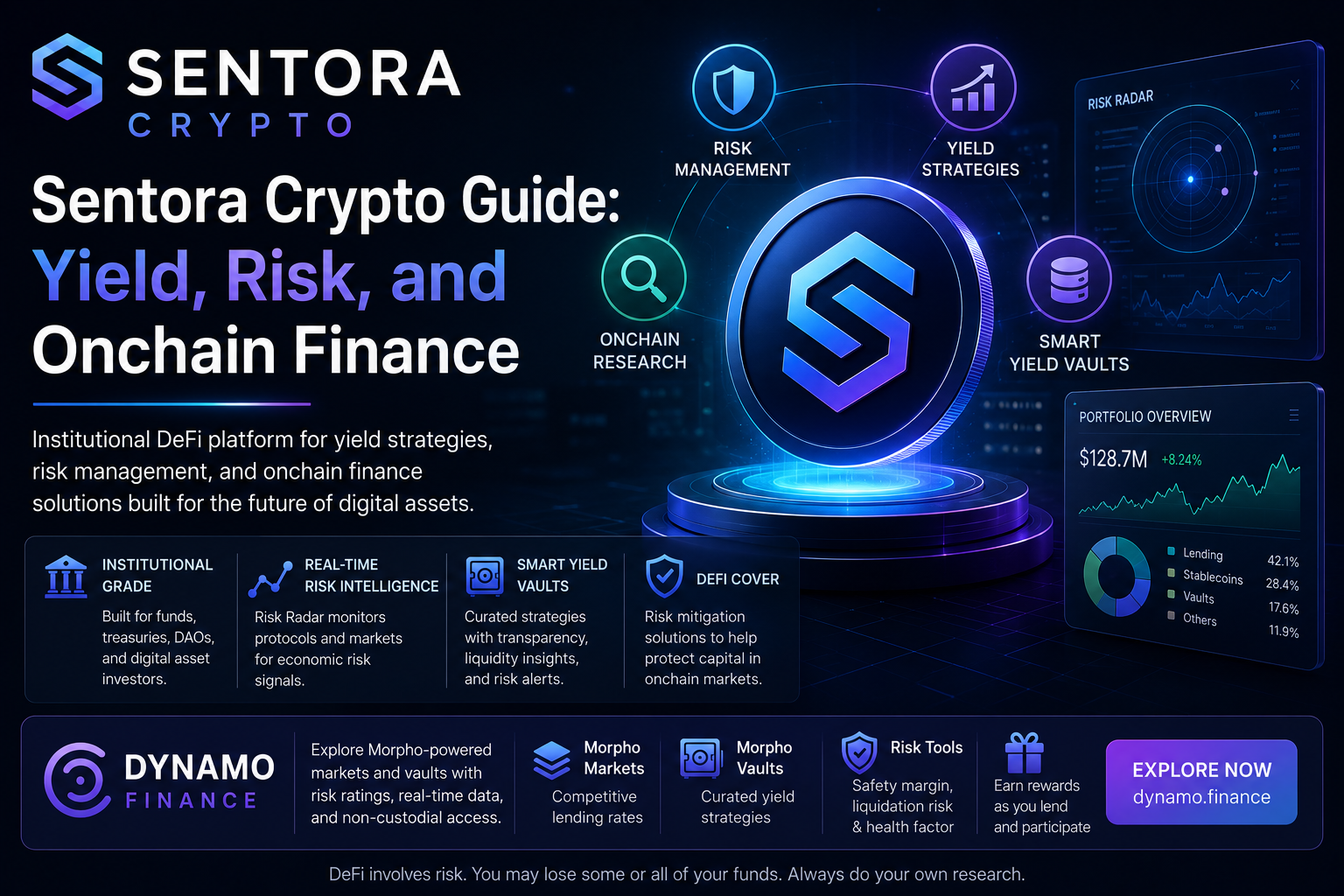
DeFi has moved far beyond simple token swaps and high-APY farms. Today, capital allocators are evaluating vaults, risk dashboards, tokenized assets, stablecoin strategies, hedging tools, institutional lending flows, and real-time protocol monitoring. That is why more investors are searching for sentora crypto and trying to understand where Sentora fits in the onchain finance stack.
The short answer: Sentora is not just another crypto app. It is positioned as an institutional DeFi platform focused on yield strategies, risk management, research, and structured access to onchain markets. For DeFi investors, Sentora matters because it represents a broader shift toward professional-grade infrastructure, where vault selection, economic risk, capital allocation, and transparency become as important as headline APY.
Sentora crypto refers to Sentora, an institutional DeFi platform formed from the merger of IntoTheBlock and Trident Digital. It combines DeFi strategy design, real-time risk management, research, vault infrastructure, and institutional onchain finance solutions for funds, treasuries, DAOs, and digital asset firms.
This guide explains what Sentora does, how it relates to DeFi yield and risk management, why institutional onchain finance is becoming more important, and how users can apply the same risk-first approach when evaluating Morpho-based markets and vaults through Dynamo Finance.
Key Takeaways
- Sentora is an institutional DeFi platform focused on yield strategies, risk management, research, vaults, and structured onchain finance solutions.
- Sentora was formed through the merger of IntoTheBlock and Trident Digital, bringing together analytics, risk intelligence, and institutional DeFi services.
- Its core themes include DeFi strategies, Risk Radar, Smart Yield vaults, DeFi cover, stablecoin adoption, tokenized equity yield, and risk curation.
- For investors, Sentora highlights why APY alone is not enough. Yield must be evaluated against liquidity, collateral, protocol, oracle, counterparty, and strategy risk.
- Dynamo Finance helps users apply similar discipline to Morpho-based markets and vaults with risk ratings, market data, liquidation-risk views, safety margins, rewards, and non-custodial access.
What Is Sentora Crypto?
Sentora crypto is best understood as institutional DeFi infrastructure. Rather than serving only as a retail wallet or standalone lending app, Sentora focuses on the tools and strategies that institutions need before they can deploy meaningful capital into decentralized finance.
Those tools include DeFi yield strategies, risk monitoring, structured vaults, protocol research, economic risk analytics, and capital allocation support. Sentora’s public positioning centers on institutional-grade DeFi solutions, including risk-managed access to onchain markets and research for professional investors.
The company emerged from the merger of IntoTheBlock and Trident Digital. IntoTheBlock was known for blockchain analytics, market intelligence, and DeFi risk data. Trident Digital focused on institutional digital asset services. Combined as Sentora, the new platform targets the institutional DeFi layer: the space between raw protocols and large-scale capital deployment.
For beginners, the easiest way to understand Sentora is this: it helps professional investors and crypto-native organizations access DeFi opportunities with more structure, monitoring, and risk controls than a user would get by simply chasing vault APYs on their own.
Why Sentora Matters in DeFi
DeFi’s early growth came from permissionless access. Anyone with a wallet could lend, borrow, trade, farm, and provide liquidity. That openness is powerful, but it also creates challenges for institutions and serious capital allocators.
Large investors need risk frameworks, reporting, compliance boundaries, liquidity analysis, counterparty awareness, stress testing, and governance visibility. A fund or treasury cannot responsibly deploy capital into DeFi just because a vault shows a double-digit APY. It needs to know how the yield is generated, what risks sit underneath, and how the position behaves during market stress.
Sentora matters because it focuses on those institutional requirements. The company’s platform areas include DeFi Strategies, Risk Management, DeFi Cover, Stablecoin Adoption, Tokenized Equity Yield, and Risk Curation. These categories show where onchain finance is heading: toward more structured products, stronger risk oversight, and clearer bridges between traditional capital and DeFi protocols.
This is also why Sentora is relevant for everyday DeFi investors. Even if you are not an institution, the same principles apply. You still need to understand liquidity, collateral, market structure, protocol risk, and downside scenarios before putting capital to work.
Sentora’s Origin: IntoTheBlock and Trident Digital
Sentora was created from the merger of IntoTheBlock and Trident Digital. That background is important because it helps explain the company’s focus.
IntoTheBlock built its reputation around crypto analytics, onchain data, and DeFi market intelligence. Its risk products focused on economic risk signals across protocols, liquidity conditions, exposure monitoring, and data-driven insights. Trident Digital brought institutional digital asset services, including structured solutions for professional clients.
The merger created a platform designed to serve funds, treasuries, DAOs, and institutions looking for DeFi access with more professional infrastructure. Media coverage from outlets such as Yahoo Finance and Blockworks described the new entity as an institutional DeFi platform combining yield strategies, risk management, and financial services.
For investors, the important takeaway is that Sentora combines two capabilities that DeFi increasingly needs: analytics-driven risk intelligence and institutional capital markets experience.
What Does Sentora Do?
Sentora’s work can be grouped into several major areas. Each area addresses a different problem in onchain finance.
- DeFi strategies: Structured yield strategies designed for institutional-scale capital deployment.
- Risk management: Real-time monitoring of DeFi protocol risk, market conditions, exposure, and economic risk signals.
- Smart Yield: A vault platform designed to make DeFi yield opportunities more transparent and easier to evaluate.
- Research: Market intelligence, protocol analysis, dashboards, and reports focused on DeFi trends and risk.
- DeFi cover: Risk transfer and protection products designed to help users manage downside exposure.
- Stablecoin adoption: Solutions that help stablecoin capital access yield, lending, and liquidity opportunities.
- Tokenized equity yield: Strategies designed around tokenized assets and onchain lending markets.
- Risk curation: Frameworks for selecting, monitoring, and managing protocol and vault exposure.
These areas are connected by one theme: professionalizing DeFi access. Sentora is not trying to make DeFi look risk-free. It is trying to make the risk more measurable, structured, and manageable.
Sentora DeFi Strategies Explained
Sentora’s DeFi Strategies focus on helping institutions access onchain yield opportunities with stronger controls than a self-directed wallet workflow. This can include stablecoin yield, lending opportunities, liquidity strategies, protocol-specific allocations, and structured approaches to earning returns in DeFi markets.
In simple terms, a DeFi strategy is a repeatable process for deploying capital. A weak strategy says, “This APY is high, so deposit.” A stronger strategy asks: Where does the yield come from? Who pays it? What collateral supports it? How liquid is the position? What happens if utilization spikes? What happens if a protocol loses liquidity?
Sentora’s institutional framing matters because large capital cannot be managed casually. A treasury allocating millions into DeFi must consider exposure limits, stress scenarios, operating procedures, risk reporting, and exit liquidity.
Individual users can learn from that approach. Whether you use Sentora, Dynamo, or any other defi lending interface, a structured process is the best defense against impulsive APY chasing.
What Is Sentora Smart Yield?
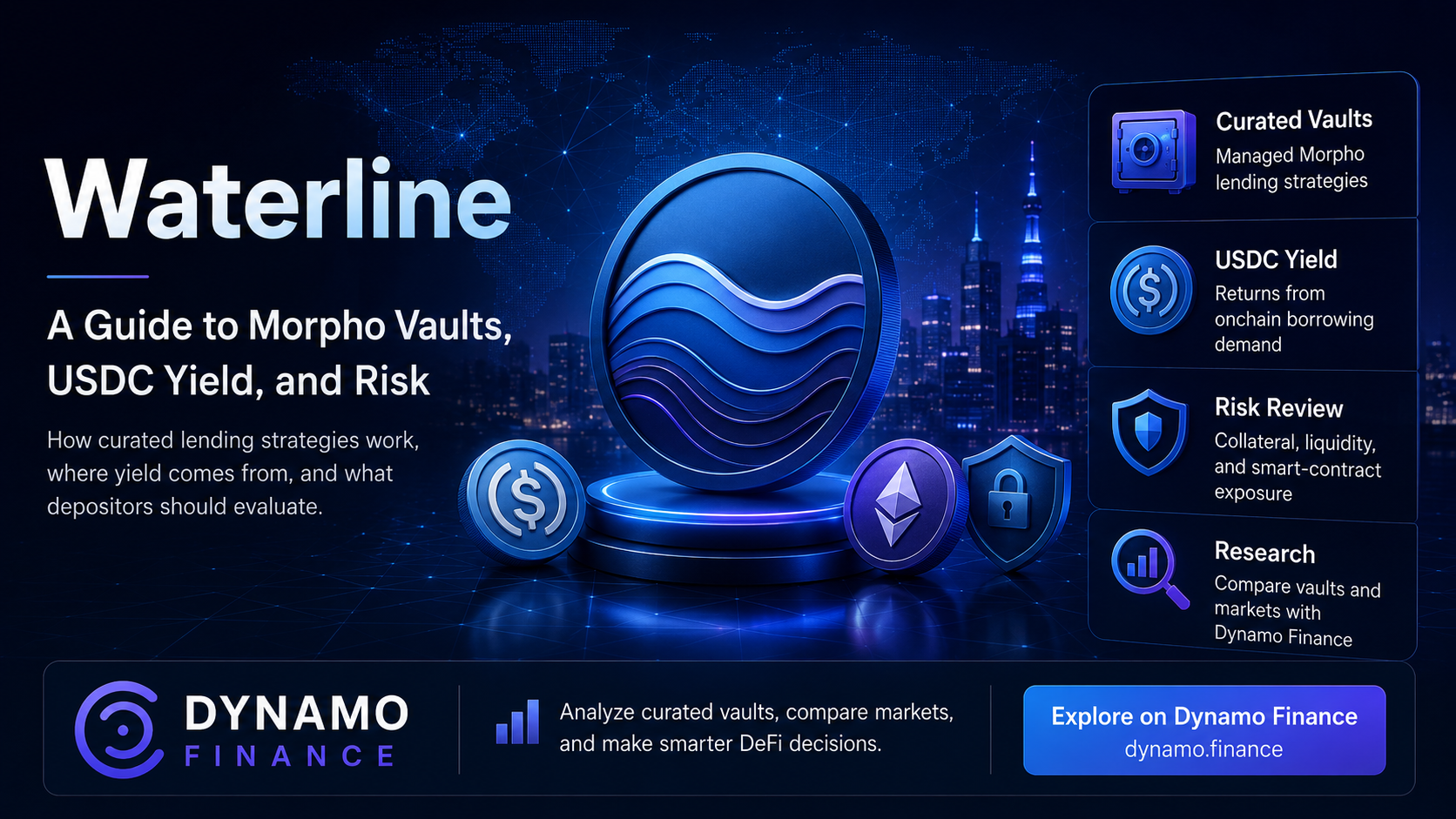
Sentora Smart Yield is Sentora’s DeFi vault layer. It is designed to make vault discovery and strategy comparison more transparent by showing information such as risk parameters, liquidity depth, capital allocation, and risk alerts.
A vault platform matters because DeFi has become too complex for many users to manually select every underlying market. Vaults can simplify capital allocation by packaging strategies into a deposit-and-monitor experience. But the wrapper is only useful if users can understand what the vault actually does.
That is where Smart Yield fits Sentora’s broader mission. Instead of presenting vaults only as APY boxes, the product emphasizes transparency around strategy, liquidity, and risk. This aligns with the broader industry shift toward curated vault infrastructure.
Users should still remember that vaults are not risk-free. A vault can be exposed to smart contract bugs, oracle failures, liquidity constraints, strategy underperformance, market concentration, and curator decisions.
How DeFi Vaults Work
A DeFi vault is a strategy container. Users deposit an asset, such as a stablecoin, and the vault allocates that capital according to a defined strategy. The yield may come from lending markets, liquidity provision, incentives, basis trades, tokenized assets, or other onchain opportunities.
In a lending vault, the basic flow is straightforward:
- A user deposits an asset into the vault.
- The vault issues shares representing the user’s proportional position.
- The strategy allocates capital across selected markets or protocols.
- Borrowers, traders, or protocol incentives generate yield depending on the strategy.
- The vault’s share value can increase as yield accrues, after applicable fees.
- The user can redeem shares subject to vault rules and available liquidity.
Vaults can reduce manual work, but they also introduce strategy risk. A user is no longer choosing a single market directly; they are choosing a manager, curator, or allocation process.
This is why platforms that show allocation, liquidity, and risk data matter. Without transparency, vaults can hide complexity behind a clean interface.
Sentora Risk Management and Risk Radar
Risk management is one of Sentora’s central themes. Its Risk Radar platform is designed to monitor real-time economic risk signals across DeFi protocols. The goal is to give institutions a more systematic view of exposures, liquidity, protocol conditions, and potential stress signals.
DeFi risk is not limited to smart contract bugs. A protocol can be technically secure and still become risky because of liquidity fragmentation, unstable collateral, poor oracle design, high leverage, governance changes, or market contagion.
Risk Radar-style analytics are valuable because onchain markets move quickly. Liquidations can happen block by block. Lending utilization can change within minutes. A stablecoin depeg can ripple across multiple markets. A vault can become liquidity-constrained if too much capital is borrowed from its underlying markets.
Sentora’s risk management platform focuses on real-time economic risk signals, programmable monitoring, and institutional risk assessment. For serious DeFi users, this reinforces a practical lesson: risk should be monitored continuously, not reviewed only before deposit.
Sentora Research and Market Intelligence
Sentora also publishes DeFi research and market intelligence. This includes articles, dashboards, reports, and analysis focused on protocols, market structure, risk, and emerging onchain finance themes.
Research matters because DeFi changes quickly. New collateral types appear, vault designs evolve, tokenized assets become integrated into lending markets, and stablecoin liquidity shifts across chains. Investors need context, not just numbers.
For example, tokenized assets can create new yield opportunities, but they also create new risks. Tokenized equities, tokenized Treasuries, private credit tokens, and stablecoin collateral all behave differently. Each asset type has different liquidity, legal, oracle, redemption, and market-structure considerations.
Sentora’s research hub is useful for readers who want to follow these themes through a DeFi risk and institutional adoption lens.
Sentora and Tokenized Equity Yield
One of Sentora’s more forward-looking themes is tokenized equity yield. The basic idea is that tokenized shares or tokenized equity-like assets could become productive collateral inside onchain lending systems.
Today, many tokenized assets remain limited by liquidity, regulation, market fragmentation, and oracle complexity. Turning real-world assets into useful DeFi collateral requires more than token issuance. Markets need reliable pricing, liquidation mechanisms, risk parameters, compliance controls, and sufficient depth.
Sentora’s public materials and related coverage have discussed tokenized equity yield in the context of products such as Stey, designed around tokenized assets, lending strategies, and risk controls. This reflects a broader industry trend: tokenization is moving from “put an asset onchain” toward “make that asset usable in DeFi.”
For DeFi investors, the lesson is not that every tokenized asset is ready for lending markets. The lesson is that tokenized collateral will require serious risk curation before it can scale safely.
Sentora vs. a Standard DeFi App
Sentora should not be confused with a basic retail DeFi dashboard. A retail app usually helps users swap, lend, borrow, or deposit. Sentora focuses more on institutional DeFi access, risk management, research, strategy design, and structured products.
| Category | Sentora | Standard Retail DeFi App |
|---|---|---|
| Primary role | Institutional DeFi platform for strategies, risk, research, vaults, and structured solutions | User-facing interface for swaps, lending, borrowing, staking, or vault deposits |
| Main users | Institutions, funds, DAOs, treasuries, and professional allocators | Retail users, crypto-native investors, and everyday wallet users |
| Core value | Risk-managed DeFi access, economic risk monitoring, and structured yield strategies | Simpler access to DeFi products and transactions |
| Risk focus | Exposure management, liquidity, economic risk, strategy design, protocol monitoring, and institutional controls | Wallet safety, protocol choice, APY comparison, and transaction execution |
| Best fit | Organizations and users who need professional-grade DeFi infrastructure | Users who want direct, simple access to DeFi features |
This comparison matters because DeFi investors increasingly encounter products built by different layers of the ecosystem. A protocol may supply infrastructure. A risk firm may curate strategy. A vault may package the strategy. An app may distribute it. A user must understand which layer they are trusting.
How Sentora Relates to Morpho, Vaults, and Lending Markets
Sentora is relevant to Morpho and lending markets because institutional DeFi strategies often depend on lending infrastructure. Morpho, Aave, Compound, Euler, and similar protocols can all provide markets where capital earns yield from borrowers.
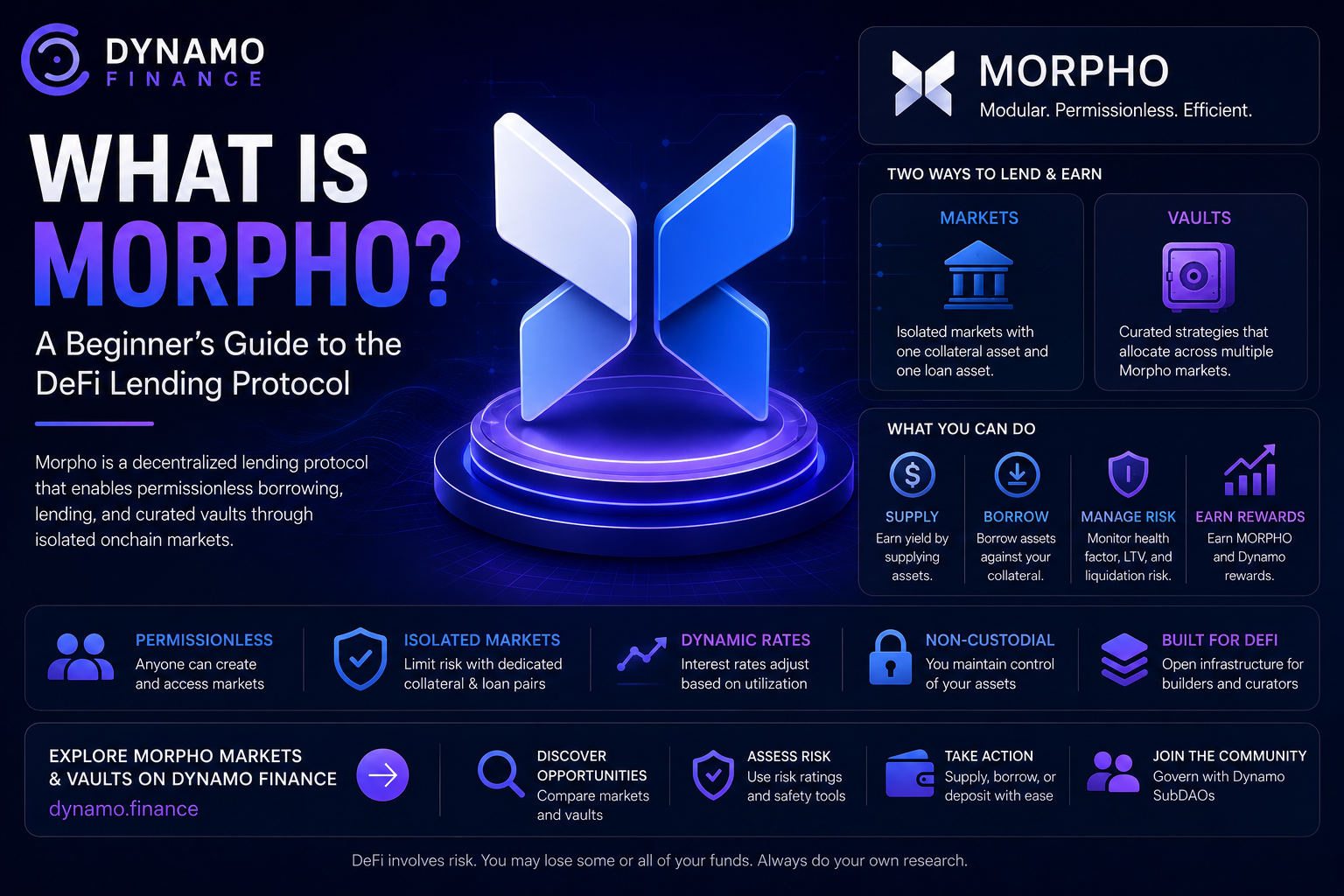
Morpho is especially important in modern vault design because it allows isolated lending markets and curated vaults. A morpho vault can allocate capital across selected markets, producing a blended yield while reducing the need for users to choose every market manually.
Sentora-style risk analysis becomes useful because vaults depend on underlying markets. If a vault allocates to a lending market, the risk depends on collateral quality, oracle reliability, loan asset liquidity, liquidation thresholds, utilization, and borrower behavior.
For users exploring morpho lending, this is the main connection: professional risk frameworks help explain why market data matters. You do not need to be an institution to ask institutional-quality questions.
Where Dynamo Finance Fits Into This Conversation
Dynamo Finance is a non-custodial, permissionless Web3 lending market built on Morpho smart contracts. Users can supply assets, borrow against collateral, deposit into vaults, compare markets, evaluate risk, earn rewards, and participate in governance from one interface.
Dynamo is relevant because it gives DeFi users a practical way to apply the same risk-first mindset that platforms like Sentora bring to institutions. Instead of viewing DeFi as a list of APYs, Dynamo helps users inspect market structure: collateral, loan asset, utilization, available liquidity, oracle, LLTV, vault allocation, and risk tier.
Dynamo does not custody user funds. Assets are held by Morpho smart contracts, while Dynamo adds a user-facing layer for discovery, analytics, risk visibility, rewards, automation, position management, and SubDAO governance participation.
This makes Dynamo useful for users who want to go deeper into crypto lending without relying only on simplified interfaces or opaque yield products.
Dynamo Markets: Direct Exposure to Morpho Lending
Dynamo markets are isolated lending pools. Each market has one loan asset, one collateral asset, one oracle, and one liquidation loan-to-value threshold. A user who supplies to a market earns interest paid by borrowers. A borrower posts collateral and draws from the loan asset pool.
This isolated-market structure helps users understand exactly which risks they are taking. A market using one collateral asset and oracle is separate from another market with different parameters. If one high-risk market runs into trouble, the design limits contagion to that market rather than spreading across all markets.
For suppliers, the key variables are supply APY, utilization, available liquidity, market TVL, collateral quality, oracle design, and risk tier. For borrowers, the key variables are borrow APY, LTV, LLTV, health factor, liquidation price, and collateral volatility.
This level of transparency is valuable for users who want cryptocurrency lending while understanding the mechanics behind the yield.
Dynamo Vaults: Curated Yield Without Manual Rebalancing
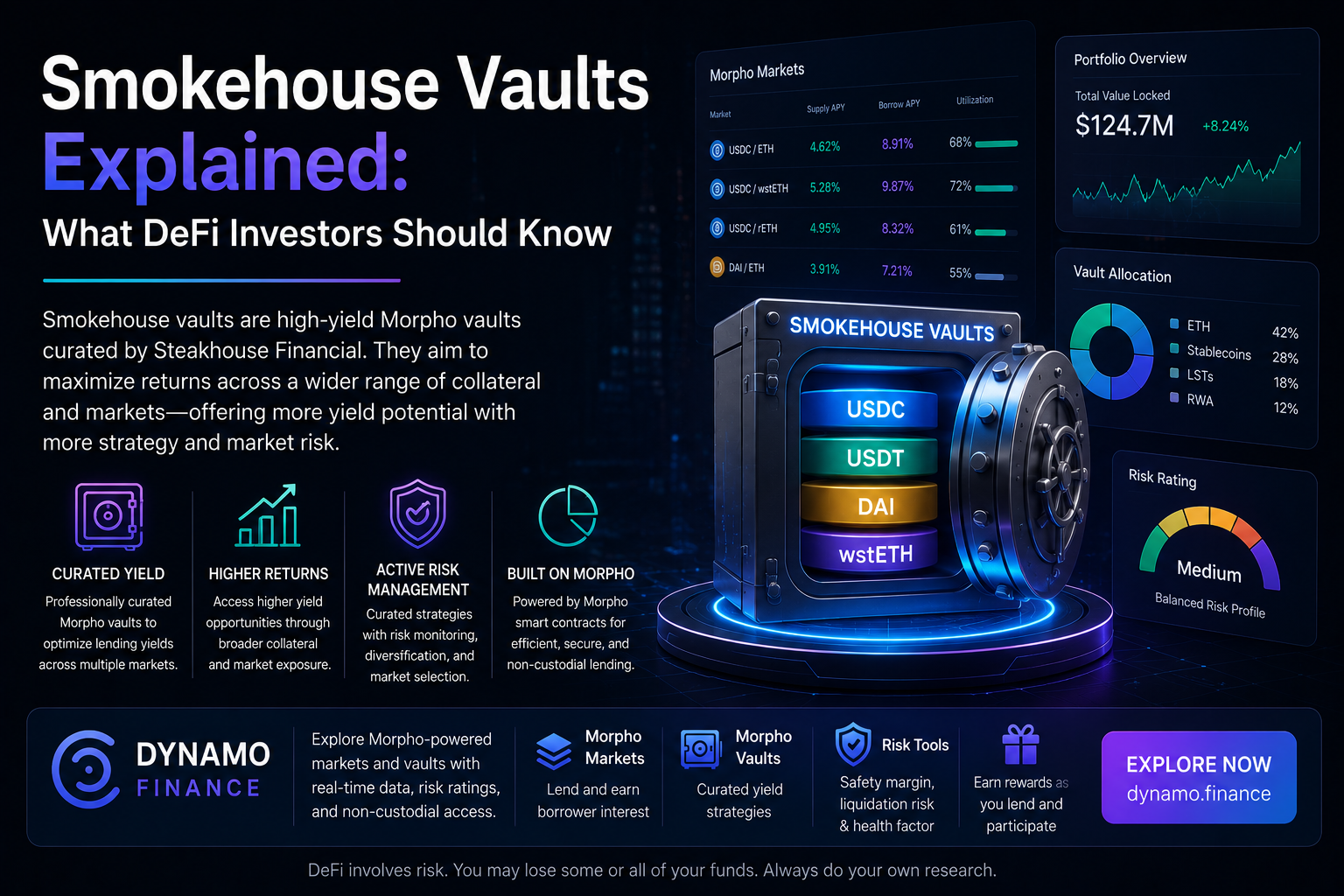
Dynamo also supports vaults built on the MetaMorpho standard. A vault lets users deposit once while a curator allocates capital across selected Morpho markets. This can simplify yield access because the user does not have to rebalance manually across every market.
Vaults can be useful for users who want curated exposure, but they require due diligence. Users should review the curator, market allocation, APY stability, TVL, performance fees, risk rating, and withdrawal liquidity.
Vault APY is a blended rate across the markets where the vault allocates capital. That rate can change when utilization changes, market demand shifts, or the curator adjusts allocation.
This is where Sentora’s broader lesson applies directly. A vault is not just an APY. It is a strategy. The strategy’s quality depends on market selection, risk controls, and liquidity awareness.
Dynamo Risk Ratings and Borrower Tools
Dynamo assigns Low, Medium, and High risk tiers to markets and vaults based on objective onchain inputs. For markets, relevant inputs include LLTV, market TVL, and how long the market has been live. For vaults, relevant inputs include total supplied value, market exposure, and live history.
These risk tiers are not guarantees, but they help users make better comparisons. A high-yield market with limited history and aggressive parameters may not suit a conservative investor. A lower-yield market with deeper liquidity and more battle-tested collateral may be more appropriate.
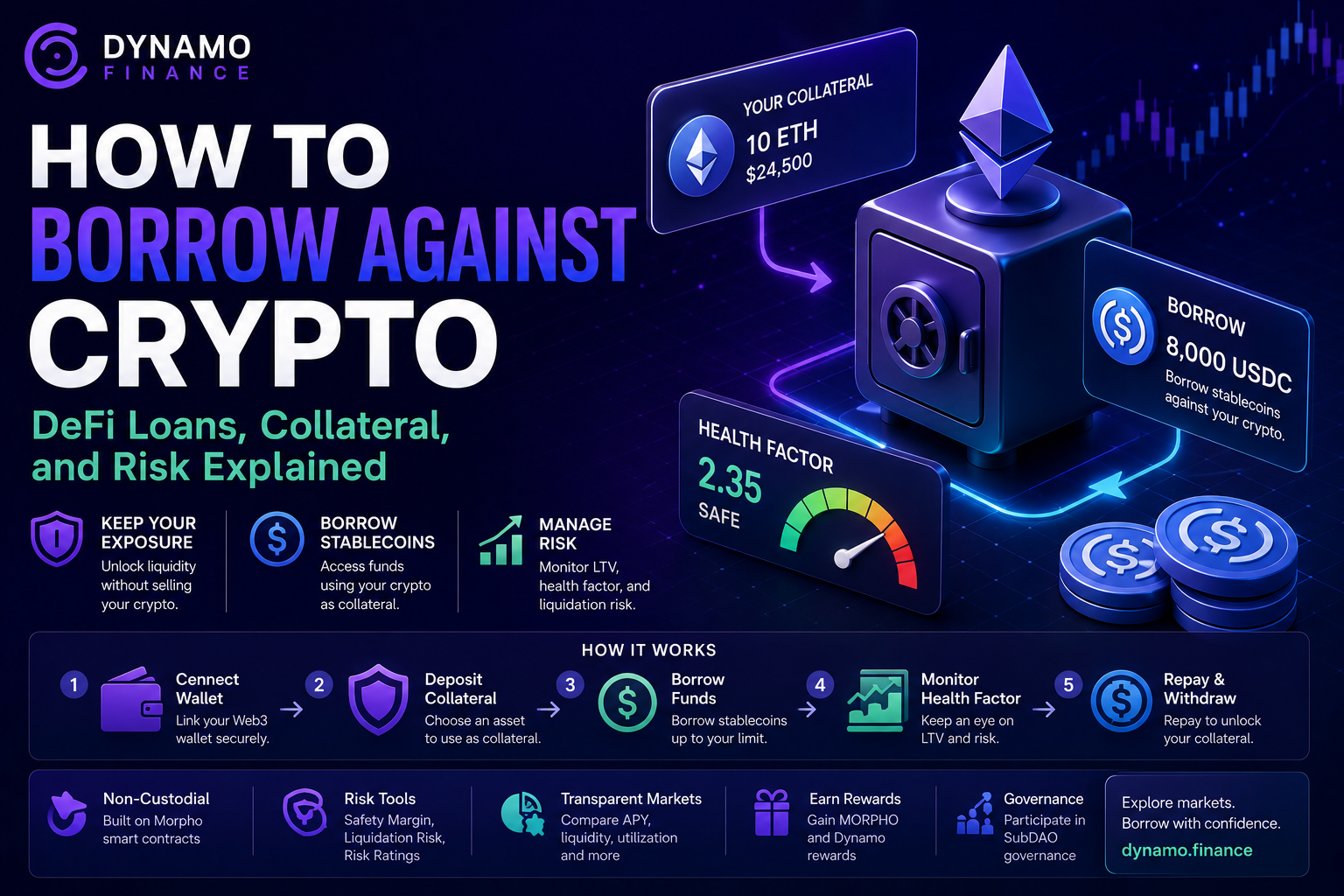
Borrowers also benefit from Dynamo’s Safety Margin and Liquidation Risk tools. Safety Margin helps users borrow below the liquidation threshold by creating a more conservative target LTV. Liquidation Risk views show health factor, price-drop tolerance, and liquidation price.
Users can explore these features through the Dynamo risk dashboard and learn the full workflow in the Dynamo Finance DeFi lending docs.
Sentora Crypto vs. Dynamo Finance
Sentora and Dynamo Finance serve different roles in the onchain finance ecosystem. Comparing them helps clarify how investors should think about each platform.
| Topic | Sentora | Dynamo Finance |
|---|---|---|
| Primary role | Institutional DeFi platform for strategies, risk, research, vault infrastructure, and structured solutions | Non-custodial user-facing platform for Morpho-based markets, vaults, borrowing, lending, risk tools, and rewards |
| Main audience | Institutions, funds, treasuries, DAOs, and professional allocators | Crypto-native users, DeFi investors, yield seekers, suppliers, and borrowers |
| Yield approach | Institutional DeFi strategies, Smart Yield vaults, and structured onchain finance products | Borrower-paid market yield, MetaMorpho vault yield, and applicable reward streams |
| Risk approach | Economic risk monitoring, Risk Radar, exposure management, coverage, and institutional risk curation | Risk ratings, market data, Safety Margin, Liquidation Risk views, and vault allocation transparency |
| Best fit | Organizations seeking institutional DeFi strategy and risk infrastructure | Users who want to compare and manage Morpho-based lending and borrowing opportunities directly |
The two are not direct substitutes. Sentora is more institutional and strategy-oriented. Dynamo is more user-facing and Morpho-specific. Both reflect the same trend: DeFi is becoming more data-driven, risk-aware, and professionally structured.
How to Evaluate Sentora-Style DeFi Opportunities
If you encounter a Sentora-related vault, strategy, risk tool, or research product, use a structured evaluation process. The goal is to understand the mechanism before allocating capital.
- Identify the product type: vault, risk dashboard, cover product, tokenized equity yield strategy, research tool, or institutional solution.
- Understand the source of yield: lending interest, liquidity provision, incentives, tokenized asset yield, hedging, or another strategy.
- Review the assets involved: stablecoins, tokenized equities, crypto collateral, vault shares, or other onchain assets.
- Check liquidity: Can you exit immediately, or does withdrawal depend on market depth and vault utilization?
- Evaluate risk controls: What monitoring, exposure limits, alerts, or cover mechanisms are used?
- Review eligibility: Some institutional or jurisdiction-sensitive products may not be available to all users.
- Compare yield with downside: Ask whether the return compensates for smart contract, oracle, liquidity, strategy, and regulatory risk.
- Start small if accessible and monitor conditions after entry.
This checklist also works for Dynamo users evaluating markets or vaults. A disciplined process is portable across DeFi platforms.
How to Evaluate a DeFi Vault
A DeFi vault should be evaluated as a portfolio, not as a single number. The APY tells you what the vault is earning now. It does not tell you what risks generate that return.
Start with the deposit asset. A USDC vault, ETH vault, or tokenized-asset vault each has different base risk. Then review the underlying allocation. Which markets receive capital? Are they diversified? Are they verified? What collateral backs the borrowing activity?
Next, study liquidity. If underlying markets have high utilization, the vault may not be able to satisfy withdrawals instantly. This is not always a failure; it is a normal lending-market constraint. But users should know it before depositing.
Finally, review curator, fees, live history, and risk rating. A vault with a strong curator and transparent allocation may still carry risk, but it gives users more information to make a reasoned decision.
How to Evaluate a Borrow Position
Borrowing against crypto can be useful when a user wants liquidity without selling. But a collateralized loan is not free money. It is a leveraged position with liquidation risk.
Before borrowing, review the collateral asset, loan asset, borrow APY, current LTV, LLTV, health factor, liquidation price, oracle, and market liquidity. Borrowers should avoid taking the maximum available loan just because the interface allows it.
Dynamo’s borrower tools are designed for this workflow. Safety Margin helps users operate below the liquidation threshold. Liquidation Risk views show how far collateral can fall before liquidation becomes likely.
For anyone researching a crypto loan, the most important habit is planning before borrowing. Decide in advance when you will repay, add collateral, or reduce exposure if markets move against you.
Institutional DeFi Risk Categories Beginners Should Know
Sentora’s institutional framing is useful because it reminds investors that DeFi risk is multidimensional. The biggest risks are not always obvious from a frontend.
- Smart contract risk: Bugs or unexpected contract behavior can cause losses.
- Oracle risk: Incorrect, stale, or manipulated price feeds can distort collateral values.
- Liquidity risk: High utilization or thin markets can make withdrawals harder.
- Collateral risk: Assets backing loans can lose value, liquidity, or market confidence.
- Strategy risk: Vaults or managed strategies can underperform or allocate poorly.
- Counterparty risk: Some tokenized or structured products may depend on custodians, issuers, or offchain entities.
- Governance risk: Protocol parameters can change through governance decisions.
- Composability risk: One protocol’s failure can affect another protocol that depends on it.
- Regulatory risk: Product access, transferability, and compliance rules can change.
- User error risk: Signing the wrong transaction or using a fake site can cause irreversible losses.
Good risk management does not eliminate these risks. It helps users identify them, monitor them, and decide whether the expected return is worth the exposure.
Practical Example: Stablecoin Yield Allocation
Imagine a user has USDC and wants yield. They can choose between a simple lending market, a curated vault, or a more structured institutional-style strategy.
A direct lending market gives maximum control. The user can inspect collateral, LLTV, utilization, APY, liquidity, and oracle. The trade-off is that the user must choose and monitor the market manually.
A curated vault simplifies allocation. The user deposits once and relies on the curator or strategy to allocate across markets. The trade-off is curator risk and less direct control.
An institutional-style strategy may add more sophisticated risk management or structured exposure. The trade-off is complexity, possible eligibility limits, and additional product-level dependencies.
The right choice depends on liquidity needs, risk tolerance, portfolio size, and how actively the user wants to monitor conditions.
Practical Example: Tokenized Equity Yield
Tokenized equity yield is an emerging area where real-world assets may become productive collateral in DeFi. For example, tokenized shares could theoretically be used inside lending strategies to generate stablecoin yield or unlock liquidity.
This sounds attractive, but the mechanics are complex. Tokenized equities require reliable price feeds, legal clarity, custody arrangements, liquidity, trading venues, and liquidation processes. If any of those components are weak, the strategy can become fragile.
Sentora’s focus on tokenized equity yield highlights a key future trend: DeFi is moving toward assets that are not purely crypto-native. That expansion can create new opportunities, but it also requires more sophisticated risk frameworks.
For users, the lesson is simple. Tokenized assets should not be treated as automatically safer because they reference real-world securities. They introduce a different set of risks that must be evaluated carefully.
Practical Example: Borrowing Instead of Selling
A crypto holder may want stablecoin liquidity without selling ETH, BTC, or another asset. Through a lending market, the user can post collateral and borrow a stablecoin. This can preserve exposure to the collateral asset while unlocking liquidity.
The trade-off is liquidation risk. If collateral falls in value or debt grows, the position can become unsafe. Borrowers should keep a conservative LTV, monitor health factor, and know their liquidation price.
Platforms like Dynamo make this easier by displaying borrower-focused risk data. But no dashboard can make a risky loan safe if the user borrows too aggressively.
A disciplined borrower treats the loan like an active position. They monitor collateral price, borrow rate, market liquidity, and liquidation buffer throughout the life of the loan.
What Beginners Often Misunderstand About Sentora Crypto
The first misunderstanding is thinking Sentora is a consumer exchange. It is better understood as an institutional DeFi platform focused on strategies, risk, research, and structured solutions.
The second misunderstanding is assuming institutional-grade means risk-free. It does not. Institutional-grade means better process, controls, monitoring, and infrastructure. DeFi risk remains.
The third misunderstanding is treating all vaults the same. A vault’s risk depends on the strategy, underlying markets, collateral, curator, liquidity, and fees.
The fourth misunderstanding is ignoring eligibility. Some Sentora products and services may not be available to certain users, including users in restricted jurisdictions.
The fifth misunderstanding is comparing APYs without comparing mechanisms. A vault APY, lending market APY, tokenized asset yield, and incentive-driven reward estimate are different things.
What Experienced Investors Look For
Experienced investors start with the source of yield. They ask who pays the return, what assets support it, how the strategy exits, and what could cause loss.
They also review liquidity before return. A high APY means little if the position becomes hard to exit during stress. Liquidity should be evaluated under normal and stressed conditions.
Experienced users also separate base yield from incentives. Incentives can be valuable, but they may disappear. Base yield from borrower demand or strategy performance is usually more important for long-term planning.
Finally, experienced investors size positions based on downside. If a strategy can lose capital, it should not be treated like cash. If a loan can be liquidated, it should not be treated like free liquidity.
How to Build a Risk-First Onchain Finance Strategy
A risk-first strategy starts with your objective. Are you trying to earn stablecoin yield, borrow against collateral, access tokenized assets, allocate treasury funds, or diversify across DeFi markets?
Next, choose the product type that matches the objective. A direct market gives control. A vault gives curated allocation. A risk-managed institutional strategy may provide more structure. A borrow position unlocks liquidity but introduces liquidation risk.
Then review the risk stack. For lending markets, focus on collateral, oracle, utilization, liquidity, and LLTV. Vaults, focus on curator, allocation, concentration, fees, and withdrawal liquidity. For tokenized strategies, focus on issuer, custody, redemption, pricing, and legal structure.
Finally, monitor after entry. DeFi markets move continuously. A strategy that looked conservative last month may look different after a volatility spike, utilization change, collateral drawdown, or governance update.
External Resources for Further Research
Readers researching Sentora should start with primary sources. The Sentora official site provides an overview of its institutional DeFi platform, while the Sentora DeFi Strategies page explains its institutional yield focus.
For risk-specific material, the Sentora Risk Management page outlines its approach to real-time economic risk signals. As for background on the company’s creation, the Sentora launch announcement covers the merger of IntoTheBlock and Trident Digital.
For Dynamo updates, product context, and community discussion, follow Dynamo Finance on X.
Final Checklist Before Using Any DeFi Strategy
Before allocating to a vault, lending market, tokenized asset strategy, or borrow position, use this checklist:
- Confirm the official website, app, and contract addresses.
- Identify the exact product type: lending market, vault, risk-managed strategy, cover product, or tokenized asset exposure.
- Understand the yield source: borrower interest, incentives, liquidity provision, tokenized asset yield, or strategy performance.
- Review collateral, oracle, utilization, liquidity, fees, and withdrawal conditions.
- Check curator, manager, issuer, or protocol dependencies.
- Separate base yield from temporary rewards.
- Evaluate smart contract, oracle, liquidity, governance, legal, and regulatory risks.
- Start small when possible and test the full entry and exit workflow.
- Monitor positions after entry and be ready to reduce risk if conditions change.
Conclusion
Sentora crypto is important because it reflects where DeFi is heading. The market is becoming more institutional, more risk-aware, and more focused on structured access to onchain yield. Sentora brings together yield strategies, risk management, research, Smart Yield vaults, DeFi cover, stablecoin adoption, tokenized equity yield, and risk curation under one institutional DeFi platform.
For everyday investors, the main lesson is not that every user needs institutional infrastructure. The lesson is that institutional-quality thinking improves outcomes. DeFi users should evaluate yield by understanding the mechanism, liquidity, risk stack, and downside scenario behind every position.
Dynamo Finance helps users apply that mindset directly to Morpho-based markets and vaults. With non-custodial access, market data, vault transparency, risk ratings, Safety Margin, Liquidation Risk views, rewards, and governance participation, Dynamo gives DeFi investors a clearer way to compare opportunities before supplying, borrowing, or depositing into vaults.
Explore Dynamo Finance to compare Morpho markets and vaults, review risk data, and build a more disciplined approach to DeFi lending, borrowing, and onchain yield.
FAQ
What is Sentora crypto?
Sentora crypto refers to Sentora, an institutional DeFi platform focused on yield strategies, risk management, research, vault infrastructure, DeFi cover, stablecoin adoption, tokenized equity yield, and risk curation.
Is Sentora a DeFi protocol?
Sentora is better understood as an institutional DeFi platform rather than a base lending protocol. It provides strategy, risk, research, and structured access tools that can interact with DeFi markets and vaults.
How was Sentora created?
Sentora was formed through the merger of IntoTheBlock and Trident Digital. The combined platform brings together onchain analytics, DeFi risk intelligence, institutional digital asset services, and structured onchain finance solutions.
What is Sentora Smart Yield?
Sentora Smart Yield is a DeFi vault platform designed to show strategy transparency, risk parameters, liquidity depth, capital allocation, and risk management information for vault-based yield opportunities.
How does Dynamo Finance relate to Sentora crypto?
Dynamo Finance is not Sentora. The connection is the broader DeFi risk and yield theme: Sentora focuses on institutional DeFi strategies and risk management, while Dynamo helps users directly explore Morpho-based markets and vaults with risk ratings, liquidity data, Safety Margin, and liquidation-risk tools.