
DeFi lending has become one of crypto’s most important use cases, but it can still feel difficult to evaluate. A market might show an attractive APY, a vault might promise easier yield, and a borrow screen might let you unlock stablecoin liquidity in minutes. The hard part is understanding what actually happens under the hood.
If you are searching for “what is morpho,” you are probably trying to understand why Morpho is showing up across crypto lending, vault curation, Coinbase loans, stablecoin yield, and DeFi risk conversations. Morpho has become a major onchain lending infrastructure layer because it separates lending into isolated markets and lets vault curators build strategies on top of those markets.
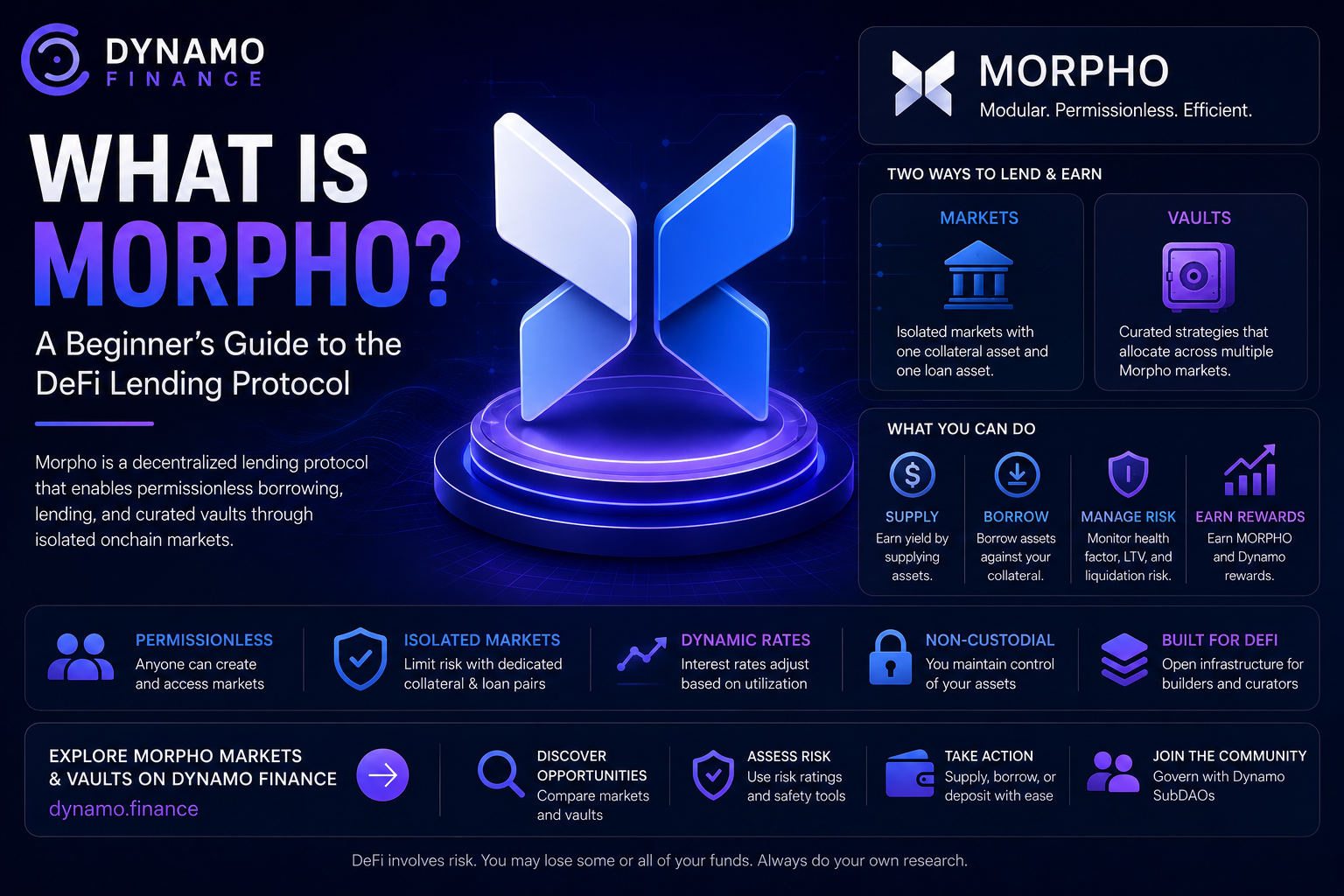
Morpho is a decentralized lending protocol that lets users supply assets, borrow against collateral, and deposit into curated vaults through isolated onchain markets. Each Morpho market pairs one loan asset with one collateral asset and has its own oracle, interest-rate model, and liquidation loan-to-value threshold.
This guide explains what Morpho is, how markets and vaults work, why isolated lending matters, what risks users should understand, and how Dynamo Finance helps DeFi investors interact with Morpho-based markets and vaults through a more risk-aware workflow.
Key Takeaways
- Morpho is a DeFi lending protocol built around isolated lending markets, where each market has one collateral asset, one loan asset, one oracle, and one liquidation threshold.
- Morpho vaults simplify lending by letting users deposit once while curators allocate capital across multiple Morpho markets.
- Supply APY, borrow APY, utilization, LLTV, oracle design, collateral quality, and available liquidity all matter when evaluating Morpho opportunities.
- Dynamo Finance is built on Morpho smart contracts and adds market discovery, vault access, risk ratings, Safety Margin, Liquidation Risk views, rewards, and governance participation.
- Morpho can be useful for lenders, borrowers, yield seekers, builders, and vault curators, but it still carries smart contract, oracle, liquidation, liquidity, and strategy risks.
What Is Morpho in Crypto?
Morpho is best understood as open lending infrastructure for decentralized finance. It lets users create and access lending markets where one asset can be borrowed against another asset as collateral. The protocol is permissionless, meaning market creation does not require the same kind of centralized approval process seen in traditional finance.
The core idea is simple. Lenders supply assets to earn yield. Borrowers post collateral and borrow assets from the market. Smart contracts enforce the rules, accrue interest, and trigger liquidations when a position becomes undercollateralized.
Morpho’s design differs from large multi-asset lending pools because each market is isolated. A USDC market backed by ETH collateral is separate from a USDC market backed by another collateral asset. This isolation helps users understand their exact exposure and limits contagion between markets.
That is why Morpho matters. It gives DeFi a more modular credit system where different markets can be created for different assets, risk profiles, and use cases. For users exploring morpho crypto, the main skill is learning how to evaluate each market or vault on its own terms.
How Morpho Evolved From Lending Pools to Isolated Markets
Early DeFi lending protocols usually used broad pooled markets. These pools made borrowing and lending easier because users supplied capital into a shared system. The trade-off was that risks across many assets could become connected through one pool.
Morpho’s isolated-market model takes a different approach. Instead of one pool that supports many collateral assets, each market has fixed parameters. Those parameters include the loan asset, collateral asset, oracle, interest-rate model, and liquidation loan-to-value threshold. Morpho’s official market materials describe these variable-rate markets as isolated, immutable, and permissionless.
This structure creates more precision. A lender can choose exposure to a specific collateral and loan asset pair. A borrower can select a market that fits their collateral and borrowing needs. A curator can build a vault that allocates across several markets according to a defined strategy.
The result is a lending system that is more flexible but also more demanding. Users need to understand market parameters rather than relying only on protocol-level branding.
The Five Core Parts of a Morpho Market
Every Morpho variable-rate market is defined by a small set of parameters. These parameters are the foundation of the market’s risk and rate behavior.
- Collateral asset: The asset borrowers deposit to secure their loan.
- Loan asset: The asset lenders supply and borrowers borrow.
- Oracle: The price feed used to value collateral against the loan asset.
- IRM: The interest-rate model that determines how rates respond to utilization.
- LLTV: The liquidation loan-to-value threshold that determines when a borrow position can be liquidated.
For example, a market could allow users to borrow USDC against ETH. In that market, lenders supply USDC, borrowers deposit ETH, and the oracle values ETH against USDC. If a borrower’s debt becomes too large relative to collateral value, liquidation can occur.
This is the first major lesson for beginners. Morpho is not one single lending rate or one universal risk profile. It is a collection of markets, and every market should be evaluated separately.
What Makes Morpho Different?
Morpho’s key difference is the combination of isolated markets and vault-based liquidity aggregation. Isolated markets give precise risk boundaries. Vaults make it easier for users to supply liquidity without manually managing every market.
Traditional pooled lending protocols are easier for beginners, but they can force users into shared risk assumptions. Isolated markets can be more efficient and customizable, but they can fragment liquidity and require more user analysis. Morpho vaults are designed to combine these approaches: simple deposit experience plus market-level flexibility.
This is why Morpho has become important infrastructure for DeFi lending products. An app, DAO, curator, or fintech interface can use Morpho markets and vaults to build lending experiences for different audiences.
For investors, the takeaway is practical. Morpho gives more choice, but choice requires better due diligence.
Morpho Markets Explained
A Morpho market is an isolated lending pool. Suppliers provide the loan asset. Borrowers provide collateral and borrow that loan asset. Interest rates adjust based on the market’s supply and demand dynamics.
Each market has its own risk profile. A market backed by liquid blue-chip collateral may behave very differently from a market backed by a newer or more volatile asset. A market with moderate utilization may have easier withdrawals than a market where almost all supplied liquidity is borrowed.
Dynamo’s market model follows this same isolated-market logic. A lending market on Dynamo is dedicated to one collateral asset and one loan asset, and each market operates independently. The platform surfaces supply APY, borrow APY, utilization, available liquidity, oracle, LLTV, and other key data so users can compare opportunities before acting.
That market-level transparency matters because users should not treat every Morpho market as interchangeable. The market you choose determines the collateral, oracle, liquidation threshold, rate behavior, and liquidity conditions attached to your position.
Morpho Vaults Explained
A Morpho vault is a curated lending strategy that deposits liquidity into one or more underlying Morpho markets. Instead of choosing each market manually, users deposit into a vault and receive vault shares representing their position.
Curators decide which markets the vault can use, how capital should be allocated, and when the vault should rebalance. As borrowers pay interest in the underlying markets, that yield flows back to vault depositors through the value of their shares.
Vaults can make lending simpler for users who do not want to monitor many markets. They can also improve capital allocation by moving funds toward markets with better risk-adjusted yield. Morpho’s vault materials describe vaults as a way to make lending into isolated markets feel more like using a lending pool.
Still, vaults introduce curator and strategy risk. A vault is only as strong as its market selection, risk limits, liquidity management, and transparency. Users evaluating a morpho crypto loan or a vault-based lending strategy should look beneath the interface and review the underlying markets.
Morpho Markets vs. Morpho Vaults
Markets and vaults both matter, but they serve different users. Direct markets are better for users who want control. Vaults are better for users who want curated exposure.
| Feature | Morpho Markets | Morpho Vaults |
|---|---|---|
| Main function | Direct lending and borrowing in one isolated market | Curated allocation across one or more lending markets |
| User decision | Choose the exact collateral and loan asset pair | Choose the vault, curator, deposit asset, and strategy |
| Risk exposure | Specific market risk | Curator, allocation, and underlying market risk |
| Rate behavior | One market’s utilization determines current APY | Blended APY across the vault’s allocations |
| Best fit | Advanced users who want precision | Users who want easier lending exposure and less manual rebalancing |
Neither option is automatically better. A market gives you precision. A vault gives you convenience. Many experienced users evaluate both depending on the role the position plays in their portfolio.
How Morpho Interest Rates Work
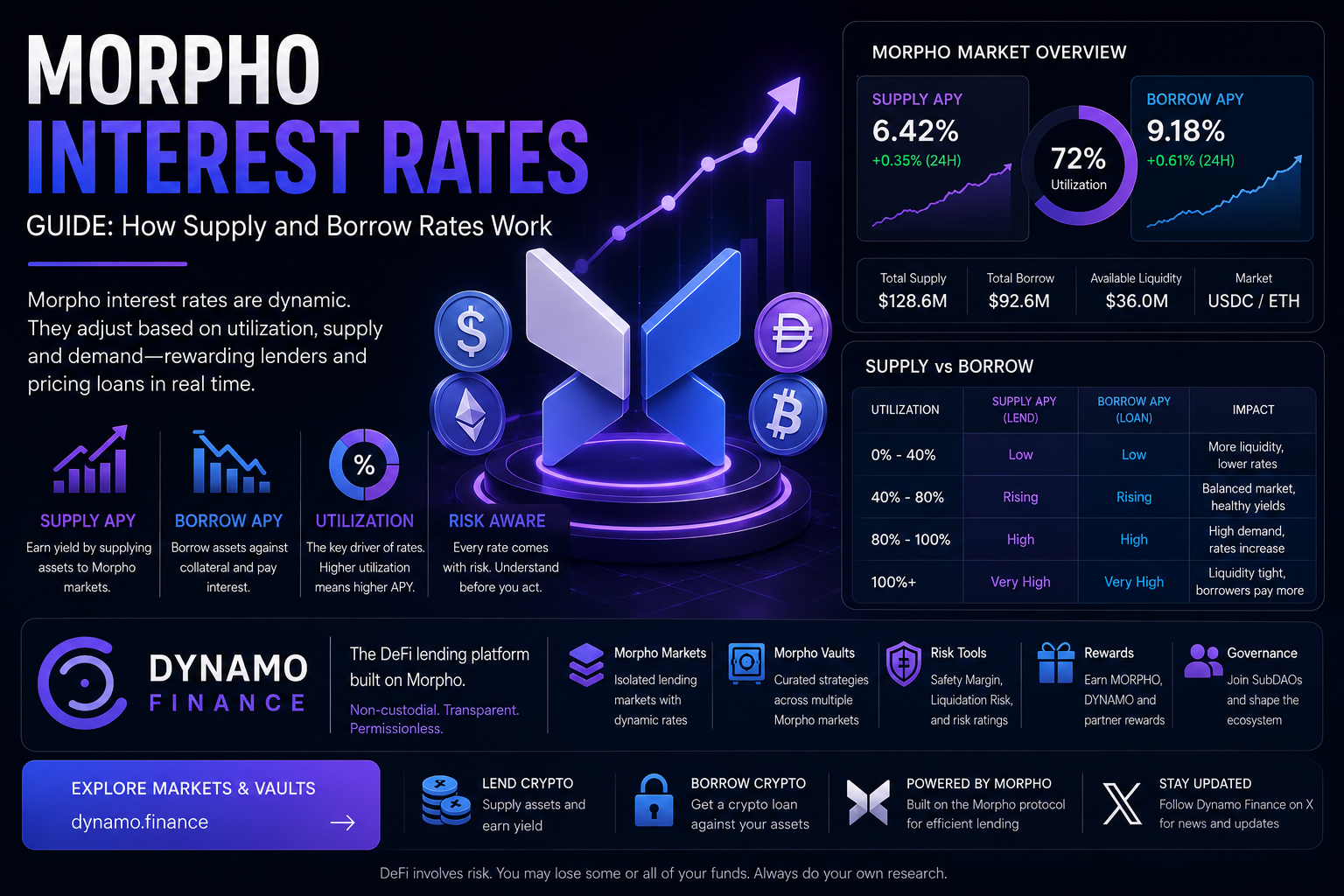
Morpho interest rates are driven by utilization. Utilization measures how much of a market’s supplied liquidity is currently borrowed. When utilization rises, borrow rates generally increase. When utilization falls, borrow rates generally decrease.
This mechanism balances the market. If liquidity becomes scarce, higher rates can attract suppliers and encourage borrowers to repay. If liquidity is abundant, lower rates can make borrowing more attractive.
Dynamo presents this concept clearly in its market workflow: utilization is calculated as total borrowed divided by total supplied, and higher utilization can improve supply APY while reducing immediately available withdrawal liquidity.
For suppliers, this means a high APY may signal strong demand, but it may also signal high utilization and tighter liquidity. For borrowers, a low borrow APY can be attractive, but it can change if utilization rises.
Supplying Assets on Morpho
Supplying means depositing the loan asset into a market or vault to earn yield. The yield comes from borrowers who pay interest to use that asset.
In a direct market, you choose the exact market. If you supply USDC into a specific ETH-backed market, your exposure is tied to that market’s parameters. That includes the collateral asset, oracle, utilization, available liquidity, and liquidation threshold.
In a vault, you deposit into a strategy. The curator allocates your asset across markets. The vault’s APY is a blended rate based on the markets where capital is deployed.
This is why supplying through lending and borrowing markets requires more than checking a single APY. You need to understand the market or vault structure behind the return.
Borrowing Against Collateral on Morpho
Borrowing means depositing collateral and drawing a loan asset from a market. A user might borrow USDC against ETH to access liquidity without selling ETH. This can be useful, but it creates liquidation risk.
The key borrowing metric is LTV, or loan-to-value. It measures borrowed value relative to collateral value. If the LTV reaches the market’s LLTV, the position can become eligible for liquidation.
Dynamo’s collateral materials emphasize that borrowing near the maximum leaves little room for price movement. More volatile collateral generally has lower borrowing capacity, and users should maintain a safety buffer rather than borrow at the limit.
Anyone considering loan crypto strategies should treat a borrow position as active risk. Collateral prices move, debt accrues interest, and liquidation can happen automatically through smart contracts.
Understanding LLTV, LTV, and Health Factor
LLTV stands for liquidation loan-to-value. It is the maximum loan-to-value threshold before a borrow position can be liquidated. A market with an 80% LLTV allows a borrower to borrow up to a defined proportion of collateral value before crossing into liquidation risk.
LTV is the borrower’s current debt-to-collateral ratio. If collateral value falls or debt grows, LTV rises. Health factor summarizes the safety of a borrow position by comparing collateral value against debt at the liquidation threshold.
Dynamo’s risk tools show health factor, price-drop tolerance, and liquidation price for borrow positions. This helps users understand how far collateral can fall before liquidation becomes likely.
Beginners should remember one rule: the liquidation threshold is not a target. It is a danger line. The safer approach is to borrow well below it.
What Happens During Liquidation?
Liquidation occurs when a borrower’s collateral no longer safely backs the debt. A liquidator repays part of the debt and receives collateral at a discount. This process protects lenders and keeps the market solvent.
Liquidations are enforced by smart contracts, so they do not require a human collections process. Once a liquidation happens onchain, it cannot be reversed. Dynamo’s liquidation materials highlight that users can reduce liquidation risk by monitoring health factor, adding collateral, repaying debt, and avoiding borrowing near LLTV.
This is one of the biggest differences between DeFi borrowing and traditional loans. In DeFi, collateral management happens continuously. Markets move every day, and liquidation risk can change quickly.
A disciplined borrower checks health factor regularly and has a plan before market volatility arrives.
Why Oracles Matter in Morpho
An oracle is a price feed used to value collateral against the loan asset. In lending markets, oracle quality is critical because liquidations depend on accurate pricing.
If an oracle is delayed, manipulated, or unreliable, borrowers may be liquidated unfairly or lenders may face bad debt. Morpho’s risk materials emphasize that every market is connected to an oracle established at market creation, and that no oracle is completely immune to manipulation.
For users, this means oracle review is not optional. A market with high APY may look attractive, but if the oracle design is weak, the market may be riskier than the yield suggests.
When comparing markets, ask: What prices the collateral? How liquid is the collateral? Can the asset be liquidated efficiently if needed?
How Morpho Vault Curators Fit In
Vault curators manage strategy decisions. They choose which markets a vault can allocate to, how much exposure each market can receive, and how allocations should change as conditions shift.
This creates a professionalized layer on top of Morpho markets. Instead of every user manually choosing markets, curators can build vaults for different risk profiles. Some vaults may focus on conservative stablecoin lending. Others may seek higher yield through broader collateral exposure.
Morpho Vault V2 expands this concept with adapters, role separation, caps, automatic asset reporting, optional gates, and liquidity controls. These features give curators more flexibility and risk-management tools, but users still need to understand each vault’s strategy.
A vault may be easier to use than direct market selection, but easier does not mean risk-free. Curator quality, market exposure, fees, and liquidity still matter.
How Dynamo Finance Fits Into Morpho
Dynamo Finance is a non-custodial, permissionless Web3 lending market built on Morpho smart contracts. It lets users supply assets, borrow against collateral, deposit into vaults, access analytics, earn rewards, and participate in governance from a single interface.
Dynamo does not replace Morpho. It builds on Morpho’s smart contract layer and adds a user-facing experience for market discovery, risk visibility, vault access, rewards, automation, and SubDAO governance participation.
This matters because Morpho is powerful infrastructure, but raw infrastructure can be difficult for beginners. Dynamo gives users a clearer workflow for comparing markets and vaults, reviewing APYs and utilization, and managing borrow risk.
For users researching crypto currency loans, the value of Dynamo is context. It helps users see the numbers that matter before they deposit collateral or borrow assets.
What Dynamo Adds for DeFi Investors
Dynamo adds several features on top of Morpho-based lending. It surfaces verified markets, vault options, live APYs, utilization, liquidity, risk ratings, liquidation data, and rewards. It also participates in Morpho governance as a SubDAO.
Its market view helps direct users compare individual markets. Its vault experience helps users compare curated strategies. Its risk layer helps users understand whether a market or vault fits their risk tolerance.
Dynamo’s risk framework assigns Low, Medium, and High tiers to markets and vaults using objective onchain inputs such as LLTV, TVL, live history, market exposure, and total supplied value. These tiers are structural heuristics rather than predictions or guarantees.
Users can go deeper through the Dynamo Finance documentation, which covers markets, vaults, interest rates, collateral, liquidations, risk ratings, rewards, fees, and position management.
Dynamo Markets: Direct Morpho Exposure
Dynamo markets are useful for users who want direct exposure to a specific Morpho market. This can be attractive for advanced lenders who know exactly which loan asset and collateral pair they want.
For example, a user may prefer supplying USDC to a market backed by liquid ETH collateral. Another user may be comfortable with a higher-yield market backed by more specialized collateral. The correct choice depends on risk tolerance, liquidity needs, and monitoring ability.
Dynamo lets users compare supply APY, borrow APY, utilization, available liquidity, collateral, loan asset, oracle, LLTV, and verification status. This helps users make decisions based on market structure rather than APY alone.
That approach is especially important in de.fi crypto lending, where transparent data is available but users still need a process for interpreting it.
Dynamo Vaults: Curated Yield Through MetaMorpho
Dynamo vaults are built on the MetaMorpho standard. Users deposit into a vault, receive vault shares, and let the curator allocate capital across verified Morpho markets.
Vaults can simplify lending because users do not need to manually rebalance every time market rates change. Dynamo’s vault materials note that vault APY is a blended rate across market allocations and that withdrawals are available as long as liquidity exists in the underlying markets.
Users should still review the curator, allocation breakdown, APY stability, fees, TVL, market diversity, and withdrawal liquidity. A vault concentrated in one market has a different risk profile than a vault spread across many markets.
DeFi investors can review current opportunities through Dynamo vaults and compare how different curated strategies deploy capital.
Markets vs. Vaults: Which Should Beginners Choose?
Beginners usually find vaults easier because the curator handles allocation. A vault can provide a single deposit experience and reduce manual market selection.
Direct markets may be better for users who want precision. If you understand collateral, oracle design, utilization, LLTV, and liquidity, choosing a specific market can give more control.
The trade-off is simple. Markets provide control but require more active management. Vaults provide convenience but require trust in curator strategy and risk controls.
A cautious beginner might start by learning how vaults work, then gradually study direct markets. A more advanced user may use both: vaults for passive exposure and direct markets for specific lending or borrowing opportunities.
How Morpho Compares With Aave and Compound
Aave and Compound helped define DeFi lending. They use broader pooled market designs where multiple assets can be supplied and borrowed through protocol-managed risk parameters.
Morpho takes a more modular approach. Its markets are isolated and permissionless. This design gives builders and curators flexibility, but it also places more emphasis on market selection and vault curation.
| Feature | Morpho | Aave / Compound-Style Lending |
|---|---|---|
| Market structure | Isolated markets with one collateral asset and one loan asset | Broader pooled markets with shared protocol-level risk settings |
| Market creation | Permissionless market creation | Typically governed asset listing and parameter changes |
| User experience | Direct markets can be complex; vaults simplify access | Usually simpler pooled-market interface |
| Risk model | Risk isolated at market level | Risk can be shared across the broader pool design |
| Best fit | Users, curators, and builders seeking modular credit infrastructure | Users seeking a familiar pooled lending experience |
Neither model is universally superior. Morpho’s strength is flexibility and isolation. Pooled protocols can be simpler. Users should choose based on their desired control, risk tolerance, and understanding of the underlying markets.
How to Evaluate a Morpho Market
Before supplying or borrowing in a Morpho market, use a repeatable checklist. This helps avoid decisions based only on APY.
- Identify the loan asset and collateral asset.
- Review supply APY and borrow APY.
- Check utilization and available liquidity.
- Review the oracle used to value collateral.
- Understand the LLTV and liquidation mechanics.
- Look at market TVL, total borrow, and live history.
- Confirm whether the market is verified in the interface you are using.
- Compare the market’s risk rating and collateral profile.
- Decide whether the yield or borrowing terms compensate for the risk.
- Start with a position size you can monitor responsibly.
This process is useful whether you are supplying stablecoins, borrowing against ETH, or evaluating specialized collateral markets. The goal is to understand the mechanism before taking risk.
How to Evaluate a Morpho Vault
A vault should be evaluated as a strategy, not as a single APY. The APY tells you what the vault is currently earning. It does not tell you whether the underlying markets match your risk tolerance.
Start with the deposit asset. Then review the curator, allocation breakdown, market diversity, fees, total supplied value, APY history, and withdrawal liquidity.
Next, inspect the markets where the vault allocates capital. Look at collateral assets, oracles, LLTVs, utilization, liquidity, and risk tiers. A vault with high APY may be attractive, but it may also depend on higher-risk markets.
Vaults can be a practical way to access cryptocurrency lending, but users should remember that curation reduces manual work; it does not eliminate risk.
Key Risks of Using Morpho
Morpho is transparent and non-custodial, but it is still DeFi. Users should understand the major risk categories before depositing or borrowing.
- Smart contract risk: Bugs or vulnerabilities can cause losses even in audited systems.
- Oracle risk: Incorrect or manipulated pricing can create bad liquidations or bad debt.
- Liquidation risk: Borrowers can lose collateral if LTV exceeds the market’s LLTV.
- Liquidity risk: Suppliers may face withdrawal delays if most liquidity is borrowed.
- Collateral risk: A collateral asset can fall sharply, lose liquidity, or become difficult to price.
- Vault curator risk: Vault performance depends on allocation decisions and risk controls.
- Governance and configuration risk: Vault roles, caps, adapters, and fees can affect user exposure.
- User error risk: Signing the wrong transaction, using fake sites, or misunderstanding a market can cause losses.
Morpho’s risk materials highlight smart contract, oracle, counterparty, liquidation, bad debt, liquidity, and vault governance risks. They also emphasize that users should perform due diligence on markets and vault strategies before using them.
Practical Example: Supplying USDC
Imagine a user has USDC and wants to earn DeFi yield. They can choose a direct Morpho market or a vault.
In a direct market, the user chooses exactly where USDC goes. They might supply to a market backed by ETH collateral because the collateral is familiar and liquid. The user should still review utilization, oracle design, available liquidity, APY, and LLTV.
In a vault, the user deposits USDC once and lets the curator allocate across markets. This can reduce manual work, but the user should review the vault’s allocation and curator process.
The right choice depends on whether the user values control or convenience. A careful user may test a small amount first, confirm withdrawals work, and scale only after understanding the market or vault.
Practical Example: Borrowing Against ETH
Suppose a user holds ETH and wants stablecoin liquidity without selling. They can use a Morpho-based market where ETH or a related asset is accepted as collateral and a stablecoin is available as the loan asset.
The benefit is liquidity without selling the collateral asset. The trade-off is liquidation risk. If ETH falls or debt grows, the loan can become unsafe.
The borrower should choose a conservative LTV, monitor health factor, and be ready to repay debt or add collateral if market conditions change. Dynamo’s Safety Margin feature is useful here because it creates a synthetic target LTV below Morpho’s enforced LLTV.
Users should avoid borrowing the maximum simply because the interface allows it. Capital efficiency is not useful if a normal market move triggers liquidation.
Practical Example: Choosing a Vault for Passive Yield
A yield seeker may prefer a vault because they do not want to pick individual markets. This can make sense, especially for users who want passive stablecoin or ETH-denominated lending exposure.
The user should not choose a vault only by APY. A higher yield may come from higher utilization, newer markets, specialized collateral, incentives, or concentrated exposure.
A better process is to compare curator, TVL, APY stability, fees, market allocation, and underlying risk tiers. If a vault allocates heavily to one market, the user should evaluate that market as if they were depositing directly.
This is where Dynamo’s vault interface can help by surfacing allocations and risk context in one place.
Common Mistakes Beginners Make With Morpho
The first mistake is assuming all Morpho markets are equally safe. They are not. Each market has its own collateral, oracle, LLTV, utilization, and liquidity profile.
The second mistake is chasing the highest APY. High APY may be attractive, but it often reflects higher utilization, scarcer liquidity, riskier collateral, or temporary incentives.
The third mistake is borrowing too close to the liquidation threshold. A position near LLTV can become liquidatable after a normal price move.
The fourth mistake is assuming vaults remove risk. Vaults simplify allocation, but users still face smart contract, liquidity, market, and curator risks.
The fifth mistake is ignoring liquidity. A supplier may earn more when utilization is high, but withdrawals can become harder if most funds are borrowed.
What Experienced DeFi Investors Look For
Experienced DeFi investors start with the mechanism. They want to know where yield comes from, who pays it, what collateral backs it, and how the position exits.
They also compare risk-adjusted yield. A moderate APY from a deep, conservative market may be more attractive than a high APY from a thin, volatile market.
Borrowers focus on safety buffers. They review health factor, liquidation price, borrow APY, and collateral volatility before taking a loan.
Vault users focus on curator quality. They ask whether the vault is diversified, transparent, fee-efficient, and suitable for their portfolio role.
How Morpho Fits Into the Future of Onchain Lending
Morpho reflects a broader shift in DeFi lending. The market is moving from single app experiences toward modular credit infrastructure. Protocols provide rails. Curators build vaults. Interfaces help users manage positions. Institutions integrate lending in familiar products.
This modular structure can make DeFi more scalable. It allows different teams to specialize in risk curation, user experience, governance, analytics, embedded lending, and vault design.
The trade-off is that users need to understand more layers. A user may interact with Dynamo, but the settlement layer is Morpho. A vault may be accessible through one interface, but its allocation may be managed by a curator. A loan may look simple, but it depends on collateral, oracles, and smart contracts.
The best DeFi users will not be the ones who chase every new APY. They will be the ones who understand which layer creates the return and which layer carries the risk.
How to Start With Morpho Through Dynamo Finance
A beginner-friendly starting point is to learn the difference between markets and vaults. Markets give direct control. Vaults provide curated allocation.
Next, connect the concept to your goal. If you want yield, compare markets and vaults by APY, utilization, liquidity, collateral, curator, and risk tier. If you want liquidity, compare borrow markets by collateral, loan asset, borrow APY, LLTV, and liquidation risk.
After that, start small. DeFi is easier to understand when you test the full workflow with a manageable amount. Deposit, monitor, withdraw, or repay before scaling into larger positions.
For ongoing education and product updates, follow Dynamo Finance on X. Strong DeFi execution depends on both good tools and active awareness.
External Resources for Further Research
Primary sources are the best place to verify protocol mechanics. Morpho’s variable-rate market documentation explains isolated markets, market parameters, LLTV, oracles, IRMs, and core user actions. Morpho’s vaults overview explains why vaults help simplify isolated-market lending. Morpho’s Vault V2 documentation covers adapters, caps, roles, and liquidity controls. Morpho’s risk and security documentation outlines smart contract, oracle, liquidation, liquidity, and vault governance risks.
For Dynamo-specific workflows, review markets, vaults, interest rates, collateral, risk ratings, Safety Margin, Liquidation Risk, rewards, and fees in the Dynamo knowledge base before supplying or borrowing.
Final Checklist Before Using Morpho
Use this checklist before supplying assets, borrowing, or depositing into a vault:
- Confirm whether you are using a direct market or a vault.
- Identify the loan asset and collateral asset.
- Review supply APY, borrow APY, utilization, and available liquidity.
- Check the oracle and understand how collateral is priced.
- Review LLTV, LTV, health factor, and liquidation price if borrowing.
- For vaults, evaluate curator, market allocations, fees, TVL, and APY stability.
- Check risk ratings and avoid relying only on headline APY.
- Separate base yield from temporary incentives or rewards.
- Start with a small position and test the full workflow.
- Monitor positions after entry because rates, utilization, and collateral prices can change.
Conclusion
Morpho is one of the most important lending protocols in DeFi because it turns onchain credit into modular infrastructure. Its isolated markets make lending risk more specific and transparent. Its vaults help users access curated yield without manually rotating across every market.
The opportunity is real, but the responsibility is also real. Users must evaluate collateral, oracles, LLTV, utilization, liquidity, interest rates, vault allocation, curator quality, and liquidation risk. Morpho gives DeFi more flexibility, but flexibility rewards users who do the work.
Dynamo Finance helps make that process more practical by giving users a non-custodial interface for Morpho-based markets and vaults, plus risk ratings, Safety Margin, Liquidation Risk views, rewards, and governance participation. Explore Dynamo Finance to compare Morpho markets and vaults, review risk data, and build a more disciplined approach to DeFi lending and borrowing.
FAQ
What is Morpho?
Morpho is a decentralized lending protocol that uses isolated markets and curated vaults. Users can supply assets to earn yield, borrow against collateral, or deposit into vaults that allocate capital across Morpho markets.
How does Morpho lending work?
Morpho lending works through markets where suppliers deposit a loan asset and borrowers post collateral to borrow that asset. Borrowers pay interest, and suppliers earn yield from that interest.
What are Morpho vaults?
Morpho vaults are curated lending strategies that allocate deposits across one or more Morpho markets. Users deposit once, receive vault shares, and rely on the curator’s strategy for market selection and rebalancing.
Is Morpho safe?
Morpho is non-custodial and built around transparent smart contracts, but it is not risk-free. Users still face smart contract, oracle, liquidation, liquidity, collateral, curator, and governance risks.
How does Dynamo Finance relate to Morpho?
Dynamo Finance is built on Morpho smart contracts and adds a user-facing layer for markets, vaults, risk ratings, Safety Margin, Liquidation Risk views, rewards, and governance participation. Users interact with Morpho infrastructure while using Dynamo’s tools to compare and manage positions.