
Crypto yield has changed. A few years ago, most yield seekers focused on staking, liquidity pools, lending markets, or incentive campaigns. Today, investors can also access tokenized investment products that bring real-world asset exposure, market-neutral strategies, and institutional-style yield onchain. That is why more DeFi users are searching for midas crypto.
The topic can feel confusing at first. Midas is not a typical DeFi lending protocol, not a stablecoin issuer in the usual sense, and not simply a yield farm. It sits in the growing category of tokenized finance, where offchain or professionally managed strategies are represented by onchain tokens that can move through crypto wallets and DeFi protocols.
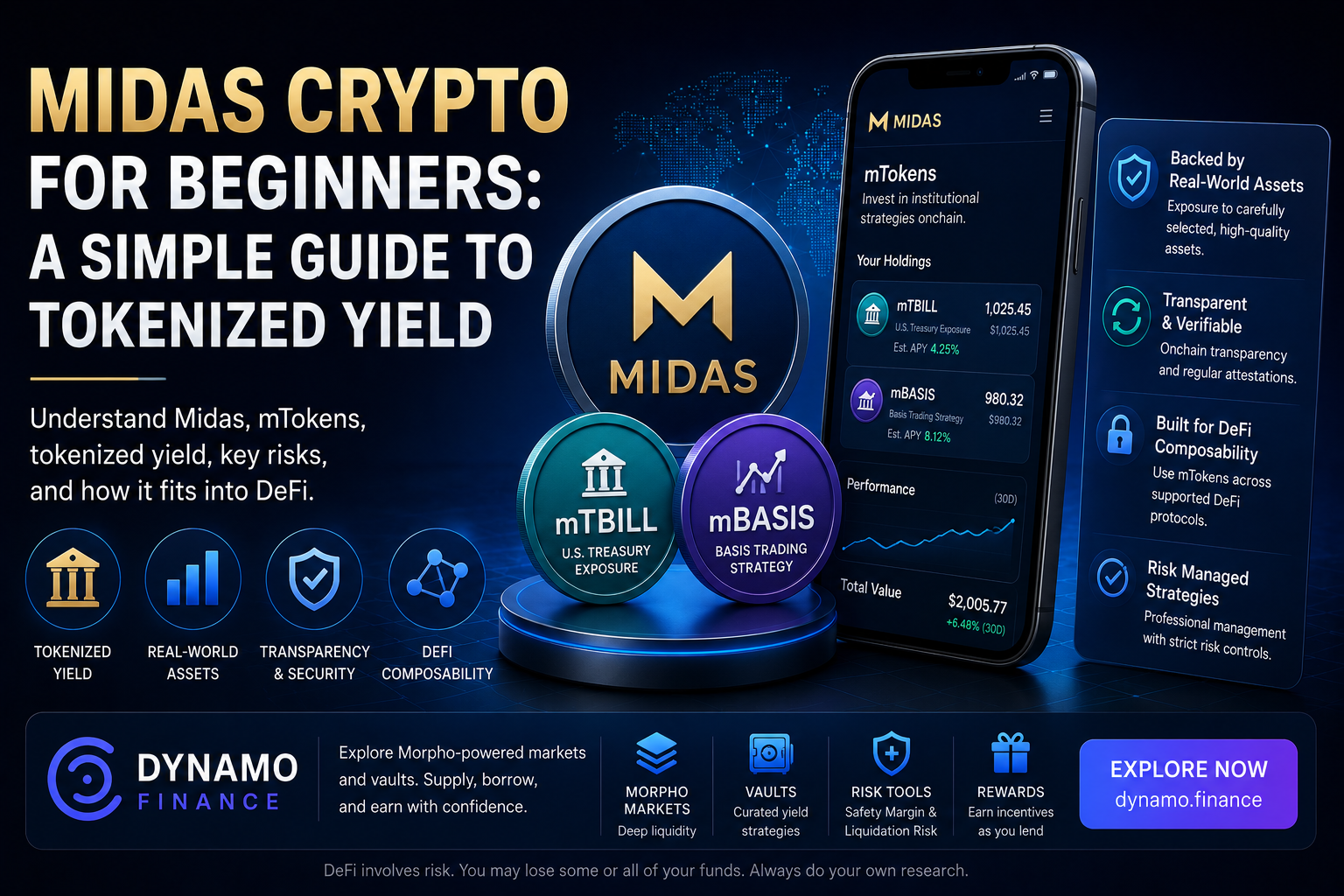
Midas crypto refers to Midas, a platform for composable onchain investment products. It enables strategy managers to turn institutional investment strategies into tokenized products called mTokens, which are designed to provide transparency, redemption mechanics, and DeFi composability while tracking an underlying reference portfolio.
This guide explains what Midas does, how tokenized yield works, why mTokens are different from stablecoins and vaults, what risks investors should understand, and how to compare Midas-style products with Morpho-based lending and vault opportunities through Dynamo Finance.
Key Takeaways
- Midas is a tokenized investment product platform, not a standard DeFi lending protocol or simple stablecoin app.
- Midas products, often called mTokens, track underlying reference portfolios and may include strategies linked to Treasury bills, basis trades, Bitcoin yield, or other professionally managed exposures.
- mTokens are not risk-free. Their NAV can rise or fall based on the underlying strategy, market conditions, liquidity, execution, counterparty exposure, and legal structure.
- Tokenized yield and DeFi lending are related because both compete for stablecoin and crypto capital, but they generate returns through different mechanisms.
- Dynamo Finance helps DeFi investors compare Morpho-based markets and vaults with risk ratings, liquidation-risk tools, safety margins, rewards, and a non-custodial workflow.
What Is Midas Crypto?
Midas crypto is best understood as tokenized investment infrastructure. Instead of creating a regular DeFi pool where users deposit assets and borrowers pay interest, Midas helps transform investment strategies into onchain tokens that users can hold, transfer, redeem, and potentially use across compatible DeFi venues.
The core product type is the mToken. An mToken is a tokenized financial product with a Net Asset Value, or NAV, that reflects the performance of an underlying reference portfolio. That portfolio may be managed by an appointed strategy manager and may follow rules around eligible assets, liquidity thresholds, leverage limits, counterparty concentration, and risk monitoring.
This structure is very different from a stablecoin. A stablecoin aims to maintain a stable price, usually near one dollar. An mToken may be denominated in dollars, Bitcoin, ETH, or another base currency, but its value is not necessarily pegged or guaranteed. It can increase or decrease depending on the assets or strategy behind it.
For a DeFi investor, the simple takeaway is this: Midas is part of the tokenized yield market. It brings investment strategies onchain, while still requiring users to understand product structure, eligibility, redemption mechanics, legal risk, and the difference between yield and guaranteed income.
How Midas Fits Into the Tokenized Yield Market
Tokenized yield is one of the most important trends in crypto finance. It connects traditional financial strategies, real-world assets, institutional managers, and DeFi composability. Instead of keeping investment products inside brokerage accounts or private funds, tokenization makes them accessible through blockchain rails, subject to product rules and jurisdictional restrictions.
Midas focuses on this intersection. Its product architecture is built around liquidity, transparency, and composability. In practice, that means users can review product information, hold mTokens onchain, and in some cases redeem through standard or instant redemption methods.
Examples commonly associated with Midas include mTBILL and mBASIS. mTBILL is linked to short-duration U.S. Treasury bill exposure, while mBASIS is associated with a basis-trading-style yield strategy. Product availability, eligibility, managers, chains, and terms can change, so investors should always review the current product page before taking action.
For additional background, readers can review Midas documentation, which explains how mTokens are designed around transparency, liquidity, and DeFi composability.
What Are mTokens?
mTokens are tokenized investment products issued through the Midas platform. Each mToken represents exposure to a specific reference portfolio or strategy. The value of the token is expressed through NAV rather than a fixed peg.
This distinction matters. A user holding an mToken is not simply holding a dollar-backed stablecoin. They are holding a tokenized instrument whose value can move with the underlying portfolio. The portfolio may include assets, positions, or strategy exposures managed by a professional strategy manager under defined rules.
For example, a Treasury-linked product may aim to track short-duration government debt exposure. A market-neutral product may aim to capture yield from trading or basis opportunities. A Bitcoin yield product may be designed around BTC-denominated returns. Each product has its own mechanics, legal documents, risks, and redemption rules.
Beginners should think of mTokens as onchain wrappers around investment strategies, not as magic-yield tokens. The token is easy to transfer, but the underlying strategy can still involve real financial risk.
Midas Is Not a Stablecoin or a DeFi Vault
One of the biggest beginner mistakes is grouping every yield product together. Midas products may look similar to stablecoins or vault shares because they are onchain tokens, but they are structurally different.
A stablecoin is designed to maintain a target price. A DeFi vault typically pools user deposits and allocates them across strategies or lending markets. A Midas mToken tracks a reference portfolio and reflects NAV changes based on the performance of that portfolio.
| Product Type | Primary Goal | How Yield Is Generated | Main Investor Question |
|---|---|---|---|
| Stablecoin | Maintain price stability near a target value | Usually no native yield unless deposited elsewhere | How strong is the peg, backing, liquidity, and redemption mechanism? |
| DeFi lending market | Connect suppliers and borrowers | Borrowers pay interest to suppliers | Is the collateral, oracle, utilization, and liquidity profile acceptable? |
| DeFi vault | Allocate deposits across markets or strategies | Curated allocation earns blended yield | Who curates the vault, where does capital go, and what risks sit underneath? |
| Midas mToken | Tokenize an investment product or strategy | Underlying portfolio performance affects NAV | What is the reference portfolio, legal structure, liquidity path, and downside risk? |
This comparison is important because Midas products may appeal to the same users who are also evaluating stablecoin lending, Morpho vaults, Treasury yield, or DeFi basis strategies. The mechanisms are different, so the due diligence process must be different too.
How Tokenized Yield Works in Simple Terms
Tokenized yield takes an investment exposure and represents it onchain through a token. That token can be held in a wallet, transferred where permitted, and potentially integrated into DeFi applications.
The simplified process looks like this:
- A product is created around a defined investment strategy or reference portfolio.
- An issuer and strategy manager define the product rules, eligible assets, risk limits, legal structure, and investor rights.
- Eligible users subscribe by contributing an accepted asset, such as a stablecoin.
- The user receives an mToken representing exposure to the product.
- The token’s NAV updates as the underlying portfolio gains or loses value.
- The user may redeem according to the product’s redemption rules, subject to liquidity, compliance checks, fees, and settlement timelines.
- If the token is supported by DeFi protocols, it may also be used in compatible lending markets, liquidity pools, or other onchain strategies.
This model can make institutional-style strategies more accessible and composable. It also introduces complexity. Investors must understand both the crypto layer and the financial product layer.
Why Midas Crypto Matters for DeFi Investors
Midas matters because it reflects a major shift in DeFi. The market is moving from pure crypto-native yield toward a broader system where real-world assets, tokenized strategies, institutional managers, and onchain liquidity all interact.
For yield seekers, this expands the opportunity set. Stablecoins no longer need to sit idle. BTC or other assets may gain access to new yield formats. Tokenized products may be used in DeFi if compatible markets support them.
For risk-aware investors, the shift also raises the bar. A DeFi lending market can be evaluated with collateral, LLTV, utilization, oracle, and liquidity data. A tokenized investment product requires additional analysis: legal structure, issuer risk, NAV methodology, strategy rules, redemption limits, manager oversight, and compliance restrictions.
The best investors do not ask only, “What is the APY?” They ask, “What generates the return, what can go wrong, and how do I exit if conditions change?”
Midas Products and Real-World Asset Exposure
Midas is often discussed in the context of real-world assets, or RWAs. RWAs are tokenized representations of offchain financial exposure, such as Treasury bills, credit products, funds, or other income-producing instruments.
Products such as mTBILL are relevant because Treasury bill exposure has become one of the clearest use cases for tokenized finance. Many crypto investors hold stablecoins and want yield that is less dependent on volatile DeFi incentives. Tokenized T-bill products aim to bring government debt exposure onchain in a more composable format.
However, tokenized RWAs are not the same as holding a Treasury bill directly in a brokerage account. The investor may face issuer risk, legal-structure risk, redemption risk, liquidity limitations, jurisdictional restrictions, operational risk, and smart contract risk.
Data platforms such as RWA.xyz track tokenized asset products including mTBILL and can help investors evaluate market size, chain distribution, holders, and other onchain metrics. These metrics are useful, but they should complement product-level legal and risk review, not replace it.
Midas and DeFi Composability
Composability means onchain assets can plug into other protocols. A token may be used in a wallet, a lending market, a liquidity pool, or a structured strategy if those integrations exist and the token is supported.
Midas emphasizes composability because mTokens are designed to be usable across DeFi where supported. This is what makes tokenized yield different from traditional investment products. A fund share in a brokerage account is usually not something you can permissionlessly move into a DeFi lending market. An onchain token can be integrated more easily, subject to technical, legal, and risk constraints.
That said, composability is a double-edged sword. More integrations can increase utility and liquidity, but they can also introduce additional dependencies. If an mToken is used as collateral in a lending market, investors must evaluate both the mToken and the lending market.
This is where DeFi-native risk tools become valuable. Users who understand morpho lending can better evaluate how tokenized assets might behave if they are ever used as collateral, loan assets, or vault components in onchain credit markets.
How Midas Liquidity and Redemptions Work
Liquidity is one of the most important questions for any tokenized investment product. A token may be onchain, but that does not automatically mean every holder can exit instantly at any size or under all market conditions.
Midas uses an Open Liquidity Architecture that offers standard and instant redemption paths where available. Standard redemption follows the natural settlement timeline of the underlying assets and is designed as a fee-free exit path. Instant redemption can provide immediate settlement into a stablecoin such as USDC, but it depends on available liquidity capacity and may include a fixed instant redemption fee.
This matters for portfolio planning. If you need immediate liquidity, you must understand whether instant redemption capacity exists and what fee applies. If you can wait for settlement, standard redemption may be more appropriate.
Readers who want to explore this mechanism can review Midas’ Open Liquidity Architecture, which outlines the difference between standard and instant redemptions.
How Midas Pricing and NAV Work
Midas products are priced through NAV. NAV stands for Net Asset Value. It represents the current value of one mToken based on the underlying reference portfolio and the number of tokens outstanding.
A beginner-friendly way to think about NAV is this: if the underlying portfolio increases in value after fees and adjustments, the mToken’s NAV can rise. If the portfolio loses value, the NAV can fall. There is no automatic guarantee that the token will maintain a fixed value.
Midas uses valuation processes that involve data from strategy managers, internal review, independent data checks, and onchain verification tools. NAV update cadence can vary by product. Some strategies may update daily, while others may follow different valuation timelines depending on the assets and methodology.
For users, NAV creates a key due diligence point. Before buying an mToken, ask how the NAV is calculated, how often it updates, what inputs are used, what fees apply, and what happens during market disruption events.
Transparency and Attestations
Transparency is one of the strongest promises of tokenized finance. If done well, onchain products can give investors better visibility into holdings, wallet addresses, NAV updates, risk controls, and service-provider attestations than traditional private investment products.
Midas uses collateral transparency and an attestation model to support product verification. The transparency layer is intended to show underlying portfolio composition, allocations, protocol exposures, and onchain wallets used by strategies. The attestation layer is designed to convert structured claims into verifiable onchain checkpoints.
This kind of transparency is valuable, but investors should understand its limits. Transparency can help you verify information, but it does not remove investment risk. A portfolio can be transparent and still lose money. An attestation can improve trust in reporting, but it does not guarantee future performance.
For more detail, Midas provides information about its Attestation Engine, including how attestations can anchor claims related to asset backing, NAV calculations, collateralization, governance decisions, and operational workflows.
Midas Risk Management: What Investors Should Know
Midas products rely on risk frameworks, strategy rules, manager oversight, legal controls, and monitoring systems. These controls are important, but they do not make products risk-free.
Strategy managers operate within defined rules. These rules may include permitted investment universe, liquidity thresholds, leverage limits, asset concentration limits, counterparty caps, protocol exposure limits, and screening standards. The purpose is to create boundaries around how a strategy can be executed.
Midas also describes monitoring systems that track portfolio composition, valuations, protocol exposures, stablecoin exposures, market-neutrality, leverage, and risk limits. Automated alerts can help identify deviations before the next formal NAV update.
For investors, the key point is that risk management should be evaluated as a process, not a guarantee. Good controls reduce the chance of unmanaged exposure, but extreme market events, counterparty failures, operational errors, or regulatory changes can still cause losses.
Key Risks of Midas Crypto Products
Tokenized yield involves several layers of risk. Some are familiar to DeFi users. Others come from traditional finance, legal structures, and offchain operations.
- Performance risk: The underlying strategy can lose money, and the mToken’s NAV can decline.
- Liquidity risk: Instant redemption may depend on available capacity, while standard redemption can take time.
- Counterparty risk: Strategies may rely on exchanges, custodians, stablecoin issuers, brokers, managers, or other service providers.
- Smart contract risk: mTokens and redemption systems use smart contracts that may contain vulnerabilities or unexpected behavior.
- Oracle and pricing risk: NAV calculations may depend on third-party data sources, methodologies, or delayed estimates.
- Manager risk: Strategy results depend on manager execution, monitoring, and operational discipline.
- Legal-structure risk: Investor protections can differ depending on issuance structure, jurisdiction, and product terms.
- Regulatory risk: Product availability, transferability, and redemption may change if laws or compliance requirements change.
- User error risk: Using the wrong contract, fake site, unsupported chain, or misunderstood product can cause irreversible losses.
Midas’ investment risk materials emphasize that security tokens involve a high degree of risk, including the possibility of total capital loss. That point should be taken seriously by beginners and experienced users alike.
Eligibility and Compliance Matter
Not every crypto user can access every tokenized investment product. Midas products may be restricted based on jurisdiction, user status, sanctions screening, wallet screening, KYC or AML requirements, and product-specific offering rules.
This is especially important for U.S. users. Midas states that its tokens are not offered to U.S. persons. Certain products may also require professional or institutional onboarding before a wallet can interact with the smart contracts.
These restrictions are not just frontend choices. Compliance controls can exist at the application and protocol level. A user may be blocked from subscribing, redeeming, or interacting if they are ineligible or if a wallet fails screening.
Before evaluating yield, investors should first confirm whether they are eligible. A product that looks attractive is irrelevant if you cannot legally or technically access it.
Midas Crypto vs. DeFi Lending
Midas-style tokenized yield and DeFi lending both appeal to yield seekers, but they are not the same. DeFi lending usually generates returns from borrowers paying interest. Midas mTokens generate returns from the performance of a reference portfolio or strategy.
In a Morpho-based lending market, suppliers deposit a loan asset, borrowers post collateral, and interest rates respond to utilization. In a Midas product, the user holds a tokenized exposure whose NAV changes according to the underlying product methodology.
The comparison matters because many users are deciding where to allocate stablecoins, BTC, ETH, or other assets. A user might compare mTBILL against a stablecoin lending vault. Another might compare a basis-strategy mToken against a DeFi yield vault. Another might use a lending protocol to borrow while keeping investment exposure elsewhere.
The right choice depends on the investor’s objective. If you want direct exposure to borrower-paid DeFi yield, a lending market or vault may make more sense, or if you want tokenized exposure to a managed strategy, an mToken may be more relevant. If you want liquidity without selling assets, a collateralized borrow position may be the right tool.
How Dynamo Finance Fits Into the Conversation
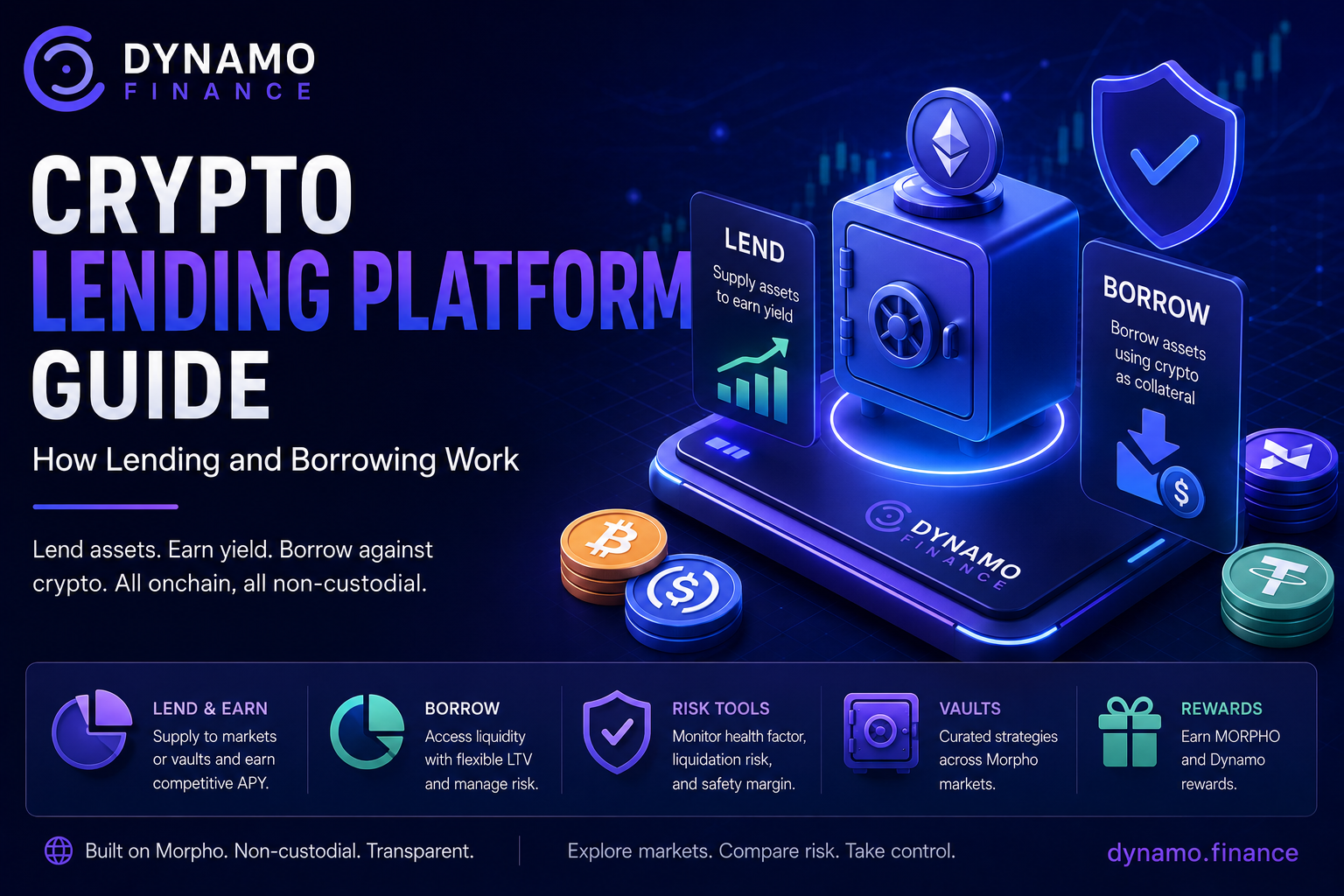
Dynamo Finance is a non-custodial, permissionless Web3 lending market built on Morpho smart contracts. It gives users a way to supply assets, borrow against collateral, deposit into vaults, compare markets, evaluate risk, earn rewards, and participate in governance from one interface.
Dynamo does not custody user funds. Assets are held by Morpho smart contracts, while Dynamo adds a user-facing layer for discovery, risk analytics, position management, rewards, and governance participation. This makes it useful for investors who want more visibility into market mechanics than a simplified yield interface usually provides.
The connection to Midas is strategic rather than identical. Midas represents tokenized yield products. Dynamo represents DeFi-native access to Morpho-based lending and vaults. Both are part of the broader onchain yield market, and both require users to understand where return comes from.
For investors comparing tokenized products in the morpho protocol, Dynamo’s market data, vault breakdowns, and risk tools can help develop a more disciplined process before allocating capital.
Dynamo Markets: Direct DeFi Lending Exposure
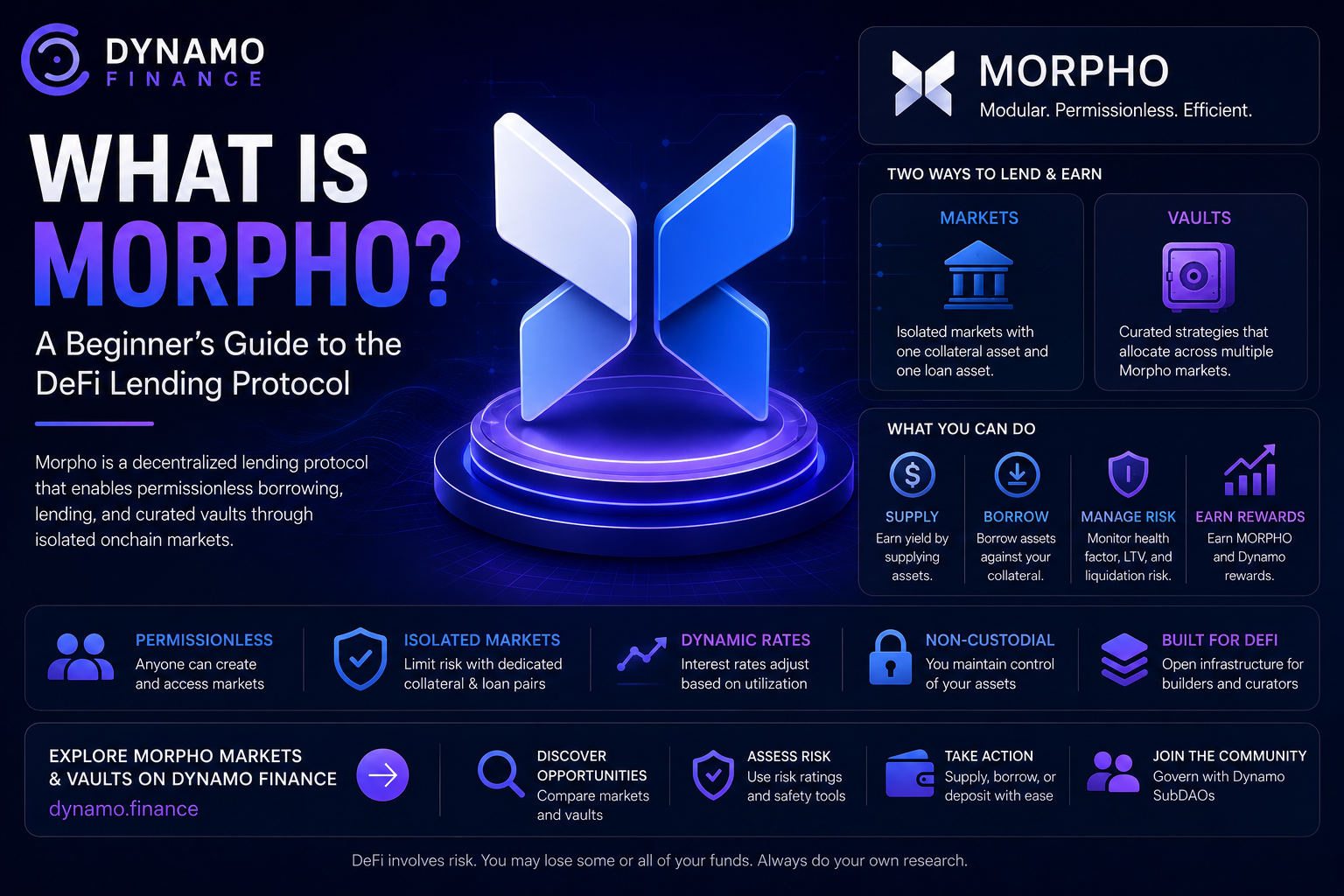
Dynamo markets are isolated lending pools. Each market has one loan asset, one collateral asset, one oracle, and one liquidation loan-to-value threshold. This isolation helps users understand exactly which market they are entering.
When users supply the loan asset, they earn interest paid by borrowers. When users borrow, they draw from the loan asset pool against collateral they have posted. Each market operates independently, so a risk event in one market does not automatically affect another market.
Dynamo surfaces active Morpho markets with key data such as supply APY, borrow APY, utilization, available liquidity, collateral asset, loan asset, oracle, LLTV, and market status. These details matter because high APY alone does not tell the full story.
For anyone comparing a tokenized yield product against a crypto lending platform, direct market data is essential. It helps you understand whether yield comes from borrower demand, incentives, collateral risk, or market stress.
Dynamo Vaults: Curated Yield Through Morpho
Dynamo also supports vaults built on the MetaMorpho standard. A vault lets users deposit once while a curator allocates capital across selected Morpho markets. This can simplify yield access for users who do not want to rebalance manually.
Vaults generate yield from borrower interest in the underlying markets. Users receive vault shares that represent their proportional position. As the vault earns interest, the value of those shares can increase, subject to fees, liquidity, market performance, and allocation decisions.
Vaults are convenient, but they introduce curator and allocation risk. Users should review curator reputation, market diversity, APY stability, performance fees, underlying market risk, and withdrawal liquidity before depositing.
This is the same mindset that applies to Midas products. Whether you hold an mToken or a vault share, you need to understand the strategy beneath the wrapper.
Dynamo Risk Tools and Why They Matter
Dynamo adds risk tooling for users who want more than headline APY. Markets and vaults receive Low, Medium, or High risk tiers based on objective onchain inputs. For markets, relevant factors include LLTV, TVL, and how long a market has been live. For vaults, relevant factors include total supplied value, market exposure, and live history.
These tiers are useful heuristics, not predictions. A Low-risk market can still lose money during oracle failure, smart contract issues, or extreme collateral moves. Still, risk tiers help users compare opportunities more thoughtfully.
Dynamo also provides borrower tools such as Safety Margin and Liquidation Risk views. Safety Margin creates a synthetic target LTV so users can borrow more conservatively than Morpho’s liquidation threshold. Liquidation Risk views help borrowers understand health factor, price-drop tolerance, and liquidation price.
Users can explore these tools through the Dynamo risk dashboard and review core concepts in the Dynamo Finance protocol guide.
Midas Crypto vs. Dynamo Finance
Midas and Dynamo serve different roles in onchain finance. Comparing them helps users decide which tool fits which portfolio objective.
| Category | Midas Crypto | Dynamo Finance |
|---|---|---|
| Primary role | Tokenized investment product platform | Non-custodial interface for Morpho-based lending markets and vaults |
| Core product | mTokens tracking reference portfolios | Isolated lending markets and MetaMorpho vaults |
| Yield source | Underlying strategy or reference portfolio performance | Borrower-paid interest, vault allocation, and applicable rewards |
| Main risk focus | Strategy, NAV, liquidity, issuer, manager, legal, and compliance risk | Collateral, oracle, utilization, LLTV, liquidation, vault, and market risk |
| Best fit | Users seeking tokenized investment exposure | Users who want to supply, borrow, or compare Morpho-based DeFi opportunities |
The two are not substitutes in a narrow sense. They are different ways to put capital to work onchain. A sophisticated DeFi investor may evaluate both, but should use different risk frameworks for each.
How to Evaluate Midas Before Investing
Before buying or subscribing to a Midas product, take a structured approach. The token may be easy to hold, but the underlying product can be complex.
- Identify the exact mToken and read its product materials.
- Confirm your eligibility based on jurisdiction and investor requirements.
- Understand the reference portfolio or strategy behind the token.
- Review who manages the strategy and what rules constrain the manager.
- Check how NAV is calculated, how often it updates, and what data sources are used.
- Understand standard and instant redemption options, including fees and settlement timelines.
- Review legal structure, issuer risk, and whether assets are segregated or compartmentalized.
- Evaluate smart contract, oracle, counterparty, liquidity, and regulatory risks.
- Start with a small position and test the full entry and exit workflow where possible.
- Monitor product updates, NAV changes, liquidity capacity, and risk disclosures after investing.
This checklist is intentionally conservative. Tokenized yield products can be powerful, but they require more than a quick APY comparison.
How to Compare Tokenized Yield With DeFi Lending Yield
When comparing Midas products with DeFi lending opportunities, focus on the source of return. Tokenized products may earn through Treasury exposure, basis strategies, managed portfolios, or other reference assets. DeFi lending earns through borrower demand and interest payments.
Next, compare liquidity. A DeFi lending vault may offer withdrawals subject to underlying market liquidity. A Midas product may offer standard redemption with settlement time or instant redemption subject to liquidity capacity. Neither structure guarantees unlimited instant exits.
Then compare downside scenarios. In a lending market, a collateral crash or oracle failure can affect suppliers and borrowers. In an mToken, strategy losses, pricing disruptions, counterparty failures, legal events, or redemption constraints can affect value.
Finally, compare transparency. A Morpho-based market may show utilization, TVL, borrow rate, supply rate, oracle, and LLTV. A Midas product may show NAV, portfolio composition, attestations, redemption terms, and risk materials. Strong investors learn how to read both types of data.
Practical Example: Stablecoin Investor Choosing Between mTBILL and DeFi Lending
Imagine a user holds USDC and wants a relatively conservative yield strategy. One option is a Treasury-linked tokenized product such as mTBILL. Another option is a stablecoin lending vault through Morpho-based infrastructure.
The mTBILL-style route may appeal to a user who wants exposure linked to short-duration Treasury assets. The user should review eligibility, legal structure, NAV methodology, redemption timing, and product-specific risks.
The DeFi lending vault route may appeal to a user who wants borrower-paid yield and onchain market exposure. The user should review curator, allocations, collateral, utilization, liquidity, APY stability, and risk rating.
Neither path is automatically better. The Treasury-linked route may involve offchain legal and redemption risks. The DeFi lending route may involve collateral, oracle, liquidation, and smart contract risks. The best choice depends on the investor’s liquidity needs, jurisdiction, risk tolerance, and ability to monitor positions.
Practical Example: Borrowing Against Crypto Instead of Selling
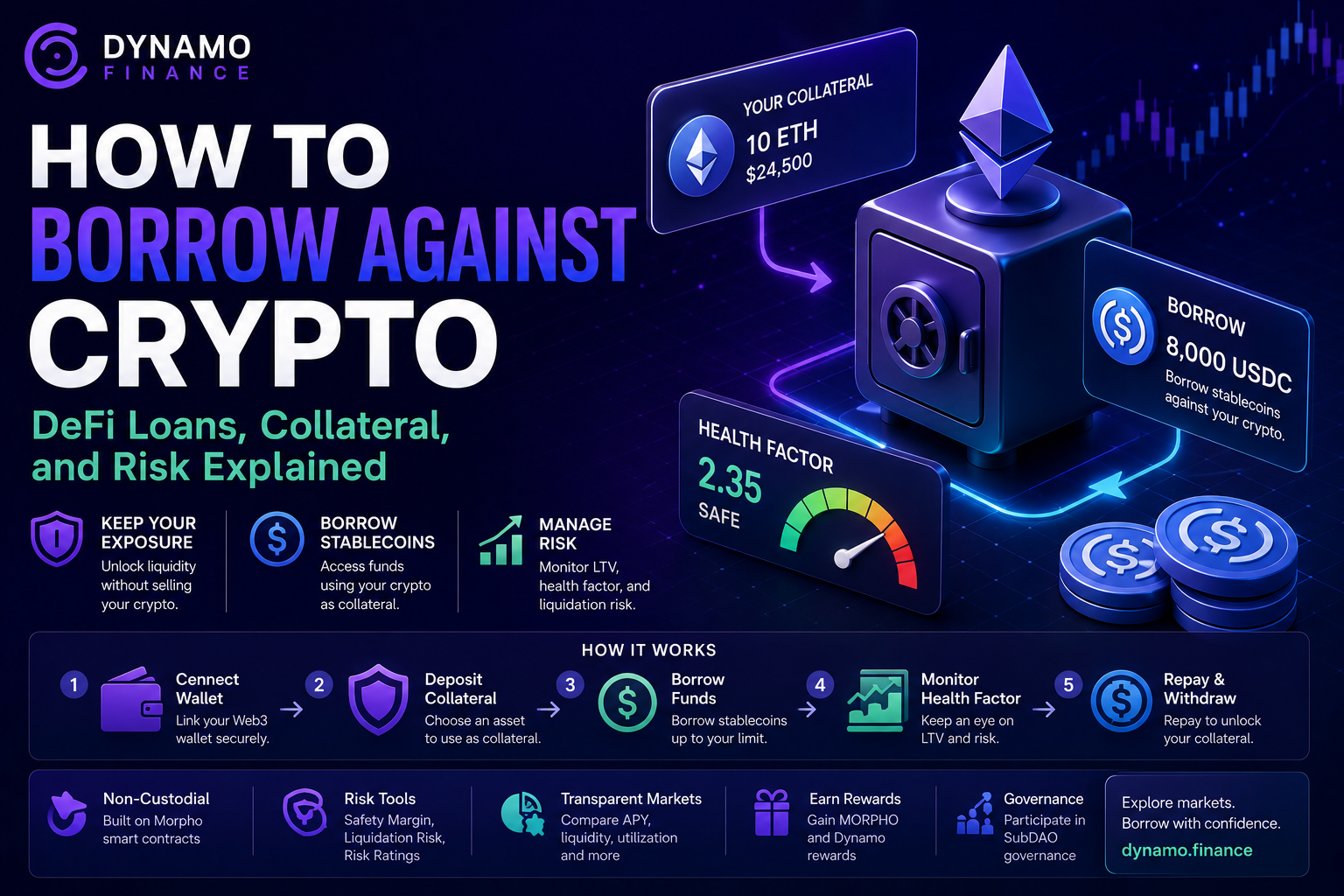
A user holding ETH or BTC may want stablecoin liquidity without selling. Tokenized yield products may help put assets to work, but they do not solve every liquidity need. A DeFi borrow position can be more appropriate when the goal is to unlock liquidity while maintaining collateral exposure.
Through a lending protocol, a borrower posts collateral and draws a loan asset. The borrower keeps exposure to the collateral asset but accepts liquidation risk. If collateral value falls or debt grows enough to reach the liquidation threshold, the position can be liquidated.
This is where Dynamo’s borrower tools become useful. Users researching how to borrow against crypto or to take out crypto currency loans can review LTV, LLTV, health factor, Safety Margin, and liquidation-risk data before taking action.
The lesson is simple: tokenized yield is one tool, lending is another, and borrowing is another. Good portfolio construction uses the right tool for the right problem.
Common Beginner Mistakes With Midas Crypto
The first mistake is assuming every yield-bearing token is a stablecoin. Midas mTokens are not stablecoins. They track underlying products and can gain or lose value.
The second mistake is ignoring eligibility. If a product is not offered in your jurisdiction, attempting to access it through workarounds can create legal, technical, and redemption problems.
The third mistake is focusing only on advertised yield. Yield means little without understanding the strategy, liquidity path, fees, and downside risk.
The fourth mistake is assuming instant redemption is always available. Instant redemption can depend on dedicated liquidity capacity. Standard redemption may take time because it follows the underlying asset settlement process.
The fifth mistake is ignoring legal structure. Investor protections can differ depending on whether a product is issued through a securitization vehicle, a German issuer setup, or another structure.
Common Beginner Mistakes With DeFi Lending
DeFi lending has its own mistakes. The most common is chasing APY without checking why the APY is high. High utilization, thin liquidity, volatile collateral, or temporary incentives can all produce high rates.
Another mistake is borrowing too close to liquidation. A borrower who maximizes borrowing power may have no room for normal market volatility. A conservative safety buffer can be more valuable than extra capital efficiency.
Vault users often assume curation removes risk. It does not. A vault can reduce manual work, but users still face curator risk, market risk, liquidity risk, and smart contract risk.
Finally, users sometimes fail to monitor positions. DeFi markets run continuously. APYs, utilization, collateral values, and liquidation risk can change quickly.
What Experienced Investors Look For
Experienced investors start with the mechanism. They ask what generates the yield, who manages the exposure, what assets sit underneath, how pricing works, and how exits are handled.
They also think in portfolio roles. A Treasury-linked mToken may serve a different role from a high-yield DeFi vault. A direct lending market may serve a different role from a collateralized borrow position. A market-neutral strategy may serve a different role from directional BTC or ETH exposure.
Experienced investors also test liquidity. They do not assume a product is liquid simply because a token exists onchain. They review redemption methods, liquidity pools, secondary markets, settlement timelines, and stress conditions.
Most importantly, they size positions based on downside, not upside. If a product can lose capital, it should not be treated as cash. If a loan can be liquidated, it should not be treated as free liquidity.
How to Build a Risk-First Onchain Yield Strategy
A risk-first strategy starts with your objective. Are you trying to preserve stablecoin liquidity, earn moderate yield, access tokenized Treasury exposure, take market-neutral risk, borrow against collateral, or increase DeFi-native yield?
Once the objective is clear, choose the product type. A Midas mToken may fit a tokenized investment exposure. A Dynamo vault may fit curated lending yield. A direct Dynamo market may fit users who want market-level control. A borrow position may fit users who want liquidity without selling crypto.
Then evaluate the mechanism. For Midas, review NAV, strategy manager, legal structure, redemption, and eligibility. But for Dynamo markets, review collateral, oracle, LLTV, utilization, liquidity, and risk tier. For Dynamo vaults, review curator, allocation, TVL, fees, market exposure, and APY stability.
Finally, monitor after entry. Yield products are not static. Rates change, NAV changes, liquidity changes, collateral values change, and strategy conditions change.
Where Ledger Fits Into Midas Adoption
Wallet-native integrations are an important part of tokenized yield adoption. Ledger has integrated Midas tokenized investment strategies into Ledger Wallet’s Discover section, giving users access to selected Midas products while maintaining self-custody through their Ledger signer.
This matters because many users do not want to give up control of their private keys just to access yield. Wallet-native integrations can reduce friction while keeping the user in control of the signing process.
Ledger’s overview of tokenized investment strategies with Midas highlights products such as mTBILL and mHYPER and describes Midas as a platform that enables strategy managers to turn institutional strategies into compliant tokens.
For investors, the broader takeaway is that tokenized yield is moving closer to everyday wallet workflows. That makes education even more important, because easier access can sometimes hide complex risk.
Why Follow Dynamo Finance
Dynamo is useful for users who want a more transparent, DeFi-native way to compare lending and borrowing opportunities. It brings Morpho markets, vaults, risk ratings, liquidation-risk views, Safety Margin tools, rewards, and governance participation into one workflow.
For a Midas user, Dynamo can help build the market-literacy needed to compare tokenized yield with DeFi lending yield. For a DeFi lender, Dynamo can help evaluate opportunities more carefully before supplying assets or borrowing against collateral.
Users who want product updates, market context, and community news can follow Follow Dynamo Finance on X.
The larger point is that onchain finance is becoming more sophisticated. The strongest users will not be the ones who chase every new yield source. They will be the ones who understand how each product works before allocating capital.
Final Checklist Before Using Midas or Dynamo
Use this checklist before putting capital into any tokenized yield product, lending market, vault, or borrow position.
- Confirm the official website and contract addresses.
- Identify whether you are using an mToken, vault share, direct lending market, or borrow position.
- Understand the source of return and whether it is strategy-based, borrower-paid, incentive-driven, or NAV-based.
- Review liquidity, redemption paths, fees, and withdrawal limitations.
- Check eligibility, jurisdictional restrictions, and compliance requirements.
- Evaluate smart contract, oracle, issuer, counterparty, manager, and market risks.
- Start small and test the full workflow before scaling.
- Monitor your position after entry, especially during market volatility or product updates.
Conclusion
Midas crypto is part of the next stage of onchain finance. It brings tokenized investment products, NAV-based mTokens, strategy managers, transparency tools, redemption architecture, and DeFi composability into one framework.
For beginners, the most important lesson is that tokenized yield is not the same as a stablecoin, vault, or bank account. mTokens can provide access to professionally managed strategies, but they also involve performance risk, liquidity risk, issuer risk, legal risk, compliance restrictions, and smart contract risk.
Dynamo Finance fits into this broader yield landscape by helping users compare Morpho-based markets and vaults with more transparency. If Midas helps investors understand tokenized investment products, Dynamo helps them understand DeFi lending mechanics: collateral, utilization, APY, vault allocation, risk tiers, and liquidation risk.
Explore Dynamo Finance to compare Morpho markets and vaults, review risk data, and build a more disciplined approach to onchain yield, lending, and borrowing.
FAQ
What is Midas crypto?
Midas crypto refers to Midas, a platform for composable onchain investment products. It enables strategy managers to create tokenized products called mTokens, which track underlying reference portfolios and can be held onchain.
Are Midas mTokens stablecoins?
No. Midas mTokens are not stablecoins. They are tokenized investment products whose NAV can rise or fall based on the performance of the underlying reference portfolio, strategy rules, fees, liquidity, and market conditions.
What is tokenized yield?
Tokenized yield is yield exposure represented by an onchain token. The yield may come from Treasury bills, lending, basis trades, market-neutral strategies, credit products, or other investment exposures depending on the product design.
Is Midas crypto safe for beginners?
Midas products can be useful for sophisticated investors, but they are not risk-free. Beginners should understand eligibility, NAV, redemption mechanics, strategy risk, smart contract risk, legal structure, and the possibility of capital loss before investing.
How does Dynamo Finance relate to Midas crypto?
Dynamo Finance is not Midas. The connection is that both are part of the onchain yield ecosystem. Midas focuses on tokenized investment products, while Dynamo helps users explore Morpho-based lending markets and vaults with risk ratings, liquidity data, and borrower protection tools.