
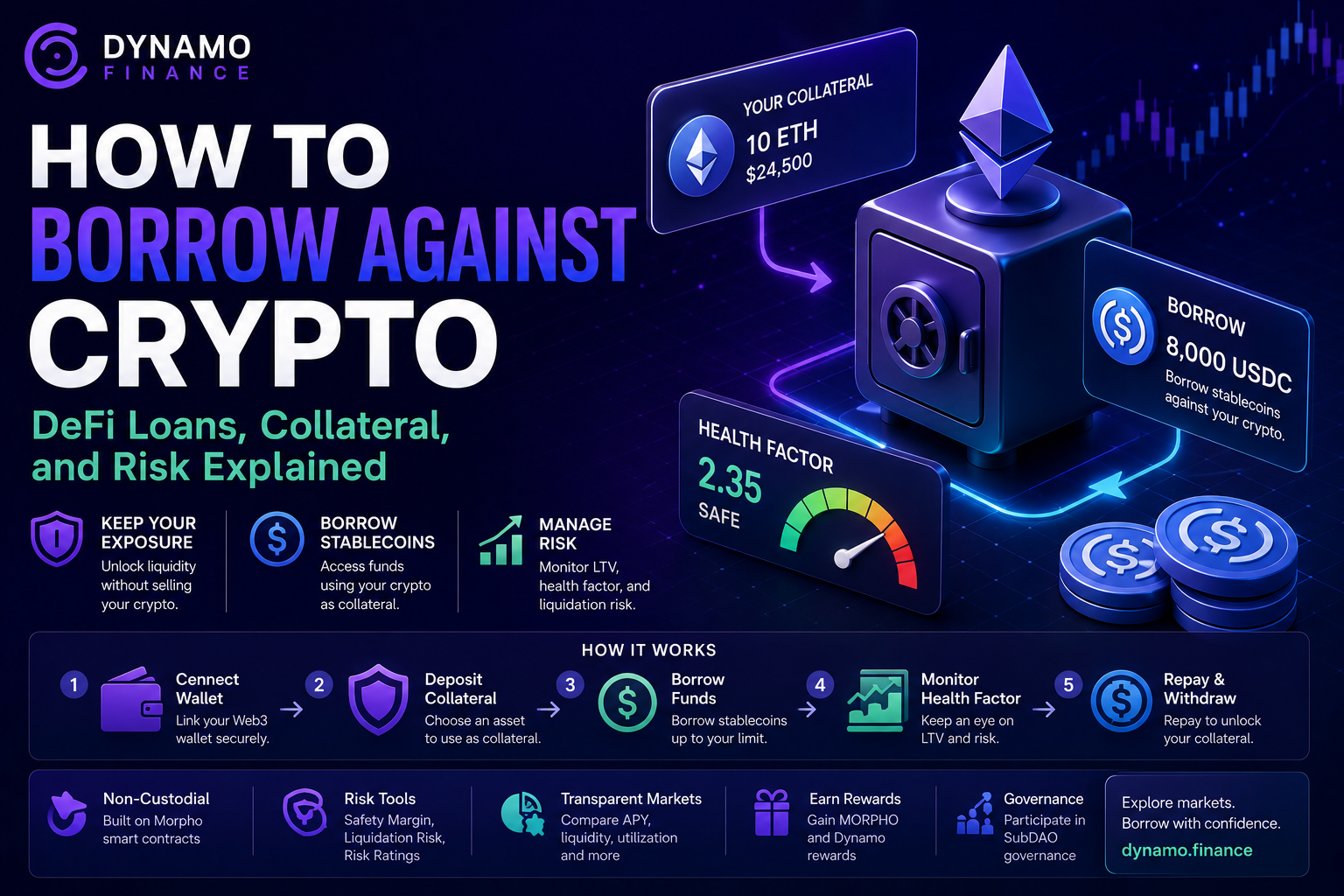
Holding crypto creates a common dilemma. You may want liquidity, but selling ETH, BTC, or another asset means giving up exposure, potentially triggering tax questions, and locking in a portfolio decision you might regret later. That is why many investors search for how to borrow against crypto instead of selling.
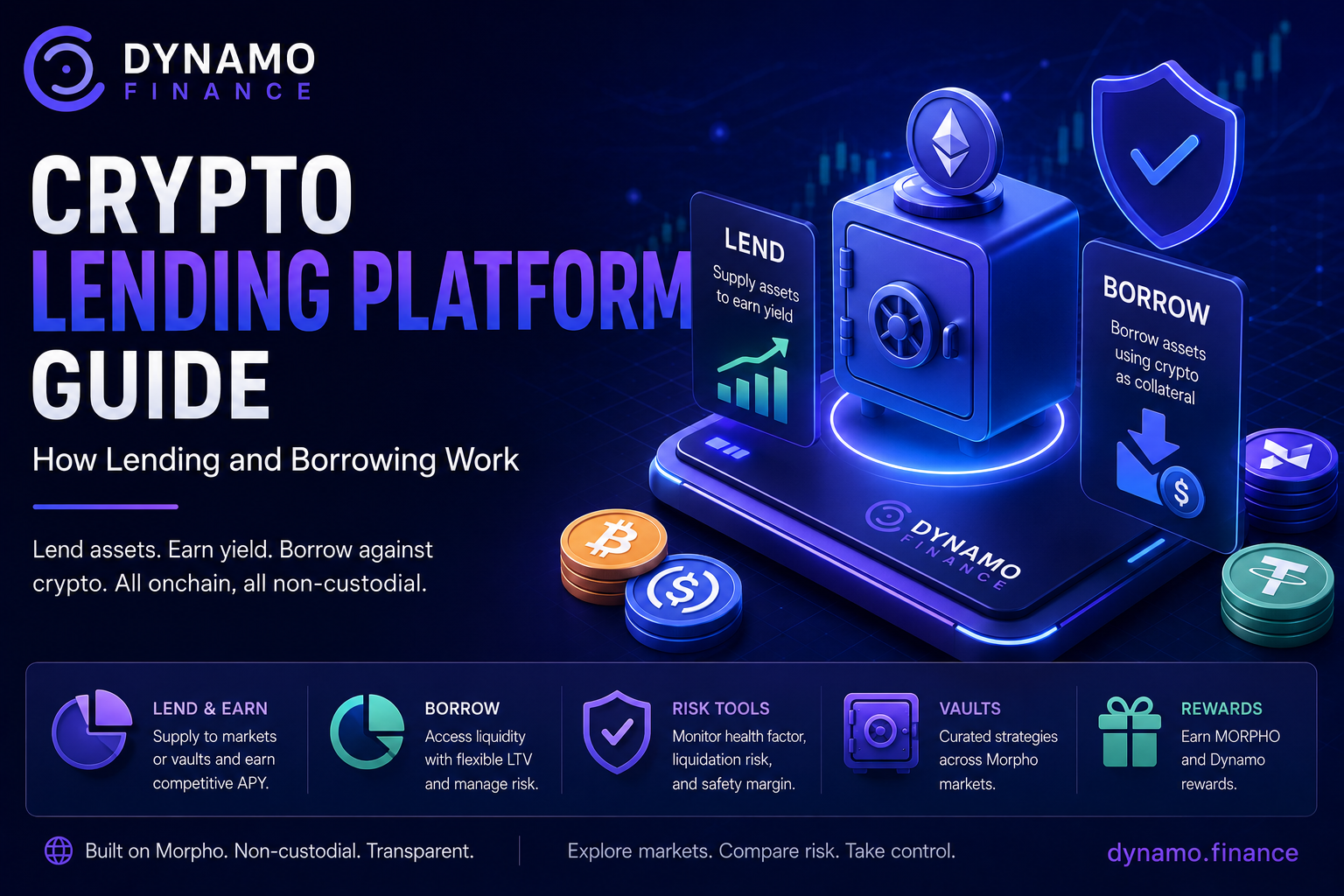
Borrowing against crypto lets you use digital assets as collateral to access another asset, often a stablecoin such as USDC. In DeFi, this usually happens through smart contracts: you deposit collateral, borrow from a lending market, pay variable interest, and manage your loan-to-value ratio so the position does not get liquidated.
To borrow against crypto, you deposit a supported asset as collateral, borrow a loan asset from a lending market, monitor your LTV and liquidation threshold, and repay the debt to unlock your collateral. The strategy can unlock liquidity without selling, but it introduces interest-rate risk, collateral volatility, and liquidation risk.
This guide explains how crypto-backed borrowing works, how collateral and LTV affect your loan, what liquidation means, how DeFi borrowing differs from centralized lending, and how Dynamo Finance helps users compare Morpho-based lending markets with risk tools designed for safer decision-making.
Key Takeaways
- Borrowing against crypto means using digital assets as collateral to take a loan, commonly in stablecoins.
- DeFi loans are usually overcollateralized, meaning your collateral must be worth more than the amount you borrow.
- The most important borrower metrics are LTV, LLTV, health factor, borrow APY, liquidation price, and available liquidity.
- A crypto-backed loan can preserve asset exposure, but it can also lead to liquidation if collateral value falls too much.
- Dynamo Finance gives users non-custodial access to Morpho-based markets, plus Safety Margin, Liquidation Risk views, risk ratings, rewards, and market data.
What Does It Mean to Borrow Against Crypto?
Borrowing against crypto means using your digital assets as collateral for a loan. Instead of selling an asset, you lock it into a lending market and borrow another asset against it. The loan remains open until you repay the borrowed amount plus accrued interest.
For example, a user might deposit ETH as collateral and borrow USDC. The user keeps exposure to ETH price movements while gaining stablecoin liquidity. If ETH rises, the loan becomes safer. If ETH falls, the loan becomes riskier.
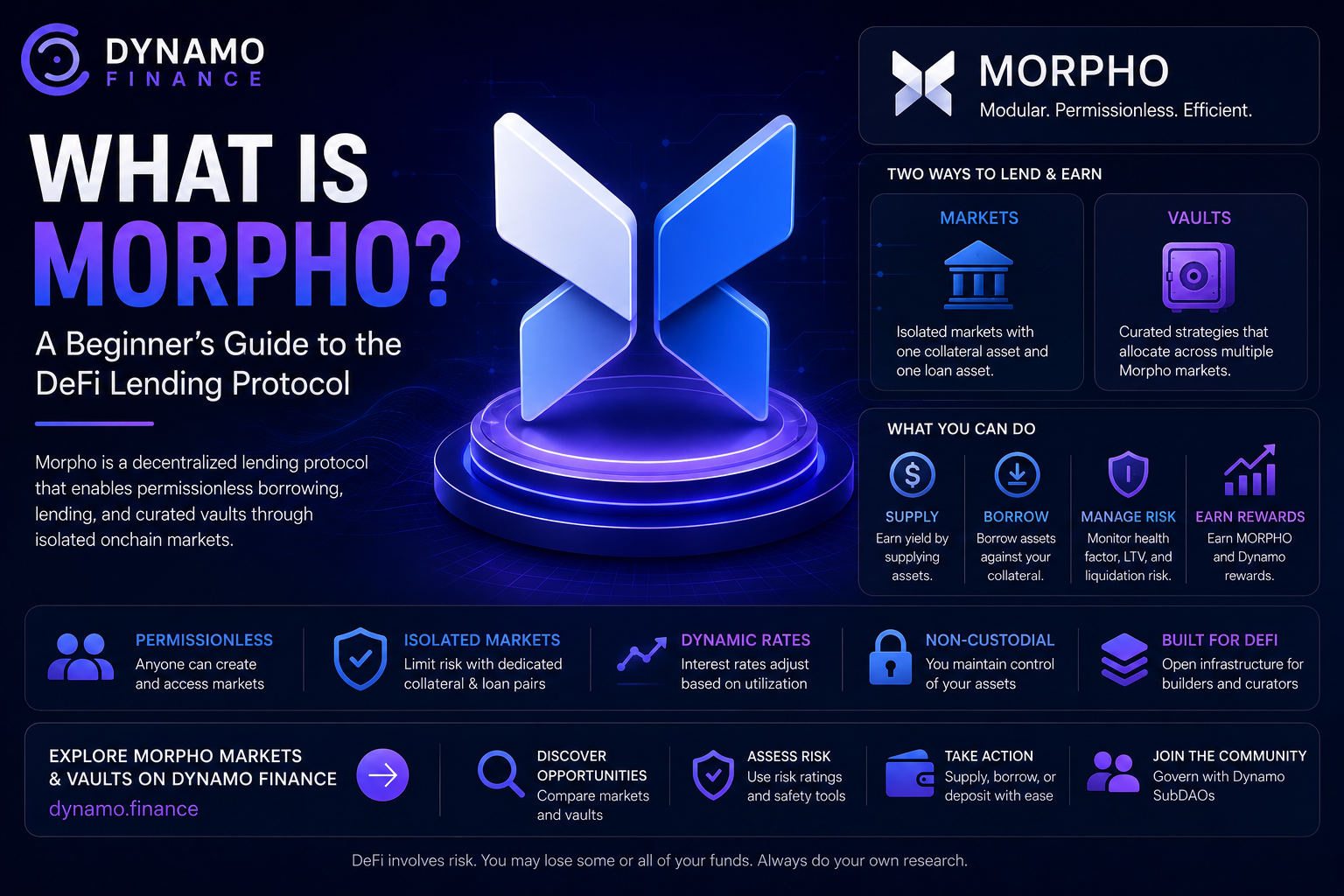
This structure is common across DeFi lending markets. Morpho describes its variable-rate markets as isolated lending pools where one collateral asset is paired with one loan asset, and each market has its own oracle, interest-rate model, and liquidation loan-to-value threshold. You can review the underlying market concept in the Morpho variable-rate market guide.
The benefit is flexibility. The cost is active risk management. A loan against crypto is not free liquidity; it is a collateralized position that must be monitored.
Why Borrow Against Crypto Instead of Selling?
The main reason is liquidity without exiting the asset. A long-term holder may want cash-like liquidity while still maintaining exposure to ETH, BTC, or another crypto asset.
Borrowing can also help users avoid selling during unfavorable market conditions. If a user believes their collateral asset has long-term upside, a loan may feel preferable to selling during a temporary drawdown.
There can also be tax considerations. In many jurisdictions, selling crypto can trigger a taxable event, while borrowing may be treated differently. Tax treatment depends on the user’s location, transaction structure, collateral movement, liquidations, and other details. The IRS states that digital assets may need to be reported and that income from digital assets can be taxable; users should review current guidance and consult a qualified tax professional through resources such as the IRS digital assets page.
Borrowing is not always better than selling. If the loan creates stress, liquidation risk, or high interest expense, selling a smaller amount may be simpler. The right choice depends on your goals, risk tolerance, and ability to monitor the position.
How Crypto-Backed Loans Work
A crypto-backed loan has three core elements: collateral, debt, and liquidation rules. Collateral protects lenders. Debt gives borrowers liquidity. Liquidation rules define what happens if the collateral no longer safely supports the loan.
The process usually works like this:
- You connect a wallet or use a supported lending interface.
- You select a market with the collateral asset you want to post and the loan asset you want to borrow.
- You deposit collateral into the smart contract.
- You borrow an amount below the market’s liquidation threshold.
- Interest accrues on the borrowed balance over time.
- You monitor LTV, health factor, borrow APY, collateral price, and liquidation price.
- You repay the loan to unlock your collateral.
In DeFi, this process is handled by smart contracts rather than a human loan officer. There is no traditional credit score check in most overcollateralized DeFi loans. The system relies on collateral value and liquidation mechanics to protect lenders.
That makes borrowing fast and transparent, but it also makes user responsibility much higher. If you borrow too aggressively, a market move can liquidate your collateral automatically.
DeFi Borrowing vs. Centralized Crypto Loans
Crypto borrowing can happen through centralized companies or decentralized protocols. Both models can unlock liquidity, but the risk profiles are different.
| Feature | DeFi Borrowing | Centralized Crypto Borrowing |
|---|---|---|
| Custody model | Assets are held by smart contracts | Assets may be held or controlled by a company |
| Loan rules | Defined by smart contracts and market parameters | Defined by platform policies and internal systems |
| Transparency | Rates, markets, collateral, and positions can be visible onchain | Depends on company disclosures and reporting |
| Main borrower risk | Liquidation, smart contract risk, oracle risk, user error, variable rates | Liquidation, custody risk, withdrawal restrictions, counterparty risk, policy changes |
| Best fit | Users comfortable with wallets, onchain markets, and self-custody | Users who prefer account-based borrowing and platform-managed workflows |
Centralized platforms can feel easier because they abstract away wallet interactions. The trade-off is that users depend on the company’s solvency, custody practices, and operating policies.
DeFi borrowing can provide more transparency and control, but it requires better self-custody habits. The borrower must understand smart contract interactions, collateral rules, and liquidation risk before signing transactions.
Key Terms You Need to Know Before Borrowing
Crypto-backed borrowing has its own vocabulary. Understanding these terms before taking a loan can prevent expensive mistakes.
- Collateral: The asset you deposit to secure your loan.
- Loan asset: The asset you borrow, often a stablecoin.
- LTV: Loan-to-value, or the ratio between your borrowed amount and collateral value.
- LLTV: Liquidation loan-to-value, the threshold where your position can be liquidated.
- Health factor: A simplified measure of how safe your loan is from liquidation.
- Borrow APY: The annualized interest rate paid by borrowers.
- Utilization: The share of supplied liquidity currently borrowed in a market.
- Available liquidity: The amount available for new borrowing or withdrawals.
- Oracle: The price feed used to value collateral against the borrowed asset.
- Liquidation price: The collateral price level where your position can become liquidatable.
These terms are not just technical details. They directly affect how much you can borrow, how much your loan costs, and how likely you are to be liquidated.
What Is LTV?
LTV stands for loan-to-value. It measures your debt relative to your collateral. If you deposit $10,000 of ETH and borrow $4,000 of USDC, your LTV is 40%.
A lower LTV gives you a larger safety buffer. A higher LTV gives you more borrowed liquidity but leaves less room for collateral price declines.
Borrowers often make the mistake of focusing on maximum borrowing power. A platform may allow a large borrow amount, but using the maximum can be dangerous. Crypto collateral can move quickly, and a high-LTV loan can become risky after a normal market swing.
The better question is not “How much can I borrow?” It is “How much can I borrow while still surviving volatility?”
What Is LLTV?
LLTV stands for liquidation loan-to-value. It is the threshold where a borrow position can be liquidated. If a market has an 80% LLTV, a position can become liquidatable once the borrowed value reaches 80% of the collateral value.
LLTV is usually set based on collateral risk. More liquid and less volatile assets may support higher borrowing capacity. More volatile or less liquid collateral usually requires a lower threshold.
Morpho-based markets use LLTV as a market-level parameter. That means each market has its own collateral rules, and borrowers should inspect the exact market before borrowing.
The liquidation threshold should never be treated as a target. It is the boundary you want to stay far away from.
What Is Health Factor?
Health factor is a borrower safety metric. It tells you how close your position is to liquidation. A higher health factor means more room before liquidation. A lower health factor means the position is closer to the danger zone.
Different protocols display health factor slightly differently, but the concept is similar across DeFi lending. Aave’s liquidation materials describe health factor as a key risk indicator and show how positions can become liquidatable when health deteriorates; the Aave liquidation guide is a useful comparison point for borrowers learning DeFi risk.
On Dynamo, Liquidation Risk views are designed to make this concept practical. Users can monitor health factor, price-drop tolerance, and liquidation price rather than guessing how safe a loan is.
A healthy borrow position is not one that merely avoids liquidation today. It is one that can withstand a realistic market move tomorrow.
How Borrow Interest Rates Work
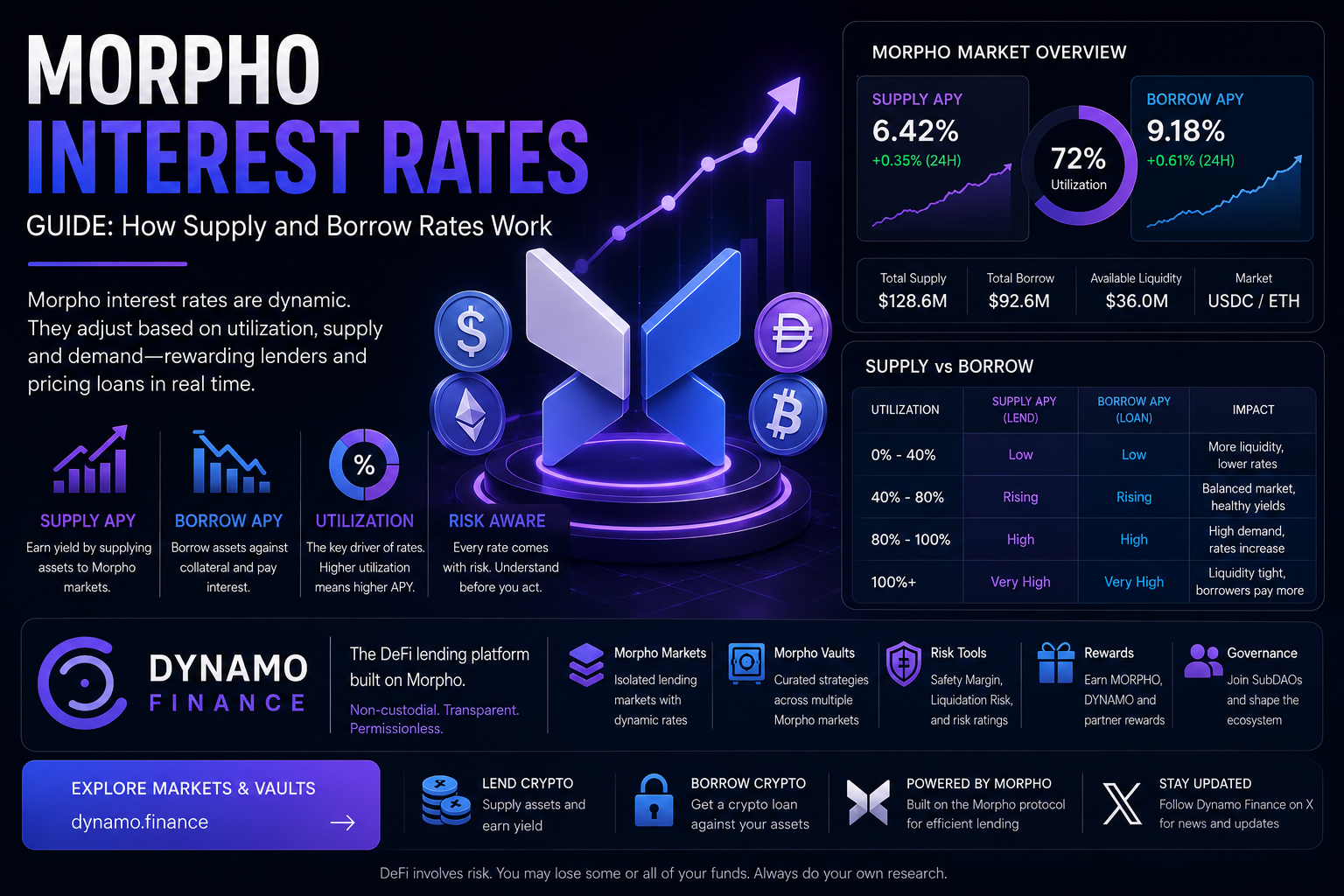
Most DeFi borrow rates are variable. They move based on supply, demand, and utilization in the specific market. If many borrowers use the available liquidity, rates can rise. If demand falls or more suppliers deposit, rates can decline.
Borrow APY matters because it determines how quickly your debt grows. If your borrowed balance grows while collateral value stays flat or falls, your LTV increases. Rising LTV brings you closer to liquidation.
Morpho’s interest-rate materials explain how market rates respond to utilization and how supply and borrow APYs are linked to the market’s rate model. Technical users can review the Morpho interest-rate guide.
Borrowers should always assume rates can change. A loan that looks cheap at entry can become more expensive if market liquidity tightens.
How Collateral Price Moves Affect Your Loan
Collateral price is the most important driver of liquidation risk. If your collateral rises in value, your LTV falls and your position becomes safer. If your collateral drops, LTV rises and liquidation risk increases.
For example, assume you deposit $20,000 of ETH and borrow $8,000 of USDC. Your starting LTV is 40%. If ETH collateral value falls to $12,000 and the debt remains $8,000, LTV rises to about 66.7%.
That move may still be safe in some markets, but it is much riskier than the original position. If the market’s LLTV is near that range, a further decline could trigger liquidation.
Borrowers should stress test positions before taking a loan. Ask what happens if collateral falls 10%, 20%, 30%, or more. If a normal drawdown would create panic, the loan is too large.
What Is Liquidation?
Liquidation is the process that protects lenders when collateral no longer safely backs a loan. If your LTV reaches or exceeds the market’s liquidation threshold, a liquidator can repay part or all of your debt and receive some of your collateral at a discount.
This mechanism keeps lending markets solvent, but it can be costly for borrowers. Liquidation often happens during market stress, when collateral prices are falling and transaction activity is high.
In DeFi, liquidation is automated. No one calls you to negotiate. Smart contracts and liquidators act based on market rules.
The best liquidation strategy is prevention. Borrow conservatively, monitor frequently, and act before your position becomes unsafe.
What Happens After You Repay?
Repayment reduces or closes your debt. When the loan is fully repaid, your collateral becomes withdrawable according to the market’s mechanics.
Some borrowers repay gradually. Others wait until they have the full amount. Both approaches can work, but partial repayment can be useful when collateral prices fall or borrow APY rises.
Repaying early may reduce interest costs and improve health factor. Adding collateral can also improve health factor, but it increases the amount of capital exposed to the same borrow position.
A good borrower knows both options before opening the loan. The worst time to design a risk plan is after markets start moving against you.
How to Borrow Against Crypto With Dynamo Finance
Dynamo Finance is a non-custodial, permissionless Web3 lending market built on Morpho smart contracts. It lets users supply assets, borrow against collateral, deposit into vaults, compare markets, evaluate risk, earn rewards, and participate in governance from one interface.
Users exploring morpho lending can use Dynamo to compare isolated markets before borrowing. Each market has one loan asset, one collateral asset, an oracle, an interest-rate model, and an LLTV. This structure helps users understand exactly which collateral and borrowing rules apply.
Dynamo does not custody user funds. Assets are held by Morpho smart contracts, while Dynamo adds discovery, analytics, position management, risk tooling, automation, rewards, and SubDAO governance participation.
That makes Dynamo especially useful for borrowers who want more than a basic borrow button. It gives users context before they take on debt.
Step-by-Step: Borrowing Against Crypto
A careful borrowing process should be structured. The goal is to access liquidity without taking unnecessary liquidation risk.
- Choose the asset you want to use as collateral.
- Choose the asset you want to borrow, such as a stablecoin.
- Compare markets by borrow APY, available liquidity, LLTV, oracle, utilization, and risk rating.
- Decide on a conservative target LTV before entering the transaction.
- Deposit collateral into the selected market.
- Borrow less than the maximum amount available.
- Review your health factor, liquidation price, and price-drop tolerance.
- Monitor the position regularly after borrowing.
- Repay part of the loan or add collateral if risk increases.
- Repay in full when you are ready to unlock your collateral.
This process may sound cautious, but caution is the point. Borrowing against crypto works best when you plan for volatility before it arrives.
How Dynamo Markets Help Borrowers Compare Loans
Dynamo markets are isolated lending pools. Each market is dedicated to one collateral asset and one loan asset. Activity in one market does not spill over into another market.
This matters because borrowers should not compare loans only by borrow APY. They also need to compare collateral quality, oracle design, LLTV, utilization, available liquidity, and market history.
Users can inspect morpho markets through Dynamo and choose the market that best matches their collateral and borrowing goal. A borrower using liquid collateral may prefer a market with deeper liquidity and a conservative liquidation threshold. A more advanced borrower might evaluate a specialized market, but only after understanding the added risk.
Market selection is the first risk decision. The loan amount is the second.
Using Safety Margin Before You Borrow
Dynamo’s Safety Margin feature helps borrowers avoid operating too close to the liquidation line. Morpho enforces LLTV at the smart contract level, while Dynamo lets users set a more conservative target LTV for risk management.
This is useful because maximum borrowing power can be misleading. A user may be able to borrow a certain amount, but that does not mean the amount is prudent.
A safety margin creates room for collateral price declines and debt growth. It also gives the borrower time to react before liquidation becomes likely.
For users looking for a crypto loan, Safety Margin encourages the right behavior: borrow with discipline rather than stretching the position to the limit.
Using Liquidation Risk Views
Dynamo’s Liquidation Risk views show borrower-focused metrics such as health factor, price-drop tolerance, and liquidation price. These numbers help translate risk into something actionable.
Price-drop tolerance is especially useful. It tells you how much your collateral can fall before the loan becomes liquidatable. A wide tolerance gives breathing room. A narrow tolerance means the position needs attention.
Liquidation price helps borrowers plan. If collateral approaches that price, the user may repay part of the loan, add collateral, or reduce exposure.
A strong borrow workflow should make liquidation risk visible before and after the loan is opened. Dynamo is built around that kind of visibility.
Borrowing From Markets vs. Using Vaults
Borrowing usually happens in direct lending markets. Vaults are more relevant to lenders because they allocate supplied capital across markets to earn yield.
Still, vaults matter to borrowers indirectly. Borrowers receive liquidity because suppliers or vaults have deposited loan assets into markets. If vaults allocate capital away from a market, available liquidity and rates can change.
Dynamo supports vaults built on the MetaMorpho standard. Vault users deposit once and rely on curators to allocate capital across markets. Borrowers benefit from deep and efficient lending markets when supplier liquidity is healthy.
Users who want to understand how supplied capital supports loans for crypto currency should study both sides of the market: borrower demand and lender liquidity.
Crypto-Backed Loans in the Real World
Crypto-backed loans are no longer limited to DeFi-native users. Coinbase, for example, has offered USDC loans where supported users borrow against crypto collateral through Morpho infrastructure. Coinbase’s help materials state that collateral can be held on Morpho to secure repayment and returned after full repayment with fees and accrued interest. The Coinbase USDC loan collateral guide is a useful example of how embedded crypto-backed borrowing can work.
This trend matters because DeFi lending infrastructure is becoming more accessible through familiar interfaces. Users may interact with a consumer app while the back end uses onchain credit rails.
Convenience does not remove risk. Whether borrowing through a DeFi-native interface or an embedded product, users still need to understand collateral, LTV, interest rates, liquidation, and liquidity.
The future of borrowing against crypto will likely include both direct DeFi platforms and integrated lending products. The strongest users will understand the mechanics behind both.
How Much Should You Borrow?
The safest answer is usually less than the maximum. Maximum borrowing power is designed by the market’s liquidation threshold, not by your personal risk tolerance.
A conservative borrower starts with a target LTV well below LLTV. The right buffer depends on collateral volatility, borrow time horizon, liquidity needs, and how actively the user can monitor the loan.
For volatile collateral such as ETH or BTC, a lower LTV can make the position more resilient. For less volatile collateral, users may choose a tighter buffer, but they should still plan for unexpected market moves.
Borrow size should also reflect repayment ability. If you do not know how you will repay, the loan is speculative, not strategic.
When Borrowing Against Crypto Makes Sense
Borrowing can make sense when you need liquidity and want to maintain exposure to your collateral asset. It can also make sense for short-term portfolio management, treasury needs, hedging, or avoiding an unwanted sale.
A good use case has a clear purpose and repayment plan. For example, a user may borrow stablecoins for a short period and plan to repay after incoming funds arrive. Another may borrow to manage liquidity while keeping long-term ETH exposure.
Borrowing is less appropriate when the user is already overexposed, lacks a repayment plan, or is borrowing mainly to chase more risk. Using borrowed funds to buy more volatile assets can amplify losses quickly.
DeFi leverage can be powerful, but it is unforgiving. Borrow only when the downside is clear.
When Selling May Be Better Than Borrowing
Selling may be better when you do not want liquidation risk. If you need liquidity and cannot monitor a loan, selling a portion of your holdings may be simpler and safer.
It may also be better when borrow rates are high. If interest costs are too expensive, a loan can become a drag on your portfolio.
Selling can also be more appropriate when collateral is extremely volatile or when your portfolio is already concentrated. A loan against a concentrated asset can increase stress during drawdowns.
Borrowing is a tool, not a default answer. Good investors compare it with selling, hedging, or doing nothing.
Key Risks When You Borrow Against Crypto
Borrowing against crypto introduces several risk categories. Some are obvious, while others are easy to miss.
- Liquidation risk: Your collateral can be sold if your LTV reaches the market’s liquidation threshold.
- Collateral volatility: Crypto prices can move quickly, reducing your safety buffer.
- Variable rate risk: Borrow APY can rise if market utilization increases.
- Oracle risk: Price feeds can be delayed, manipulated, or inaccurate.
- Liquidity risk: A market may not have enough liquidity for large borrows or smooth exits.
- Smart contract risk: Bugs or vulnerabilities can affect DeFi protocols.
- User error risk: Signing the wrong transaction or using a fake website can cause irreversible losses.
- Tax and reporting risk: Borrowing, liquidation, collateral conversion, and repayment may have jurisdiction-specific implications.
These risks do not mean borrowing is a bad strategy. They mean the position must be managed deliberately.
Oracle Risk Explained
Oracles provide the prices used to value collateral. If an oracle says your collateral is worth less, your LTV rises. If the oracle is wrong or manipulated, liquidations can happen in ways users do not expect.
Oracle risk matters more for newer, illiquid, or complex collateral assets. Liquid blue-chip assets tend to have deeper markets and more mature pricing infrastructure, though no oracle is risk-free.
Before borrowing, review the oracle used by the market. If you cannot understand how collateral is priced, consider choosing a simpler market.
A low borrow APY is not enough to justify weak pricing infrastructure. Reliable collateral valuation is central to safe borrowing.
Liquidity Risk Explained
Liquidity risk affects both borrowers and suppliers. Borrowers need enough available liquidity to take the loan. Suppliers need enough available liquidity to withdraw.
High utilization means much of the supplied capital is already borrowed. This can raise rates and reduce available liquidity. If you enter a high-utilization market, borrow costs can be more sensitive to changes in supply and demand.
Borrowers should check available liquidity before opening a position. A market with thin liquidity may not support the desired loan size, and rate movements may be sharper.
Liquidity also matters during liquidation. If collateral markets are thin, liquidation execution can become more difficult during stress.
Smart Contract Risk Explained
DeFi borrowing relies on smart contracts. These contracts enforce collateral deposits, borrowing, repayments, interest accrual, and liquidation. If the code has a vulnerability, users can lose funds.
Audits reduce risk but do not eliminate it. Smart contract risk exists even in established systems.
Dynamo is built as an interface and feature layer on Morpho smart contracts rather than as a separate protocol that custodies funds. This distinction matters because the core lending logic and assets live on Morpho’s onchain infrastructure, while Dynamo provides tools, analytics, and a user workflow.
Users should still perform their own due diligence. Non-custodial does not mean risk-free.
How to Compare Borrowing Markets
Borrowing market comparison should be systematic. Do not choose the first market that lets you borrow the most.
- Compare collateral assets accepted by each market.
- Compare the loan asset you want to borrow.
- Check borrow APY and whether the rate is variable.
- Review available liquidity and utilization.
- Compare LLTV and liquidation risk.
- Inspect oracle design and collateral price reliability.
- Check market verification and live history.
- Review risk ratings and market-level warnings.
- Calculate a conservative target LTV.
- Choose the market that fits your risk tolerance, not the one with the largest headline borrow limit.
This process takes longer than clicking “borrow,” but it is how serious borrowers avoid preventable liquidations.
How Dynamo Helps Compare Borrowing Markets
Dynamo brings market data into a single workflow. Borrowers can compare borrow APY, supply conditions, utilization, available liquidity, collateral, loan asset, oracle, and LLTV.
For users evaluating defi platform options, this market-level visibility is important. A polished app is not enough. Borrowers need to see the parameters that govern the loan.
Dynamo also adds risk ratings, Safety Margin, and Liquidation Risk views. These features help users move from “How much can I borrow?” to “How safely can I borrow?”
That shift is the difference between responsible liquidity management and reckless leverage.
Practical Example: Borrowing USDC Against ETH
Assume a user has $25,000 worth of ETH and wants USDC liquidity. The market allows borrowing up to a high percentage of collateral value, but the user chooses to borrow only $7,500.
The starting LTV is 30%. If ETH falls by 25%, collateral value drops to $18,750 and LTV rises to 40%. The position is still safer than if the user had borrowed $15,000 at the start.
The conservative loan gives the borrower time. If conditions worsen, the user can repay part of the debt, add collateral, or close the position.
A smaller loan may feel less efficient, but it can be much more resilient.
Practical Example: Borrowing Against BTC Exposure
A BTC holder may want stablecoin liquidity without selling long-term holdings. They can borrow against BTC or a supported wrapped BTC asset in a compatible market.
The same risk rules apply. BTC can be volatile, borrow rates can change, and collateral can be liquidated if the position becomes unsafe.
Borrowers should also understand wrapped-asset mechanics where applicable. If a platform requires BTC to be represented as a wrapped token, users should review custody, conversion, tax, and smart contract implications.
Do not assume a familiar asset removes all complexity. The collateral path matters.
Practical Example: Borrowing to Rebalance
Some users borrow stablecoins to rebalance without selling collateral immediately. For example, a user may borrow USDC against ETH, then use the USDC for short-term liquidity while waiting for another portfolio event.
This can work if the repayment source is clear. It becomes risky if the user borrows and then uses the funds for speculative trades with no repayment plan.
Borrowing to rebalance should have a defined timeline, target LTV, and exit plan. The user should know when they will repay and what market conditions would force them to reduce risk.
A good loan solves a liquidity problem. A bad loan creates a leverage problem.
Common Borrowing Mistakes
The first mistake is borrowing too close to the liquidation threshold. This leaves little room for market volatility.
The second mistake is ignoring borrow APY after the loan is opened. Variable rates can change, and debt can grow faster than expected.
The third mistake is assuming collateral will always remain liquid. In stressed markets, even major assets can experience sharp moves and liquidity pressure.
The fourth mistake is failing to test repayment. Users should understand how repayment works before they urgently need to close a position.
The fifth mistake is using borrowed funds to take more correlated risk. Borrowing against ETH to buy more ETH can increase liquidation danger during a downturn.
Best Practices for Safer Crypto Borrowing
A safer borrow strategy starts with modest leverage. Choose an LTV that gives your collateral enough room to move.
Use stable repayment assets when possible. If you borrow a volatile asset, repayment risk can become more complicated.
Monitor the position after opening. Borrowing is not a set-and-forget activity. Rates, collateral prices, and utilization can change quickly.
Finally, keep dry powder. A borrower with spare stablecoins or additional collateral has more options when markets move against the loan.
How Lenders Fit Into the Borrowing Market
Borrowers can only access liquidity because suppliers deposit loan assets into markets or vaults. That means every borrower is connected to a lending market on the other side.
Suppliers earn interest paid by borrowers. In a healthy market, borrowers get liquidity and suppliers earn yield. The rate adjusts as utilization changes.
Users who understand both sides make better borrowing decisions. If utilization is high, borrow rates may rise. If suppliers withdraw liquidity, borrowers may face tighter conditions.
This is why lending cryptocurrency and borrowing are two halves of the same system. Borrowers should know what lenders are seeing too.
Borrowing Against Crypto vs. Earning Yield
Borrowing and earning yield are different goals. Borrowing creates debt. Supplying creates potential income. Vault deposits create strategy exposure.
A user with idle stablecoins may choose lending or vaults. A user with ETH who needs liquidity may choose borrowing. A user with both may combine strategies, but complexity rises quickly.
Avoid circular strategies unless you understand them deeply. Borrowing to lend, looping collateral, or using borrowed assets to chase APY can create hidden leverage.
For most beginners, one simple borrow position is enough to learn the mechanics. Complexity should come only after experience.
How Vaults Can Affect Borrowing Costs
Vaults allocate supplier capital into markets. When vaults supply more capital to a market, available liquidity can increase and borrow rates may become more competitive. If vaults withdraw or reallocate, liquidity can tighten and rates may rise.
This is one reason Morpho-based lending is dynamic. Curators, suppliers, and borrowers all influence the market’s rate environment.
Dynamo’s vault and market views can help users see how capital is moving across opportunities. A borrower does not need to manage vaults directly, but understanding supplier behavior helps explain rate changes.
When borrowing, keep an eye on utilization. It is one of the clearest signals that liquidity conditions are changing.
Tax and Reporting Considerations
Crypto borrowing can create tax and reporting questions. Borrowing itself may be different from selling, but related actions can matter. Collateral conversion, liquidation, rewards, interest, and repayment may all require review depending on jurisdiction.
Users should keep detailed records of collateral deposits, borrowed amounts, repayments, interest, liquidations, and wallet transactions. If a platform wraps or converts assets before collateralizing them, that deserves extra attention.
Tax rules can change and differ by country. A DeFi lending strategy that is efficient in one jurisdiction may be treated differently elsewhere.
Consult a qualified tax advisor before relying on borrowing as a tax strategy. This article is educational, not tax or legal advice.
Security Checklist Before Borrowing
Security starts before the transaction. Use the official website, verify wallet prompts, and avoid clicking suspicious links from search ads or social media.
Check the network, token approvals, contract address, and transaction details. Do not approve unlimited permissions unless you understand the risk.
Use a hardware wallet or dedicated DeFi wallet for larger positions. Keep recovery phrases offline and never enter them into a website.
For Dynamo-specific workflows, review the Dynamo Finance DeFi lending docs before borrowing. The docs cover markets, collateral, LTV, liquidations, risk ratings, Safety Margin, Liquidation Risk, rewards, fees, and security concepts.
Should Beginners Borrow Against Crypto?
Beginners can borrow against crypto, but they should start cautiously. The mechanics are easier to understand with a small position than with a stressful one.
Start by learning collateral, LTV, LLTV, health factor, borrow APY, and liquidation price. Then test the workflow with a manageable amount. Repay part of the loan to understand how debt reduction works.
A beginner should avoid leverage loops, thin collateral markets, and borrowing near maximum limits. Simpler markets with liquid collateral are easier to learn from.
The goal of a first loan should be education and controlled liquidity, not maximum capital efficiency.
What Experienced Borrowers Watch
Experienced borrowers monitor more than collateral price. They watch utilization, borrow APY, available liquidity, oracle conditions, and market-wide volatility.
They also maintain action thresholds. For example, a borrower may decide to repay part of the loan if health factor falls below a certain level. Another may add collateral if price-drop tolerance becomes too narrow.
Advanced users often size positions based on stress scenarios. They ask what happens if collateral drops 30%, borrow APY doubles, or liquidity tightens.
This mindset is what separates borrowing as portfolio management from borrowing as unchecked leverage.
How to Build a Borrowing Plan
A borrowing plan should answer five questions. Why are you borrowing? How much do you need? What collateral are you using? What is your repayment source? What is your liquidation response plan?
Write down your target LTV before opening the position. Decide in advance when you will repay, add collateral, or reduce risk.
Track your position regularly. If you are not willing to monitor the loan, you should either borrow less or avoid borrowing entirely.
Good borrowing plans are boring. They prioritize safety, liquidity, and exit options over aggressive capital efficiency.
Final Checklist Before You Borrow Against Crypto
Use this checklist before opening a crypto-backed loan:
- Confirm the official platform URL and connect the correct wallet.
- Identify your collateral asset and loan asset.
- Compare borrow APY, utilization, available liquidity, oracle, and LLTV.
- Choose a conservative target LTV below the liquidation threshold.
- Review health factor, price-drop tolerance, and liquidation price.
- Plan how you will repay the loan.
- Decide when you will add collateral, repay debt, or close the position.
- Understand smart contract, oracle, liquidity, collateral, tax, and user-error risks.
- Start small if you are new to DeFi borrowing.
- Monitor the position after borrowing because rates and collateral prices change.
Where to Learn More and Stay Updated
Borrowing against crypto is becoming a mainstream DeFi use case, but market conditions change quickly. New collateral assets, interest-rate models, vault strategies, and integrations can affect what borrowers should watch.
Dynamo users can compare markets, review risk ratings, monitor liquidation risk, and evaluate current borrowing conditions from one interface. For product updates, governance news, and community context, follow Dynamo Finance Twitter/X.
Users who want to compare live borrowing opportunities can explore Dynamo markets and review the loan asset, collateral asset, APY, utilization, liquidity, oracle, and LLTV before taking action.
DeFi rewards preparation. The more you understand before borrowing, the less likely you are to make expensive decisions during volatility.
Conclusion
Learning how to borrow against crypto is really learning how to manage collateralized risk. The strategy can unlock liquidity without selling, preserve market exposure, and give users flexible access to stablecoins or other assets. It can also create liquidation risk if collateral falls, interest accrues, or the borrower overextends.
The right borrowing process starts with market selection, conservative LTV, reliable collateral, sufficient liquidity, clear repayment planning, and ongoing monitoring. Borrowers should understand LTV, LLTV, health factor, borrow APY, liquidation price, oracle risk, and smart contract risk before signing a transaction.
Dynamo Finance helps make that workflow more transparent. With Morpho-based markets, risk ratings, Safety Margin, Liquidation Risk views, vault context, rewards, and non-custodial access, Dynamo gives users the tools to compare borrowing opportunities with more discipline.
Explore Dynamo Finance to review live markets, compare borrowing conditions, and build a safer approach to DeFi loans before using your crypto as collateral.
FAQ
How do you borrow against crypto?
You borrow against crypto by depositing a supported asset as collateral, choosing a loan asset, borrowing below the market’s liquidation threshold, and repaying the debt plus interest to unlock your collateral.
Can I borrow against crypto without selling it?
Yes. A crypto-backed loan lets you access liquidity while keeping collateral exposure. You still face liquidation risk if the collateral value falls too much relative to the borrowed amount.
What is the safest LTV when borrowing against crypto?
There is no universal safest LTV. A lower LTV gives more protection from volatility. Many users choose a conservative buffer well below the market’s liquidation threshold rather than borrowing the maximum available amount.
What happens if my crypto loan gets liquidated?
If your position reaches the liquidation threshold, a liquidator can repay part or all of your debt and receive some of your collateral at a discount. Liquidation reduces or removes your collateral exposure and can be costly.
How does Dynamo Finance help users borrow against crypto?
Dynamo Finance helps users compare Morpho-based borrowing markets, review borrow APY, utilization, collateral, oracle, LLTV, risk ratings, Safety Margin, and Liquidation Risk data before opening or managing a loan.