
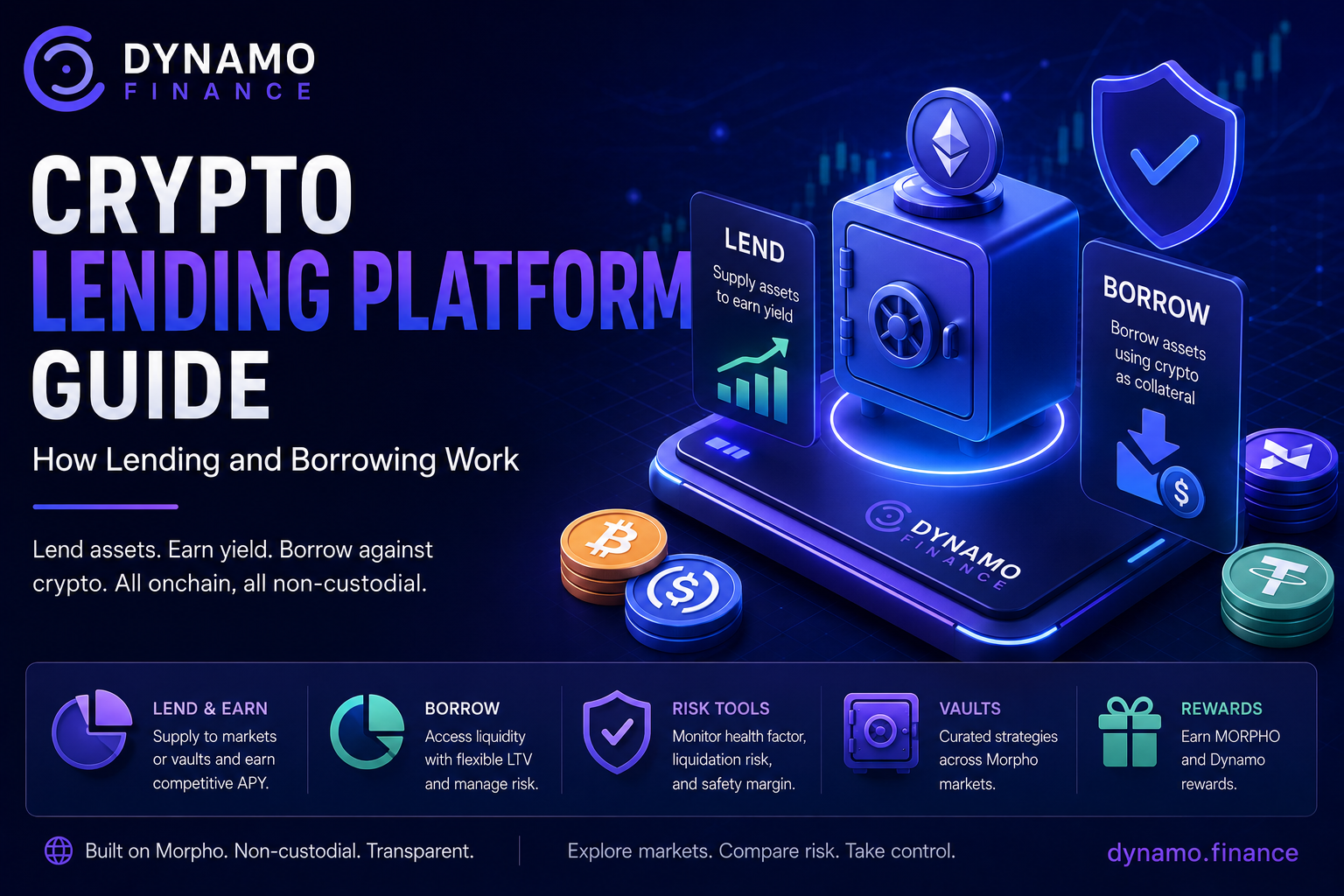
Crypto lending has become one of the most practical use cases in DeFi. Instead of letting assets sit idle, users can supply tokens to earn yield, borrow stablecoins against crypto collateral, or deposit into vaults that allocate capital across lending markets. The challenge is knowing how to separate a useful defi platform from a risky one.
The market is crowded. Some crypto lending platforms are centralized businesses that custody user assets. Others are non-custodial DeFi protocols where users interact directly with smart contracts. A third category sits in between: user-friendly interfaces that help users access onchain lending infrastructure while adding analytics, risk tools, vault discovery, and better position management.
A crypto lending platform is a service or protocol that lets users lend digital assets to earn yield or borrow assets by posting crypto as collateral. In DeFi, lending and borrowing are usually handled by smart contracts, with interest rates, collateral requirements, liquidations, and withdrawals governed by transparent onchain rules.
This guide explains how crypto lending platforms work, how lenders earn yield, how borrowers access liquidity, how DeFi lending differs from centralized lending, what risks matter most, and how Dynamo Finance helps users compare Morpho-based markets and vaults with clearer risk context.
Key Takeaways
- A crypto lending platform connects suppliers who want yield with borrowers who want liquidity against collateral.
- DeFi lending platforms use smart contracts, while centralized lending platforms rely on a company to custody assets and manage lending operations.
- Collateral, LTV, liquidation risk, utilization, liquidity, APY, smart contract risk, and oracle reliability are the core concepts every user should understand.
- Dynamo Finance is a non-custodial Web3 lending interface built on Morpho smart contracts, with markets, vaults, risk ratings, Safety Margin, Liquidation Risk views, rewards, and governance participation.
- The best crypto lending decision is not always the highest APY or the largest loan. It is the market, vault, or borrow position where the risk is clear and the trade-off is worth it.
What Is a Crypto Lending Platform?
A crypto lending platform lets digital asset holders supply capital, borrow assets, or do both. Lenders typically deposit assets such as stablecoins, ETH, BTC-backed tokens, or other supported crypto assets. Borrowers post collateral and borrow a loan asset, often a stablecoin.
In a traditional loan, a lender may assess credit history, income, employment, and repayment capacity. In crypto lending, loans are usually overcollateralized. That means the borrower must lock crypto worth more than the amount borrowed. If the collateral value falls too far, the position can be liquidated to protect lenders.
DeFi lending platforms use smart contracts to automate this process. Ethereum.org describes DeFi as financial products and services built on public blockchains, often enabling users to transact without a centralized intermediary through wallets and smart contracts. A broader overview is available from Ethereum.org’s DeFi guide.
For users, the practical benefit is access. Lenders can seek onchain yield. Borrowers can unlock liquidity without selling crypto. Both sides need to understand that DeFi lending is not the same as a bank account, a brokerage account, or a guaranteed fixed-income product.
How Crypto Lending Works
Crypto lending starts with two user groups: suppliers and borrowers. Suppliers provide the loan asset. Borrowers provide collateral and borrow from the available liquidity.
The process usually works like this:
- A lender supplies an asset into a lending market or vault.
- A borrower deposits collateral into a supported market.
- The borrower draws a loan asset, subject to collateral limits.
- Interest accrues on the borrowed amount.
- The lender earns yield from borrower-paid interest.
- If collateral value falls too much, the borrower can be liquidated.
- When the borrower repays the debt, collateral becomes withdrawable again.
This flow is simple, but the details matter. Each platform may use different market structures, risk parameters, collateral assets, rate models, fees, vault designs, and liquidation rules.
That is why users should never compare platforms by APY alone. The key question is not just “What can I earn?” It is “What risk am I taking to earn it?”
Why People Use Crypto Lending Platforms
Users generally come to crypto lending for two reasons: earning yield or accessing liquidity. Lenders want to put idle assets to work. Borrowers want to unlock value from holdings without selling them.
A long-term ETH holder, for example, may want stablecoin liquidity for expenses, trading, or portfolio management while keeping ETH exposure. A stablecoin holder may want to lend USDC or USDT to earn borrower-paid interest. A yield seeker may prefer a vault that allocates across multiple markets to avoid manual rebalancing.
Crypto lending platforms also support more advanced strategies. Traders may borrow to hedge, arbitrage, farm rewards, or rebalance portfolios. DAOs and treasuries may lend stablecoins to earn yield. Curators may create vaults for specific risk-return profiles.
Beginners should start with the basic use cases before exploring advanced strategies. Supplying stablecoins and borrowing conservatively against blue-chip collateral are easier to understand than complex leveraged loops or exotic vault strategies.
Centralized vs. Decentralized Crypto Lending Platforms
The first major distinction is centralized finance, often called CeFi, versus decentralized finance, or DeFi. Both can offer lending and borrowing, but they work very differently.
| Feature | Centralized Crypto Lending | DeFi Crypto Lending |
|---|---|---|
| Asset custody | A company typically holds or controls user assets | Users interact with smart contracts through wallets |
| Loan operations | Managed by the platform’s internal systems and policies | Governed by transparent smart contract rules |
| Transparency | Depends on company reporting and disclosures | Market data, positions, and contract activity can be visible onchain |
| User experience | Often simpler and account-based | Requires wallet use, transaction signing, and self-custody habits |
| Main risks | Custody, counterparty, insolvency, withdrawal freezes, and platform policy risk | Smart contract, oracle, liquidation, liquidity, governance, and user error risk |
Centralized lending can feel easier because users log into an account and let a company handle the back end. The trade-off is counterparty risk. Users depend on the company’s solvency, custody practices, risk controls, and withdrawal policies.
DeFi lending gives users more transparency and control, but it also demands more responsibility. A wallet transaction cannot usually be reversed. A liquidation is executed by smart contracts. A user who signs a malicious transaction or chooses a risky market may lose funds.
What Makes a Good Crypto Lending Platform?
A good lending platform should make the mechanics visible. Users should be able to understand what they are supplying, what collateral supports borrowing, how rates change, what fees apply, and how liquidation risk is calculated.
The strongest platforms do not hide risk behind simple APY numbers. They show utilization, available liquidity, collateral parameters, vault allocation, market history, and risk signals. They also help borrowers monitor liquidation risk instead of encouraging maximum leverage.
A useful platform should also make clear whether it is custodial or non-custodial. If users retain wallet control and funds are held in smart contracts, that is a different risk model from sending assets to a centralized company.
For DeFi users, the ideal platform combines transparency, usability, smart contract security, live market data, strong risk tooling, and a workflow that helps users make better decisions before signing transactions.
Where Dynamo Finance Fits
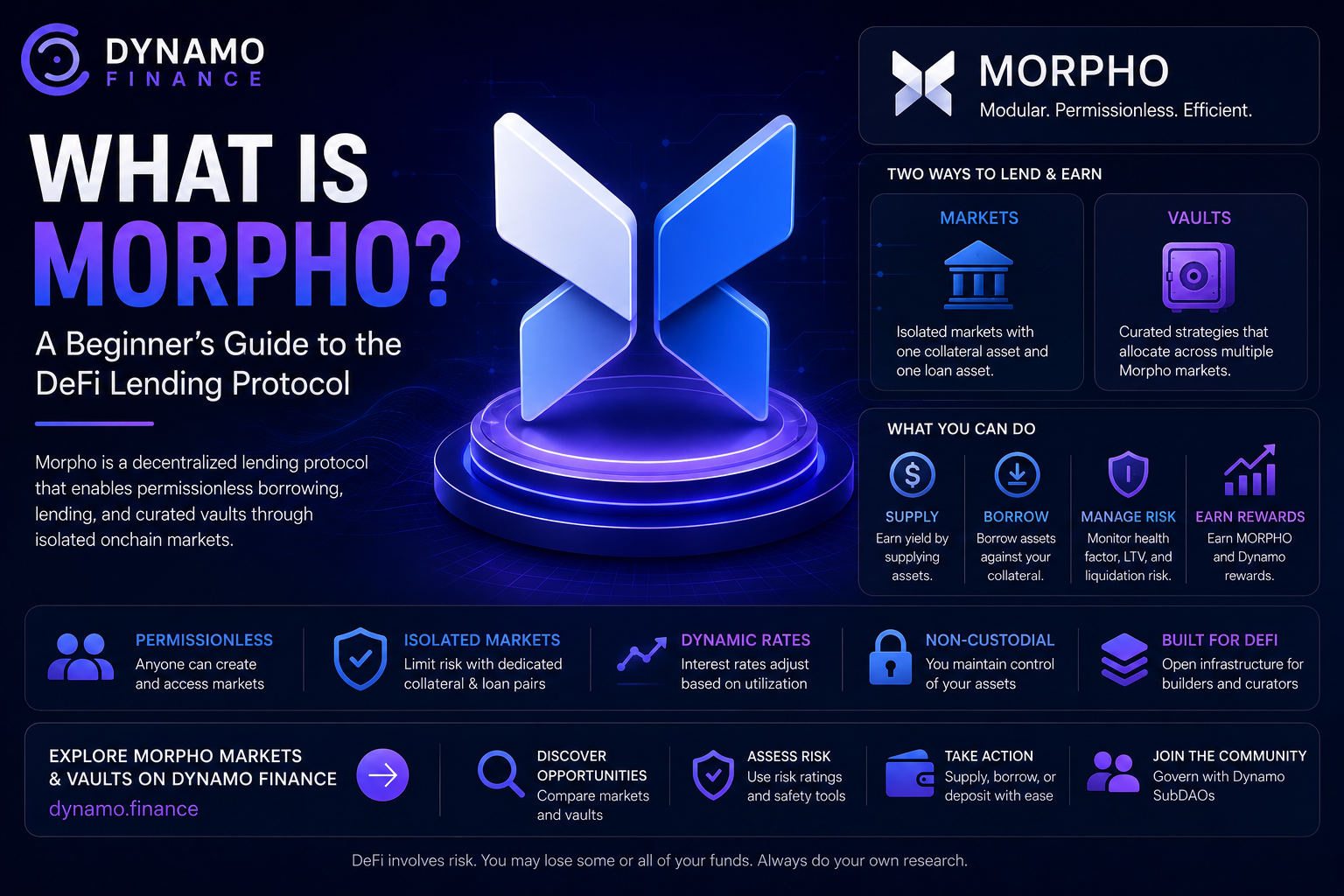
Dynamo Finance is a non-custodial, permissionless Web3 lending market built on Morpho smart contracts. It gives users access to markets, vaults, borrowing, lending, risk tools, rewards, and governance participation from one interface.
Dynamo does not custody user funds. Assets are held by Morpho smart contracts, while Dynamo adds a user-facing layer for discovery, analytics, position management, risk visibility, automation, rewards, and SubDAO governance participation.
This is important because Morpho’s lending infrastructure is powerful, but users still need a clear way to compare markets and vaults. Dynamo helps users evaluate APYs, utilization, liquidity, collateral, loan assets, risk tiers, and liquidation data before taking action.
For users comparing crypto lending platforms, Dynamo is most relevant if they want non-custodial DeFi access, Morpho-based markets, curated vaults, and risk-oriented tools instead of a simple custodial earn product.
How DeFi Lending Markets Work
A DeFi lending market is a pool where one asset can be supplied and borrowed against collateral. On Morpho-based markets, each market is isolated. That means one market has one loan asset, one collateral asset, one oracle, and one liquidation loan-to-value threshold.
This market isolation is useful because users know exactly what risk they are taking. A market that lends USDC against ETH collateral is separate from a market that lends USDC against another asset. A risk event in one market does not automatically affect another market.
Dynamo surfaces active Morpho markets in a filterable interface. Users can compare supply APY, borrow APY, utilization, available liquidity, collateral asset, loan asset, oracle, LLTV, and market verification status.
This matters because a lending market is not just a yield source. It is a risk container. The collateral, oracle, utilization, and liquidation threshold determine whether the market fits your strategy.
How Crypto Lending Rates Work
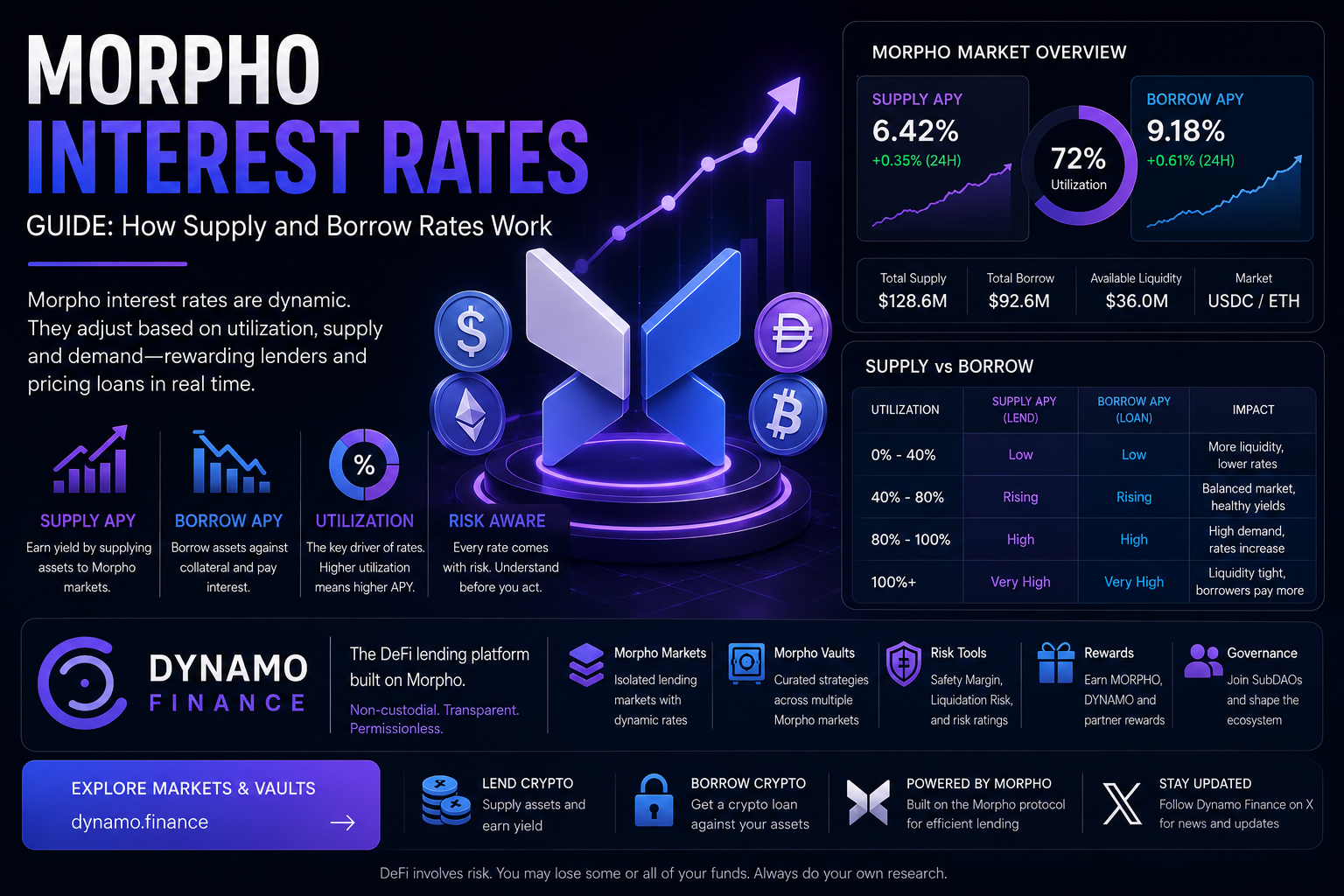
Most DeFi lending rates are variable. They change based on supply and demand. The core metric behind rate movement is utilization, which measures how much supplied liquidity is currently borrowed.
When utilization is low, borrow rates are usually cheaper and supplier APY is usually lower. When utilization rises, borrow rates increase, and suppliers may earn more because more capital is being used by borrowers.
This self-balancing rate design is common across DeFi lending. Morpho’s interest-rate materials describe utilization as a key input that determines borrow rates in each market through an interest rate model. More technical readers can review Morpho’s interest rate documentation.
For lenders, high utilization can be attractive because it often increases supply APY. It can also mean less immediately available liquidity for withdrawals. For borrowers, high utilization can mean higher borrowing costs and faster debt growth.
Supply APY, Borrow APY, and Utilization
Crypto lending platforms often show several rate metrics. Understanding the difference can prevent costly mistakes.
| Metric | Meaning | Why It Matters |
|---|---|---|
| Supply APY | The annualized yield earned by suppliers | Shows current lender return, but it can change as utilization changes |
| Borrow APY | The annualized cost paid by borrowers | Shows loan cost and affects how quickly debt grows |
| Utilization | The share of supplied assets currently borrowed | High utilization can improve yield but reduce available liquidity |
| Available liquidity | Capital available for withdrawals or new borrowing | Important for users who may need to exit quickly |
| LLTV | Liquidation loan-to-value threshold | Defines when a borrow position can become eligible for liquidation |
A high supply APY is not automatically good. It may reflect healthy demand, but it may also reflect tight liquidity, riskier collateral, or short-term incentives.
A low borrow APY is not automatically safe. Borrowers can still be liquidated if collateral falls or if debt grows over time. Rates and liquidation risk should always be evaluated together.
How Borrowing Against Crypto Works
Borrowing against crypto lets users unlock liquidity without selling their assets. A user deposits collateral, borrows a loan asset, and repays later to recover the collateral.
This can be useful for users who believe in long-term asset appreciation but need short-term liquidity. It can also help users avoid selling during unfavorable market conditions. Still, it introduces liquidation risk.
If collateral value falls or debt increases enough, the position can become undercollateralized. Smart contracts can allow liquidators to repay part of the loan and receive collateral at a discount. Aave’s help center explains a similar health-factor and liquidation concept in its own lending system, which is useful background for users comparing DeFi lending protocols. See Aave’s liquidation explainer.
Borrowers using crypto loans should think conservatively. The question is not how much the platform allows you to borrow. The question is how much you can borrow while surviving volatility.
Understanding Collateral and LTV
Collateral is the asset a borrower deposits to secure a loan. LTV, or loan-to-value, measures the borrowed amount relative to the value of collateral. If a user posts $10,000 of collateral and borrows $5,000, the LTV is 50%.
LLTV, or liquidation loan-to-value, defines the point where the position can be liquidated. More volatile collateral usually supports lower borrowing capacity because its price can move quickly.
Dynamo’s Safety Margin feature is designed for this exact issue. Morpho uses LLTV at the contract level, while Dynamo lets users set a more conservative synthetic LTV so they borrow below the liquidation threshold. This creates a configurable buffer between the current position and the danger zone.
For borrowers, that buffer can be the difference between managing volatility and losing collateral. A conservative LTV gives users time to repay debt, add collateral, or reduce risk before liquidation becomes likely.
What Happens During Liquidation?
Liquidation is the mechanism that protects lenders when a borrower’s collateral no longer safely backs the debt. A liquidator repays part of the borrower’s debt and receives some collateral at a discount.
This process is automatic in DeFi lending. There is no collections department and no manual negotiation. Smart contracts determine when a position becomes eligible for liquidation based on the market’s parameters.
Liquidation can be painful because it often happens during market stress, when collateral prices are falling. A borrower may lose part of the collateral and still have a remaining position to manage.
To reduce risk, borrowers should monitor health factor, liquidation price, borrow APY, collateral volatility, and price-drop tolerance. Dynamo’s Liquidation Risk view helps users see how far collateral can fall before a position becomes liquidatable.
How Lenders Earn Yield
Lenders earn yield from borrower-paid interest. When borrowers take loans from a market, interest accrues on their debt. Suppliers receive that interest based on their share of supplied liquidity and the market’s rate model.
Yield may also include rewards. Some DeFi platforms offer token incentives, curator rewards, or campaign-based boosts. These can improve total returns, but they should be separated from base lending yield.
Base lending yield comes from borrowers paying interest. Rewards may be temporary. A market with strong organic borrower demand may offer more durable yield than a market driven mostly by incentives.
Users evaluating crypto currency loans from the lender side should always ask who is paying the yield, what collateral backs the borrowing, and how quickly liquidity can be withdrawn.
How Vaults Work on Crypto Lending Platforms
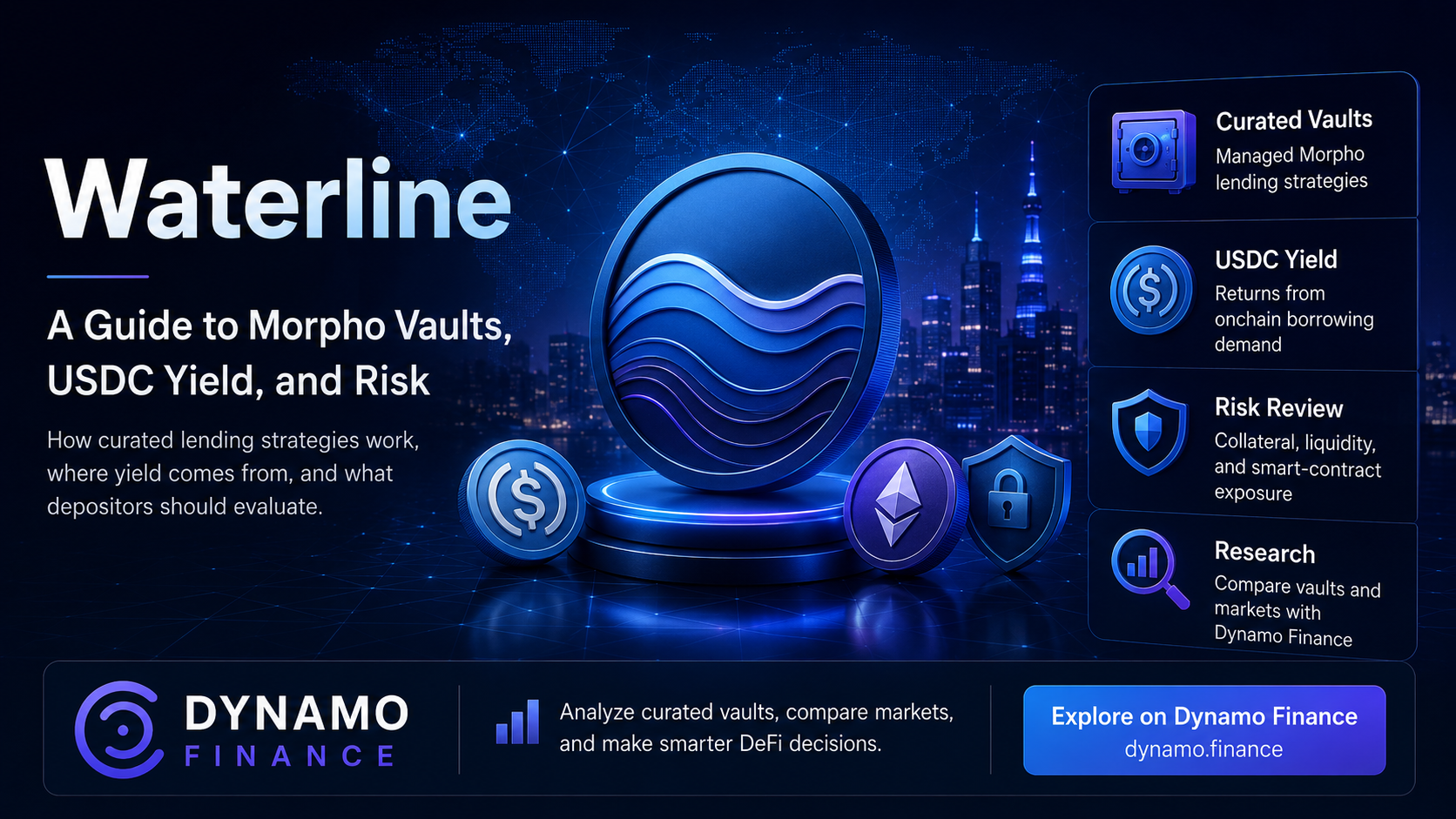
Vaults simplify lending by pooling deposits and allocating them across markets. Instead of choosing one market manually, users deposit into a vault and receive shares representing their position.
A curator or strategy manager decides where the vault allocates capital. If one market becomes less attractive, the vault may rebalance to another market with better risk-adjusted yield. This can reduce manual work for users.
Morpho vaults are designed to make isolated market lending easier by aggregating liquidity across markets. Morpho’s vault overview explains how vaults can combine isolated market flexibility with a simpler lending experience. See Morpho’s vault guide.
Users interested in morpho vault exposure should evaluate curator reputation, market allocation, APY stability, TVL, fees, and withdrawal liquidity before depositing.
Markets vs. Vaults: Which Is Better?
Markets and vaults serve different user needs. Direct markets offer precision. Vaults offer convenience.
| Feature | Direct Lending Market | Curated Vault |
|---|---|---|
| User control | High control over exact market selection | Curator controls allocation strategy |
| Risk exposure | Specific collateral and loan asset pair | Blended exposure across selected markets |
| Effort required | More manual research and monitoring | Less manual management after deposit |
| APY behavior | Driven by one market’s utilization | Blended APY across multiple allocations |
| Best fit | Advanced users who want precision | Users who want curated lending exposure |
Direct markets are useful if you want to choose exact collateral exposure. Vaults can be better if you want a strategy that adapts as rates change.
Neither choice removes risk. Markets require careful selection. Vaults require trust in curator process and allocation quality.
Dynamo Markets: Direct Access to Morpho-Based Lending
Dynamo markets let users access isolated Morpho lending markets through a more user-friendly interface. Each market is dedicated to one loan asset and one collateral asset.
Suppliers can compare supply APY, utilization, available liquidity, and collateral. Borrowers can compare borrow APY, LLTV, oracle, liquidity, and liquidation risk. This makes Dynamo useful for users who want more context than a simple earn page provides.
Because each market operates independently, users can choose exposure more precisely. A conservative user may prefer larger markets with established collateral and moderate utilization. A more advanced user may evaluate higher-yield markets with more specialized collateral.
This is where morpho crypto becomes practical. The user is not just reading about a protocol; they are comparing live lending opportunities with risk data attached.
Dynamo Vaults: Curated Yield Without Manual Rebalancing
Dynamo vaults are built on the MetaMorpho standard. Users deposit into a vault, receive vault shares, and let the curator allocate capital across Morpho markets.
Vaults can help users earn blended yield without manually rotating across markets. A curator may allocate to markets with better risk-adjusted APY and rebalance as utilization changes.
Dynamo surfaces vault information such as curator, APY, TVL, underlying asset, market allocation, and risk tier. This helps users compare vaults by more than headline yield.
For users who want to explore vault opportunities, the Dynamo risk dashboard is useful for comparing market and vault risk signals before depositing.
Dynamo Risk Ratings
Dynamo assigns Low, Medium, and High risk tiers to markets and vaults using objective onchain inputs. For markets, the framework considers variables such as LLTV, market TVL, and how long a market has been live. For vaults, it considers total supplied value, market exposure, and live history.
Risk ratings are not guarantees. A Low-risk market can still experience smart contract bugs, oracle issues, extreme collateral moves, or liquidity stress. But risk tiers help users avoid relying only on APY.
This feature is especially useful for beginners. A new user may not know how to interpret every market parameter immediately. A clear risk tier can act as a first filter, followed by deeper market review.
Users should treat ratings as a starting point, not the final decision. Always review the underlying collateral, liquidity, utilization, and market details.
Safety Margin and Liquidation Risk
Borrowing is where risk can accelerate quickly. A borrower who takes too much debt can become vulnerable to normal market volatility.
Dynamo’s Safety Margin helps users borrow more conservatively than Morpho’s LLTV. Instead of pushing a position close to the liquidation threshold, users can set a target buffer so their borrow amount stays below a safer effective LTV.
Dynamo’s Liquidation Risk view shows health factor, price-drop tolerance, and liquidation price for open borrow positions. These metrics translate abstract collateral risk into practical numbers.
For anyone comparing de.fi crypto borrowing options, these tools matter. A good interface should help users avoid liquidation, not merely maximize borrowing power.
Key Risks of Crypto Lending Platforms
Crypto lending can be useful, but it carries real risks. Users should understand the risk stack before supplying or borrowing.
- Smart contract risk: Bugs or vulnerabilities can cause losses in DeFi systems.
- Oracle risk: Incorrect or manipulated price feeds can distort collateral values.
- Liquidation risk: Borrowers can lose collateral if LTV rises too high.
- Liquidity risk: Suppliers may face withdrawal delays when utilization is high.
- Collateral risk: Borrower collateral can become volatile, illiquid, or difficult to price.
- Counterparty risk: Centralized lending platforms can expose users to company solvency and custody risk.
- Curator risk: Vault performance depends on strategy design and market allocation.
- Governance risk: Protocol parameters, incentives, and market policies can change.
- User error risk: Using fake sites, wrong networks, or misunderstood transactions can cause irreversible losses.
Good platforms make these risks easier to see. They do not eliminate them.
How to Evaluate a Crypto Lending Platform
Before using any crypto lending platform, evaluate how the product works. A polished interface is not enough. The underlying mechanics decide the risk.
- Confirm whether the platform is custodial or non-custodial.
- Identify the assets supported for lending and borrowing.
- Review how interest rates are calculated and whether they are fixed or variable.
- Check collateral requirements, LTV, LLTV, and liquidation rules.
- Inspect available liquidity and utilization.
- Review market or vault-level risk data.
- Understand fees, rewards, and incentive campaigns.
- Check security history, audits, and smart contract dependencies.
- Start small and test deposits, withdrawals, borrowing, and repayment.
- Monitor positions after entry because rates, liquidity, and collateral prices can change.
This checklist is simple, but it can prevent many common mistakes. Most bad lending decisions come from misunderstanding the mechanism behind the yield or loan.
How to Evaluate Lending APY
APY is useful, but it should never be the only metric. A high APY may come from strong borrower demand. It may also come from high utilization, risky collateral, temporary rewards, or low liquidity.
Start by separating base APY from rewards. Base APY comes from borrowers paying interest. Rewards may come from token emissions, curator campaigns, or platform incentives. Both can matter, but they are not equally durable.
Next, check utilization. High utilization often means higher supplier yield, but it can reduce available liquidity for withdrawals. A moderate APY with healthier liquidity may be better for users who need flexibility.
Finally, review collateral. A high-yield market backed by weak collateral may not be worth the extra return. Yield should compensate for risk, not distract from it.
How to Evaluate Borrowing Costs
Borrowers should look beyond the displayed borrow APY. Rate, liquidation risk, collateral volatility, and repayment plan all matter.
A low borrow APY can be attractive, but it can change if the market uses variable rates. If utilization rises, borrow costs can increase. Interest accrual also increases debt over time.
Borrowers should calculate a conservative target LTV before borrowing. They should know their liquidation price, price-drop tolerance, and response plan. That plan might include repaying debt, adding collateral, or reducing exposure.
Users who want crypto backed loans should prioritize survival over maximum borrowing. A smaller loan with a wider collateral buffer is often more useful than an aggressive loan that becomes stressful during volatility.
How to Compare Crypto Lending Platforms
Comparison should start with custody. A non-custodial platform gives users more control but requires wallet discipline. A custodial platform may be simpler, but it introduces counterparty risk.
Next, compare market structure. Does the platform use isolated markets, pooled lending, curated vaults, or centralized loan books? Each model has different risk assumptions.
Then compare data quality. Can users see utilization, liquidity, APY history, collateral, oracle, LLTV, and vault allocations? If the platform hides these details, users must trust more and verify less.
Finally, compare risk tools. Strong crypto lending platforms help users understand liquidation risk, market risk, and withdrawal liquidity. Weak platforms focus only on yield or borrowing limits.
Practical Example: Lending USDC
Imagine a user holds USDC and wants yield. They compare two DeFi markets. One offers 4% supply APY with moderate utilization and deep liquidity. Another offers 10% supply APY with high utilization and newer collateral.
A beginner may choose the 10% APY immediately. A more experienced user asks why the APY is higher. Is borrower demand strong and is liquidity tight? Is the collateral volatile? Are rewards temporarily boosting yield?
The higher-yield market may still be useful, but it may deserve a smaller allocation. The lower-yield market may fit capital that needs easier withdrawal access.
This is how risk-adjusted lending works. The best decision depends on the role the capital plays in the portfolio.
Practical Example: Borrowing Against ETH
Now imagine a user holds ETH and wants stablecoin liquidity without selling. They post ETH as collateral and borrow USDC.
If ETH rises, the position becomes safer, but If ETH falls, LTV rises. If the position gets too close to the liquidation threshold, the borrower may need to repay debt or add collateral.
A disciplined borrower starts with a moderate LTV rather than borrowing the maximum. They also track borrow APY, liquidation price, and health factor.
Dynamo’s Safety Margin and Liquidation Risk tools are built for this workflow. They help borrowers see whether the position has enough room to survive price movement.
Practical Example: Choosing a Vault
A user who does not want to pick markets manually may choose a vault. They deposit USDC into a curated strategy that allocates across multiple markets.
The vault may show a blended APY. The user should review curator, TVL, fees, market allocation, APY stability, and risk rating. A vault with diversified exposure may suit a passive strategy. A concentrated high-yield vault may require more monitoring.
Vaults are convenient because they reduce manual rebalancing. They are not risk-free because the underlying markets still carry collateral, liquidity, oracle, and liquidation risk.
A good vault decision starts with understanding what the vault owns.
Common Mistakes Beginners Make
The first mistake is treating crypto lending like a bank savings account. DeFi lending is an onchain financial activity with smart contract, collateral, liquidity, and market risk.
The second mistake is chasing the highest APY. High returns can reflect higher risk, temporary incentives, or low liquidity.
The third mistake is borrowing too aggressively. A loan that starts near liquidation can become dangerous after a normal market move.
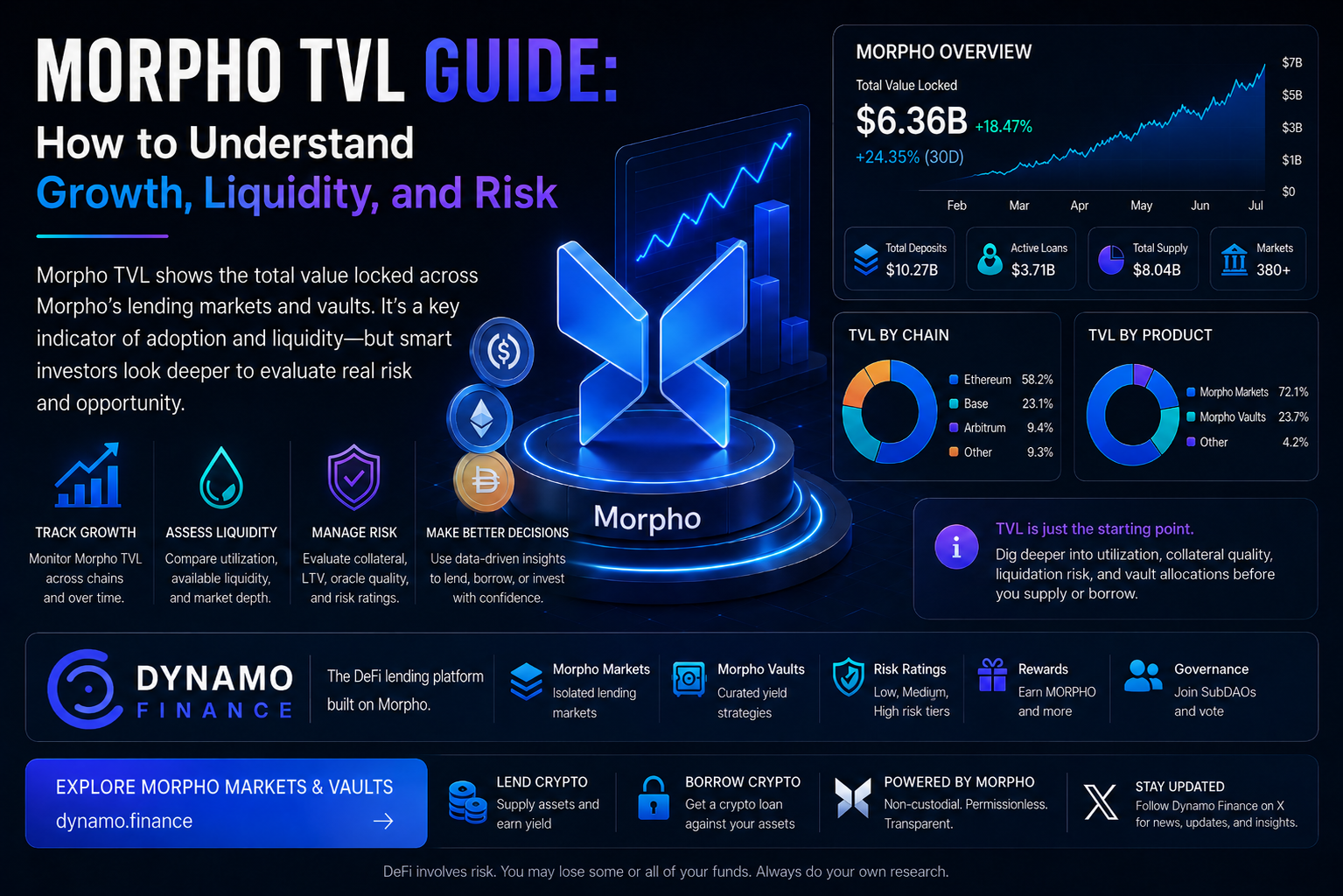
The fourth mistake is ignoring withdrawal liquidity. A market can have high TVL but limited available liquidity if utilization is high.
The fifth mistake is using unofficial links or fake apps. Always verify the URL and contract interaction before signing a transaction.
What Experienced Users Look For
Experienced users start with the mechanism. They want to know where yield comes from, who pays it, what collateral backs it, and how exits work.
They also compare risk-adjusted yield. A moderate APY from a deep, conservative market can be better than a high APY from a thin, volatile market.
Borrowers focus on buffers. They use conservative LTVs, track health factor, and prepare a liquidation-response plan before they borrow.
Vault users evaluate curators. They review allocation diversity, fees, APY history, and underlying market risk. A vault is a strategy, not just a number.
Why Non-Custodial Lending Matters
Non-custodial lending means users interact with smart contracts directly from their wallet. The platform does not hold user funds in a traditional company-controlled account.
This can reduce custody and counterparty risk, but it does not remove all risk. Users still face smart contract risk, oracle risk, liquidation risk, and user error risk.
The biggest advantage is transparency and control. Users can see onchain positions, verify smart contract interactions, and withdraw according to protocol rules and available liquidity.
The biggest responsibility is self-custody. Users must protect their wallets, verify transactions, and understand the markets they enter.
Where Regulation and Tax Fit In
Crypto lending can create legal, regulatory, and tax questions. Treatment varies by jurisdiction, product design, custody model, and user activity.
Borrowing against crypto may have different tax implications from selling crypto, but users should not assume every action is tax-neutral. Collateral transfers, liquidations, interest, rewards, and repayments can matter.
Regulatory treatment may also differ between centralized lending, DeFi protocols, stablecoin products, and tokenized assets. Access may depend on jurisdiction and platform policy.
Users should keep records and consult qualified professionals for tax or legal advice. A good DeFi strategy includes operational discipline, not just market analysis.
How to Start Using a Crypto Lending Platform Safely
Start with education before capital. Learn the difference between supplying, borrowing, vault deposits, collateral, LTV, LLTV, utilization, and liquidation.
Next, choose a small test amount. Use it to understand deposits, approvals, withdrawals, borrowing, repayment, and dashboard monitoring. Testing the full workflow is more valuable than rushing into a large position.
Then build a monitoring routine. Check APY, utilization, collateral prices, liquidation risk, and available liquidity after entering a position.
For Dynamo users, the Dynamo Finance DeFi lending docs provide a structured way to learn markets, vaults, interest rates, collateral, liquidations, risk ratings, rewards, fees, and position management.
External Resources for Further Research
For DeFi basics, Ethereum.org’s DeFi overview is a useful starting point. As for Morpho-specific lending mechanics, review Morpho’s interest-rate documentation and Morpho’s vault overview. For general liquidation concepts in a major DeFi lending protocol, Aave’s liquidation guide is also useful.
Academic work on DeFi lending shows why risk monitoring matters. The Bank for International Settlements published research on DeFi leverage and lending-platform dynamics, which is helpful context for users who want a deeper risk perspective. See the BIS working paper on DeFi leverage.
For Dynamo product updates, feature announcements, and market context, follow Follow Dynamo Finance on X.
Final Checklist Before Lending or Borrowing
Use this checklist before using any crypto lending platform:
- Confirm whether the platform is custodial or non-custodial.
- Verify the official website and avoid fake links.
- Identify whether you are using a direct market, vault, or borrow position.
- Review the supplied asset, borrowed asset, and collateral asset.
- Check supply APY, borrow APY, utilization, and available liquidity.
- Review LTV, LLTV, health factor, and liquidation price before borrowing.
- Understand fees, rewards, and whether APY includes incentives.
- Evaluate smart contract, oracle, liquidity, collateral, and curator risk.
- Start with a small position and test the full workflow.
- Monitor positions regularly because rates and collateral values change.
Conclusion
A crypto lending platform can help users earn yield, access liquidity, and participate in onchain credit markets. The value is real, but so are the risks. Lending platforms are not all the same, and users should compare custody model, transparency, collateral rules, rates, liquidity, vault design, and risk tools before allocating capital.
Dynamo Finance brings a risk-aware DeFi lending workflow to Morpho-based markets and vaults. Users can supply assets, borrow against collateral, deposit into curated vaults, compare APYs, review utilization, inspect risk ratings, use Safety Margin, monitor Liquidation Risk, earn rewards, and participate in governance from one non-custodial interface.
Explore Dynamo Finance to compare Morpho markets and vaults, review risk data, and build a more disciplined approach to crypto lending, borrowing, and yield.
FAQ
What is a crypto lending platform?
A crypto lending platform lets users lend digital assets to earn yield or borrow assets by posting crypto as collateral. DeFi lending platforms usually use smart contracts to manage rates, collateral, liquidations, and withdrawals.
How do crypto lending platforms make money for lenders?
Lenders earn yield from borrower-paid interest. In some cases, they may also receive token rewards or platform incentives. Users should separate base lending APY from temporary rewards before comparing returns.
Are crypto lending platforms safe?
No crypto lending platform is risk-free. Risks include smart contract bugs, oracle failures, liquidation, liquidity constraints, collateral volatility, counterparty risk, regulatory changes, and user error. Non-custodial platforms reduce custody risk but still carry DeFi risks.
What is the difference between a crypto loan and a bank loan?
A crypto loan is usually collateral-based. Borrowers lock crypto assets and borrow against them, often without traditional credit underwriting. A bank loan may rely on credit scores, income, legal contracts, and offchain enforcement.
How does Dynamo Finance compare with other crypto lending platforms?
Dynamo Finance is a non-custodial DeFi lending interface built on Morpho smart contracts. It focuses on Morpho markets, vaults, APY comparison, risk ratings, Safety Margin, Liquidation Risk tools, rewards, and governance participation.