
When DeFi investors compare lending protocols, one number usually gets attention first: TVL. Total value locked can make a protocol look dominant, fast-growing, or battle-tested. But Morpho TVL is more nuanced than a single headline number, especially because Morpho combines isolated lending markets, curated vaults, multi-chain deployments, active loans, deposits, and market-level liquidity.
That nuance matters. A high TVL can signal stronger liquidity and market adoption, but it does not automatically mean lower risk, better yield, or safer borrowing. A smaller market with conservative collateral may be safer than a large market with high utilization and thin available liquidity. A vault with high TVL may be well-established, but its actual risk depends on allocation, collateral, curator decisions, fees, and withdrawal liquidity.
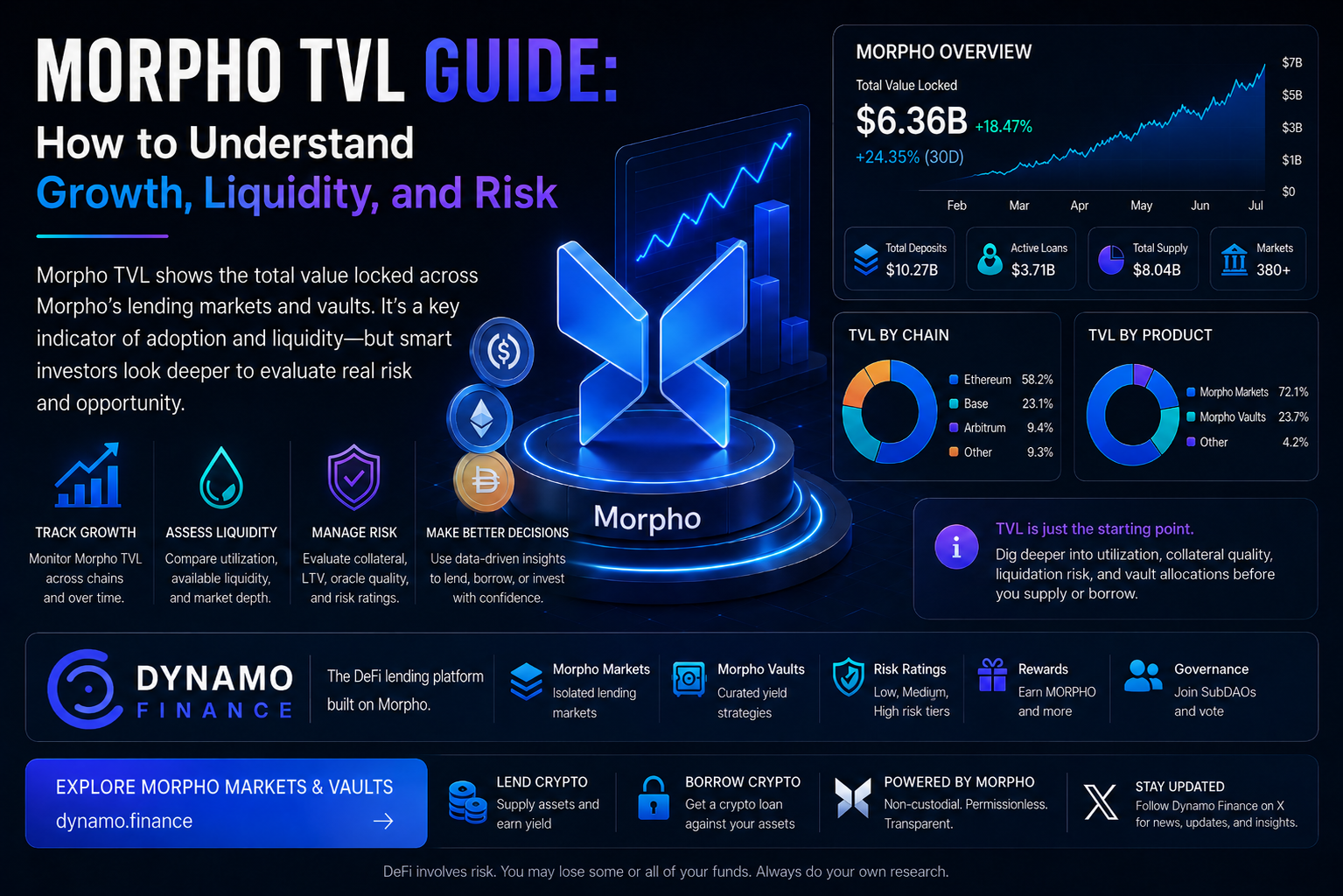
Morpho TVL refers to the total value locked across Morpho’s lending infrastructure, including assets supplied into Morpho markets and vaults. It is a useful adoption and liquidity signal, but investors should interpret it alongside active loans, available liquidity, utilization, collateral quality, chain distribution, vault allocation, and risk parameters.
This guide explains what Morpho TVL means, why different dashboards may report different numbers, how TVL relates to liquidity and risk, and how DeFi investors can use Dynamo Finance to compare Morpho-based markets and vaults with more context before supplying, borrowing, or depositing into yield strategies.
Key Takeaways
- Morpho TVL is a helpful measure of protocol adoption, but it should not be treated as a complete risk score.
- Different data sources may report different Morpho TVL figures because they define deposits, supply, active loans, and locked value differently.
- For lenders, TVL should be compared with utilization, available liquidity, collateral quality, vault allocation, and curator reputation.
- For borrowers, TVL matters because deep markets can support larger loans, but liquidation thresholds, borrow APY, and collateral volatility still matter more than headline size.
- Dynamo Finance helps users evaluate Morpho-based lending opportunities with market data, vault views, risk ratings, Safety Margin, Liquidation Risk tools, rewards, and non-custodial access.
What Does TVL Mean in DeFi?
TVL stands for total value locked. In DeFi, it usually measures the dollar value of assets deposited into a protocol, smart contract, market, or vault. If users deposit USDC, ETH, WBTC, or other assets into a lending protocol, those assets contribute to TVL depending on how the analytics provider defines and counts them.
TVL became popular because it gives a quick view of scale. A protocol with billions of dollars deposited has attracted meaningful user capital. A market with very low TVL may be newer, more experimental, or less liquid.
However, TVL is not the same as safety. It does not tell you whether a protocol has strong oracle design, conservative liquidation thresholds, healthy utilization, diversified collateral, or good curator decisions. It also does not tell you whether the capital is sticky or incentive-driven.
The best way to use TVL is as a starting point. It tells you where capital is sitting. It does not tell you whether you should join it.
What Is Morpho TVL?
Morpho TVL measures the value deposited across Morpho’s lending ecosystem. That ecosystem includes isolated markets, Morpho vaults, assets under curation, active loans, and deployments across multiple chains.
DefiLlama, which tracks Morpho protocol metrics across many chains and categories, lists Morpho combined TVL at about above $10 billion, with Ethereum and Base representing the largest chain allocations.
Those numbers are close, but not identical. This is normal. TVL dashboards can differ because they decide how to treat supplied assets, borrowed assets, vault deposits, chain deployments, double counting, protocol versions, and combined protocol categories.
For investors, the exact number matters less than the interpretation. Morpho has meaningful liquidity across its ecosystem, but smart users still need to evaluate the specific market or vault they are entering.
Why Morpho TVL Is Not One Simple Number
Morpho is not a single pooled lending market. It is a modular lending system. That means TVL can be discussed at several levels: protocol-level TVL, chain-level TVL, vault-level TVL, market-level supply, active loans, and available liquidity.
This is why two users can both talk about Morpho TVL and mean different things. One may mean total protocol deposits. Another may mean a specific USDC vault’s TVL. Another may mean liquidity inside a single ETH-backed borrowing market.
Understanding the layer matters because risk lives at the market and vault level. A high protocol TVL does not automatically make every individual market safe. A small market may still be reasonable if it has conservative parameters and high-quality collateral. A large market may still be risky if utilization is high or collateral quality is weak.
The correct question is not only “How big is Morpho?” It is “How much liquidity is available in the specific market or vault I want to use, and what risks support that liquidity?”
How Morpho’s Architecture Affects TVL
Morpho’s structure is different from traditional pooled lending protocols. Instead of one large pool with many assets sharing risk, Morpho uses isolated markets. Each market is defined by a loan asset, collateral asset, oracle, interest-rate model, and liquidation loan-to-value threshold.
Morpho vaults sit on top of this market layer. A vault can accept one deposit asset and allocate it across multiple Morpho markets. This can simplify lending for users who do not want to choose markets manually.
Morpho describes this as a way to combine the efficiency and flexibility of isolated markets with a simpler vault-based user experience. At the base layer, Morpho provides isolated markets; above that, Morpho vaults aggregate liquidity and make lending into multiple isolated markets easier for users.
This architecture affects how TVL should be read. TVL can sit in individual markets or in vaults that allocate across markets. A vault’s TVL may look simple, but the underlying allocation determines the actual exposure.
Morpho TVL vs. Total Deposits vs. Active Loans
One of the most important beginner lessons is that TVL is not the only useful metric. Morpho’s own data separates total deposits, active loans, total value locked, and total supply. These metrics answer different questions.
| Metric | What It Measures | Why It Matters |
|---|---|---|
| Total deposits | The broad amount of assets deposited into Morpho-related infrastructure | Shows overall capital inflow and protocol adoption |
| Total value locked | The value considered locked in the protocol under a specific dashboard’s methodology | Useful for protocol-level comparison, but methodology can vary |
| Total supply | The assets supplied and available in lending contexts | Helps lenders and borrowers understand the capital base |
| Active loans | The value currently borrowed from markets | Shows borrower demand and helps interpret utilization |
| Available liquidity | The portion of supplied assets not currently borrowed | Important for withdrawals and new borrowing capacity |
These metrics should be read together. A protocol can have large deposits but also high active loans. That can be positive because capital is being used, but it can also reduce immediately available liquidity for withdrawals.
For lenders, available liquidity and utilization often matter more than protocol-level TVL. For borrowers, market depth and collateral-specific borrowing capacity matter more than global deposits.
Why Morpho TVL Growth Matters
TVL growth can be a positive signal. It may show that users, vault curators, institutions, and DeFi integrations are choosing Morpho for lending and borrowing. It may also indicate deeper liquidity, more market options, stronger network effects, and more confidence in the protocol’s architecture.
For yield seekers, higher TVL can make vaults and markets more attractive because larger pools may support more borrower demand and more consistent lending activity.
For the broader DeFi ecosystem, Morpho TVL growth also matters because it shows demand for modular lending infrastructure. Instead of relying only on large pooled protocols, users are increasingly comfortable with isolated markets and curated vaults.
Still, growth should be evaluated carefully. TVL can rise because of sustainable demand, but it can also rise because of incentives, temporary campaigns, market speculation, new integrations, or short-term yield opportunities.
What High Morpho TVL Does and Does Not Tell You
High TVL can tell you that a protocol has attracted capital. It can suggest stronger liquidity, more adoption, more curator interest, and more market activity. It can also help identify which chains or assets are drawing the most attention.
But high TVL does not tell you everything. It does not guarantee smart contract safety and that a specific market has enough available liquidity. It does not guarantee that vault allocations are diversified and that borrowers are safe from liquidation.
Think of TVL as a popularity and scale signal, not a complete underwriting report. It helps you decide where to look. It does not replace market analysis.
This is why morpho tvl should always be studied alongside market-level data, especially for users who plan to supply assets, borrow against collateral, or deposit into vaults.
How Chain Distribution Affects Morpho TVL
Morpho is deployed across multiple chains, and TVL is not evenly distributed. DefiLlama’s Morpho page shows Ethereum and Base as the largest chain contributors to combined Morpho TVL at the time of writing, followed by smaller allocations across newer or more specialized networks.
Chain distribution matters because each chain has different liquidity, users, assets, bridges, oracles, execution environments, and risk profiles. Ethereum may offer deep liquidity and mature infrastructure. Base may provide a strong consumer and Coinbase-linked ecosystem. Smaller chains may offer newer opportunities but less battle-tested liquidity.
A vault or market on one chain should not be evaluated exactly the same way as a vault or market on another chain. Gas costs, bridge assumptions, oracle depth, liquidator activity, and market participants can differ.
For investors, chain-level TVL is useful because it shows where capital is concentrated. But you still need to inspect the exact market or vault before entering.
How TVL Affects Lenders
For lenders, TVL can indicate how established a market or vault is. A vault with larger TVL may have more history, more users, and more curator attention. A market with larger supply may support more borrower activity and potentially deeper liquidity.
However, lenders should not supply assets based only on TVL. The more important questions are: What asset am I lending? What collateral backs the borrowing? How high is utilization? How much liquidity is available for withdrawal? What oracle determines collateral value? What is the market’s LLTV?
Dynamo’s market views are designed for exactly this type of analysis. A lending market on Dynamo is dedicated to one collateral asset and one loan asset; suppliers earn interest paid by borrowers, and each market operates independently.
This market-level structure helps lenders identify what they are actually exposed to instead of relying on protocol-level TVL alone.
How TVL Affects Borrowers
For borrowers, TVL matters because deep markets may support larger loans and smoother borrowing. If a market has limited available liquidity, a borrower may not be able to borrow the desired amount or may face higher rates as utilization increases.
But borrowers should care even more about collateral risk, LTV, LLTV, borrow APY, and liquidation price. A large market can still liquidate an overextended borrower if collateral falls sharply.
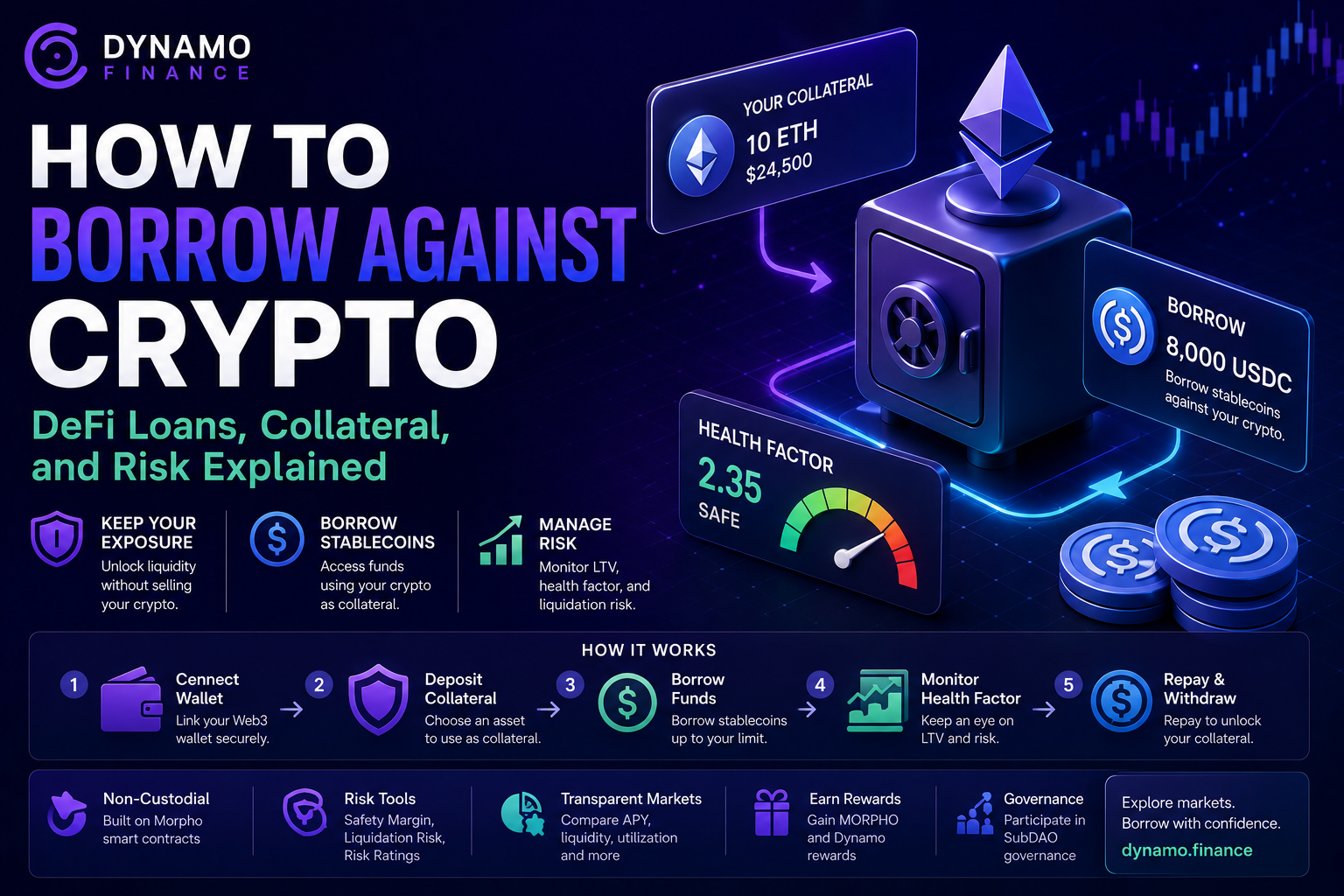
Crypto backed loans are useful when a user wants liquidity without selling assets. But it creates an active risk position. Borrowers need to monitor collateral value, debt growth, and liquidation thresholds.
That is why Dynamo’s borrower tools matter. Safety Margin gives users a more conservative target LTV than the liquidation threshold, while Liquidation Risk views show how far collateral can fall before liquidation becomes likely.
How TVL Affects Vault Users
Vault users should read TVL differently from direct market users. A vault’s TVL shows how much capital has been deposited into that curated strategy. Larger TVL may indicate stronger adoption or more confidence in the curator. But it does not tell you where the vault allocates capital.
A vault on Dynamo is a managed strategy that allocates deposits across lending markets to pursue risk-adjusted yield. Vaults are built on the MetaMorpho standard, and current allocations, market weights, and performance data are visible onchain.
When evaluating a vault, compare TVL with market diversity, APY stability, performance fees, curator reputation, and underlying risk. A vault concentrated in a single market can behave very differently from a diversified vault, even if both have similar TVL.
Vault TVL is useful, but allocation is more important. A vault’s risk comes from what it owns, not just how much it owns.
How Dynamo Finance Helps Users Interpret Morpho TVL
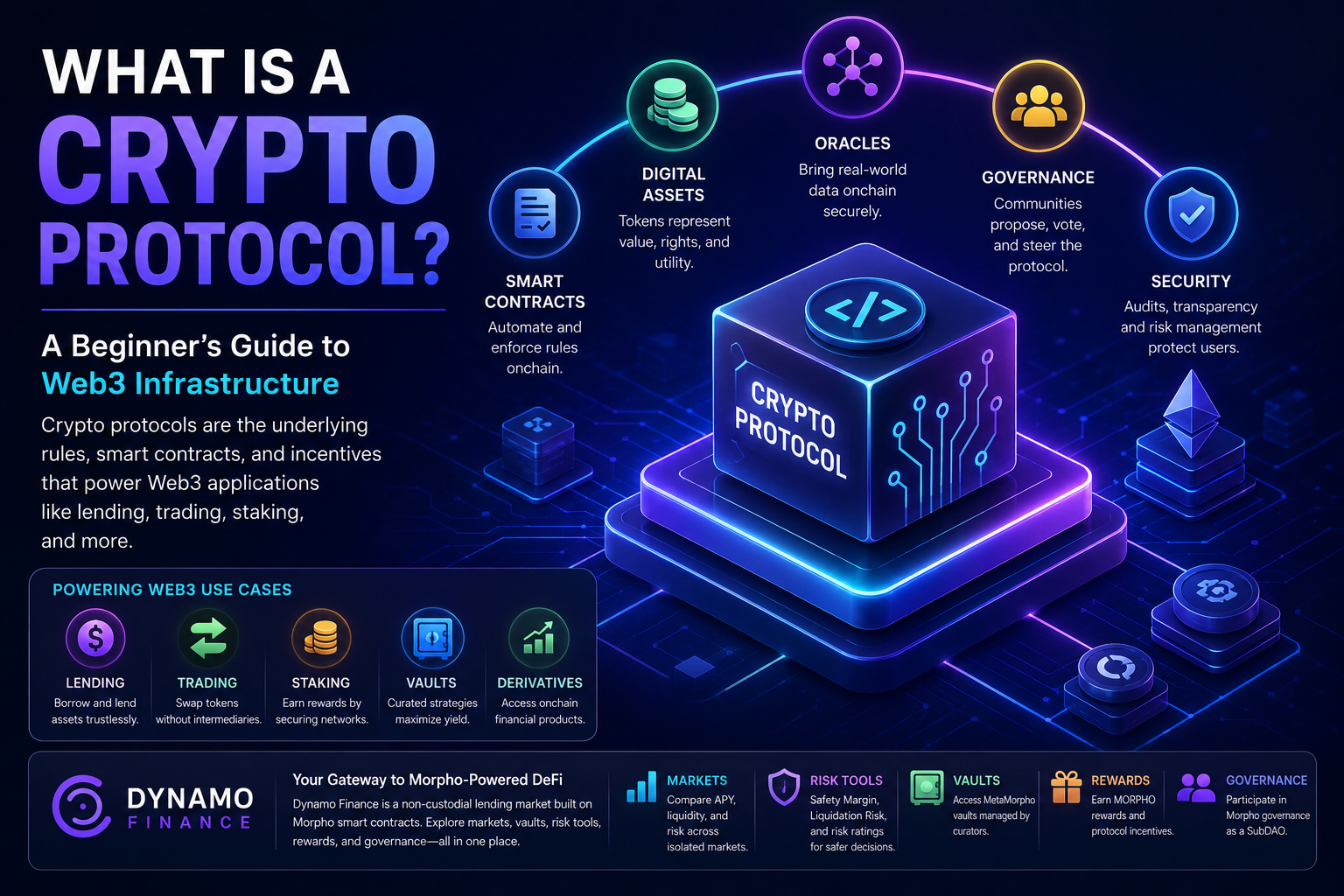
Dynamo Finance is a non-custodial, permissionless Web3 lending market built on Morpho smart contracts. It lets users supply assets, borrow against collateral, deposit into vaults, compare opportunities, evaluate risk, earn rewards, and participate in governance from one interface.
Dynamo is especially relevant for users studying Morpho TVL because it moves the analysis from protocol-level size to market-level decision-making. Instead of asking only how large Morpho is, users can compare individual markets, vaults, APYs, utilization, collateral, loan assets, liquidity, and risk tiers.
For users researching morpho lending, this level of visibility is essential. Morpho’s overall TVL tells you that the ecosystem has scale. Dynamo helps you decide which specific opportunities deserve attention.
Dynamo does not custody user funds. Assets are held by Morpho smart contracts, while Dynamo adds discovery, analytics, position management, risk tools, rewards, automation, and SubDAO governance participation.
Dynamo Markets: Going Beyond Protocol-Level TVL
Dynamo markets help users evaluate lending opportunities one market at a time. Each market has one loan asset, one collateral asset, one oracle, and one liquidation loan-to-value threshold. Nothing that happens in one isolated market automatically spills into another.
This is important because Morpho TVL can be large while specific markets differ widely. One market may have deep supply and conservative collateral. Another may be newer, smaller, or more volatile.
When browsing markets, users should compare supply APY, borrow APY, utilization, available liquidity, total supply, total borrow, oracle, collateral asset, loan asset, and LLTV. These are the metrics that determine whether a specific market fits a strategy.
For users looking at crypto lending, direct market analysis is often the difference between informed yield seeking and blind APY chasing.
Dynamo Vaults: Reading TVL at the Strategy Level
Dynamo vaults give users a way to deposit once and receive exposure to curated market allocations. Instead of manually choosing every market, the user relies on a curator and vault strategy.
Dynamo’s vault interface helps users compare curator, APY, TVL, underlying asset, current market allocations, and risk-related data. This matters because vault TVL only becomes meaningful when paired with allocation transparency.
A vault with high TVL and diversified exposure may suit a user seeking hands-off yield. A vault with high TVL but concentrated exposure may fit a more advanced user who understands that concentration. A smaller vault may still be attractive if it has a strong curator and conservative markets, but the user should recognize that it has less live history.
For users comparing morpho vaults, TVL is one of the first filters. It should never be the last filter.
Dynamo Risk Ratings and the Limits of TVL
Dynamo assigns Low, Medium, and High risk tiers to markets and vaults based on objective onchain inputs. These tiers help users avoid treating APY or TVL as a complete answer.
TVL can be high while risk remains elevated. A large vault may still allocate to markets with volatile collateral. A deep market may still have aggressive LLTV. A popular opportunity may still have high utilization and limited available liquidity.
Dynamo’s risk framework gives users a practical way to compare opportunities by more than size. It is not a guarantee of safety, but it helps structure the analysis.
Users can explore the Dynamo risk dashboard for market and vault risk context, then review the Dynamo Finance lending docs to understand markets, vaults, risk ratings, Safety Margin, Liquidation Risk, rewards, and fees.
TVL vs. Utilization: The Metric Pair Every Lender Should Know
TVL shows how much value is deposited. Utilization shows how much supplied capital is currently borrowed. In lending markets, this distinction is critical.
A market with high TVL and low utilization may have plenty of liquidity but lower supply APY. A market with high utilization may offer stronger yield but less immediately available liquidity for withdrawals.
Dynamo’s market materials define utilization as total borrowed divided by total supplied. As utilization rises, borrow rates increase automatically, and supply APY reflects the interest borrowers pay. High utilization can improve supply yield, but it can also mean less liquidity is immediately available.
This is one of the biggest reasons investors should not rely on Morpho TVL alone. A protocol may have billions in deposits, but your specific market may still have limited available liquidity if utilization is high.
TVL vs. Available Liquidity
Available liquidity is the amount that can be withdrawn or borrowed right now. It is more practical than TVL for users who care about exits.
A vault can have strong TVL, but if the underlying markets are heavily borrowed, immediate withdrawals may be constrained. Dynamo notes that vault shares can be redeemed at any time, subject to market liquidity, and that high utilization in underlying markets can create withdrawal delays until liquidity frees up.
This is not necessarily a failure. Lending markets are designed to lend capital out. If borrowers are using the capital, suppliers may need to wait for repayment, new supply, or reallocation before all withdrawals can be satisfied.
For investors, the lesson is simple: TVL tells you scale; available liquidity tells you exit capacity.
TVL vs. APY
TVL and APY often move in opposite directions. When a market has limited supply and strong borrow demand, APY can rise. When a market attracts a lot of supply, APY can compress unless borrower demand also grows.
A high-TVL vault may offer lower APY because capital has crowded into the strategy. A smaller vault may show higher APY because the opportunity is less crowded, newer, or riskier.
Neither is automatically better. High TVL with moderate APY may suit conservative lenders. Lower TVL with higher APY may suit advanced users willing to accept more risk.
The right question is not “Which APY is highest?” It is “Is this yield attractive relative to TVL, liquidity, utilization, collateral, and risk?”
TVL vs. Collateral Quality
Collateral quality can matter more than TVL. A market lending against liquid, established collateral may be easier to evaluate than a larger market backed by complex or thinly traded assets.
Collateral quality depends on liquidity, volatility, oracle reliability, market depth, token design, and liquidation pathways. A market with highly liquid ETH collateral has a different risk profile than a market using a newer yield-bearing token or tokenized credit asset.
Morpho’s isolated design makes this analysis more precise because each market has a defined loan asset, collateral asset, oracle, and LLTV. The isolation is helpful, but it also puts more responsibility on users and curators.
A market’s TVL tells you how much capital is there. The collateral tells you what protects lenders if borrowers cannot repay.
TVL and Oracle Risk
Oracles are price feeds used to value collateral. They matter because lending protocols need to know how much collateral is worth relative to the borrowed asset. If an oracle is wrong, stale, manipulated, or delayed, liquidations can happen incorrectly or too late.
A market can have high TVL and still depend on an oracle that users should review carefully. This is especially important for newer assets, tokenized assets, thinly traded collateral, or assets with complex pricing.
Dynamo’s market view surfaces oracle-related parameters so users can inspect the market before entering. Users should avoid assuming that high TVL automatically validates oracle design.
In DeFi lending, price integrity is central. Without reliable collateral pricing, TVL can become a false comfort.
TVL and Liquidation Risk
Liquidation risk is most relevant for borrowers, but it also matters for suppliers. If many borrowers are liquidated during a sharp market move, lenders depend on liquidators, oracle updates, market depth, and collateral liquidity to keep the market solvent.
A high-TVL market with strong liquidation infrastructure may handle volatility better than a small market with thin collateral liquidity. But large TVL does not guarantee smooth liquidations. Stress events can reveal weaknesses quickly.
Borrowers should monitor current LTV, LLTV, health factor, and liquidation price. Suppliers should review whether the collateral can realistically be liquidated in stressed conditions.
Dynamo’s Liquidation Risk view helps borrowers understand how far collateral prices can fall before liquidation becomes likely. That kind of position-level data is more useful than protocol-level TVL when managing a loan.
TVL and Curator Risk
Vaults introduce curator risk. A curator decides which markets the vault can use, how capital is allocated, and when rebalancing should occur. That means vault TVL partially reflects trust in the curator’s process.
A high-TVL vault curated by a respected team may be attractive, but users should still review allocations. A curator can make good decisions or poor decisions. A vault can become concentrated. A strategy can drift. Market conditions can change faster than expected.
Morpho vaults are transparent onchain, and Dynamo surfaces current allocations in the UI. This helps users see where their capital goes instead of relying only on curator branding.
Good curator reputation is useful. Transparent allocation is better.
TVL and Incentives
TVL can be influenced by incentives. If a market or vault offers token rewards, deposits may increase quickly. When rewards decline, capital may leave. This can create TVL volatility that has little to do with long-term organic demand.
Dynamo supports reward streams such as MORPHO emissions, Dynamo-specific incentives, and third-party curator rewards on top of base lending yield. Users should separate base yield from reward-driven yield before comparing opportunities.
Incentives are not bad. They can bootstrap liquidity and reward early users. But investors should understand whether TVL is sticky or mercenary.
A market with lower APY but durable borrower demand may be more attractive than a market inflated by short-term rewards that disappear next month.
How to Analyze Morpho TVL Like a DeFi Investor
A disciplined Morpho TVL analysis starts broad and then narrows. Start with protocol-level data to understand scale. Then move to chain-level TVL to understand where liquidity lives. Then evaluate vault-level or market-level data before taking action.
- Check protocol-level Morpho TVL across reliable dashboards such as Morpho Network Data and DefiLlama.
- Review chain distribution to understand where liquidity is concentrated.
- Identify whether you want direct market exposure, vault exposure, or a borrow position.
- For markets, compare loan asset, collateral asset, oracle, LLTV, utilization, available liquidity, supply APY, and borrow APY.
- For vaults, compare curator, TVL, allocation, APY stability, market diversity, performance fees, and withdrawal liquidity.
- Separate organic yield from temporary rewards or incentives.
- Evaluate downside scenarios, including high utilization, oracle stress, collateral drawdown, and liquidation waves.
- Start with a position size that matches your ability to monitor risk.
This process is slower than choosing the highest APY, but it is far more durable. DeFi investors who survive multiple market cycles usually prioritize process over excitement.
Practical Example: Evaluating a High-TVL Morpho Vault
Imagine a user finds a USDC Morpho vault with high TVL and attractive APY. The high TVL suggests that many users have deposited capital and that the vault may be established. But the analysis should not stop there.
The user should inspect the curator, market allocations, APY history, performance fees, and liquidity. If the vault allocates across many established markets, the risk may be easier to understand. If it is heavily concentrated in one specialized market, the user needs to examine that market closely.
Next, the user should review utilization. If underlying markets are highly utilized, APY may be attractive, but withdrawals may depend on repayments or new deposits.
Finally, the user should decide whether the vault fits the portfolio role. A high-TVL vault may be suitable for core stablecoin yield if its allocations are conservative. It may be less suitable if the yield comes from collateral or markets the user does not understand.
Practical Example: Evaluating a Low-TVL Morpho Market
Now imagine a smaller market with lower TVL but strong supply APY. A beginner might dismiss it because it is small. An advanced user might investigate further.
Low TVL can mean the market is new, illiquid, or niche. It can also mean the market is early and potentially attractive if parameters are conservative and collateral is strong.
The user should review collateral quality, oracle reliability, LLTV, available liquidity, utilization, total borrow, and whether the market is verified. Dynamo emphasizes that users should only interact with verified markets because unverified markets may have unreliable price feeds or misconfigured parameters.
A small market can be useful, but only if the user understands why it is small and what risks come with that size.
Practical Example: Borrowing Against Crypto
A user holding ETH may want USDC liquidity without selling. Morpho-based lending markets can support that goal if the user chooses a market where ETH or a related asset is accepted as collateral.
The user should not focus on Morpho TVL first. They should focus on the specific market’s available liquidity, borrow APY, collateral oracle, LLTV, and liquidation price.
Borrowers should also use conservative buffers. If a market allows liquidation at a specific LLTV, that threshold should be treated as a danger line, not a target.
Dynamo is useful for users researching Morpho DeFi because it shows position-level borrowing metrics and risk views rather than only protocol-level deposits.
Common Mistakes When Reading Morpho TVL
The first mistake is assuming high TVL means low risk. High TVL can indicate adoption, but it does not eliminate smart contract, oracle, collateral, liquidity, liquidation, curator, or governance risk.
The second mistake is comparing TVL across protocols without understanding methodology. Morpho Network Data and DefiLlama may show different numbers because they use different definitions and categories.
The third mistake is ignoring available liquidity. A market may have high supply, but if most of it is borrowed, withdrawals or new borrows may be constrained.
The fourth mistake is ignoring vault allocation. A vault’s TVL tells you how much capital is in the strategy, but allocation tells you what risks the strategy actually holds.
The fifth mistake is chasing APY in low-TVL markets without checking collateral, oracle, LLTV, and verification status.
What Experienced Investors Look For
Experienced DeFi investors use Morpho TVL as a screening tool, not a decision tool. They want to know where liquidity is concentrated, how fast it is growing, and whether that growth appears sustainable.
They also study the relationship between TVL and active loans. If active loans grow with deposits, that can signal real borrower demand. If deposits grow while loans remain flat, supply APY may compress.
Experienced users also compare vault TVL with diversification. A vault with $500 million across many conservative markets may behave differently from a vault with the same TVL concentrated in one collateral category.
How Morpho TVL Fits Into the Future of DeFi Lending
Morpho’s TVL growth reflects a larger trend in DeFi lending: the move from monolithic lending pools toward modular credit infrastructure. Isolated markets, curated vaults, and embedded lending integrations make it easier to design strategies for specific assets, risks, and user groups.
This is useful for DeFi because one-size-fits-all lending is not always efficient. Different assets need different collateral rules, and Different users need different risk profiles. Different curators can compete on allocation quality.
The trade-off is complexity. More modularity means users need better data, better interfaces, and better risk frameworks.
That is where platforms like Dynamo matter. They help translate Morpho’s modular infrastructure into a workflow that lets users compare opportunities, inspect risk, and manage positions more clearly.
External Resources for Further Research
Readers researching Morpho TVL should start with primary and widely used analytics sources. Morpho Network Data provides protocol-level metrics such as total deposits, active loans, TVL, and total supply. DefiLlama’s Morpho page provides a combined DeFi analytics view with TVL by chain, fees, and protocol metrics.
For architecture context, Morpho’s article on Morpho vaults and isolated markets explains why vaults simplify lending into isolated markets. Morpho’s contract resources list the core market, vault, oracle, interest-rate, and allocator components relevant to the protocol stack.
For Dynamo product updates, market context, and community information, follow Dynamo Finance community updates.
Final Checklist Before Using Morpho TVL in an Investment Decision
Use this checklist before supplying assets, depositing into a vault, or borrowing against collateral:
- Check Morpho protocol-level TVL, but do not treat it as a safety rating.
- Compare TVL across multiple sources and understand that methodologies can differ.
- Look at chain distribution to understand where liquidity is concentrated.
- For markets, review supply APY, borrow APY, utilization, available liquidity, collateral, oracle, and LLTV.
- For vaults, review curator, TVL, allocation, APY stability, fees, market diversity, and withdrawal liquidity.
- Separate base lending yield from incentives and temporary rewards.
- Evaluate collateral quality and liquidation pathways.
- Use risk ratings and position-level tools instead of relying on headline TVL.
- Start with a position size that matches your knowledge and monitoring capacity.
- Revisit the market or vault regularly because TVL, utilization, and APY change over time.
Conclusion
Morpho TVL is an important metric because it shows how much capital is flowing into one of DeFi’s most important lending ecosystems. It can reveal growth, liquidity concentration, chain adoption, and market confidence. But it is not a complete risk framework.
Smart DeFi investors read Morpho TVL alongside utilization, active loans, available liquidity, collateral quality, oracle design, LLTV, vault allocation, curator reputation, and fees. The goal is not to chase the largest number. The goal is to understand the market or vault where your capital will actually sit.
Dynamo Finance helps users apply that process directly. By surfacing Morpho-based markets, vaults, APYs, utilization, liquidity, risk ratings, Safety Margin, Liquidation Risk views, rewards, and governance features, Dynamo gives lenders, borrowers, and yield seekers the context they need before taking action.
Explore Dynamo Finance to compare Morpho markets and vaults, review risk data, and build a more disciplined approach to DeFi lending, borrowing, and onchain yield.
FAQ
What is Morpho TVL?
Morpho TVL is the total value locked across Morpho’s lending ecosystem. It can include assets supplied into Morpho markets and vaults, depending on the data provider’s methodology.
Why do different websites show different Morpho TVL numbers?
Different dashboards may count deposits, active loans, supplied assets, vault deposits, chains, and protocol versions differently. That is why Morpho Network Data and DefiLlama can show slightly different figures.
Does high Morpho TVL mean Morpho is safe?
No. High TVL can signal adoption and liquidity, but it does not eliminate smart contract, oracle, collateral, liquidation, liquidity, curator, or governance risk.
How should lenders use Morpho TVL?
Lenders should use Morpho TVL as a starting point, then review market-level data such as utilization, available liquidity, collateral, oracle, LLTV, supply APY, and vault allocation before supplying assets.
How does Dynamo Finance help with Morpho TVL analysis?
Dynamo Finance helps users move from protocol-level TVL to market-level and vault-level analysis. Users can compare Morpho markets and vaults, inspect APY, utilization, liquidity, risk tiers, collateral parameters, Safety Margin, and Liquidation Risk data before supplying or borrowing.