
Crypto lending has entered a new phase. Instead of choosing between a centralized loan desk and a fully self-directed DeFi protocol, users can now access onchain lending infrastructure through familiar consumer apps. That is why demand for coinbase lending have grown as users try to understand how Coinbase, Morpho, USDC, Base, and crypto-backed loans fit together.
The opportunity is clear: borrow USDC without selling crypto, lend USDC for potential yield, and access DeFi markets through a familiar interface. The risk is equally clear: loans are collateralized, rates are variable, collateral can be liquidated, and the underlying lending activity depends on smart contracts and market liquidity.
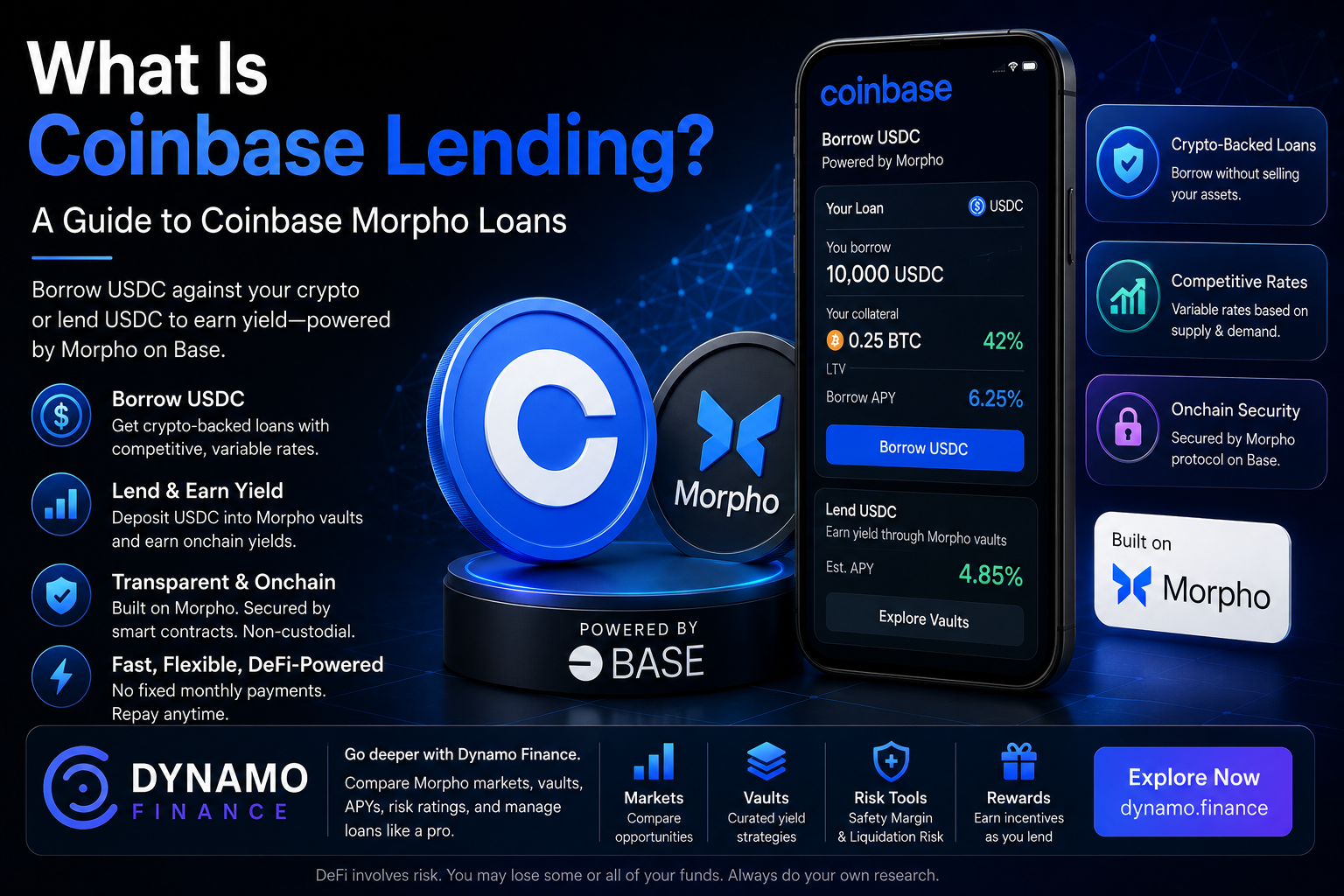
Coinbase lending refers to Coinbase’s Morpho-powered onchain lending and borrowing products, including crypto-backed loans where eligible users borrow USDC against supported crypto collateral and USDC lending products where users can earn yield through Morpho vaults.
This guide explains how Coinbase Morpho loans work, what Coinbase lending means in practice, how onchain credit differs from traditional loans, what risks borrowers and lenders should understand, and how DeFi investors can compare Morpho-based opportunities through Dynamo Finance.
Key Takeaways
- Coinbase lending uses Morpho, an onchain lending protocol on Base, to connect eligible Coinbase users with DeFi borrowing and lending markets.
- Coinbase Morpho loans let eligible users borrow USDC against supported crypto collateral without going through a traditional credit check.
- Borrow rates are variable and depend on supply and demand in the lending market, so loan costs can change over time.
- Collateral can be liquidated if a loan’s LTV reaches the liquidation threshold, which makes risk monitoring essential.
- Dynamo Finance helps users go deeper into Morpho-based markets, vaults, APYs, risk ratings, liquidity, safety margins, and liquidation-risk analysis.
What Is Coinbase Lending?
Coinbase lending is the broader category of Coinbase products that let users participate in onchain lending and borrowing through Morpho. It includes borrowing USDC against crypto collateral and, in certain markets, lending USDC through Morpho vaults to earn yield.
The borrowing side is usually what users mean when they search for Coinbase Morpho loans. In that workflow, eligible users pledge supported crypto assets as collateral and receive USDC. Coinbase provides the interface, while the borrowing activity is enabled by Morpho’s onchain lending protocol on Base.
The lending side is different. Users can deposit USDC into Morpho-powered vaults, where capital is allocated across lending markets. Borrowers pay interest, and lenders can earn yield based on market demand, vault strategy, and liquidity conditions.
This is important because “lending” and “borrowing” are two sides of the same credit market. Borrowers want liquidity without selling crypto. Lenders want yield on assets such as USDC. Morpho provides the onchain infrastructure that connects those two groups.
What Is Morpho?
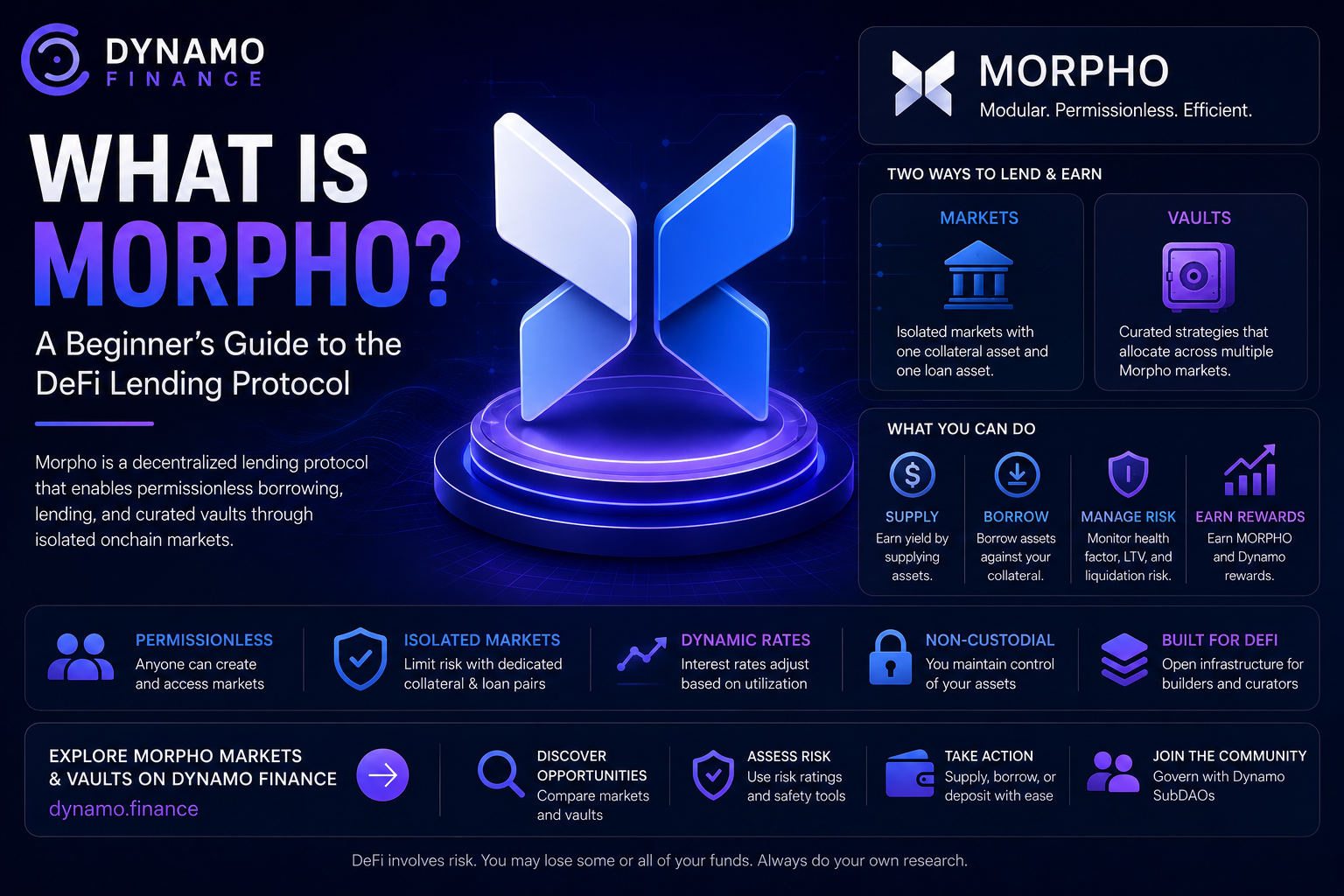
Morpho is an onchain credit protocol that enables lending markets, vaults, and embedded borrowing or lending products. It is used by platforms that want to offer DeFi credit experiences while controlling the user interface and product design.
In simple terms, Morpho provides the lending rails. A company like Coinbase can integrate those rails into its own app. A DeFi-native platform like Dynamo can give users direct access to Morpho markets and vaults with deeper market data and risk tooling.
Morpho matters because it separates infrastructure from distribution. The protocol can power borrowing, lending, vault curation, and embedded yield products, while different interfaces present those products in different ways.
For users, this means the same underlying DeFi infrastructure can appear in more than one environment. Coinbase offers a simplified experience inside the Coinbase app. Dynamo gives users a more DeFi-native interface for comparing morpho lending markets, vaults, APYs, risk tiers, and collateral parameters.
How Coinbase Morpho Loans Work
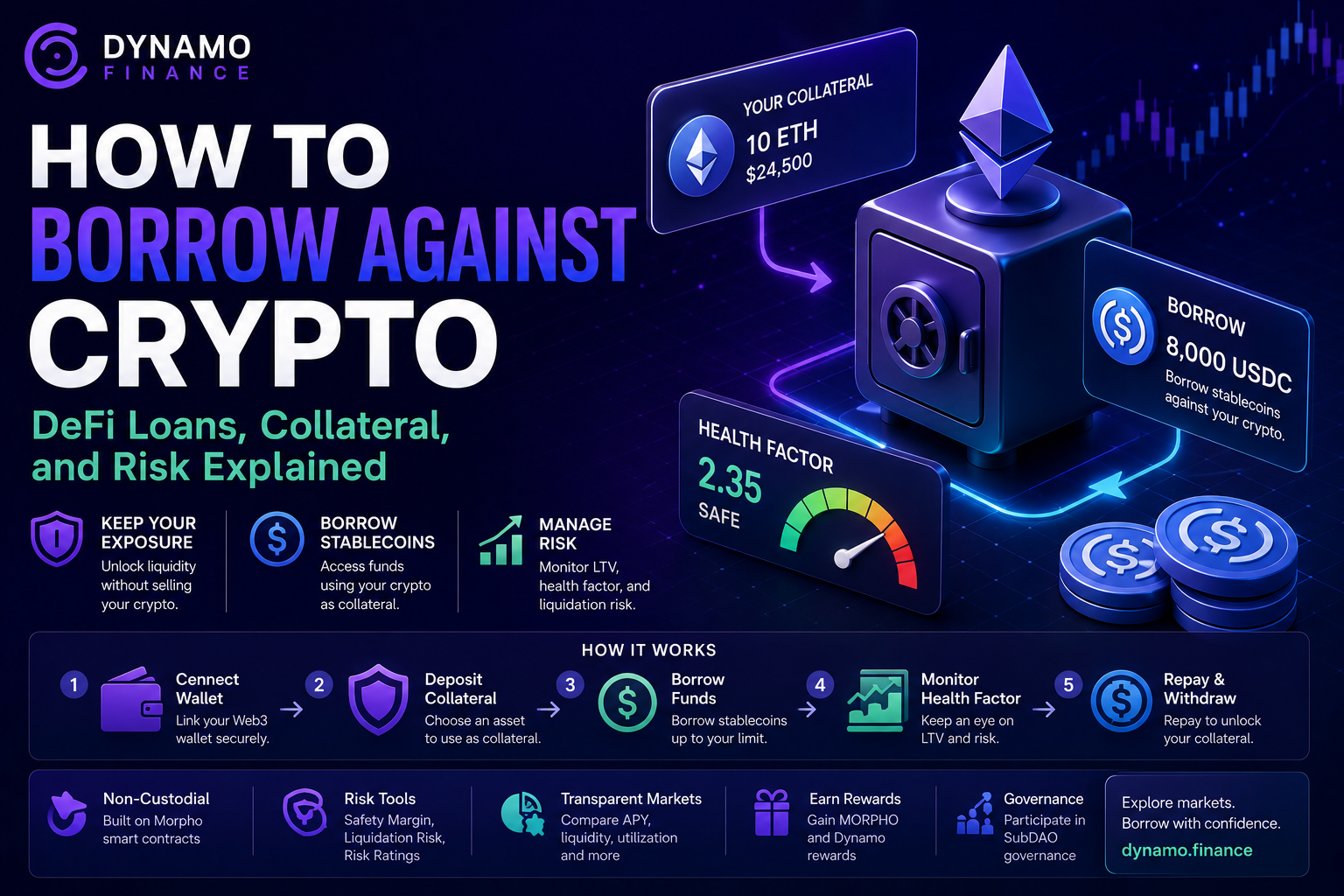
A Coinbase Morpho loan is a crypto-backed loan. Instead of selling a crypto asset to get cash or stablecoins, an eligible user pledges crypto as collateral and borrows USDC against it. The collateral is locked on Morpho, and the borrower can repay later to recover the collateral.
The basic flow looks like this:
- An eligible Coinbase user selects Borrow in the Coinbase app or supported web flow.
- The user chooses supported crypto collateral and enters the amount of USDC they want to borrow.
- The collateral is moved onchain to Morpho, where it secures repayment of the loan.
- USDC is deposited into the user’s Coinbase account.
- Interest accrues over time based on variable market rates.
- The user can repay partially or fully, with no fixed monthly payment schedule.
- After full repayment, the collateral is returned automatically, subject to the loan’s mechanics and fees.
Coinbase’s initial bitcoin-backed loan product converted BTC into Coinbase Wrapped Bitcoin, or cbBTC, before transferring it onchain to Morpho. The eligible collateral list has expanded over time, so users should always check the current Coinbase product page and loan review screen before borrowing.
The user experience may feel simple, but the structure is still DeFi credit. The loan depends on collateral value, interest accrual, liquidation thresholds, liquidity, and smart contract execution.
Coinbase Lending vs. Traditional Lending
Coinbase lending is different from a traditional bank loan. A bank may evaluate income, credit history, debt-to-income ratio, employment, and repayment capacity. A crypto-backed loan primarily relies on collateral value.
This creates a faster and more automated experience, but it also shifts the key risk. Instead of default risk being managed through credit underwriting, the system protects lenders by liquidating collateral if the loan becomes too risky.
| Feature | Coinbase Morpho Loans | Traditional Personal Loans |
|---|---|---|
| Loan asset | USDC | Usually fiat currency |
| Collateral | Supported crypto assets | Often unsecured, or secured by traditional assets |
| Credit check | Generally collateral-based rather than credit-score based | Usually based on credit score, income, and repayment history |
| Interest rate | Variable, based on DeFi lending market supply and demand | Often fixed or variable based on lender terms |
| Repayment schedule | No fixed monthly payment schedule in the standard Coinbase crypto-backed loan model | Usually fixed monthly payments |
| Main risk | Liquidation if collateral value falls or debt grows too much | Credit damage, collections, late fees, or asset repossession depending on loan type |
The biggest advantage is flexibility. A user can unlock USDC liquidity without selling crypto. The biggest drawback is collateral volatility. If the collateral falls sharply, the loan can become unsafe quickly.
Why Coinbase Chose Morpho
Coinbase’s Morpho integration is a major example of embedded DeFi. Instead of sending users to an external DeFi app, Coinbase integrates onchain lending infrastructure into its own user experience.
For Coinbase, Morpho provides open lending markets, DeFi liquidity, and smart contract execution on Base. For users, Coinbase provides a familiar interface, account experience, and simplified workflow. This combination makes onchain borrowing and lending more accessible to people who may not be comfortable navigating DeFi directly.
Morpho has also described the Coinbase integration as part of a broader pattern where fintech interfaces sit on top of open DeFi infrastructure. That model can expand adoption because users get familiar product design while the back end uses transparent onchain rails.
For advanced users, the same integration raises an important question: should you use an embedded experience or interact with Morpho-based markets more directly? The answer depends on your needs. Coinbase may offer convenience. Dynamo may offer deeper market comparison, vault analysis, risk visibility, and position-level controls.
Coinbase Morpho Loans: Benefits for Borrowers
The main benefit of Coinbase Morpho loans is that users can access liquidity without selling crypto. This is useful for people who want USDC for spending, transfers, business needs, taxes, short-term liquidity, or other financial planning goals while keeping exposure to their collateral asset.
Another benefit is speed. Crypto-backed loans can be created quickly because the system relies on collateral rather than a traditional credit application. Eligible users can borrow against supported assets without the same underwriting process used by banks.
The USDC loan structure also gives users flexibility. Coinbase states that loans can be repaid in part or in full at any time, with no minimum payment requirements or due dates. That can be attractive for users who want control over when they reduce debt.
For users researching how to borrow against crypto, the appeal is straightforward: keep crypto exposure, borrow USDC, and repay when ready. But this only works well if the borrower manages liquidation risk carefully.
The Main Risks of Coinbase Morpho Loans
Crypto-backed loans are not risk-free. They can be useful, but they should be treated as active financial positions, not passive features.
- Liquidation risk: If collateral value falls or accrued interest increases the loan balance enough, collateral can be liquidated.
- Variable rate risk: Borrow rates can change as supply and demand shift in the lending market.
- Smart contract risk: The loan depends on onchain infrastructure and smart contract execution.
- Liquidity risk: Market stress can affect borrowing rates, withdrawals, liquidations, and collateral management.
- Wrapped asset risk: Some collateral may be converted into a wrapped representation before moving onchain.
- Processing fee risk: Loan fees can increase the starting principal and accrue interest as part of the balance.
- Tax uncertainty: Borrowing may avoid an immediate sale, but users should consult a tax professional about their own situation.
The most important risk for beginners is liquidation. A user may think, “I borrowed USDC, and I still own my crypto.” That is only true as long as the loan remains healthy. If the collateral value falls too far relative to the debt, the collateral can be sold to repay the loan and any applicable penalties.
Understanding LTV and LLTV
LTV stands for loan-to-value. It measures the loan balance compared with the market value of the collateral. If a user posts $20,000 of collateral and borrows $8,000, the LTV is 40%.
LLTV stands for liquidation loan-to-value. It is the threshold where the loan becomes eligible for liquidation. Coinbase’s help materials state that a USDC loan can be automatically liquidated if it reaches an 86% LLTV threshold, with an additional penalty included when collateral is liquidated.
Borrowers should not treat the liquidation threshold as a target. It is a danger zone. A safer approach is to maintain a large buffer so the position can survive market volatility.
In practice, crypto borrowers should monitor LTV regularly. If collateral falls, they can repay part of the loan, add collateral where supported, or reduce exposure before liquidation becomes likely.
What Happens During Liquidation?
Liquidation is the mechanism that protects lenders when a borrower’s position becomes too risky. If the loan balance plus accrued interest becomes too high relative to collateral value, collateral can be liquidated to repay the debt.
On Coinbase Morpho loans, the user sees loan health through the Coinbase experience. If the position reaches the liquidation threshold, collateral can be sold automatically. After the required collateral is liquidated, any remaining collateral may be returned according to the loan process.
Liquidation can happen during fast market moves. A loan that looks safe during calm conditions can become risky during a sharp collateral drawdown. This is why a conservative LTV is often more useful than maximizing the amount borrowed.
Borrowers should also remember that interest accrual can raise the loan balance over time. Even if collateral price does not move, debt can grow gradually, increasing LTV.
Coinbase USDC Lending: The Other Side of the Market
Coinbase has also launched USDC lending through Morpho, allowing users to deposit USDC into onchain vaults that allocate capital across lending markets.
In this model, USDC lenders provide liquidity. Borrowers pay interest to use that liquidity. The lender earns yield from the lending activity, subject to vault strategy, market conditions, liquidity, fees, and risks.
Coinbase’s USDC lending product uses Morpho vaults curated by Steakhouse Financial among others. The purpose is to give users a simplified way to access DeFi yield without manually selecting markets. That is convenient, but users should still understand that vault yield depends on underlying DeFi markets.
This is where morpho vaults become relevant. A vault can make lending easier by allocating capital across markets, but users still need to evaluate curator quality, underlying collateral, APY stability, liquidity, and risk exposure.
How Morpho Vaults Generate Yield
A Morpho vault is a curated strategy that accepts deposits and allocates them into lending markets. Instead of choosing each market manually, the user deposits into the vault and receives exposure to a managed allocation strategy.
The yield comes from borrowers. Borrowers post collateral and pay interest to borrow assets such as USDC. The vault allocates supplied USDC into markets where borrowers demand liquidity. Interest paid by borrowers flows back to vault depositors, after any applicable fees.
Vaults can improve convenience, but they also introduce curator and allocation risk. A vault’s performance depends on which markets it uses, how concentrated it is, how liquid the underlying markets are, how rates change, and how the curator responds to changing conditions.
For yield seekers, this means a vault APY should never be evaluated in isolation. A higher APY may reflect healthy borrower demand, but it may also reflect higher utilization, riskier collateral, temporary incentives, or thinner liquidity.
Coinbase Lending vs. Direct DeFi Lending
Coinbase lending gives users access to Morpho through Coinbase’s interface. Direct DeFi lending gives users access through a Web3 wallet and a DeFi-native interface such as Dynamo Finance.
Neither approach is automatically better. Coinbase may be more familiar for users who already hold assets there. Direct DeFi may be better for users who want deeper control, market-level visibility, and broader comparison tools.
| Feature | Coinbase Lending | Dynamo Finance |
|---|---|---|
| User experience | Embedded inside Coinbase | DeFi-native interface built for Morpho markets and vaults |
| Underlying infrastructure | Morpho on Base for supported products | Morpho smart contracts for markets and vaults |
| Borrowing | Crypto-backed USDC loans for eligible Coinbase users | Borrow against collateral in supported Morpho markets |
| Lending | USDC lending through Coinbase-selected Morpho vaults where available | Direct market supply and vault deposits with market comparison tools |
| Risk visibility | Simplified loan and product screens | Risk ratings, market data, liquidation-risk views, and safety-margin tools |
| Best fit | Users who want a familiar Coinbase experience | Users who want more DeFi-native control and transparency |
The practical takeaway is simple. Coinbase abstracts complexity. Dynamo exposes more of the market structure. Beginners may prefer simplicity, while active DeFi investors may want more control.
Where Dynamo Finance Fits
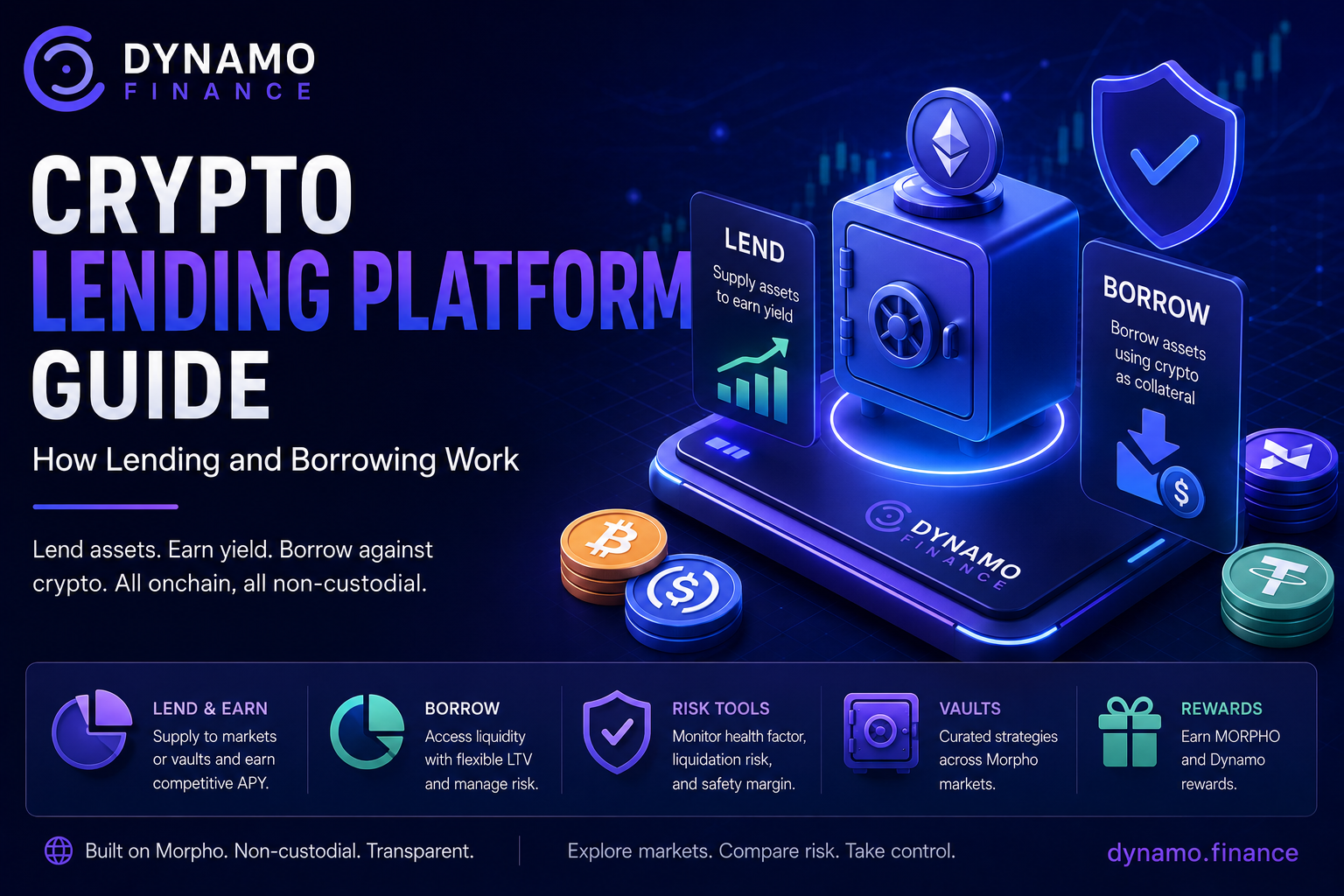
Dynamo Finance is a non-custodial, permissionless Web3 lending market built on Morpho smart contracts. Users can supply assets, borrow against collateral, deposit into vaults, compare markets, evaluate risk, and manage positions from one interface.
Dynamo does not custody user funds. Assets are held by Morpho smart contracts, while Dynamo adds a feature layer for discovery, risk analytics, position management, rewards, and governance participation.
This is useful for users who want to go beyond an embedded experience. Coinbase Morpho loans show how DeFi lending can reach mainstream users. Dynamo helps users understand the underlying mechanics: loan assets, collateral assets, utilization, LLTV, market liquidity, APY, and liquidation risk.
For anyone comparing crypto lending platform options, the difference matters. A centralized interface may be easier to use, but a DeFi-native interface can provide deeper control and context.
Dynamo Markets: Direct Exposure to Morpho Lending
Dynamo markets are isolated lending pools. Each market has one loan asset, one collateral asset, one oracle, and one liquidation loan-to-value threshold. A USDC/ETH market, for example, is separate from a USDC/BTC market.
This isolation helps users understand risk more clearly. If you supply to one market, your exposure is tied to that market’s collateral, oracle, utilization, liquidity, and borrower demand. Activity in another isolated market does not automatically spill into your selected market.
Users can browse supply APY, borrow APY, utilization, available liquidity, collateral asset, loan asset, and market parameters. That is valuable because a market’s headline APY is only the starting point.
DeFi investors who want to inspect markets directly can explore Dynamo markets and compare opportunities before committing capital.
Dynamo Vaults: Curated Yield Without Manual Market Selection
Dynamo also supports vault-based strategies built on the MetaMorpho standard. Instead of choosing an individual market, users deposit into a vault and receive shares representing their position. The vault curator allocates capital across selected markets.
Vaults are useful for yield seekers who do not want to rebalance manually. The curator can adjust allocations as rates and market conditions change. Users receive a blended yield based on the vault’s underlying markets.
That convenience does not remove risk. A vault can be diversified or concentrated. It can have stable APY or volatile APY. It can rely on conservative collateral or more aggressive markets. The curator’s process matters.
For users who want to lend crypto through a more structured interface, vaults can be a practical entry point. The key is reviewing curator, allocation, TVL, liquidity, fees, and risk rating before depositing.
Dynamo Risk Ratings and Borrower Tools
Dynamo’s risk framework helps users compare markets and vaults more carefully. Markets and vaults receive Low, Medium, or High risk tiers based on objective onchain inputs such as LLTV, TVL, market exposure, and live history.
This is useful because APY alone can be misleading. A newer market with low liquidity and aggressive parameters may show a high yield, but it may not fit a conservative portfolio. A lower-yielding market with deeper liquidity and more established collateral may be more appropriate for many users.
Borrowers also need position-level tools. Dynamo’s Safety Margin feature creates a synthetic target LTV so users can borrow more conservatively than Morpho’s underlying liquidation threshold. Its liquidation-risk view shows health factor, price-drop tolerance, and liquidation price.
These tools are directly relevant for users learning from Coinbase Morpho loans. The same core concepts apply: borrowing power, collateral value, LTV, liquidation threshold, and the need to maintain a buffer.
How to Evaluate Coinbase Morpho Loans Before Borrowing
A crypto-backed loan can be useful, but the decision should be structured. Borrowing against crypto is not the same as free liquidity. It is leverage against a volatile asset.
- Confirm eligibility, supported collateral, borrowing limits, and availability in your region.
- Review the current variable interest rate before borrowing.
- Understand the processing fee and how it affects starting principal.
- Calculate your initial LTV and choose a conservative safety buffer.
- Know the liquidation threshold and liquidation penalty before signing.
- Plan how you will respond if collateral falls sharply.
- Decide whether you will repay, add collateral, or reduce exposure during stress.
- Keep records and consult a tax professional if the loan has tax implications for you.
The most disciplined borrowers know their exit plan before they borrow. They also avoid borrowing the maximum amount simply because the interface allows it.
How to Evaluate Coinbase USDC Lending Before Depositing
For USDC lenders, the key question is different. Instead of asking whether collateral will protect your loan, you ask where your USDC goes, who borrows it, what collateral backs the borrowing, and whether the yield compensates you for the risk.
Start by understanding the vault. A Coinbase USDC lending product may route deposits through Morpho vaults curated by a third party. That means you should consider curator process, allocation strategy, borrower demand, underlying market risk, and liquidity.
Next, separate base lending yield from promotions or temporary incentives. Incentives can make yields attractive, but they may change. Base lending yield reflects market demand from borrowers.
Finally, check liquidity. A vault can allow withdrawals, but available liquidity may depend on underlying markets. During high utilization, withdrawals may be slower or less immediately available.
Why Interest Rates Change
Coinbase Morpho loan rates are variable because they depend on lending market conditions. In DeFi lending markets, rates often respond to utilization, which measures how much supplied capital is currently borrowed.
If many borrowers want USDC and available supply is limited, borrow rates can rise. Higher rates may attract more lenders and discourage excessive borrowing. If borrower demand falls or supply increases, rates may decline.
This dynamic rate model is one of the reasons DeFi lending can be efficient. It is also why users should not assume today’s rate will remain unchanged. A loan that starts at an attractive rate can become more expensive if market conditions shift.
Borrowers should monitor loan costs over time. Lenders should monitor whether yield is sustainable or temporarily boosted by unusually high utilization.
Tax Considerations: Borrowing Is Not Selling, But Be Careful
One reason users like crypto-backed loans is that borrowing may allow them to access liquidity without selling crypto. Selling can trigger tax consequences in some jurisdictions, while borrowing may be treated differently.
That said, users should not assume every step is tax-neutral. Wrapped asset conversions, collateral transfers, interest, fees, liquidations, and repayments may have tax implications depending on jurisdiction and personal circumstances.
Coinbase itself tells users to maintain detailed transaction records and consult a tax professional. That is the right approach. Crypto tax rules vary, and DeFi integrations can introduce details that are easy to overlook.
From a planning perspective, loans for cryptocurrency should be evaluated after both financial risk and tax risk are considered.
Common Beginner Mistakes With Coinbase Lending
The first mistake is borrowing too much. A large loan may feel efficient, but it reduces the collateral buffer. During volatility, a high-LTV loan can become dangerous quickly.
The second mistake is ignoring interest accrual. Even if collateral price stays flat, the loan balance can grow. That increases LTV over time.
The third mistake is assuming no monthly payment means no urgency. A loan with no fixed repayment schedule can still be liquidated if the position becomes unhealthy.
The fourth mistake is confusing Coinbase’s interface with Coinbase custody of the loan collateral. The borrowing activity is enabled by Morpho, and collateral is locked onchain according to the loan mechanics.
The fifth mistake is treating lending yield like a bank deposit. USDC lending through DeFi vaults can offer yield, but it is not the same as FDIC- or SIPC-insured savings.
Practical Example: Borrowing USDC Against BTC
Assume a user holds BTC and wants USDC liquidity for a major expense. Selling BTC would end exposure and may create tax consequences. Borrowing may preserve exposure while unlocking liquidity.
The user chooses a supported collateral amount and receives USDC. If BTC rises, the loan becomes healthier because collateral value increases. If BTC falls, LTV rises and the loan gets closer to liquidation.
A conservative borrower does not borrow the maximum available amount. They leave a buffer large enough to survive a meaningful BTC drawdown. They also decide in advance whether they will repay debt, add collateral, or accept liquidation if the market moves against them.
The right borrow amount depends on volatility tolerance, time horizon, liquidity needs, and the borrower’s ability to monitor the position.
Practical Example: Lending USDC for Yield
Now assume a user holds USDC and wants to earn yield. Coinbase may offer a simplified USDC lending product through Morpho vaults. Dynamo may let the user compare Morpho markets and vaults more directly.
The Coinbase route may be easier for someone who wants a familiar app experience. The Dynamo route may be better for a DeFi investor who wants to inspect APY, utilization, collateral, liquidity, curator, market allocation, and risk rating.
Both approaches depend on DeFi market activity. Borrowers pay interest. Lenders earn yield. If demand drops or risk rises, returns can change.
The best lenders think in terms of risk-adjusted yield. A 5% APY from a deep, conservative market may be better than a 12% APY from a thin, risky market if the additional return does not compensate for the added risk.
Coinbase Morpho Loans and the Future of Embedded DeFi
Coinbase Morpho loans are part of a larger shift toward embedded DeFi. Users may not need to visit a DeFi protocol directly to access onchain lending. Instead, the protocol runs in the background while the user interacts with a familiar app.
This can make DeFi much easier to use. It can also make the risk harder to see. A clean interface may reduce friction, but it does not eliminate smart contract risk, collateral risk, liquidation risk, liquidity risk, or variable rate risk.
That is why education matters. Users should understand what happens behind the interface: collateral moves onchain, loan health depends on market value, rates can change, and liquidation can occur automatically.
For more advanced users, embedded DeFi can be a starting point rather than an endpoint. Once you understand the mechanics, you may want to compare direct DeFi venues where you can see more of the underlying market structure.
Authoritative Resources for Further Research
Users who want to verify the underlying product details should start with primary sources. Coinbase’s help center provides current information on crypto-backed loans, including eligibility, collateral, interest rate structure, repayment, and risks. Coinbase also publishes details on USDC loan collateral and liquidation and USDC loan processing fees.
For product context, Coinbase’s announcement of USDC loans powered by Morpho explains the original BTC-backed loan flow, while its article on USDC lending through Morpho explains how lending deposits can flow into Morpho vaults. Morpho’s own overview of USDC lending on Coinbase explains the vault and borrower relationship from the protocol side.
How to Build a Safer DeFi Lending Process
Whether you use Coinbase, Dynamo, or another DeFi interface, the same lending principles apply. Start with the mechanism, not the APY or maximum borrow amount.
For borrowing, understand collateral, LTV, LLTV, liquidation penalties, interest accrual, rate variability, and repayment options. For lending, understand borrower demand, collateral quality, market utilization, vault allocation, fees, and withdrawal liquidity.
Then match the strategy to your portfolio role. A short-term liquidity loan should be managed differently from a long-term leveraged position. A conservative stablecoin yield allocation should be managed differently from a high-yield vault strategy.
Finally, monitor positions. DeFi markets run continuously. Risk can change outside business hours, during market volatility, or after a change in liquidity conditions.
Why Follow Dynamo Finance
Dynamo is built for users who want more transparency and control around Morpho-based lending. It brings markets, vaults, risk ratings, liquidation views, safety-margin tools, and rewards into a single workflow.
For a Coinbase user who wants to understand what happens behind Coinbase Morpho loans, Dynamo can be a useful next step. It shows the kinds of parameters that matter in DeFi lending: utilization, APY, liquidity, collateral, LLTV, health factor, and vault allocation.
Users who want to learn the mechanics can review the Dynamo Finance lending docs. For product updates, market context, and community news, follow Dynamo Finance updates.
DeFi is becoming more accessible, but accessibility should not replace due diligence. The strongest users combine better interfaces with better risk discipline.
Conclusion
Coinbase lending marks an important step in the mainstream adoption of onchain credit. Through Morpho, Coinbase can offer crypto-backed USDC loans and USDC lending products inside a familiar interface, while the underlying activity connects to DeFi markets on Base.
For borrowers, Coinbase Morpho loans can unlock liquidity without selling crypto. For lenders, USDC lending can create access to market-driven DeFi yield. In both cases, users need to understand variable rates, liquidation thresholds, smart contract risk, liquidity, fees, and market conditions.
Dynamo Finance helps users go deeper. By exposing Morpho-based markets, vaults, risk ratings, safety margins, and liquidation data, Dynamo gives DeFi investors the tools to compare opportunities beyond a simplified front end.
Explore Dynamo Finance to compare Morpho markets and vaults, review risk data, and build a more disciplined approach to crypto lending, borrowing, and yield.
FAQ
What is Coinbase lending?
Coinbase lending refers to Coinbase products that use Morpho’s onchain lending protocol to offer crypto-backed USDC loans and, where available, USDC lending through Morpho vaults. Coinbase provides the interface while Morpho powers the lending infrastructure.
What are Coinbase Morpho loans?
Coinbase Morpho loans are crypto-backed loans that let eligible Coinbase users borrow USDC against supported crypto collateral. The collateral is locked on Morpho, and the borrower can repay later to recover the collateral, subject to interest, fees, and liquidation risk.
Can I get a Coinbase loan without a credit check?
Coinbase crypto-backed loans are collateral-based rather than traditional credit-score-based loans. Eligibility still depends on Coinbase account status, location, supported collateral, and product availability.
What happens if my Coinbase Morpho loan is liquidated?
If your loan reaches the liquidation threshold, collateral can be sold automatically to repay the loan, accrued interest, and applicable penalties. Any remaining collateral may be returned according to the loan process.
How does Dynamo Finance relate to Coinbase lending?
Dynamo Finance is not Coinbase. The connection is Morpho: Coinbase uses Morpho to power embedded lending and borrowing products, while Dynamo gives DeFi-native users direct tools to compare Morpho markets, vaults, risk ratings, liquidity, and liquidation-risk data.