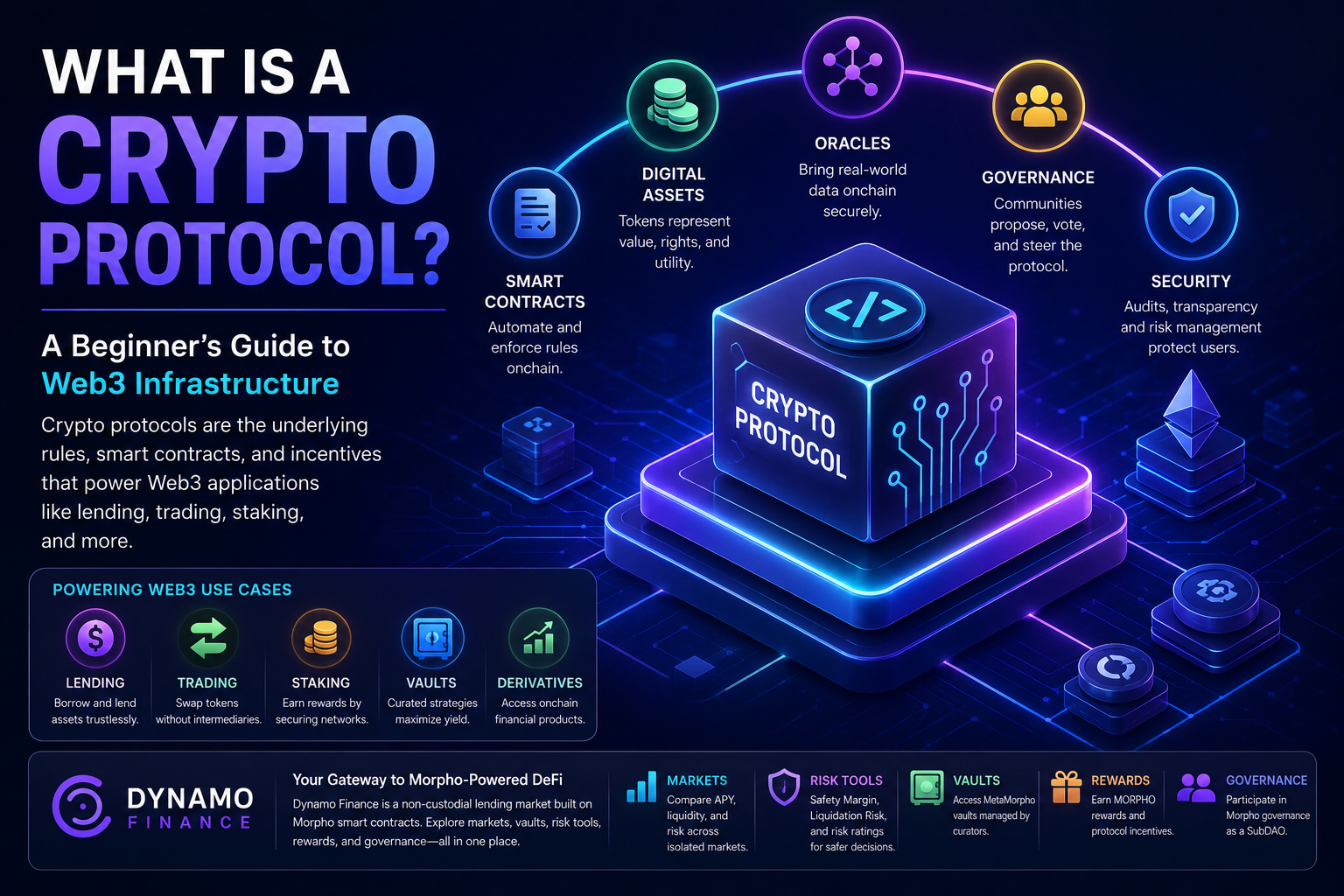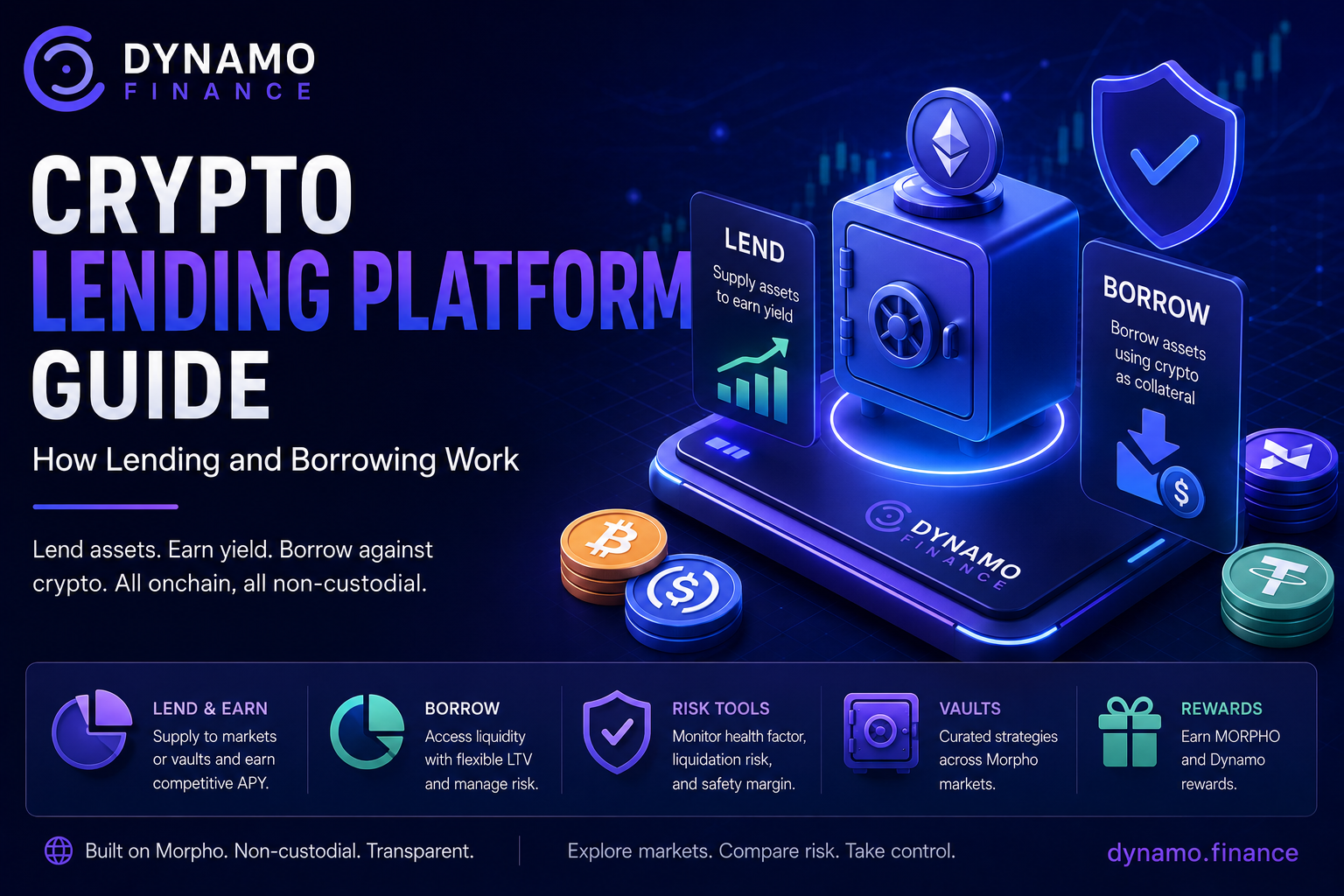

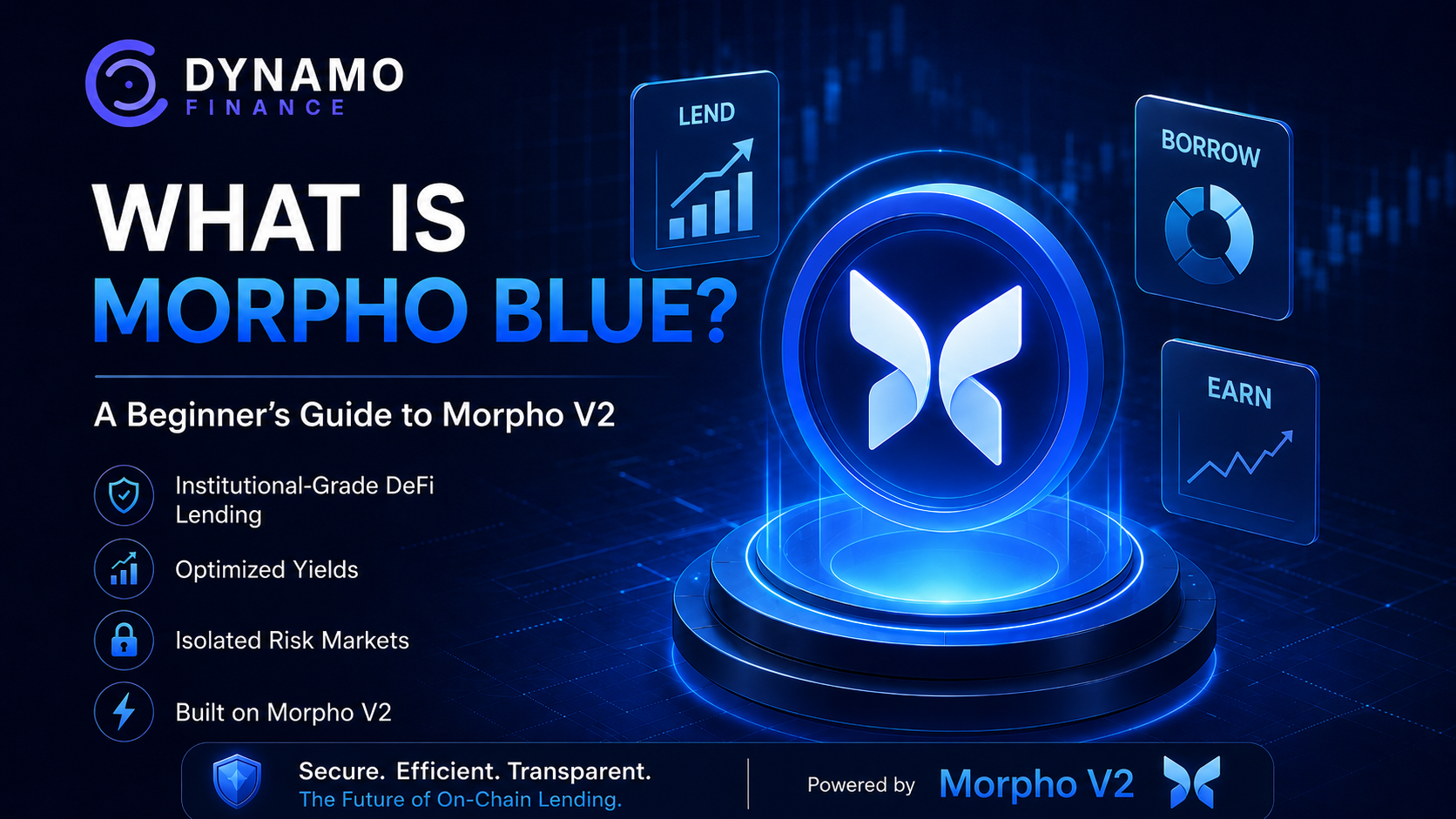
DeFi lending has matured from simple pooled money markets into a more modular, customizable credit system. For crypto-native users, DeFi investors, and yield seekers, that shift creates a major opportunity: better control over risk, collateral, liquidity, and yield. It also creates a new learning curve.
If you have searched for morpho blue, you are probably trying to understand why Morpho became one of the most talked-about lending protocols in crypto, how Morpho V2 fits into the picture, and where a platform like Dynamo Finance fits for real users.
Morpho Blue is the lending-market layer commonly associated with Morpho’s variable-rate, isolated lending model. It allows users and builders to create independent lending markets defined by a loan asset, collateral asset, oracle, interest-rate model, and liquidation loan-to-value parameter. Morpho V2 extends the Morpho ecosystem with newer infrastructure for more flexible lending, including fixed-rate, fixed-term markets and Vault V2 architecture.
This guide breaks down Morpho Blue in plain English, explains what people mean by Morpho V2, compares markets and vaults, and shows how Dynamo Finance helps users interact with Morpho-based lending through a more usable interface, curated vaults, risk tools, and position management workflows.
Key Takeaways
- Morpho Blue is best understood as Morpho’s isolated, variable-rate lending-market infrastructure, where each market has its own collateral, loan asset, oracle, and LLTV.
- Morpho V2 does not simply “replace” Morpho Blue. It expands the Morpho ecosystem with newer fixed-rate, fixed-term lending and Vault V2 infrastructure.
- Markets give advanced users direct control, while vaults simplify lending by allowing curated strategies to allocate deposits across markets.
- Dynamo Finance is built on Morpho smart contracts and adds a user-facing layer for markets, vaults, risk visibility, rewards, and governance participation.
- DeFi lending can generate yield and unlock liquidity, but users must actively manage smart contract, oracle, liquidation, liquidity, and market risks.
What Is Morpho Blue?
Morpho Blue is the name many users still use for Morpho’s isolated lending-market design. In this model, each market is separate from every other market. A market is not a giant shared pool containing many collateral assets. Instead, each market pairs one loan asset with one collateral asset and uses its own oracle, interest-rate model, and liquidation loan-to-value threshold.
That structure matters because risk is easier to isolate. If a risky market has an oracle issue, collateral crash, or liquidity problem, the impact is intended to remain limited to that market rather than spreading across a large shared pool.
In practical terms, a Morpho Blue market might allow users to borrow USDC against ETH, or supply USDC to earn interest from borrowers using a specific collateral asset. The exact parameters depend on that market’s configuration.
The design is powerful, but it also requires users to think more carefully. In a traditional pooled lending protocol, many decisions are abstracted away by governance and risk managers. In Morpho’s isolated-market model, market selection becomes more important because each market can have different collateral quality, oracle setup, LLTV, liquidity depth, utilization, and rate behavior.
Why Morpho Blue Became Important in DeFi Lending
Early DeFi lending protocols made lending simple by pooling many assets together. That design helped DeFi grow, but it also created trade-offs. Shared pools can concentrate risk, require frequent governance decisions, and force users into a broad risk profile that may not match their goals.
Morpho Blue took a more modular approach. Instead of asking every user to accept one unified risk framework, it made lending markets more customizable and isolated. Builders, curators, and users could choose markets with specific collateral, loan assets, or risk parameters.
This shift is one reason Morpho became especially relevant for sophisticated DeFi users. It made lending infrastructure more like financial rails: flexible, composable, and open to different strategies.
For beginners, the simplest way to think about it is this: Morpho Blue separates the core lending engine from the risk-management layer. The market itself handles borrowing, lending, interest accrual, and liquidation rules. Vaults, curators, interfaces, and analytics tools can then sit on top to make that infrastructure easier and safer to use.
How Morpho Blue Markets Work
Every Morpho Blue-style market has a few core components. Understanding these terms will help you compare opportunities more confidently.
- Loan asset: The asset supplied by lenders and borrowed by borrowers, such as USDC, WETH, or another supported token.
- Collateral asset: The asset posted by borrowers to secure their loan.
- Oracle: The price source used to value collateral relative to the loan asset.
- IRM: The interest-rate model that determines how borrow rates respond to utilization.
- LLTV: The liquidation loan-to-value threshold that defines when a borrow position becomes liquidatable.
- Utilization: The share of supplied liquidity currently being borrowed.
Suppose a market uses USDC as the loan asset and ETH as collateral. Lenders supply USDC. Borrowers deposit ETH and borrow USDC. If the value of ETH falls or the borrower’s debt grows too much, the borrower’s LTV can approach the market’s LLTV. If the threshold is breached, liquidation can occur.
Interest rates are usually driven by utilization. When more liquidity is borrowed, utilization rises and rates tend to increase. When less liquidity is borrowed, rates tend to fall. For suppliers, higher utilization can mean higher yield, but it can also mean less available liquidity for immediate withdrawal.
Morpho Blue vs. Morpho V2
Morpho V2 is a broader evolution of the Morpho ecosystem. It is closely associated with fixed-rate, fixed-term lending markets, intent-based lending design, and Vault V2 infrastructure. Morpho Blue remains important because it represents the variable-rate, isolated market foundation that many users still interact with today.
The distinction can be confusing because users often search for “morpho v2” when they want to know whether Morpho Blue is outdated. A better framing is that Morpho Blue and Morpho V2 address different needs.
| Topic | Morpho Blue | Morpho V2 |
|---|---|---|
| Main focus | Variable-rate isolated lending markets | Newer lending infrastructure, including fixed-rate and fixed-term loan design |
| Rate model | Rates generally respond to utilization through an interest-rate model | Market-driven pricing can allow more specific loan terms and fixed-rate structures |
| User experience | Powerful but market selection can be complex | Designed to expand flexibility for more advanced lending use cases |
| Vault relationship | MetaMorpho-style vaults can allocate across markets | Vault V2 adds broader adapter-based curation and risk-control capabilities |
| Best fit | Users who want variable-rate lending, borrowing, and isolated market exposure | Users and institutions seeking more customized terms, pricing, and fixed-duration credit |
The key point is that Morpho V2 should not be treated as a simple rebrand of Morpho Blue. Morpho Blue is the variable-rate market layer many DeFi users know. Morpho V2 expands the architecture for more flexible credit markets.
Markets vs. Vaults: The Core Choice for Users
Most users interact with Morpho through either markets or vaults. Both can be useful, but they serve different types of users.
Markets Give You Direct Control
A direct market deposit lets you choose exactly where your capital goes. You can select a specific loan asset, collateral pair, oracle, LLTV, utilization level, and APY profile.
This is attractive for advanced users who already know how to evaluate market parameters. For example, a lender may prefer a USDC market backed by highly liquid collateral, moderate utilization, and a long live history. Another lender may accept higher risk for higher yield in a newer or more specialized market.
Direct markets are not “set and forget.” You need to monitor liquidity, utilization, collateral conditions, oracle design, and potential changes in borrower demand.
Morpho does not provide a way to supply assets directly to markets; however, Dynamo Finance does.
Vaults Simplify Allocation
Vaults are designed for users who want exposure to lending yield without manually selecting and rebalancing across individual markets. A vault accepts a deposit asset and allocates capital across markets according to a curator’s strategy.
In a vault, the user receives vault shares representing their proportional claim. As borrowers pay interest in the underlying markets, the vault’s assets can grow, and the user benefits through the value of their share position.
Vaults are easier for beginners because they reduce the number of decisions. However, they introduce curator risk, strategy risk, and allocation risk. You still need to understand where the vault deploys capital, how diversified it is, what fees apply, and whether its risk profile matches your goals.
Where Dynamo Finance Fits
Dynamo Finance is a non-custodial, permissionless DeFi lending interface built on Morpho smart contracts. The important point is that Dynamo does not custody user funds. User transactions interact with Morpho’s on-chain lending infrastructure, while Dynamo adds an interface, analytics, vault access, governance participation, and tooling around that infrastructure.
For a user exploring morpho defi, this matters because the base protocol and the user experience are not the same thing. Morpho provides the lending rails. Dynamo helps users navigate those rails with clearer market discovery, risk views, vault workflows, and position management.
The protocol is especially relevant for three user types:
- Yield seekers who want to compare Morpho-based vaults and markets from one interface.
- Borrowers who want a clearer way to monitor collateral, LTV, and liquidation risk.
- Crypto-native users who want more market-level control without losing access to curated vault strategies.
Dynamo also positions itself as more than a basic front end. It operates as a SubDAO within the Morpho ecosystem, aggregates community voting power, and supports governance participation around Morpho-related decisions.
How Dynamo’s Markets Help Morpho Users
Dynamo’s market experience is built around the idea that Morpho markets are powerful but require data. A user should not evaluate a market based on APY alone. High APY may reflect healthy borrower demand, but it may also signal elevated utilization, lower liquidity, volatile collateral, or more aggressive risk settings.
On Dynamo, users can browse markets and compare relevant metrics before supplying or borrowing. The goal is to make market selection more practical for users who want direct exposure instead of only depositing into a vault.
This is useful for anyone researching crypto lending platform options because DeFi lending is not just about chasing yield. It is about matching the loan asset, collateral asset, market depth, liquidation threshold, and risk profile to your strategy.
For example, a conservative stablecoin supplier may look for markets with established collateral, larger liquidity, and lower operational complexity. A more advanced DeFi user might explore a higher-yielding market but only after reviewing utilization, oracle design, collateral volatility, and liquidation parameters.
How Dynamo’s Vaults Help Yield Seekers
Vaults are one of the most beginner-friendly ways to access Morpho-based lending. Instead of manually allocating funds across several markets, a user deposits into a vault and lets the strategy allocate capital.
Dynamo surfaces vaults so users can compare underlying asset, APY, TVL, curator, market exposure, and allocation structure. This is important because vault APY is blended across the markets where the vault deploys capital. A vault may shift allocations as market rates change, which can help maintain yield without requiring the user to rebalance manually.
That does not mean vaults are risk-free. A vault can be exposed to multiple markets, and each market can carry its own oracle, collateral, liquidity, and liquidation risks. A well-diversified vault may reduce single-market concentration, but users should still review allocation breakdowns and understand the curator’s approach.
For passive yield seekers, vaults can offer a smoother path into lending cryptocurrency. For active users, direct markets may offer more control. Many users will use both depending on their portfolio goals.
Borrowing Against Crypto with Morpho Blue-Style Markets
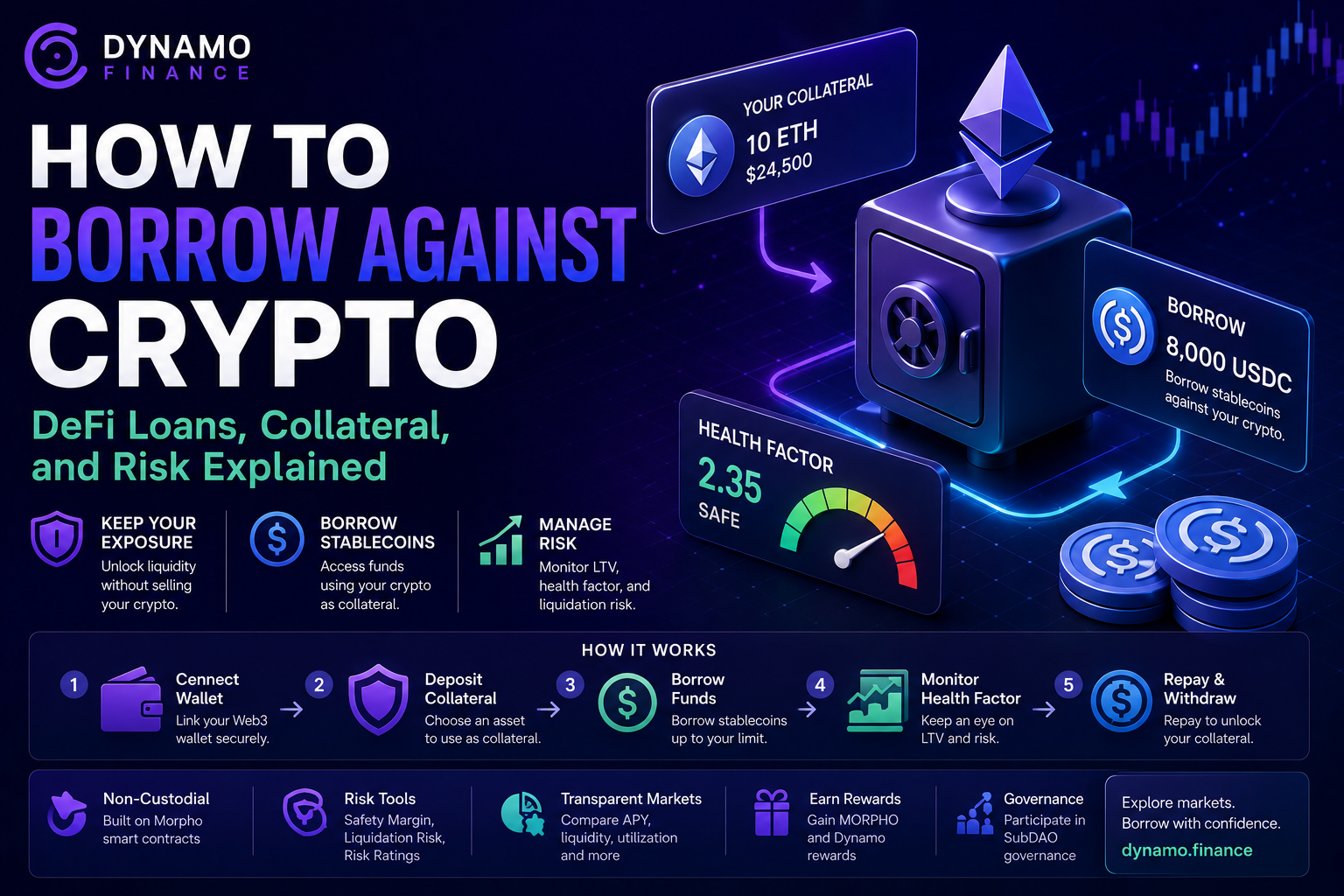
Borrowing is one of the most common reasons users explore Morpho. Instead of selling crypto assets, a borrower can post collateral and borrow another asset. This can help unlock liquidity while maintaining exposure to the collateral asset.
For example, a user who holds ETH may want USDC liquidity without selling ETH. In a Morpho-based market, they can deposit ETH as collateral and borrow USDC, provided the market supports that pair and the user stays below the liquidation threshold.
This is where cryptocurrency loans become a practical question rather than a buzzword. The borrower must understand LTV, LLTV, collateral volatility, borrow APY, interest accrual, and liquidation triggers.
A beginner should avoid borrowing near the maximum allowed LTV. A safer approach is to leave a buffer, monitor health factor, and be prepared to repay debt or add collateral if market conditions change.
Understanding LTV, LLTV, and Health Factor
LTV stands for loan-to-value. It measures how much you have borrowed compared with the value of your collateral. If you deposit $10,000 of collateral and borrow $5,000, your LTV is 50%.
LLTV stands for liquidation loan-to-value. It is the point at which a position becomes eligible for liquidation. If a market has an LLTV of 80%, a borrower should not treat 80% as a target. It is a danger line.
Health factor is a simplified way to understand how close a borrow position is to liquidation. A higher health factor means a larger safety buffer. A health factor near or below 1.0 means the position may be liquidatable.
In real market conditions, collateral prices can move quickly. Borrow rates can change as utilization changes. Oracles can update at moments that move a position closer to liquidation. That is why borrowers should monitor positions regularly, especially during volatile periods.
Dynamo’s Risk Framework and Why It Matters
Risk management is where many DeFi users make costly mistakes. A market can look attractive because of high APY, but that APY may not compensate for the actual risk. Dynamo addresses this with risk-focused tools such as risk ratings, market-level parameters, safety-margin concepts, and liquidation-risk visibility.
Dynamo assigns Low, Medium, and High risk tiers based on objective on-chain inputs such as LLTV, market TVL, and how long a market has been live. For vaults, relevant factors include total supplied value, market exposure, and live history.
This helps users move beyond surface-level APY comparison. A higher-yielding market with low TVL, new listing history, or aggressive parameters may fit an advanced strategy, but it may not fit a beginner’s first DeFi lending position.
Users can explore Dynamo’s risk tooling through the Dynamo risk dashboard and should treat risk data as part of the decision process, not as a guarantee of safety.
Important Risks in Morpho Blue and Morpho V2
DeFi lending always involves risk. Non-custodial does not mean risk-free. It means users retain control and responsibility for their assets, while smart contracts execute the rules.
Smart Contract Risk
Smart contracts can contain bugs, vulnerabilities, or unexpected behavior. Audits and formal verification can reduce risk, but they cannot eliminate it. Users should avoid depositing more than they can afford to lose.
Oracle Risk
Oracles determine collateral values. If an oracle is stale, manipulated, misconfigured, or disrupted, borrowers may be liquidated incorrectly or markets may experience bad debt. Since each isolated market has its own oracle configuration, oracle review matters.
Liquidation Risk
Borrowers can be liquidated if collateral value falls or debt grows enough to breach the market’s LLTV. Liquidation can happen quickly in volatile markets. Keeping a conservative LTV buffer is one of the simplest ways to reduce this risk.
Liquidity Risk
Suppliers may not always be able to withdraw instantly if market utilization is very high. Vault users may also face temporary withdrawal constraints if the underlying markets have limited available liquidity.
Curator and Strategy Risk
Vaults depend on curation. A curator’s allocation decisions, market selection, risk caps, and rebalancing approach affect the vault’s results. Users should review allocation transparency and not assume all vaults have the same risk profile.
How to Evaluate a Morpho Market Before Supplying
A good DeFi lending process starts before the deposit. Use a repeatable checklist so you do not get distracted by headline APY.
- Identify the loan asset you will supply and confirm you understand its risks.
- Review the collateral asset and ask how volatile or liquid it is.
- Check the market’s LLTV and decide whether it is conservative or aggressive.
- Review utilization, because high utilization can affect both yield and withdrawal liquidity.
- Inspect the oracle source and understand how collateral is priced.
- Compare market TVL and live history to judge whether the market is battle-tested.
- Look at risk ratings and dashboard data rather than relying only on APY.
This approach is especially useful for users moving from centralized yield products into DeFi. In DeFi, the transparency is better, but the responsibility is also higher.
How to Evaluate a Morpho Vault Before Depositing
Vault evaluation is slightly different because you are not choosing one market. You are choosing a curated strategy that may allocate across several markets.
Before depositing, review the vault’s deposit asset, curator, APY, TVL, allocation breakdown, market concentration, fee structure, and withdrawal conditions. A vault with high APY but concentrated exposure to a risky market may not be appropriate for a conservative user.
Also consider how the vault earns yield. If yield comes from borrower interest, incentives, or third-party rewards, those sources may change over time. Incentives can make an APY look temporarily attractive, but they may not persist.
For beginners, a stablecoin vault with diversified exposure and transparent allocations may be easier to understand than a niche vault chasing a very high yield. For advanced users, specialized vaults may be useful tools, but only when the risk profile is intentional.
Dynamo Rewards and Incentives
Yield on Dynamo can come from several sources. Base yield comes from borrower interest in Morpho markets. Some markets may also have MORPHO token emissions or other reward campaigns. Dynamo-specific incentives are part of Dynamo’s broader reward layer, and users should verify active campaigns, eligibility, and claim mechanics in the interface.
The main takeaway is that headline APR or APY may combine multiple components. A user should separate base lending yield from token incentives. Base lending yield reflects market activity. Incentives can be valuable, but they may be time-limited and subject to program rules.
This matters for portfolio planning. A vault may look attractive during an incentive period, but the expected return can change when incentives end or market utilization falls.
Fees: What Users Should Check
Fees can affect net returns. Dynamo’s market-level fee information should be checked at the market detail level before depositing. In particular, loan-asset deposits made through the Dynamo interface may have a deposit fee if the relevant fee switch is active.
Vaults can also involve fees such as performance fees or management fees depending on the vault structure and curator. Users should review the vault detail page before depositing and compare net yield rather than gross APY alone.
In DeFi, fees are not always presented like they are in traditional brokerage accounts. They may appear through deposit deductions, vault share accounting, performance fees, gas costs, or spread and slippage from related transactions.
Practical Example: A Conservative Stablecoin Yield Strategy
Imagine a user holds USDC and wants to earn DeFi yield without actively trading. They are interested in Morpho Blue but do not want to manually analyze many markets every week.
A reasonable starting point could be reviewing stablecoin vaults on Dynamo. The user would compare vault TVL, curator, APY, allocation breakdown, and risk rating. They would check whether the vault is diversified across markets or concentrated in one borrower collateral type.
If the vault’s risk profile fits, the user could deposit a small test amount first, monitor the position, and then scale gradually. This is often better than depositing a large amount immediately based on an attractive APY.
The user should also track whether yield comes primarily from borrower interest or temporary rewards. If rewards are a major portion of APY, the user should expect returns to change.
Practical Example: Borrowing USDC Against ETH
Now imagine a user holds ETH and wants USDC liquidity for expenses, trading, or another DeFi strategy. Selling ETH would create market exposure changes and possibly tax considerations. Borrowing against ETH may be an alternative.
The user would look for a market where ETH or a related asset is accepted as collateral and USDC is available as the loan asset. They would review LLTV, borrow APY, collateral volatility, oracle setup, and available liquidity.
Instead of borrowing near the maximum, the user might target a conservative LTV. If the market allows liquidation at 80% LTV, the user may choose to borrow far below that level. The exact buffer depends on their risk tolerance and the volatility of the collateral asset.
After borrowing, the work is not finished. The user should monitor health factor, collateral price, borrow rate changes, and any market stress. If ETH falls sharply, the user may need to repay part of the loan or add collateral.
Why Morpho Blue Matters for Builders and Curators
Morpho Blue is not only a user-facing lending product. It is infrastructure. Builders can create markets. Curators can build vault strategies. Interfaces can create user experiences on top. DAOs can participate in governance and risk curation.
This modularity is part of why Morpho has attracted attention across DeFi. Instead of one protocol trying to own every decision, the ecosystem lets different participants specialize. One team may focus on risk curation. Another may focus on analytics. Another may build a better borrowing interface or build vault strategies for a specific collateral category.
Dynamo’s role is to make that infrastructure more accessible through a platform focused on lending, borrowing, vaults, risk data, and governance participation. Users who want to go deeper can review Dynamo Finance documentation for platform workflows, market concepts, vault concepts, fees, and risk material.
Authoritative Resources for Further Research
Readers who want to verify the underlying protocol mechanics should use primary sources whenever possible. Morpho’s official market documentation explains variable-rate markets and isolated market parameters and cover the newer adapter-based vault architecture. Morpho’s V2 announcement explains the direction toward fixed-rate, fixed-term, market-driven loan pricing.
Useful references include Morpho variable-rate market documentation, Morpho Vault V2 documentation, and Morpho risk and security documentation.
For updates from Dynamo, users can also follow Dynamo Finance on X.
Common Mistakes Beginners Make
The first mistake is chasing APY without understanding the source of yield. A high number may come from high utilization, incentives, riskier collateral, or a newer market. None of those are automatically bad, but they require context.
The second mistake is borrowing too close to the liquidation threshold. A position that looks safe during calm markets can become risky during a sudden drawdown.
The third mistake is assuming vaults remove all risk. Vaults simplify allocation, but they do not eliminate market, oracle, liquidity, or smart contract risk.
The fourth mistake is ignoring fees and rewards timing. Net returns can change after fees, gas, or incentive changes.
The fifth mistake is failing to monitor positions. DeFi is transparent and always on, but markets move quickly. Users should treat lending and borrowing positions as active financial positions, not static bank deposits.
Is Morpho Blue Good for Beginners?
Morpho Blue can be beginner-friendly when accessed through clear interfaces and conservative strategies, but the raw market structure is more advanced than a simple savings product. Beginners should start by understanding the difference between supplying, borrowing, and depositing into a vault.
For many new users, vaults may be the easier entry point because they reduce the need to choose individual markets. However, beginners should still review the vault’s allocation, curator, fees, TVL, and risk profile.
Direct market use may be better for users who already understand collateral, LLTV, utilization, oracle risk, and liquidity risk. If you do not understand those terms yet, spend more time learning before borrowing or supplying large amounts.
Conclusion: Morpho Blue, Morpho V2, and the Next Phase of DeFi Lending
Morpho Blue helped push DeFi lending toward a more modular model: isolated markets, permissionless creation, transparent parameters, and externalized risk management. Morpho V2 expands that direction with newer infrastructure for more flexible loan terms, market-driven pricing, and advanced vault design.
For users, the opportunity is clear. Morpho-based lending can support yield strategies, collateralized borrowing, vault-based allocation, and more precise market selection. The responsibility is equally clear. Users must understand market parameters, liquidation mechanics, vault exposure, incentives, and risk controls.
Dynamo Finance brings this ecosystem into a more accessible workflow by combining Morpho-based markets and vaults with risk analytics, user-friendly position management, rewards, and governance participation. Whether you are a yield seeker, borrower, or crypto-native investor, the best starting point is not the highest APY. It is the market or vault whose risks you actually understand.
Explore Dynamo Finance, compare markets and vaults, review risk data, and start with a position size that matches your knowledge and risk tolerance.
FAQ
What is Morpho Blue in simple terms?
Morpho Blue is Morpho’s isolated lending-market infrastructure. Each market pairs one loan asset with one collateral asset and has its own oracle, interest-rate model, and liquidation loan-to-value setting. This design helps isolate risk market by market.
Is Morpho V2 the same as Morpho Blue?
No. Morpho Blue refers to the variable-rate isolated market model many users know from Morpho’s earlier architecture. Morpho V2 expands the ecosystem with newer infrastructure, including fixed-rate, fixed-term lending and Vault V2 capabilities.
How do Morpho vaults earn yield?
Morpho vaults earn yield by allocating deposited assets into lending markets where borrowers pay interest. Curators manage allocations and rebalancing. Users receive vault shares that represent their proportional claim on the vault’s assets.
Can I borrow against crypto using Morpho-based markets?
Yes, if a market supports your collateral and desired loan asset. You deposit collateral, borrow the loan asset, and maintain a safe LTV. If your position reaches the liquidation threshold, your collateral can be liquidated.
How does Dynamo Finance relate to Morpho?
Dynamo Finance is built on Morpho smart contracts and adds a user-facing layer for markets, vaults, risk data, rewards, and governance participation. When users transact through Dynamo, the underlying lending activity is executed through Morpho’s on-chain infrastructure.