
DeFi yield is no longer just about finding the highest APY on a dashboard. The market has become more specialized, with curated vaults, isolated lending markets, tokenized collateral, private credit exposure, liquid staking assets, and automated allocation strategies all competing for capital. That is why more yield seekers are searching for vaults and trying to understand what Smokehouse vaults actually do.
The opportunity is attractive: deposit assets into a curated vault, earn yield from lending markets, and avoid manually rotating across every opportunity yourself. The challenge is that vaults can hide complexity. A vault may look simple on the frontend, but under the surface it may allocate capital across markets with different collateral, liquidity, oracle, and borrower-risk profiles.
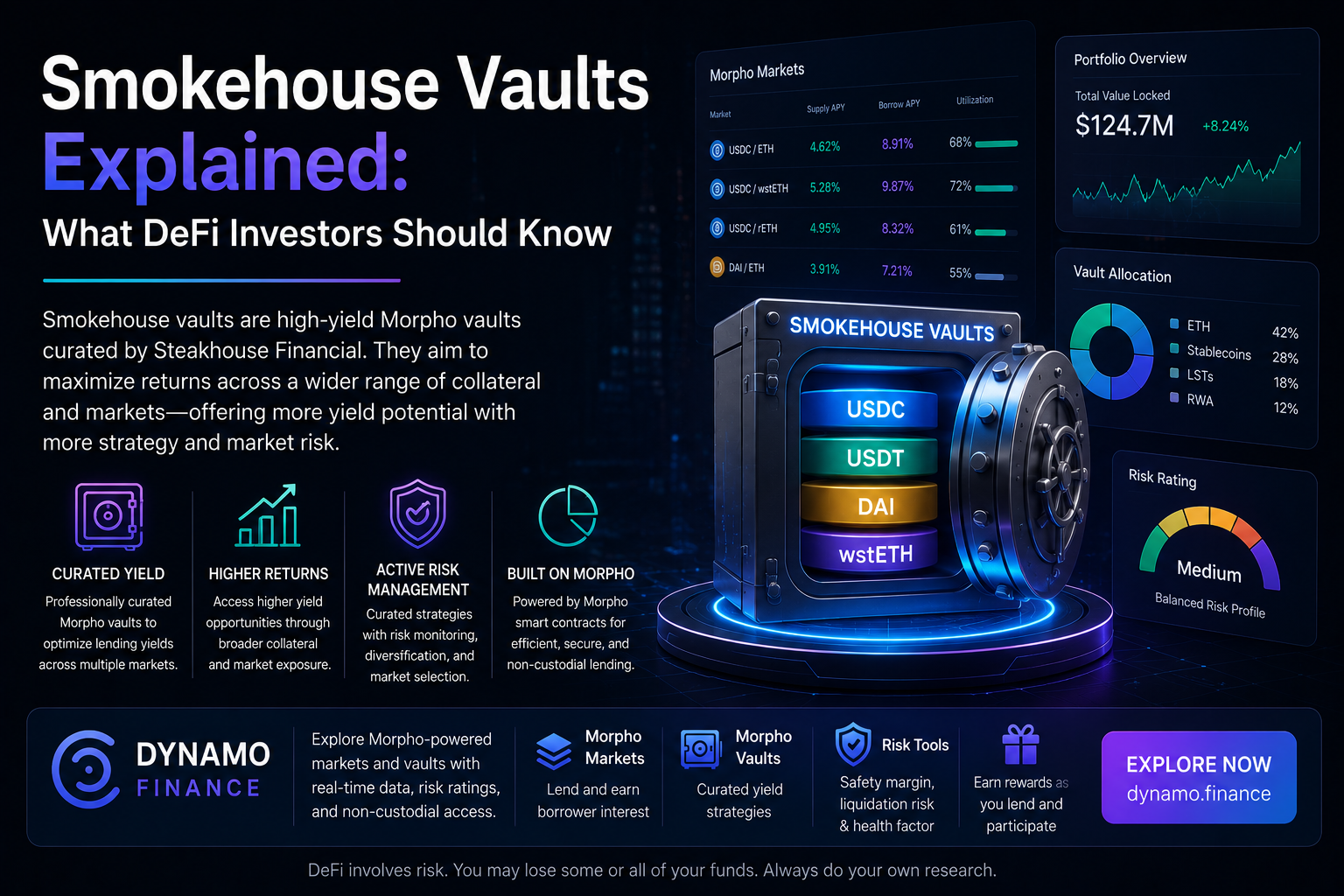
Smokehouse vaults are high-yield Morpho vaults curated by Steakhouse Financial. They are designed to optimize lending yield across a wider range of collateral than more conservative vault lines, which can create higher return potential but also introduces greater strategy, collateral, concentration, liquidity, and market risk.
This guide explains how Smokehouse vaults work, why they matter for DeFi investors, how they compare with other lending vaults, what risks beginners need to understand, and how users can evaluate Morpho-based markets and vaults through Dynamo Finance.
Key Takeaways
- Smokehouse vaults are Morpho-based high-yield lending vaults curated by Steakhouse Financial, generally designed for users comfortable with broader collateral exposure.
- Vault yield usually comes from borrowers paying interest in underlying lending markets, not from a guaranteed fixed return.
- Higher-yield vaults may use more specialized collateral, more concentrated allocations, higher utilization, or newer market opportunities.
- Dynamo Finance helps users compare Morpho-based markets and vaults with risk ratings, market data, allocation visibility, Safety Margin, Liquidation Risk views, rewards, and non-custodial access.
- Before depositing into any vault, investors should review curator, collateral, allocation, APY stability, liquidity, fees, market exposure, and downside scenarios.
What Are Smokehouse Vaults?
Smokehouse vaults are high-yield lending vaults associated with Steakhouse Financial and Morpho infrastructure. They are part of a broader category of curated DeFi vaults where a curator manages how deposited assets are allocated across underlying lending markets.
The name “Smokehouse” is generally used for Steakhouse’s higher-yield vault line, including examples such as Smokehouse USDC, Smokehouse USDT, Smokehouse DAI, and Smokehouse wstETH across supported networks and deployments. Steakhouse describes Smokehouse-style vaults as targeting higher risk-adjusted returns through exposure to a wider range of collateral, rather than limiting allocation only to the most conservative assets.
In plain English, a Smokehouse vault lets users deposit an asset, such as USDC, and receive vault shares. The vault then allocates that asset into Morpho lending markets selected by the curator. Borrowers in those markets pay interest, and that interest flows back to depositors through the vault’s share value.
Smokehouse vaults are not bank savings products. They are onchain DeFi strategies. Returns can change, liquidity can tighten, and underlying markets can carry collateral, oracle, liquidation, smart contract, and curator risks.
Who Is Steakhouse Financial?
Steakhouse Financial is a DeFi advisory, research, and vault curation firm known for institutional-grade risk curation across crypto-native and real-world asset markets. It has become one of the most visible curators in the Morpho ecosystem, where curated vaults are a major part of the lending stack.
Morpho has highlighted Steakhouse Financial as a major curator using Morpho infrastructure across multiple chains and vault types. Steakhouse’s work includes stablecoin vaults, high-yield vaults, risk curation, private credit integrations, treasury-related strategies, and onchain asset management. Readers who want primary context can review the Morpho Steakhouse Financial case study.
The curator role matters because a vault is not only a smart contract. It is also a strategy. The curator decides which markets are eligible, how much capital each market can receive, and how the vault should react when yields, utilization, collateral conditions, or liquidity change.
For DeFi investors, the practical question is not only “What is the vault APY?” It is “Who curates the vault, what markets does it use, how concentrated is it, and does the strategy fit my risk tolerance?”
How Smokehouse Vaults Work
Smokehouse vaults use the same basic vault logic that has become common across Morpho-based lending. A vault accepts deposits in one asset and allocates that asset into underlying lending markets. Users receive vault shares that represent their proportional claim on the vault.
The basic process works like this:
- A user deposits a supported asset, such as USDC, into a Smokehouse vault.
- The vault mints shares representing the user’s position.
- The curator allocates vault liquidity across selected Morpho lending markets.
- Borrowers in those markets post collateral and borrow the vault’s supplied asset.
- Borrowers pay interest, and that interest contributes to the vault’s return.
- The curator or allocation process may rebalance as market conditions change.
- The user can redeem vault shares for the underlying asset, subject to available liquidity in the underlying markets.
That flow is easy to understand, but the details matter. A vault’s return depends on borrower demand, utilization, collateral types, market selection, liquidity, fees, and curator decisions. A vault can also be exposed to temporary market stress if many users withdraw while the underlying markets are highly utilized.
In a lending vault, the user is not lending to one borrower. The user is taking exposure to a curated set of markets. That is more diversified than a single-market deposit in some cases, but it can still be concentrated if the vault allocates heavily to a small number of markets.
How Morpho Vaults Generate Yield
Morpho vaults generate yield by allocating deposits into Morpho lending markets. In those markets, borrowers post collateral and pay interest to borrow the loan asset. Suppliers receive yield from that borrower-paid interest.
In a direct Morpho market, the user chooses one specific loan asset and collateral pair. For example, a user might supply USDC to a market where borrowers post a specific collateral asset. In a vault, the curator makes allocation decisions across multiple eligible markets.
This is why morpho vaults are so important to DeFi yield. They reduce the need for users to manually choose and rebalance across markets. Instead, the vault attempts to create a blended return from multiple allocations.
However, vaults do not remove risk. They change the user’s risk exposure from direct market selection to curator and strategy selection. A user must evaluate both the vault wrapper and the underlying markets.
Smokehouse Vaults vs. More Conservative Vaults
Smokehouse vaults are typically positioned as higher-yield vaults compared with more conservative, prime-style stablecoin vaults. The difference usually comes from collateral scope, market opportunity set, concentration tolerance, and risk appetite.
A conservative vault may prioritize deeper markets, more established collateral, and lower complexity. A Smokehouse-style vault may allocate across a wider set of collateral types to capture higher yields when opportunities appear. That can improve returns during favorable conditions, but it can also increase downside if specialized collateral becomes illiquid or volatile.
| Feature | Smokehouse Vaults | More Conservative Lending Vaults |
|---|---|---|
| Primary goal | Optimize for higher risk-adjusted yield across a wider opportunity set | Prioritize steadier lending yield with more conservative collateral exposure |
| Collateral exposure | May include broader or more specialized collateral types | Usually focuses on more established or liquid collateral |
| Yield profile | Potentially higher, but more variable | Potentially lower, but often easier to evaluate |
| Investor fit | Experienced users comfortable with elevated vault and market risk | Users seeking simpler, more conservative lending exposure |
| Main due diligence focus | Collateral quality, concentration, curator process, liquidity, fees, and market complexity | Collateral depth, APY stability, liquidity, curator quality, and withdrawal conditions |
The point is not that one category is always better. The right vault depends on the investor. A higher-risk vault may fit a small satellite allocation for an experienced user. A more conservative vault may fit a larger stablecoin allocation where liquidity and simplicity matter more than maximum APY.
Why Smokehouse Vaults Became Popular
Smokehouse vaults became interesting because they sit at the intersection of three major DeFi trends: curated lending, Morpho market isolation, and demand for higher stablecoin yield.
First, curated lending is replacing simple APY chasing. Users increasingly understand that vaults need professional curation, market selection, monitoring, and risk controls. Curators such as Steakhouse Financial can create strategies that would be difficult for many users to manage manually.
Second, Morpho’s isolated market design makes vault curation more flexible. Each Morpho market has its own loan asset, collateral asset, oracle, interest-rate model, and liquidation loan-to-value threshold. That lets curators select specific markets rather than accepting a broad pooled-risk profile.
Third, stablecoin investors continue to seek yield. When conservative markets become crowded and returns compress, higher-yield vaults can attract users willing to accept broader collateral exposure or more strategy complexity.
Smokehouse vaults exist because some users want more than the lowest-risk lending opportunities. The important question is whether the additional expected yield compensates for the added risk.
What Does “High Yield” Mean in a Smokehouse Vault?
High yield does not mean guaranteed yield. In DeFi lending, yield is usually variable and depends on market conditions. Borrower demand, utilization, available supply, incentives, and market risk can all affect APY.
A Smokehouse vault may earn higher yield because it allocates to markets where borrowers are willing to pay more. Borrowers may pay more because the collateral is specialized, the market is newer, liquidity is scarcer, utilization is higher, or the strategy captures a temporary opportunity.
That can be attractive, but it also creates a key risk question. Is the higher APY a reward for efficient market selection, or is it compensation for taking more risk?
Experienced investors do not treat APY as a standalone decision. They ask why the yield exists. If the reason is unclear, the position may not belong in the portfolio.
Key Assets and Collateral Types to Watch
Smokehouse-style vaults can allocate across a broader range of collateral than more conservative vaults. Depending on the vault and market environment, users may see exposure to assets such as stablecoins, liquid staking tokens, liquid restaking tokens, fixed-maturity tokens, yield-bearing stablecoins, tokenized real-world assets, or private credit-related collateral.
Each collateral type has different risks. A blue-chip collateral asset may have deep liquidity and strong oracle coverage. A fixed-maturity token may depend on maturity date, underlying yield source, and secondary-market liquidity. A tokenized private credit asset may depend on offchain legal structures, borrower quality, and redemption mechanics.
This is why collateral review matters. Two vaults may both accept USDC deposits, but their risk can be completely different if one lends against liquid ETH collateral and the other lends against specialized tokenized credit collateral.
For users evaluating morpho lending opportunities, the deposit asset is only the starting point. The collateral behind borrowers often matters more.
Smokehouse Fees and Net Yield
Fees can materially affect net returns. Steakhouse’s product materials indicate that Smokehouse vault fees are typically around a performance-fee model, with temporary waivers possible depending on product conditions. The reason is that higher-yield curation can involve more analysis, reallocation, and monitoring than simpler vault lines.
Users should never compare vault APYs without checking fees. A vault may show a strong gross return, but performance fees, gas costs, and incentive changes can affect the investor’s actual outcome.
Fee structures can also change by vault, chain, product line, or timing. Before depositing, review the live vault page and confirm current performance fee, management fee, withdrawal conditions, underlying asset, curator, chain, vault version, and allocation.
For external verification, the Steakhouse current product lines page provides useful context on current product categories and Smokehouse-style fee positioning.
Smokehouse Vaults and Legacy Deployments
Some Smokehouse vaults are part of earlier Morpho Vaults crypto V1 deployments. Steakhouse has identified certain older deployments as legacy vaults that remain operational because the underlying infrastructure is permissionless and immutable, while newer product lines may supersede them.
This matters because a vault can still be accessible even if it is no longer the curator’s primary focus. Users should check whether a vault is current, legacy, deprioritized, or part of a newer product line before depositing meaningful capital.
Legacy status does not automatically mean a vault is broken. It does mean the user should ask extra questions. Is the curator still actively supporting it? Is liquidity deep? Are allocations still being monitored? Are there migration recommendations?
The Steakhouse legacy vaults page is a useful reference for identifying older Steakhouse Morpho Vaults V1 deployments, including historical Smokehouse examples.
Where Dynamo Finance Fits
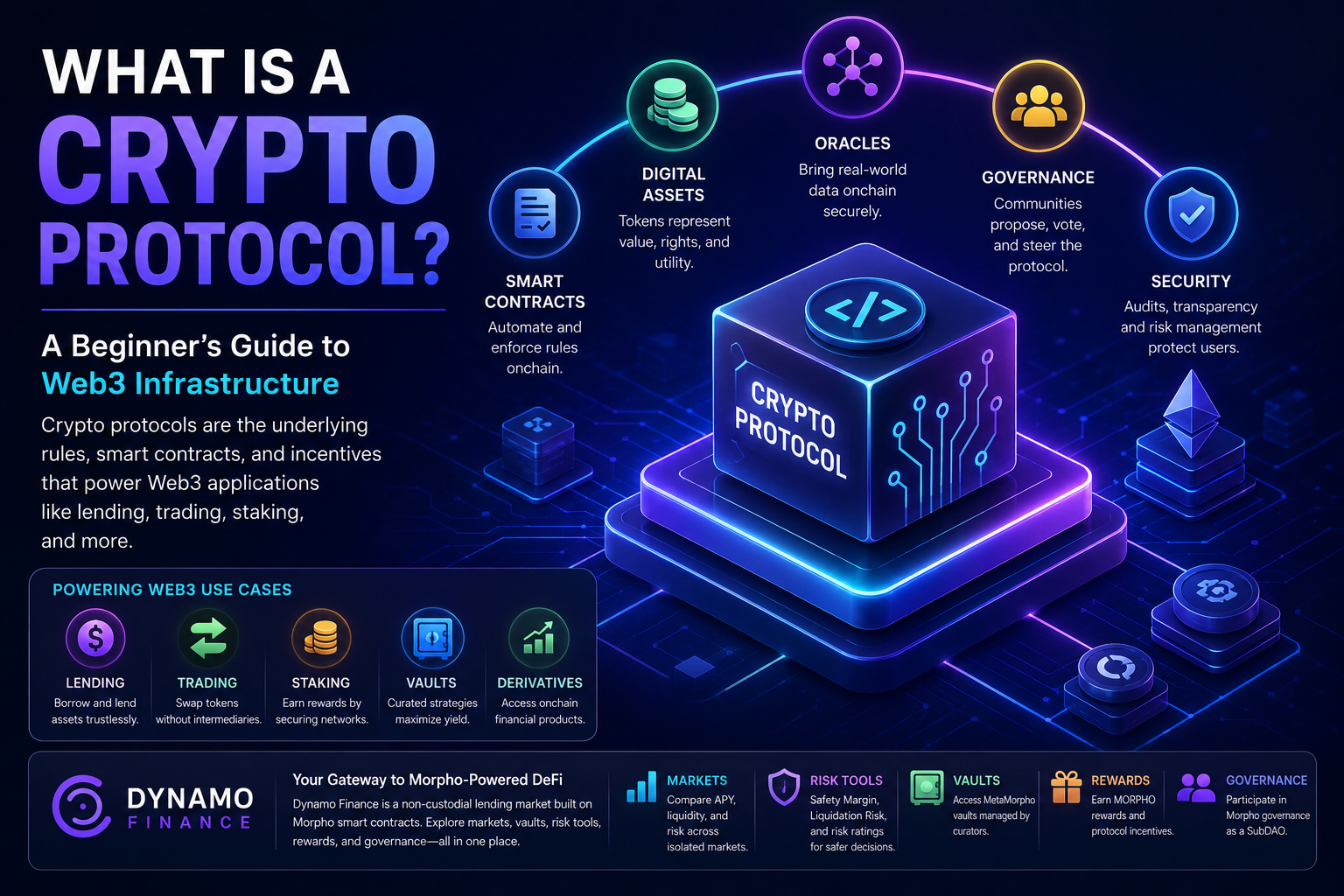
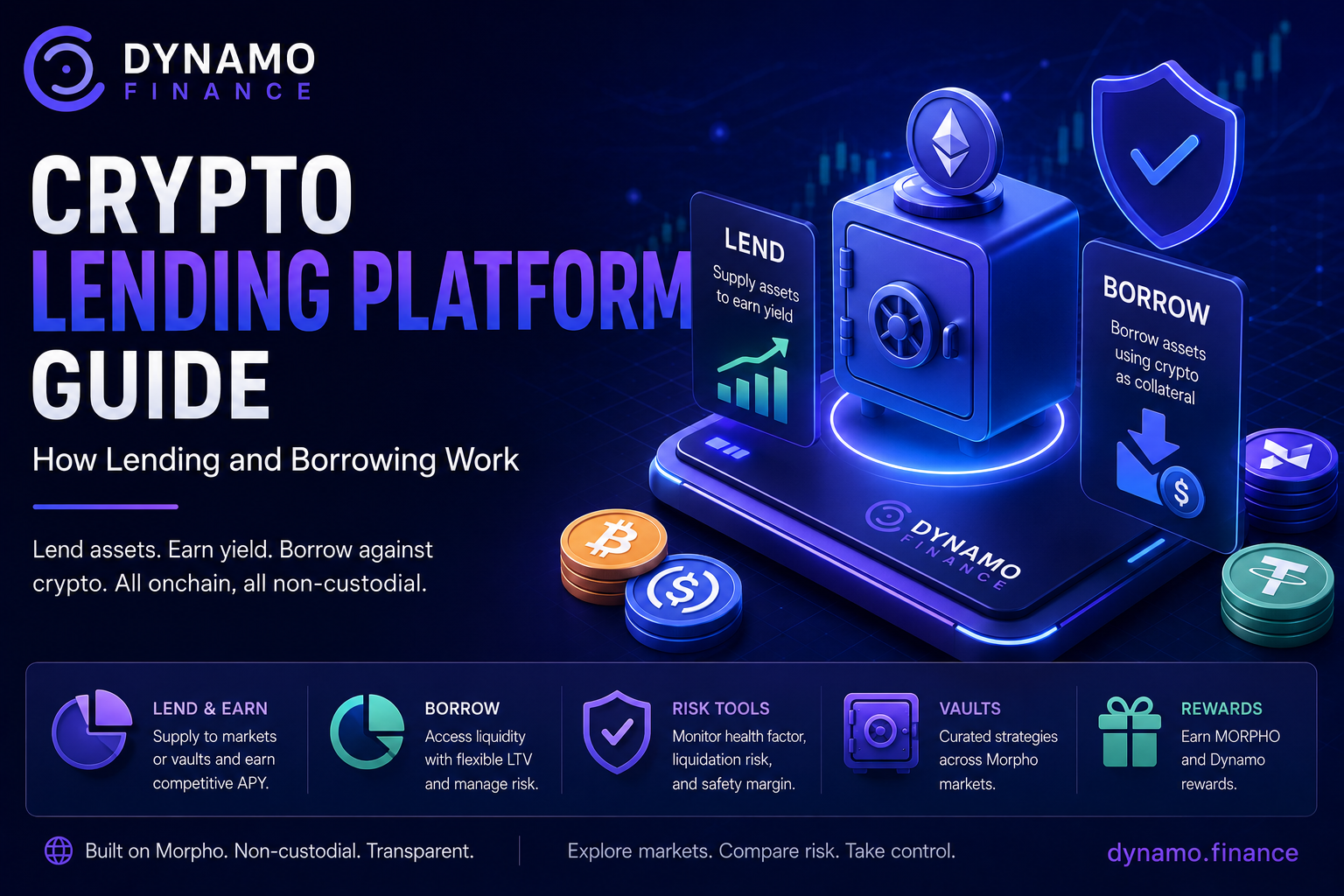
Dynamo Finance is a non-custodial, permissionless Web3 lending market built on Morpho smart contracts. It helps users supply assets, borrow against collateral, deposit into vaults, compare markets, evaluate risk, earn rewards, and participate in governance from one interface.
Smokehouse vaults show how curators can build higher-yield strategies on top of Morpho. Dynamo gives users tools to evaluate Morpho markets and vaults more directly.
Dynamo does not custody user funds. Assets are held by Morpho smart contracts, while Dynamo adds a user-facing layer for discovery, risk analytics, position management, rewards, and SubDAO governance participation.
For users who want to compare morpho crypto opportunities instead of relying only on a single vault page, Dynamo provides a more complete workflow around market data, vault data, risk tiers, and borrower protection tools.
Dynamo Markets: Direct Morpho Lending Exposure
Dynamo markets are isolated lending pools. Each market has one loan asset, one collateral asset, one oracle, one interest-rate model, and one liquidation loan-to-value threshold. This isolation helps users understand exactly what market they are entering.
When users supply a loan asset, they earn interest paid by borrowers. When users borrow, they post collateral and draw from the loan asset pool. Activity in one isolated market does not automatically affect another market.
This structure is useful because it makes risk easier to inspect. Users can review supply APY, borrow APY, utilization, available liquidity, collateral, loan asset, oracle, LLTV, and market verification.
For users evaluating Morpho lending strategies, direct market data is essential. It helps answer the most important question: what risk am I taking to earn this return?
Dynamo Vaults: Curated Strategies With More Visibility
Dynamo also supports vaults built on the MetaMorpho standard. A vault lets users deposit once while a curator allocates capital across selected Morpho markets. This can simplify yield access and reduce the need for manual rebalancing.
Vaults on Dynamo can be compared by curator, APY, TVL, underlying asset, market allocations, risk tier, and other available data. This is valuable because vaults are not interchangeable. The curator and allocation strategy determine much of the risk.
Dynamo’s vault workflow helps users see more than a headline APY. Users can evaluate whether a vault is diversified or concentrated, whether APY is stable or volatile, and whether the underlying markets match their risk tolerance.
Users can explore current vault opportunities through Dynamo vaults.
Dynamo Risk Ratings and Why They Matter
Dynamo assigns Low, Medium, and High risk tiers to markets and vaults based on objective onchain inputs. For markets, the framework considers factors such as LLTV, market TVL, and how long the market has been live. For vaults, it considers total supplied value, exposure to lower-risk markets, and live history.
These ratings are not predictions and do not guarantee safety. A Low-risk market can still suffer losses from an oracle failure, smart contract issue, or extreme collateral price move. But risk tiers help users avoid making decisions based only on APY.
This is especially relevant when thinking about Smokehouse-style vaults. Higher-yield vaults can be useful, but they require more careful review. A structured risk framework gives users a starting point for that review.
Users who want to understand Dynamo’s methodology can review the Dynamo Finance documentation, including the sections on markets, vaults, risk ratings, Safety Margin, Liquidation Risk, rewards, and fees.
Borrowing Against Crypto: The Other Side of Vault Yield
Vault depositors earn yield because borrowers pay interest. That means every lending vault has a borrowing market on the other side. Understanding borrower behavior helps suppliers understand where their yield comes from.
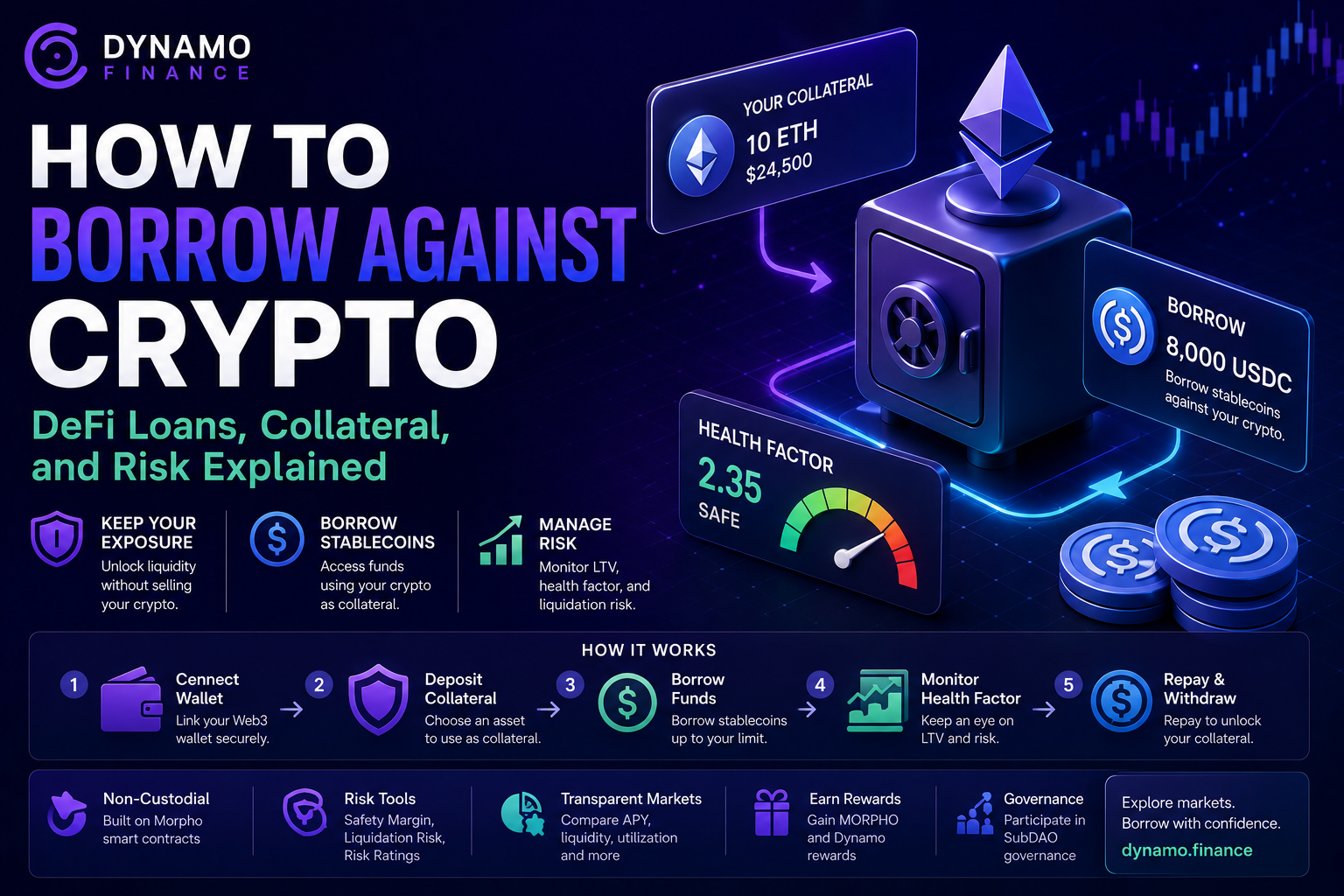
Borrowers post collateral and borrow a loan asset such as USDC, USDT, DAI, WETH, or another supported token. They pay interest to access liquidity. If collateral value falls or debt grows enough to breach the liquidation threshold, the position can be liquidated.
For users seeking a Morpho loan, the key is to borrow conservatively. A borrower should monitor LTV, LLTV, health factor, borrow APY, collateral volatility, and liquidation price.
Dynamo’s Safety Margin feature lets borrowers set a more conservative target LTV than the underlying liquidation threshold. Its Liquidation Risk view shows health factor, price-drop tolerance, and liquidation price so users can understand how much room they have before liquidation becomes likely.
How to Evaluate a Smokehouse Vault Before Depositing
A Smokehouse vault should be evaluated as a managed strategy, not as a simple yield number. Start with the asset you deposit, then work down into the markets where the vault allocates capital.
- Confirm the exact vault name, chain, underlying asset, vault address, and curator.
- Check whether the vault is current, legacy, or part of a newer product line.
- Review the vault’s APY, TVL, available liquidity, and performance history.
- Inspect the allocation breakdown across underlying Morpho markets.
- Identify the collateral assets borrowers use in those markets.
- Evaluate whether collateral is liquid, established, exotic, tokenized, or maturity-based.
- Check fees, including performance fees, management fees, and gas costs.
- Assess concentration risk: is the vault spread across many markets or dependent on a few?
- Review withdrawal liquidity and whether high utilization could delay redemptions.
- Size the position based on downside risk, not headline APY.
This checklist is intentionally conservative. Higher-yield vaults can be useful, but users should understand what makes the yield higher before allocating capital.
How to Evaluate Any Morpho Vault
The same process applies beyond Smokehouse. Any Morpho vault should be evaluated through curator, allocation, collateral, fees, APY, liquidity, and live history.
Start with curator reputation. A curator with strong risk discipline, transparent methodology, and a history of active monitoring may be more credible than an unknown curator chasing short-term yield.
Next, inspect market diversity. A vault with many markets may be more diversified, but only if those markets are meaningfully different. A vault concentrated in one collateral category may behave like a single risk exposure even if it uses multiple markets.
Finally, compare APY stability. A vault whose APY jumps wildly may be taking advantage of temporary opportunities, but it may also be exposed to volatile utilization. A lower but steadier APY may be better for users who value predictability.
Key Risks of Smokehouse Vaults
Smokehouse vaults can be useful for yield seekers, but users should understand the main risks before depositing. A higher-yield vault may involve more moving parts than a conservative lending and borrowing product.
- Smart contract risk: Vaults and underlying lending markets rely on code that can contain bugs or unexpected behavior.
- Collateral risk: Specialized collateral can lose value, become illiquid, or behave differently than expected during stress.
- Oracle risk: Incorrect, delayed, or manipulated price feeds can distort collateral valuation and liquidation outcomes.
- Liquidity risk: High utilization can reduce immediately available liquidity for withdrawals.
- Curator risk: Poor market selection or slow response to changing conditions can hurt vault performance.
- Concentration risk: A vault may rely heavily on a few markets, collateral types, or yield sources.
- Legacy vault risk: Older deployments may remain operational but no longer represent the curator’s preferred product line.
- Fee risk: Performance fees and gas costs can reduce net yield.
- Regulatory and tokenized asset risk: Exposure to real-world assets or tokenized credit can add legal, operational, and redemption complexity.
The most important beginner mistake is treating a vault as a savings account. A Smokehouse vault is an onchain investment strategy. It can be transparent and non-custodial, but it still carries real risk.
Why Exotic Collateral Requires Extra Care
Some higher-yield vaults can involve markets backed by more specialized collateral. This may include yield-bearing stablecoins, liquid staking tokens, fixed-maturity tokens, private credit tokens, or other assets that are more complex than plain ETH or USDC.
Exotic collateral is not automatically bad. In fact, it can create strong opportunities when properly underwritten. But it requires deeper due diligence because the asset may have additional layers of risk.
For example, a fixed-maturity token may depend on maturity timing and secondary-market liquidity. A private credit token may depend on an offchain borrower, legal structure, or redemption path. A liquid restaking token may depend on validator risk, restaking risk, and liquidity conditions.
When collateral becomes more complex, the vault’s curator matters more. Users should not assume that every deposit asset has the same risk simply because the vault accepts USDC.
Liquidity: The Risk Beginners Often Miss
Liquidity is the ability to exit a position without meaningful delay or loss. In lending vaults, liquidity depends on the underlying markets. If most supplied assets are currently borrowed, the vault may not be able to satisfy every withdrawal instantly.
This does not mean the vault is broken. It means the lending market is doing what it is designed to do: capital is being borrowed. But users should understand this before depositing.
High utilization can increase APY because borrowers are using more of the available supply. It can also reduce available liquidity. That trade-off is central to DeFi lending.
Before depositing into a Smokehouse vault, review available liquidity and underlying market utilization. If you may need immediate access to capital, do not allocate too much to a vault where withdrawals depend on stressed or highly utilized markets.
APY Stability and Yield Sources
APY can change quickly in DeFi. A vault that offers an attractive yield today may show a lower yield tomorrow if borrower demand falls, incentives end, or allocations shift.
Smokehouse vaults may pursue higher-yield opportunities that are not always stable. That can be useful for active users who understand variable returns. It may be less appropriate for users expecting predictable income.
When reviewing APY, ask where the yield comes from. Is it base borrower interest? Is it a temporary incentive? Is it linked to a specific collateral opportunity? Is it driven by high utilization? Is it net of fees?
Projected earnings are estimates. They are not promises. The best investors compare yield quality, not just yield size.
Practical Example: A USDC Holder Evaluating Smokehouse
Imagine a user holds USDC and wants more yield than a conservative stablecoin vault currently offers. They see Smokehouse USDC and notice the vault targets higher-yield lending opportunities.
A beginner might deposit immediately because the APY looks attractive. A more disciplined investor starts by reviewing the vault’s chain, TVL, liquidity, fee, curator, deployment status, and allocation breakdown.
Next, the user studies the underlying markets. Which collateral assets back the loans? Are they liquid? Are they established? Are they tokenized real-world assets, fixed-maturity tokens, or newer crypto-native assets? How concentrated is the vault in the top markets?
Finally, the user decides position size. If the vault uses broader collateral and higher-yield opportunities, the user may allocate only a smaller portion of their stablecoin portfolio while keeping the rest in lower-complexity products.
Practical Example: Comparing Smokehouse With a Direct Market
Suppose a user can either deposit USDC into a Smokehouse vault or supply USDC directly into a single Morpho market through Dynamo.
The Smokehouse vault offers convenience and curation. The curator allocates across markets and may rebalance as conditions change. The user gets a blended return but accepts curator and strategy risk.
The direct market offers control. The user chooses exactly which collateral pair, oracle, LLTV, utilization, and liquidity profile they want. The user may avoid some curator risk but takes on the responsibility of market selection.
Neither option is automatically better. A vault may fit users who prefer curated allocation. A direct market may fit users who want full control and are comfortable monitoring conditions.
Practical Example: Borrowing Against Crypto Instead of Depositing
Not every user is a supplier. Some users hold ETH, BTC, or another supported collateral asset and want liquidity without selling. In that case, borrowing may be more relevant than depositing into a vault.
A borrower can post collateral and borrow a loan asset. This can help unlock liquidity while preserving exposure to the collateral asset. But it also introduces liquidation risk.
Before borrowing, review the market’s LLTV, current LTV, borrow APY, oracle, collateral volatility, available liquidity, and liquidation price. Borrowing close to the maximum limit can be dangerous during volatility.
Dynamo’s Safety Margin and Liquidation Risk views are designed to help users manage this risk more carefully. Anyone researching how to borrow against crypto should start with liquidation mechanics, not maximum borrow size.
Common Mistakes With Smokehouse Vaults
The first mistake is assuming “curated” means “safe.” Curation can improve market selection, but it does not remove risk. A curated high-yield vault can still lose money or face liquidity constraints.
The second mistake is ignoring collateral. A USDC deposit vault may feel familiar, but the underlying borrower collateral may be complex. The collateral side often determines much of the risk.
The third mistake is ignoring legacy status. Some older vaults remain operational but may no longer be the newest or preferred version of a product line. Always check current product information before depositing.
The fourth mistake is treating APY as fixed. Vault APY changes as market rates, utilization, incentives, and allocations change.
The fifth mistake is depositing more than you can monitor. Higher-yield vaults require active attention, especially during market volatility or liquidity stress.
What Experienced DeFi Investors Look For
Experienced DeFi investors evaluate the mechanism before the return. They want to know what generates yield, who manages allocation, what collateral backs the loans, and how exits work.
They also separate base yield from temporary boosts. A vault may have incentives, but incentives can disappear. Borrower-paid interest is usually a more durable signal, though it also fluctuates.
Experienced users compare liquidity under stress, not only during normal conditions. They ask whether withdrawals can be met if utilization rises or if a large depositor exits.
Most importantly, experienced investors size positions around downside. A higher-yield vault may deserve a smaller allocation than a conservative market, even if the expected return is attractive.
How to Build a Risk-First Vault Strategy
A risk-first vault strategy starts with your objective. Are you trying to maximize yield, preserve liquidity, diversify stablecoin exposure, earn passive lending returns, or experiment with a small high-yield allocation?
Once the objective is clear, choose the appropriate vault type. Conservative vaults may be better for core stablecoin allocations. Higher-yield vaults such as Smokehouse may be better for users who understand the additional risks and can monitor conditions.
Then evaluate the full risk stack. Review curator, allocation, collateral, oracle, liquidity, utilization, fees, deployment history, and risk rating. Do not rely on APY alone.
Finally, monitor after entry. Vaults are dynamic. Allocations change. Market rates change. Collateral risk changes. The safest process is not passive; it is disciplined.
External Resources for Further Research
Readers researching Smokehouse vaults should start with primary sources. The Steakhouse Smokehouse USDC page shows a live Smokehouse vault interface on Base, including vault metrics, fees, allocation, rating, and curator information.
Morpho’s vault interface also lists Smokehouse deployments, including Smokehouse USDC on Ethereum and related Smokehouse vaults. The Morpho Steakhouse case study explains Steakhouse’s role as a major curator in the Morpho ecosystem.
For independent market context, platforms such as Staking Rewards and Trading Strategy provide third-party views on certain Smokehouse vault metrics, risk ratings, and historical performance data. Always verify live vault conditions before making decisions.
For Dynamo updates, market context, and product announcements, follow Dynamo Finance on X.
Final Checklist Before Depositing Into a Smokehouse Vault
Use this checklist before depositing into any Smokehouse vault or similar high-yield DeFi vault:
- Confirm the official vault URL, chain, vault address, and curator.
- Check whether the vault is current, legacy, or superseded by a newer product line.
- Review APY, TVL, available liquidity, performance history, and fee structure.
- Inspect the allocation breakdown and identify top market exposures.
- Understand the collateral assets used by borrowers in underlying markets.
- Review concentration risk across markets, collateral types, and chains.
- Check whether yield comes from borrower interest, incentives, or temporary market conditions.
- Evaluate whether high utilization could affect withdrawals.
- Start with a position size that matches your ability to monitor risk.
- Revisit the vault regularly because allocations and market conditions can change.
Conclusion
Smokehouse vaults are important because they show where DeFi yield is heading. The market is moving from simple lending pools toward curated, onchain asset management strategies that can allocate across isolated markets, broader collateral sets, and specialized yield opportunities.
For investors, the opportunity is higher risk-adjusted yield. The trade-off is more complexity. Smokehouse vaults can involve broader collateral exposure, higher concentration risk, more variable APY, liquidity constraints, and curator-dependent decisions.
Dynamo Finance helps users apply a more disciplined process to Morpho-based lending. By surfacing markets, vaults, APYs, utilization, available liquidity, risk ratings, Safety Margin, Liquidation Risk views, rewards, and governance features, Dynamo gives DeFi investors more context before they supply, borrow, or deposit into vaults.
Explore Dynamo Finance to compare Morpho markets and vaults, review risk data, and build a smarter approach to DeFi lending, borrowing, and vault-based yield.
FAQ
What is a Smokehouse vault?
A Smokehouse vault is a high-yield Morpho lending vault curated by Steakhouse Financial. It aims to optimize lending yield across a broader range of collateral and market opportunities than more conservative vault lines.
Is Vault Smokehouse safe?
No DeFi vault is risk-free. Smokehouse vaults can carry smart contract, collateral, oracle, liquidity, curator, concentration, fee, and legacy-deployment risks. Users should review the live vault allocation and risk profile before depositing.
How do Smokehouse vaults earn yield?
Smokehouse vaults earn yield by allocating deposited assets into Morpho lending markets. Borrowers in those markets post collateral and pay interest, which contributes to the vault’s return for depositors.
Who curates Smokehouse vaults?
Smokehouse vaults are curated by Steakhouse Financial, a DeFi advisory, research, and vault curation firm known for institutional-grade risk curation across Morpho markets and other onchain finance strategies.
How does Dynamo Finance relate to Smokehouse vaults?
Dynamo Finance is not Steakhouse Financial and does not create Smokehouse vaults. The connection is Morpho: Smokehouse vaults use Morpho-based lending infrastructure, while Dynamo helps users explore Morpho markets and vaults with risk ratings, liquidity data, Safety Margin, and liquidation-risk tools.