
Most people first experience crypto through an app, wallet, token, or exchange. Underneath those products is something more important: the protocol layer. If you want to understand how DeFi lending, stablecoins, swaps, vaults, and onchain markets actually work, you need to understand what a crypto protocol is.
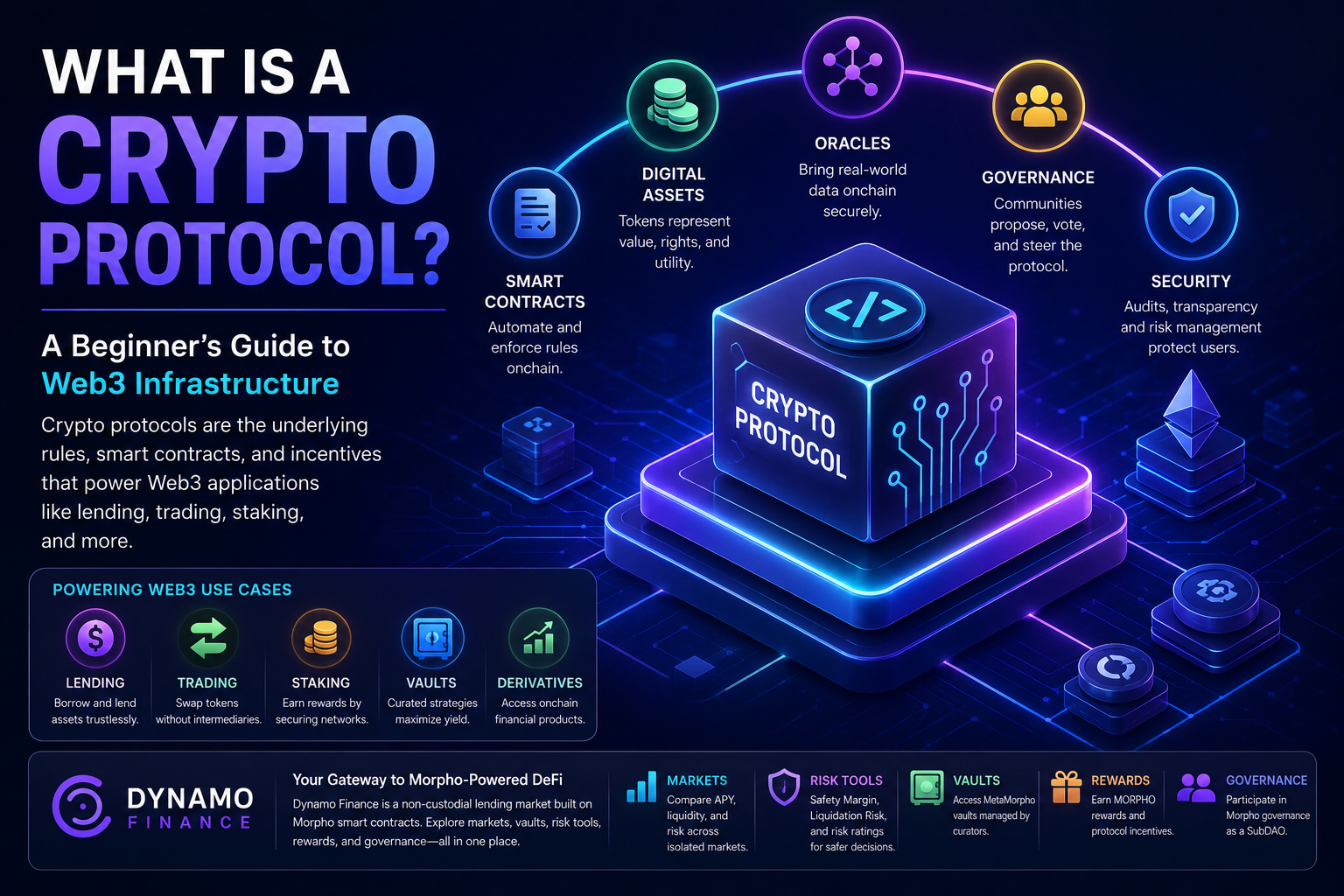
A crypto protocol is a set of blockchain-based rules, smart contracts, incentives, and technical standards that define how users, assets, and applications interact onchain. In DeFi, protocols can automate financial activities such as lending, borrowing, trading, staking, governance, collateral management, liquidations, and yield distribution.
This matters because crypto protocols are not just websites. A website may be the interface, but the protocol is the underlying system that executes transactions. When users supply assets, borrow against collateral, deposit into a vault, or vote in governance, they are interacting with protocol rules enforced by code.
In this guide, we will break down what a crypto protocol is, how it differs from a crypto platform, why smart contracts matter, how DeFi protocols manage money, what risks users should evaluate, and how Dynamo Finance helps users access Morpho-based lending infrastructure with clearer market and risk context.
Key Takeaways
- A crypto protocol is the rule system that powers blockchain applications, digital assets, and DeFi markets.
- Smart contracts let protocols automate actions such as lending, borrowing, liquidations, trading, and vault allocation.
- A crypto platform is usually the user-facing interface, while the protocol is the underlying infrastructure.
- DeFi protocols can be transparent and non-custodial, but users still face smart contract, oracle, liquidity, collateral, governance, and user-error risks.
- Dynamo Finance is built on Morpho smart contracts and adds markets, vaults, risk ratings, Safety Margin, Liquidation Risk views, rewards, and governance participation.
What Is a Crypto Protocol?
A crypto protocol is a technical and economic rulebook for a blockchain-based system. It defines what users can do, how assets move, how transactions are verified, how fees are calculated, how collateral is valued, how rewards are distributed, and how governance decisions are made.
Some protocols are base-layer networks, such as Bitcoin or Ethereum. Others are application-layer protocols built on top of blockchains, such as lending protocols, decentralized exchanges, liquid staking protocols, stablecoin protocols, and vault protocols.
In DeFi, a protocol often consists of smart contracts that users interact with through wallets or apps. Ethereum.org describes smart contracts as programs deployed on a blockchain that run as programmed when users submit transactions. You can review Ethereum’s official smart contract introduction for a beginner-friendly technical foundation.
The simplest way to think about a protocol is this: the protocol is the machine; the app is the control panel. A user interface helps people interact with the system, but the protocol rules determine what actually happens onchain.
Crypto Protocol vs. Crypto Platform
People often use “protocol” and “platform” interchangeably, but they are not the same. The difference matters when user funds, smart contracts, and risk are involved.
| Category | Crypto Protocol | Crypto Platform |
|---|---|---|
| Primary role | Defines the onchain rules, contracts, incentives, and mechanics | Provides a user-facing interface or service built around the protocol |
| Examples | Lending protocol, exchange protocol, stablecoin protocol, staking protocol | Wallet app, trading dashboard, analytics interface, lending frontend |
| Where funds may sit | In smart contracts controlled by protocol rules | Depends on whether the platform is custodial or non-custodial |
| Main risk focus | Smart contracts, oracles, governance, liquidity, collateral, incentives | Custody, UX, permissions, security practices, routing, platform policies |
| User question | How does the system work? | How do I access the system safely? |
A protocol can exist without a polished website. A platform can make a protocol easier to use. The strongest DeFi experiences combine transparent protocol infrastructure with a user interface that helps people make informed decisions.
Dynamo is a good example of this distinction. It is not a separate lending protocol that custodies user funds. It is a non-custodial interface and feature layer built on Morpho smart contracts, giving users market discovery, vault access, risk tools, rewards, automation, and governance participation.
Why Crypto Protocols Matter
Crypto protocols matter because they create open financial infrastructure. Instead of relying only on banks, brokers, exchanges, or centralized intermediaries, users can interact with financial systems through code and wallets.
This is the foundation of DeFi. Ethereum.org describes decentralized finance as an open alternative to the current financial system, with products that can let users borrow, save, invest, trade, and more through open-source technology. A broader overview is available in Ethereum’s DeFi guide.
Protocols also make composability possible. One protocol can plug into another. A lending protocol can accept a token created by another protocol. A vault can allocate into lending markets. A wallet can access many protocols from one interface.
This open design creates innovation, but it also increases responsibility. When protocols interact, users need to understand not just one product, but the layers of smart contracts, assets, oracles, and governance systems behind it.
How Crypto Protocols Work
Most crypto protocols combine code, assets, users, incentives, and governance. The code enforces rules. Assets move through smart contracts. Users supply capital or take actions. Incentives encourage certain behavior. Governance may adjust parameters or influence future development.
A simplified protocol flow looks like this:
- A protocol defines a set of rules through smart contracts.
- Users connect wallets and submit transactions to those contracts.
- The blockchain validates and records the transaction.
- The protocol updates balances, positions, rewards, or risk metrics according to its rules.
- External data, such as asset prices, may enter through oracles.
- Governance or authorized roles may adjust supported parameters, depending on the protocol design.
- Users can monitor, exit, repay, withdraw, vote, or manage positions through compatible interfaces.
This workflow removes many traditional intermediaries, but it does not remove risk. Instead, the risk shifts from human discretion and institutional trust toward code quality, market design, price feeds, liquidity, collateral behavior, and user execution.
The Role of Smart Contracts
Smart contracts are the engine of many crypto protocols. They are code deployed to a blockchain that can hold assets, enforce rules, and execute logic when users send transactions.
In a lending protocol, smart contracts may track supplied assets, borrowed assets, interest accrual, collateral balances, liquidation thresholds, and user positions. In a decentralized exchange, smart contracts may route swaps, update liquidity pools, and calculate fees.
Smart contracts reduce reliance on manual processing. A loan can be opened, interest can accrue, and liquidation can occur without a traditional bank officer. That makes DeFi efficient, but it also means contract bugs can be serious.
Good users treat smart contracts as infrastructure, not magic. They ask whether contracts have been audited, how long they have been live, whether they are upgradeable, and what dependencies they have.
The Role of Tokens
Tokens are assets that move through crypto protocols. Some represent value, such as stablecoins or wrapped assets. Others represent governance rights, vault shares, liquidity provider positions, or claims on a strategy.
A protocol token may be used for governance, incentives, staking, fee distribution, or ecosystem coordination. A vault share token may represent a user’s proportional claim on assets held inside a vault. A stablecoin may function as the loan asset in a lending market.
Beginners often assume every token is the same type of asset. That is a mistake. A governance token, stablecoin, collateral token, wrapped token, and vault share all behave differently.
Before using a protocol, identify the asset you deposit, the asset you receive, and the asset you might owe. This one habit can prevent many misunderstandings.
The Role of Oracles
Oracles bring external data into smart contracts. DeFi protocols often need price data to value collateral, calculate liquidation thresholds, settle derivatives, or determine exchange rates.
Without reliable oracles, a lending protocol cannot safely determine whether a borrower’s collateral still supports their debt. If an oracle is wrong, delayed, or manipulated, liquidations can occur incorrectly or losses can spread through the market.
Chainlink’s education materials describe blockchain oracles as systems that connect smart contracts to external data, enabling protocols to use information that does not originate directly onchain. The Chainlink oracle explainer is a useful reference for readers who want to understand this layer.
Oracle risk is one reason protocol analysis must go deeper than APY. A high-yield market with weak pricing infrastructure may not be attractive after risk is considered.
The Role of Governance
Governance defines how a protocol changes over time. Some protocols use token voting. Others use multisigs, councils, delegated voting, or a combination of mechanisms.
Governance can influence markets, risk parameters, incentives, protocol fees, treasury spending, integrations, upgrades, and emergency responses. This gives communities and stakeholders a way to coordinate decisions.
Governance also introduces risk. Poor decisions, voter apathy, governance attacks, or misaligned incentives can affect users. A protocol that looks strong technically can still make bad parameter choices.
Dynamo participates in the Morpho ecosystem as a SubDAO, aggregating community power to help steer governance. For users, this means Dynamo is not only a frontend; it also gives its community a pathway into broader protocol decision-making.
Types of Crypto Protocols
Crypto protocols serve many functions. Some are broad infrastructure systems, while others are specialized financial applications.
- Layer 1 protocols: Base blockchains such as Ethereum or Bitcoin.
- Layer 2 protocols: Scaling networks that settle to a base chain.
- Lending protocols: Markets for supplying assets and borrowing against collateral.
- Decentralized exchange protocols: Systems for swapping assets without a traditional order book or centralized intermediary.
- Stablecoin protocols: Systems that issue or manage dollar-denominated crypto assets.
- Staking protocols: Systems that help users participate in validator economics or receive liquid staking tokens.
- Vault protocols: Strategy systems that allocate capital across markets or yield opportunities.
- Oracle protocols: Infrastructure that delivers external data to smart contracts.
- Governance protocols: Systems for voting, delegation, treasury decisions, and parameter changes.
Most advanced DeFi strategies involve more than one protocol type. A vault may use a lending protocol, collateral token, oracle protocol, and governance system at the same time.
What Is a DeFi Protocol?
A DeFi protocol is a crypto protocol focused on financial activity. It can automate lending, borrowing, trading, yield strategies, collateral management, staking, or asset issuance.
DeFi protocols usually run on public blockchains and interact with wallets. Users do not need a traditional account in the same way they would with a bank or broker. Instead, they sign transactions with their wallet.
This gives users more control, but also more responsibility. There may be no customer support team that can reverse a bad transaction. If a user sends assets to the wrong contract or signs a malicious approval, funds may be lost.
Strong DeFi participation starts with understanding protocol mechanics. Interface design can help, but it cannot replace user due diligence.
Crypto Protocols and DeFi Lending
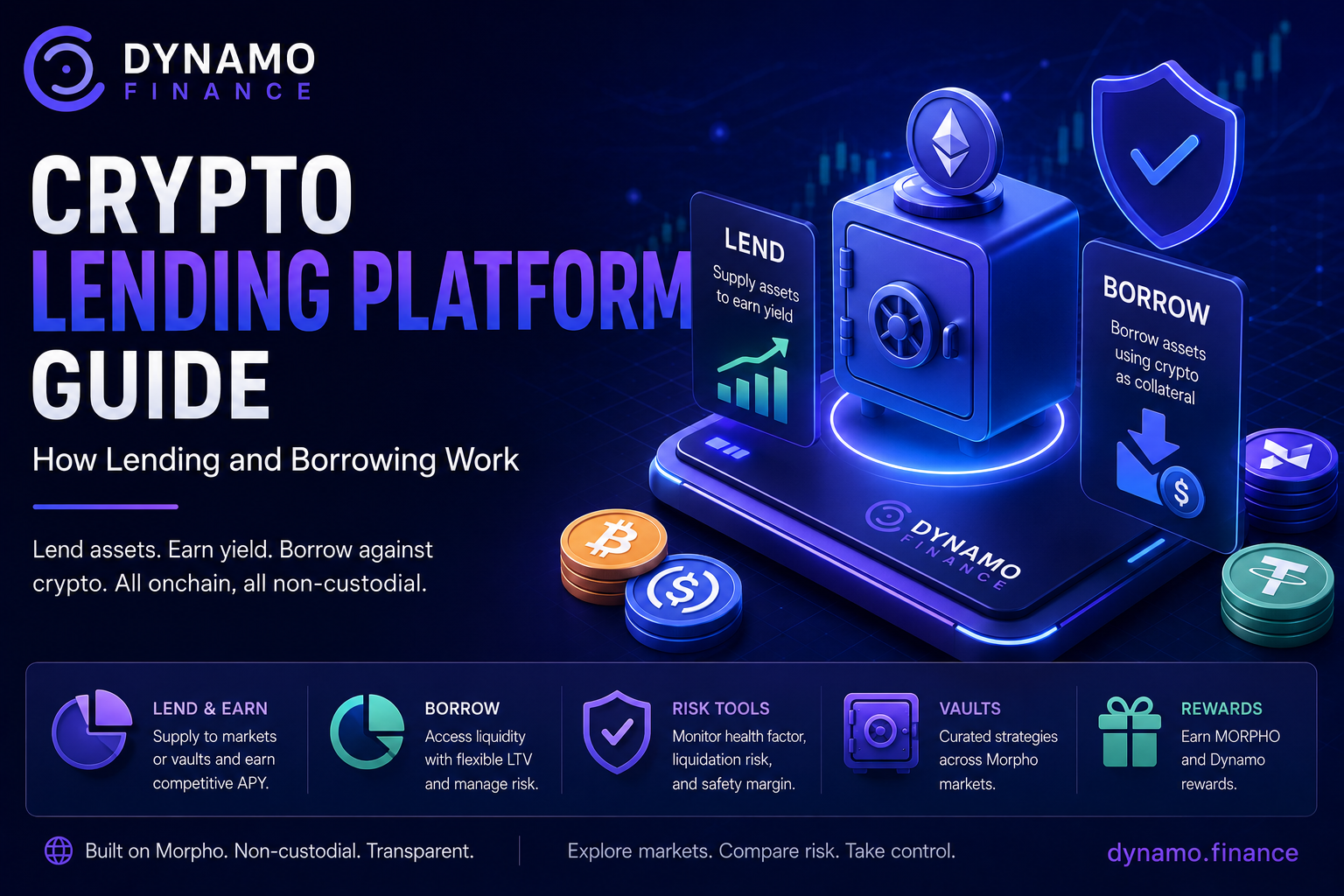
Lending is one of the clearest examples of crypto protocols in action. A lending protocol defines how suppliers earn yield, how borrowers post collateral, how interest rates adjust, and when liquidation occurs.
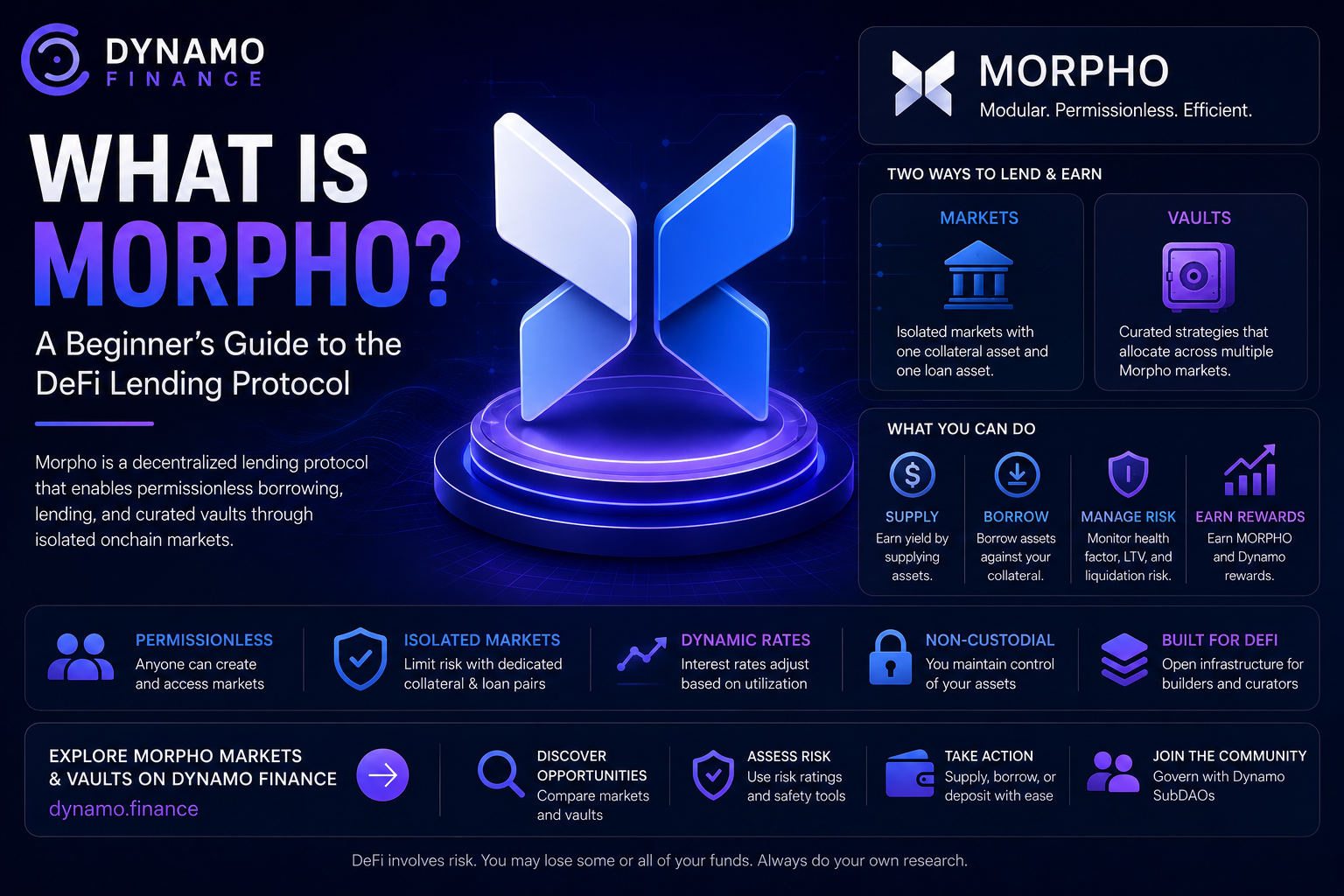
In Morpho-based lending markets, each market pairs one loan asset with one collateral asset. The market also has an oracle, interest-rate model, and liquidation loan-to-value threshold. This isolated-market structure gives users a more precise view of their exposure.
Dynamo uses Morpho smart contracts as its lending foundation while adding tools for market comparison, risk ratings, vaults, rewards, and position management. Users exploring morpho lending can compare markets by supply APY, borrow APY, utilization, available liquidity, collateral, oracle, and LLTV before taking action.
This is what a practical crypto protocol stack looks like: Morpho provides the smart contract layer, while Dynamo provides a user workflow for DeFi lenders, borrowers, and vault users.
How Lending Markets Work
A lending market connects two sides: suppliers and borrowers. Suppliers deposit the loan asset to earn interest. Borrowers post collateral and borrow the loan asset.
Interest rates usually respond to utilization. Utilization measures how much supplied liquidity is currently borrowed. When utilization rises, borrowing becomes more expensive and suppliers may earn more. When utilization falls, borrowing becomes cheaper and supplier APY usually declines.
Each market’s collateral matters. If collateral is liquid, widely traded, and reliably priced, the market may be easier to evaluate. If collateral is newer, volatile, or complex, lenders may need more yield to compensate for risk.
For users comparing lending cryptocurrency opportunities, the question is not only “What is the APY?” It is “Which collateral, oracle, and liquidation mechanics support that APY?”
How Borrowing Works in a Crypto Protocol
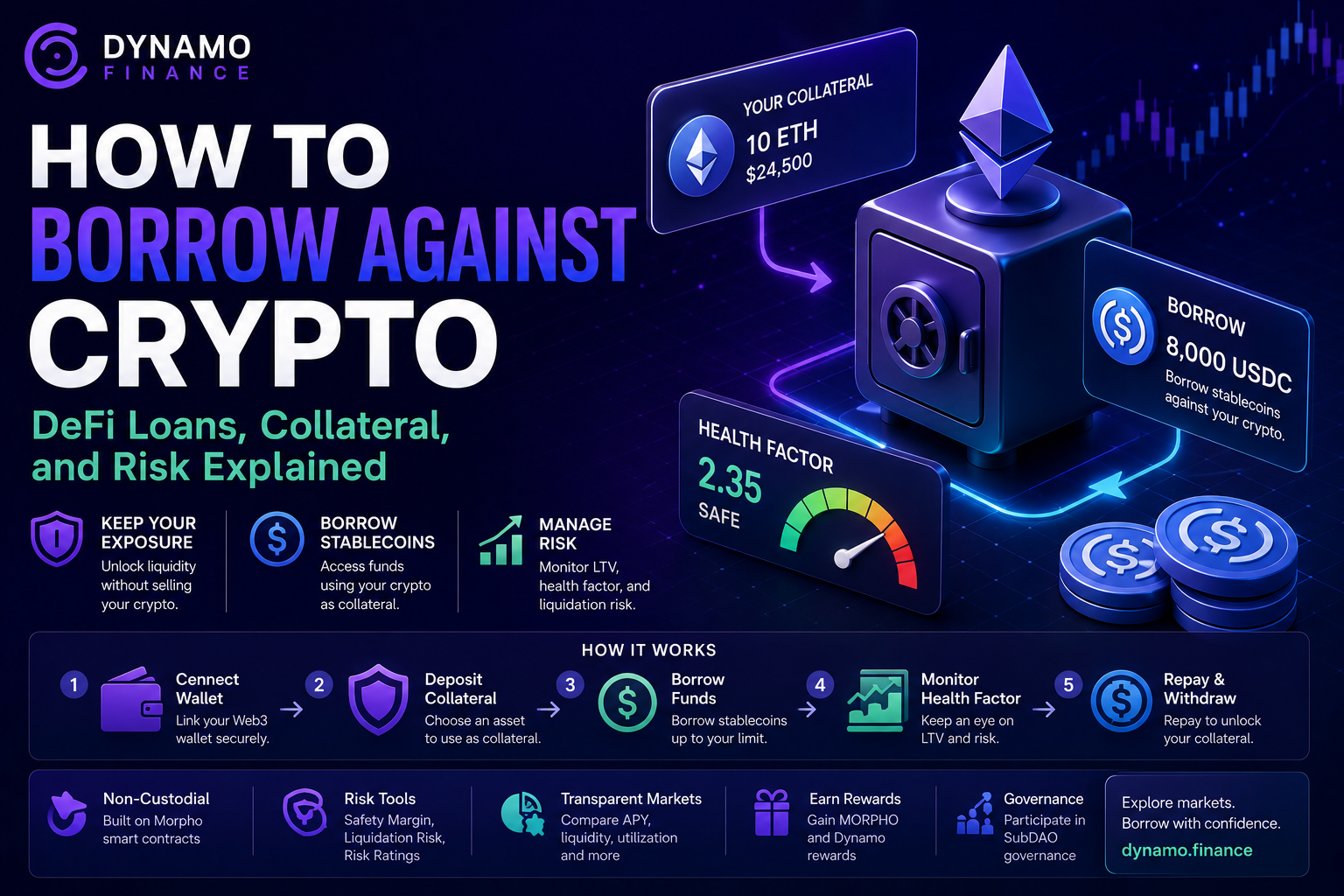
Borrowing in DeFi usually means posting collateral and drawing a loan asset. Borrowers use this to access liquidity without selling their crypto.
For example, a user may deposit ETH as collateral and borrow USDC. The user keeps ETH exposure while receiving stablecoin liquidity. If ETH falls too much, the user may need to repay debt, add collateral, or risk liquidation.
This is where a crypto loan differs from a traditional personal loan. The system usually does not depend on credit scores or income verification. It depends on overcollateralization, price feeds, and liquidation rules.
The borrower’s job is to manage LTV, borrow APY, collateral volatility, health factor, and liquidation price. A good borrow position is not the largest possible loan. It is the loan with enough buffer to survive realistic market moves.
Markets vs. Vaults in DeFi Protocols
Markets and vaults are two different ways to interact with DeFi lending protocols. Direct markets give users precise control. Vaults offer curated allocation.
| Feature | Direct Lending Market | Curated Vault |
|---|---|---|
| User action | Choose one specific market | Deposit into a strategy that allocates across markets |
| Control | High control over exact exposure | Curator manages allocation |
| Yield source | Borrower-paid interest from one market | Blended yield across selected markets |
| Risk | Specific collateral, oracle, utilization, and LLTV risk | Curator, allocation, concentration, liquidity, and market risk |
| Best fit | Advanced users who want precision | Users who want curated exposure and less manual rebalancing |
Dynamo supports both market and vault workflows. Users can supply directly to individual markets or deposit into MetaMorpho-based vaults where curators allocate capital across lending opportunities.
Vaults can reduce manual work, but they do not remove risk. A vault is a strategy. Users should review the curator, allocation, APY stability, fees, liquidity, and risk tier before depositing.
Dynamo Finance as a DeFi Protocol Interface
Dynamo Finance is a non-custodial, permissionless Web3 lending market built on Morpho smart contracts. It helps users supply assets, borrow against collateral, deposit into vaults, access analytics, earn rewards, and participate in governance from one interface.
The key distinction is custody. Dynamo does not hold user funds. Assets are held by Morpho smart contracts, while Dynamo adds a feature layer for discovery, market comparison, risk tooling, rewards, automation, and governance participation.
This design is useful for users who want to interact with DeFi lending infrastructure without manually piecing together every market detail themselves. Dynamo surfaces APYs, utilization, available liquidity, collateral assets, loan assets, risk ratings, vault data, and liquidation-risk metrics.
For users researching defi lending, Dynamo offers a practical example of how a modern protocol interface can make onchain finance easier to understand while preserving non-custodial access.
What Dynamo Adds on Top of Morpho
Morpho provides the smart contract layer for markets and vaults. Dynamo adds user-facing tools and community infrastructure on top.
Dynamo’s feature set includes market browsing, direct market supply, borrowing against collateral, MetaMorpho vault access, risk ratings, Safety Margin, Liquidation Risk views, rewards, automation features, advanced analytics, and SubDAO governance participation.
Users who want exact market exposure can compare individual markets. Users who prefer curated allocation can explore vaults. Borrowers can use risk tools to understand liquidation exposure before and after opening a position.
This is the difference between raw protocol access and a guided workflow. The protocol executes the rules. The interface helps users understand and act on them.
Dynamo Markets
Dynamo markets are isolated lending pools built on Morpho infrastructure. Each market has one collateral asset, one loan asset, one oracle, one interest-rate model, and one liquidation loan-to-value threshold.
Market isolation helps users understand exposure. A position in one market is not automatically exposed to another market. A risk event in a high-risk market does not spread to every other market by design.
Users can compare live market data before supplying or borrowing. Important metrics include supply APY, borrow APY, utilization, available liquidity, total supply, total borrow, collateral asset, loan asset, oracle, LLTV, and verification status.
This market-level transparency is one of the main advantages of DeFi protocols when paired with good tooling. The data is available; the user still needs to interpret it.
Dynamo Vaults
Dynamo vaults are built on the MetaMorpho standard. A vault holds deposits and allocates them across lending markets according to a curator’s strategy.
Vaults can be useful because they reduce manual rebalancing. Instead of choosing one market and monitoring it constantly, a user deposits into a vault where the curator manages allocation across selected opportunities.
Users should still analyze vaults carefully. A vault’s APY is a blended rate, not a fixed promise. Withdrawals depend on underlying market liquidity. Strategy quality depends on curator decisions and market conditions.
For users who want curated access to Morpho infrastructure, morpho loan markets and vault strategies are easier to compare when allocation, liquidity, and risk data are visible in one place.
Dynamo Risk Ratings
Dynamo assigns Low, Medium, and High risk tiers to markets and vaults using objective onchain inputs. For markets, inputs include LLTV, TVL, and live history. For vaults, inputs include total supplied value, market exposure, and live history.
Risk ratings are not guarantees. A Low-risk market can still experience losses from oracle failure, smart contract bugs, or extreme collateral moves. The value of risk ratings is that they help users filter opportunities before deeper analysis.
Beginners often sort by APY. More experienced users sort by risk-adjusted return. A risk rating helps move users closer to that second mindset.
Users who want to review risk tools can explore the Dynamo risk dashboard for market and vault risk context.
Dynamo Safety Margin and Liquidation Risk
Borrowing is one of the areas where protocol risk becomes personal. If a user borrows too much against volatile collateral, liquidation can happen quickly.
Dynamo’s Safety Margin feature lets users operate more conservatively than Morpho’s liquidation threshold. It creates a synthetic target LTV, helping borrowers stay below the danger zone instead of borrowing up to the maximum.
The Liquidation Risk view shows current health factor, price-drop tolerance, and liquidation price. These metrics help borrowers understand how much room they have before collateral price movement becomes dangerous.
This is important because a protocol can enforce liquidations automatically. A good user interface should help borrowers see risk early, not only after a position becomes stressed.
How to Evaluate a Crypto Protocol
Before using any crypto protocol, evaluate both the mechanics and the risk. Do not stop at the brand name, token price, TVL, or APY.
- Identify what the protocol actually does: lending, trading, staking, stablecoin issuance, vault allocation, or governance.
- Check whether the protocol is custodial, non-custodial, permissioned, or permissionless.
- Review the smart contracts, audits, upgradeability, and live history.
- Understand the assets involved and whether you receive a new token, vault share, or debt position.
- Review oracle dependencies and how prices enter the system.
- Study liquidity, utilization, TVL, fees, incentives, and exit conditions.
- Understand governance rights, admin controls, emergency powers, and parameter-change processes.
- Evaluate downside scenarios before depositing capital.
- Start small and test the full workflow.
- Monitor positions after entry because protocol conditions can change.
This checklist is useful for lending protocols, vault protocols, decentralized exchanges, staking systems, bridges, and tokenized asset platforms.
Key Metrics to Review Before Using a DeFi Protocol
DeFi protocols provide more public data than traditional financial platforms, but users need to know what to look for. The most important metrics depend on the protocol type.
For lending protocols, review supply APY, borrow APY, utilization, available liquidity, collateral assets, oracles, LLTV, market TVL, total borrow, and liquidation history. For vaults, review curator, allocation, APY history, fees, TVL, withdrawal liquidity, and risk tier.
For swaps and liquidity protocols, review pool depth, slippage, volume, fees, impermanent loss risk, and token quality. For stablecoin protocols, review collateral backing, redemption mechanics, peg history, liquidity, governance, and legal structure.
DefiLlama is one widely used analytics source for comparing TVL, fees, revenue, volume, and yields across DeFi protocols and chains. Its DeFi analytics dashboard can be useful as a starting point, though users should still verify protocol-specific details before acting.
TVL: Useful but Incomplete
Total value locked, or TVL, measures the value of assets deposited into a protocol, market, vault, or chain. It is often used as a scale and adoption signal.
High TVL can suggest that a protocol has attracted meaningful capital. It may also indicate deeper liquidity and stronger network effects. Still, TVL is not a safety score.
A protocol with high TVL can still have smart contract risk, governance risk, oracle risk, or liquidity concentration. A smaller protocol can be well-designed but less battle-tested.
Use TVL as a starting point, then inspect the exact market, vault, or strategy where your funds will sit.
APY: Yield Is a Signal, Not a Guarantee
APY tells you the current or projected annualized yield. In DeFi, APY can change quickly because rates respond to utilization, incentives, rewards, trading volume, or strategy performance.
A high APY may come from strong demand. It may also come from high risk. The source of yield matters more than the size of the number.
For lending markets, ask who pays the yield. Usually, borrowers pay interest. For vaults, ask where the vault allocates capital. For reward programs, ask whether incentives are temporary.
Yield should compensate risk. It should not distract from risk.
Liquidity: The Exit Question
Liquidity answers a simple question: can you exit when you need to? A protocol may have high TVL, but your specific position may still face withdrawal limits, high utilization, slippage, bridge delays, redemption queues, or thin secondary markets.
In lending protocols, available liquidity matters because supplied assets may be borrowed. In vaults, withdrawals may depend on the underlying markets. In tokenized asset protocols, redemptions may depend on settlement rules or issuer processes.
Liquidity is especially important during stress. The best time to evaluate exits is before you enter, not when everyone else is trying to leave.
For active DeFi users, liquidity quality can matter more than headline yield.
Security: Audits Help, but They Are Not Enough
Security is one of the most important protocol evaluation categories. Audits, bug bounties, formal verification, immutable contracts, cautious upgrades, and transparent incident response all matter.
Audits reduce risk, but they do not eliminate it. Some exploited protocols had audits. New integrations can also introduce risk even if the base protocol is well-tested.
Users should ask whether contracts are upgradeable, who controls upgrades, whether emergency pause powers exist, whether code is open-source, and how long the contracts have been live with real capital.
Security is not only about code. It also includes oracle design, governance controls, role permissions, liquidity assumptions, and user behavior.
Governance and Admin Risk
Many crypto protocols have governance mechanisms that can adjust parameters, approve markets, change fees, direct incentives, or upgrade contracts. Governance can improve adaptability, but it can also create risk.
If a small group controls key permissions, users should understand those powers. If token voting controls protocol changes, users should understand voter distribution, quorum, delegation, and proposal processes.
Admin keys, multisigs, timelocks, emergency controls, and upgradeability all affect trust assumptions. A fully immutable protocol has different trade-offs from one that can be upgraded quickly.
There is no one perfect model. The right design depends on protocol maturity, complexity, and risk surface.
Composability Risk
Composability is one of DeFi’s greatest strengths. It lets protocols connect like building blocks. A vault can use a lending market. A lending market can accept a token created by another protocol. An app can route users into several protocols at once.
The downside is dependency risk. If one protocol in the stack fails, other protocols that depend on it can be affected. A stablecoin depeg, oracle failure, bridge exploit, or collateral collapse can ripple through several systems.
Composability means users should map the full stack. Ask what tokens are involved, what oracles price them, what protocols hold them, and what happens if one layer breaks.
Simple strategies are easier to analyze. Complex strategies may be powerful, but they demand more due diligence.
Practical Example: A Lending Protocol
Imagine a user wants to earn yield on USDC. They compare a direct market and a vault.
In a direct market, the user supplies USDC to a market backed by one collateral asset. The user reviews supply APY, utilization, available liquidity, collateral quality, oracle, LLTV, and risk rating.
In a vault, the user deposits USDC into a curated strategy. The vault allocates across multiple markets. The user reviews curator, allocation, APY stability, fees, total supplied value, and withdrawal liquidity.
Both options can be valid. The direct market gives precision. The vault gives curation. The better choice depends on whether the user wants control or convenience.
Practical Example: Borrowing Through a Protocol
A user holding ETH may want stablecoin liquidity without selling. They deposit ETH as collateral and borrow USDC through a lending market.
The user must monitor LTV, LLTV, health factor, borrow APY, collateral price, and liquidation price. If ETH falls too much, the position may become liquidatable.
This is where crypto backed loans need discipline. A low borrow rate does not make an aggressive position safe. A conservative safety buffer is often more valuable than maximum capital efficiency.
Dynamo’s Safety Margin and Liquidation Risk views are designed for this exact workflow. They help borrowers understand how close they are to the liquidation threshold before stress arrives.
Practical Example: A Vault Protocol
Vaults can make DeFi easier by handling allocation. A user deposits once, and the vault strategy allocates capital across markets or yield sources.
The user should still ask what the vault owns. If the vault allocates to high-utilization lending markets, withdrawals may be constrained. If it uses specialized collateral, risk may be higher than the deposit asset suggests.
Curator quality matters. A strong curator can improve market selection and rebalancing, but no curator can eliminate smart contract, oracle, liquidity, or market risk.
Vaults are best evaluated as strategies, not savings accounts.
Common Mistakes Beginners Make With Crypto Protocols
The first mistake is confusing a website with a protocol. A polished website can route to risky contracts, while a simple interface can access strong infrastructure.
The second mistake is chasing APY without understanding the yield source. High returns often come from higher risk, temporary incentives, or scarce liquidity.
The third mistake is ignoring contract permissions. Upgrade keys, admin roles, vault caps, and governance controls can affect user risk.
The fourth mistake is assuming non-custodial means risk-free. Non-custodial means the platform does not hold funds in a traditional account, but users still face smart contract and market risks.
The fifth mistake is failing to test exits. Always understand how withdrawals, redemptions, repayments, and emergency actions work before depositing large amounts.
What Experienced DeFi Users Look For
Experienced users start with mechanics. They identify the protocol layer, assets, contracts, oracles, governance controls, liquidity paths, and exit conditions.
They also evaluate risk-adjusted yield. A moderate APY from a transparent, liquid market may be better than a high APY from a complex, thinly traded strategy.
Borrowers watch liquidation buffers. Suppliers watch utilization and collateral quality. Vault users watch allocations and curator decisions.
Strong users do not rely on slogans. They build a repeatable checklist and apply it before capital is deployed.
How to Use Dynamo as a Learning Path
Dynamo can help users learn how DeFi protocols function because it exposes the building blocks of Morpho-based lending. Users can see markets, vaults, APYs, utilization, liquidity, risk tiers, collateral, loan assets, and liquidation data in one place.
A beginner can start by browsing markets without depositing. Review how supply APY changes across markets, how utilization affects rates, and how collateral differs from market to market.
Next, compare vaults. Look at curator, TVL, deposit asset, allocation, and risk tier. This helps users understand how vault strategies differ from direct market exposure.
For deeper product education, review the Dynamo Finance documentation. It covers markets, vaults, interest rates, collateral and LTV, liquidations, risk ratings, Safety Margin, Liquidation Risk, rewards, security, fees, and governance.
External Resources for Further Research
For smart contract fundamentals, Ethereum’s smart contract guide is a strong starting point. For a broader view of decentralized finance, read Ethereum’s DeFi overview.
For oracle infrastructure, Chainlink’s blockchain oracle explainer helps explain how external data reaches smart contracts. For market-level protocol analytics, DefiLlama is widely used to compare TVL, fees, volume, yields, and protocol activity.
For Morpho-specific lending infrastructure, Morpho’s market documentation explains isolated markets, collateral assets, loan assets, oracles, interest-rate models, and LLTV.
For product updates and community context, Follow Dynamo Finance on X.
Final Checklist Before Using Any Crypto Protocol
Use this checklist before connecting a wallet, supplying assets, borrowing, swapping, staking, or depositing into a vault:
- Confirm the official URL and avoid fake apps or sponsored phishing links.
- Identify whether you are using a protocol, platform, interface, vault, market, or bridge.
- Understand which smart contracts will hold or move your assets.
- Review the assets involved, including collateral, loan assets, vault shares, and governance tokens.
- Check oracle dependencies, liquidity, utilization, TVL, APY, fees, and withdrawal conditions.
- Understand governance controls, admin roles, upgrades, caps, and emergency permissions.
- Evaluate smart contract, oracle, liquidity, collateral, governance, and user-error risks.
- Start small and test deposits, withdrawals, repayments, and exits.
- Monitor positions after entry because market conditions and protocol parameters can change.
- Keep records for tax, reporting, and portfolio tracking.
Conclusion
A crypto protocol is the infrastructure layer that makes Web3 applications work. It defines the rules, contracts, incentives, assets, governance, and risk mechanics behind onchain activity. In DeFi, protocols can automate lending, borrowing, trading, staking, vault allocation, liquidations, and yield distribution.
The opportunity is powerful. Users can access open financial markets, retain wallet-based control, verify onchain data, and interact with systems that operate continuously. The risk is also real. Smart contracts can fail, oracles can misprice assets, liquidity can disappear, governance can change parameters, and users can make irreversible mistakes.
Dynamo Finance helps users approach this world with more structure. Built on Morpho smart contracts, Dynamo gives DeFi lenders, borrowers, and yield seekers access to markets, vaults, risk ratings, Safety Margin, Liquidation Risk views, rewards, and governance participation from a non-custodial interface.
Explore Dynamo Finance to compare Morpho-based markets and vaults, review risk data, and build a more disciplined approach to onchain lending, borrowing, and protocol-based finance.
FAQ
What is a crypto protocol?
A crypto protocol is a blockchain-based system of rules, smart contracts, incentives, and standards that defines how users and assets interact onchain. Protocols can power networks, tokens, lending markets, exchanges, vaults, stablecoins, and governance systems.
What is the difference between a crypto protocol and a crypto platform?
A crypto protocol is the underlying onchain infrastructure and rule system. A crypto platform is usually the user-facing product or interface that helps people access that infrastructure.
Are crypto protocols safe?
No crypto protocol is risk-free. Users can face smart contract bugs, oracle failures, liquidity constraints, governance changes, collateral volatility, composability risk, and user-error risk. Strong protocols reduce risk through audits, transparency, risk controls, and clear market design.
How do DeFi lending protocols work?
DeFi lending protocols let suppliers deposit assets to earn yield and borrowers post collateral to borrow assets. Smart contracts manage interest accrual, collateral requirements, withdrawals, and liquidations.
How does Dynamo Finance relate to crypto protocols?
Dynamo Finance is a non-custodial interface and feature layer built on Morpho smart contracts. It helps users access Morpho-based lending markets and vaults while adding risk ratings, Safety Margin, Liquidation Risk views, rewards, analytics, and governance participation.