Borrowing against crypto sounds simple: keep your Bitcoin, ETH, or other supported asset, borrow USDC, and avoid selling into the market. That is why Coinbase crypto loans have become one of the most searched borrowing topics among crypto holders who want liquidity without giving up long-term exposure.
The important detail is that these loans are not traditional Coinbase balance-sheet loans. They are onchain, collateral-backed loans enabled by Morpho on Base, with Coinbase providing the user interface. That makes the product easier to access, but the core risks are still DeFi risks: variable rates, collateral volatility, smart contracts, liquidation thresholds, and loan health monitoring.
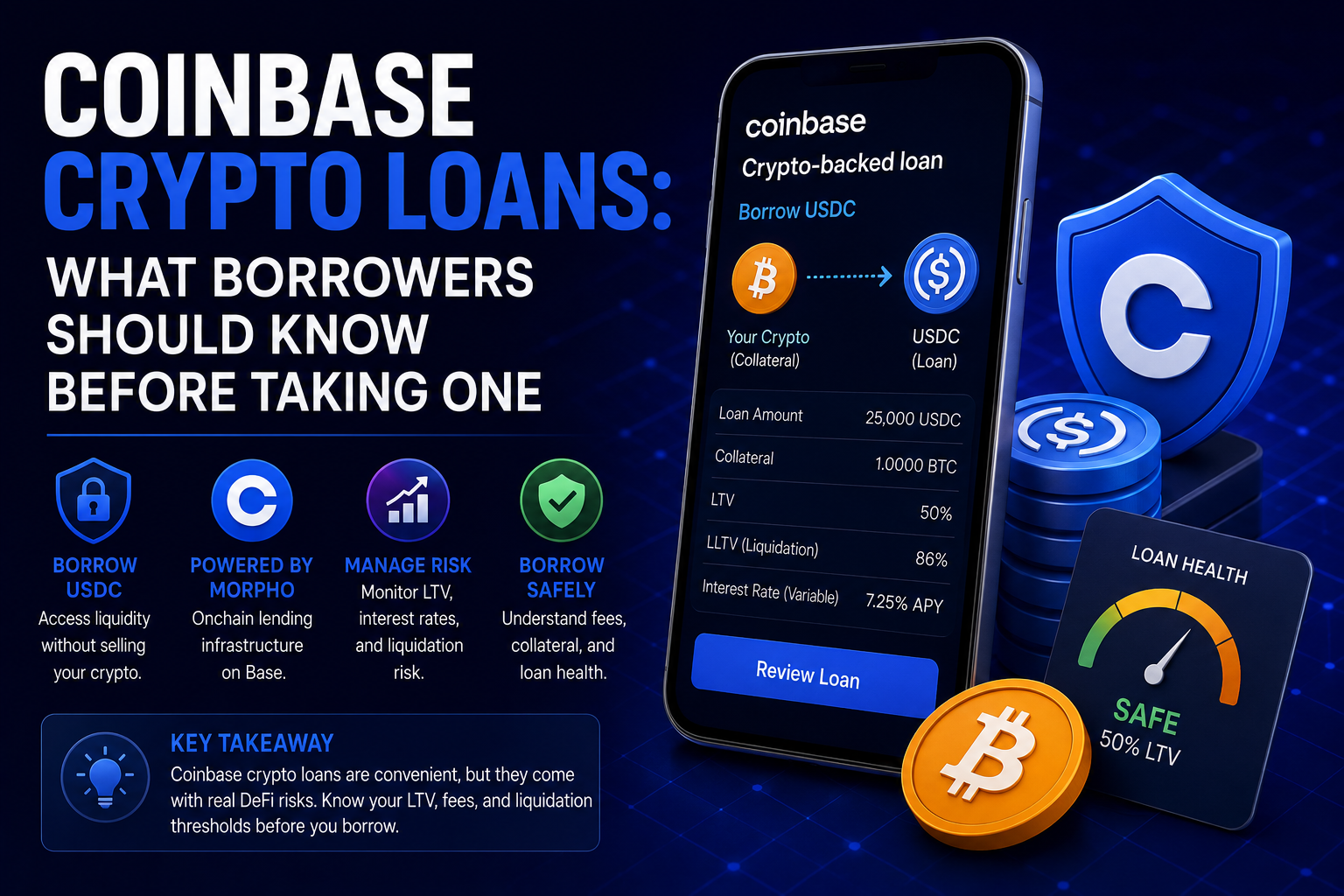
Coinbase crypto loans let eligible users borrow USDC by using supported crypto assets as collateral. The borrowing is enabled by the Morpho onchain lending protocol on Base, while Coinbase provides the interface for setting up, managing, and repaying the loan.
This guide takes a borrower-first angle. Instead of only asking what Coinbase crypto loans are, we will focus on what you should check before taking one, how Morpho Coinbase loans work behind the scenes, where fees and liquidation risk enter the picture, and how Dynamo Finance can help DeFi users compare Morpho-based borrowing markets more directly.
Key Takeaways
- Coinbase crypto loans are collateral-backed USDC loans enabled by Morpho on Base, with Coinbase acting as the borrower-facing interface.
- Borrowers should understand LTV, LLTV, variable borrow rates, liquidation penalties, collateral movement, and processing fees before taking a loan.
- Coinbase’s public materials state that crypto collateral is locked on Morpho and returned automatically after full repayment, including fees and accrued interest.
- Loan convenience does not remove risk. If collateral value falls or interest accrues enough for the loan to reach the liquidation threshold, collateral can be liquidated.
- Dynamo Finance gives DeFi-native users a way to compare Morpho-based markets, borrow APY, collateral, liquidity, risk ratings, Safety Margin, and Liquidation Risk data.
What Are Coinbase Crypto Loans?
Coinbase crypto loans are crypto-backed loans where eligible users borrow USDC against supported crypto collateral. Coinbase provides the app and account experience, while Morpho supplies the underlying onchain lending infrastructure on Base.
They describe their crypto-backed loan product as collateral-based lending with no credit checks, with borrowing enabled by Morpho’s onchain lending protocol. Users can review Coinbase’s current product details on its crypto-backed loans introduction.
For borrowers, the biggest difference from a traditional loan is underwriting. Instead of a bank reviewing your salary, credit score, or debt-to-income ratio, the system relies on crypto collateral. If the collateral safely supports the debt, the loan can remain open. If the loan becomes too risky, liquidation can occur.
This is powerful, but it also changes the borrower’s responsibility. You are not mainly managing a monthly payment schedule. You are managing collateral value, debt growth, borrow rates, LTV, and liquidation risk.
How Morpho Coinbase Loans Work Behind the Scenes
The phrase “morpho coinbase” usually refers to Coinbase’s integration with Morpho. Morpho is the onchain lending infrastructure, and Coinbase is the consumer interface that makes borrowing accessible from within the Coinbase experience.
When a user starts a crypto-backed loan through Coinbase, collateral is moved onchain into Morpho. In the case of Bitcoin-backed borrowing, Coinbase states that BTC is converted into Coinbase Wrapped BTC, or cbBTC, and transferred into a Morpho smart contract as collateral. More detail is available in Coinbase’s launch article on USDC loans without selling crypto.
That means the loan is not simply an internal database entry. It is connected to an onchain lending market, with collateral, interest, and liquidation mechanics governed by protocol rules.
This matters for risk. The Coinbase app may feel familiar, but the loan still depends on market conditions, smart contracts, the collateral asset, the loan asset, and Morpho’s lending logic.
Why Borrowers Use Coinbase Crypto Loans
The main appeal is liquidity without selling. A long-term crypto holder may want USDC for spending, portfolio management, business expenses, taxes, or short-term liquidity while keeping exposure to the collateral asset.
Borrowing can also feel more flexible than a traditional personal loan. Coinbase’s public materials describe no fixed repayment schedule, meaning users can repay on their own timeline as long as the loan remains healthy and below the liquidation threshold.
Another attraction is speed. Crypto-backed borrowing can be faster than traditional credit because the loan is secured by collateral rather than a long underwriting process.
Still, convenience should not be confused with safety. A fast loan can become risky if the collateral falls sharply, the borrower starts with a high LTV, or interest accrues for too long without repayment.
Coinbase Crypto Loans vs. Traditional Loans
Coinbase crypto loans are closer to DeFi collateralized borrowing than to a bank personal loan. That distinction affects how borrowers should think about risk.
| Feature | Coinbase Crypto Loans | Traditional Personal Loans |
|---|---|---|
| Loan asset | USDC | Usually fiat currency |
| Collateral | Supported crypto assets | Often unsecured, or secured by traditional assets |
| Credit check | Collateral-based model | Typically depends on credit score, income, and repayment profile |
| Interest rate | Variable and based on Morpho market conditions | Often fixed or contractually defined by lender terms |
| Repayment | No fixed repayment schedule in the standard Coinbase crypto-backed loan model | Usually fixed monthly payments |
| Main risk | Collateral liquidation if LTV reaches the threshold | Credit damage, collections, late fees, or repossession depending on loan type |
The DeFi model can be efficient because collateral makes automated lending possible. The trade-off is that liquidation risk is immediate and market-driven. If the collateral value moves fast enough, the system does not need to wait for a missed monthly payment.
What Assets Can Be Used as Collateral?
Collateral availability can change by region, account status, market support, and Coinbase product rollout. Coinbase’s public borrow pages have referenced borrowing limits that vary by collateral asset, including higher limits for Bitcoin and Ethereum and lower limits for certain additional supported assets.
Users should always rely on the live Coinbase loan review screen before borrowing. That screen is where the current eligible collateral, borrowing limit, rate, processing fee, and loan terms are shown for the user’s account.
For Bitcoin-backed loans, the BTC-to-cbBTC conversion is especially important. Coinbase states that BTC used as collateral through its Morpho integration is converted to cbBTC and moved onchain into a Morpho smart contract.
That collateral path may matter for taxes, accounting, custody assumptions, wallet tracking, and personal risk review. Borrowers should not treat every collateral movement as a simple internal Coinbase balance change.
How Much Can You Borrow?
Your borrow amount depends on the value of your collateral, the market’s LTV requirements, Coinbase account limits, and the supported collateral asset. A user with more eligible collateral can generally borrow more, but the maximum amount is not necessarily the prudent amount.
Coinbase’s public borrow materials have described maximum limits that can reach millions of USDC for certain collateral assets and lower limits for others. These limits are product-level ceilings, not personal risk recommendations.
The better borrower question is not “What is the most Coinbase will let me borrow?” It is “How much can I borrow while keeping enough buffer against volatility?”
A conservative borrower may borrow far below the maximum to leave room for collateral drawdowns, variable-rate changes, and delayed reaction during volatile markets.
Understanding LTV and Loan Health
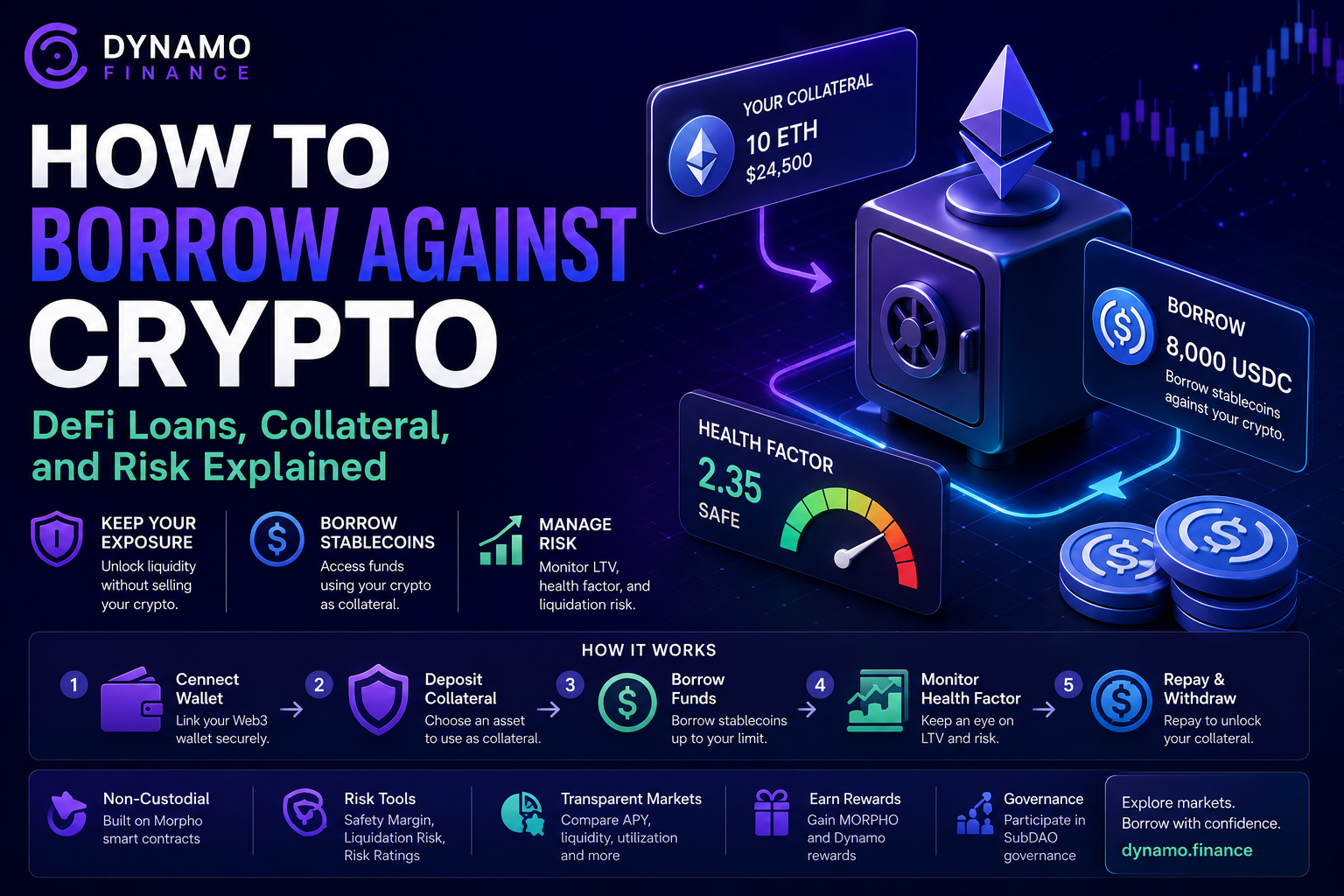
LTV stands for loan-to-value. It measures your outstanding loan balance relative to the market value of your collateral. If you borrow $10,000 against $25,000 of collateral, your starting LTV is 40%.
Loan health gets worse when your LTV rises. LTV can rise because collateral falls, interest accrues, or you borrow more. It can improve when collateral rises or when you repay part of the loan.
Coinbase’s USDC loan health materials explain that LTV and LLTV together determine liquidation risk, and that borrowers may need to add collateral or repay part of the loan as LTV approaches the market’s LLTV.
For borrowers, LTV is not a passive number. It is the core risk gauge for the loan.
What Is LLTV?
LLTV stands for liquidation loan-to-value. It is the threshold where the loan can be automatically liquidated. Coinbase’s collateral page states that a USDC loan can be liquidated automatically if it reaches an 86% LLTV threshold, with an additional penalty included when collateral is liquidated.
That does not mean borrowers should operate anywhere near 86%. The threshold is a danger line, not a target. A position can move from safe to at risk quickly if the collateral asset falls sharply.
For example, a loan that starts at 50% LTV may feel manageable. If collateral value drops by 30% while debt remains the same, LTV rises meaningfully. Add interest accrual, and the buffer becomes smaller over time.
Borrowers should plan their loan around stress scenarios, not calm market conditions.
Coinbase Crypto Loan Fees
Fees are easy to overlook because borrowers often focus on the USDC amount received. Coinbase states that a one-time processing fee is added each time a user borrows or increases the loan amount, and that this fee becomes part of the principal.
The public Coinbase USDC loan processing fee page describes a tiered structure: 2% on the first $250,000 and 1% on the amount above $250,000. Because the fee is added to the loan balance, it can also accrue interest over time.
This detail matters. If you borrow $10,000, your starting debt can be higher than the cash amount you receive because the processing fee is added to principal. Borrowers should review the final loan review screen rather than calculating from the headline borrow amount alone.
Fees also affect LTV. A higher starting principal means slightly higher initial debt relative to collateral, which can reduce the borrower’s safety buffer.
Interest Rates Are Variable
Coinbase crypto loan interest rates are variable because they are calculated through Morpho market conditions. Coinbase’s loan launch materials state that rates are calculated automatically by Morpho and can vary as blocks are created on Base.
This means the rate shown at loan opening is not necessarily the rate you will pay forever. Borrow APY can rise if utilization increases or if market liquidity tightens. It can fall if more supply enters or borrowing demand declines.
Variable rates are common in DeFi lending. They help balance supply and demand, but they also mean borrowers should monitor costs after opening the loan.
A borrower who keeps a loan open for months should not only track collateral price. They should also track interest accrual and rate changes.
What Happens If Your Collateral Drops?
If your collateral drops in value, your LTV rises. If it rises enough to reach the LLTV threshold, liquidation can occur automatically.
Coinbase’s USDC loan collateral materials state that collateral is locked on Morpho and returned after full repayment, but also explain that liquidation can happen if the loan reaches the liquidation threshold. That page also describes a liquidation penalty applied when collateral is liquidated.
Liquidation is not a theoretical risk. Crypto assets can move quickly, especially during market-wide selloffs. A borrower who uses too much of their available borrowing capacity can be forced into liquidation during volatility.
The best defense is to borrow conservatively, monitor loan health, and take action before the loan approaches the threshold.
What Is Loan Protection?
Coinbase describes loan protection as a feature that can apply additional collateral when a loan reaches a certain LTV threshold and is at risk of liquidation. It must be enabled for each loan, requires the collateral asset to be available in the user’s balance, and is not a guarantee against liquidation.
This is useful, but borrowers should treat it as a backup layer, not a primary risk plan. Market volatility, technical issues, unavailable funds, and rapid price moves can still result in liquidation.
A strong borrower plan should not depend entirely on automation. Users should know when they will repay, add collateral, or reduce risk manually.
Loan protection can lower risk, but it does not turn a high-LTV position into a safe one.
Coinbase Crypto Loans vs. Morpho Direct Access
Coinbase makes borrowing easier by integrating the experience into a familiar app. Direct DeFi access gives users more market visibility and more control, but it also requires wallet knowledge and more responsibility.
| Feature | Coinbase Crypto Loans | Direct Morpho-Based DeFi Access |
|---|---|---|
| User experience | Simplified Coinbase interface | Wallet-based DeFi workflow |
| Underlying infrastructure | Morpho on Base through Coinbase integration | Morpho markets and vaults through DeFi interfaces |
| Risk visibility | Coinbase loan health, alerts, and loan management screens | Market-level APY, utilization, collateral, oracle, liquidity, LLTV, and risk tools depending on interface |
| Control | More guided and productized | More granular market selection and wallet control |
| Best fit | Users who want a familiar Coinbase loan flow | Users who want to compare Morpho markets directly and manage DeFi risk themselves |
For many beginners, Coinbase can feel simpler. For DeFi-native users, direct market access may offer more transparency and flexibility. The right choice depends on the borrower’s goals, skill level, and risk tolerance.
Where Dynamo Finance Fits
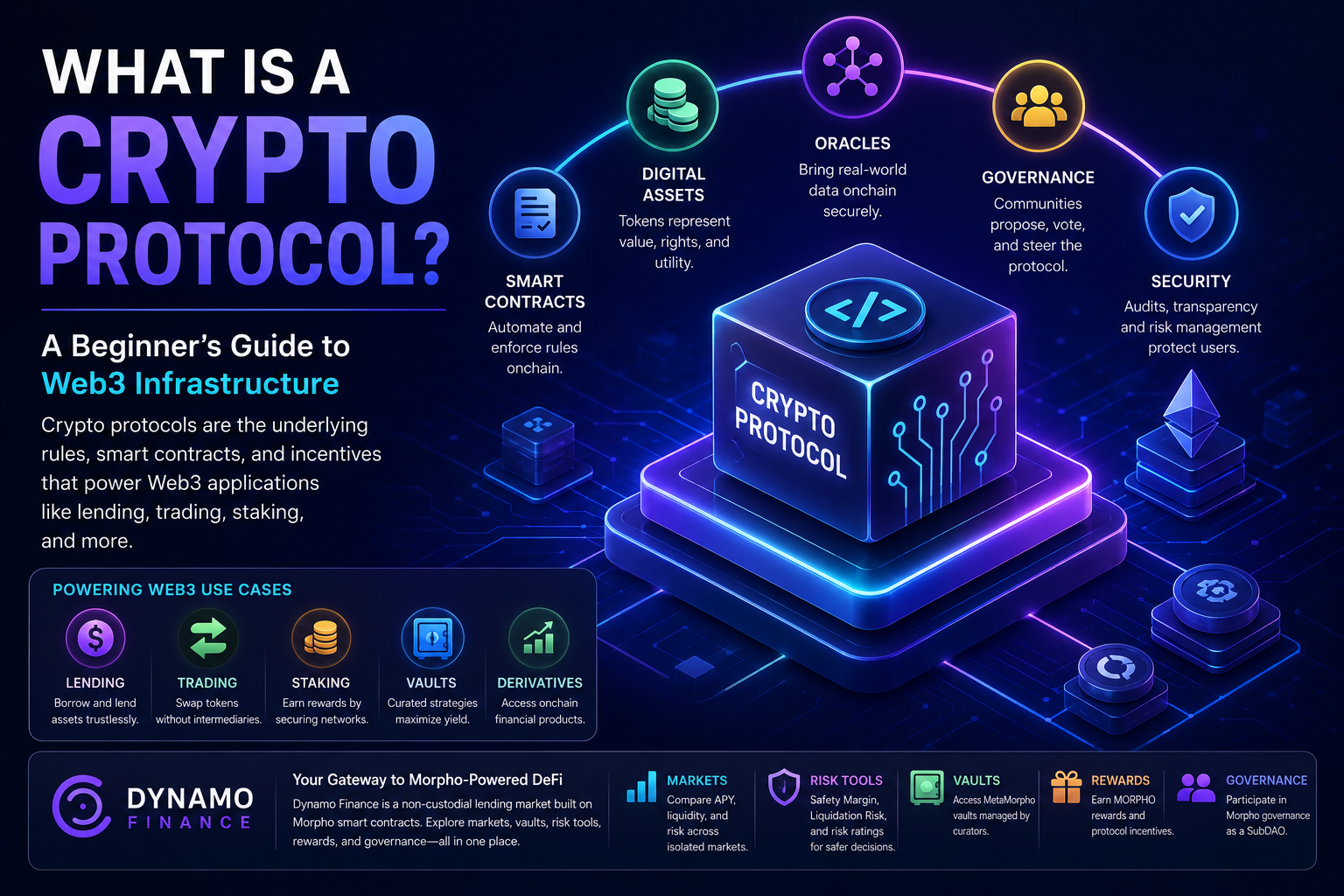
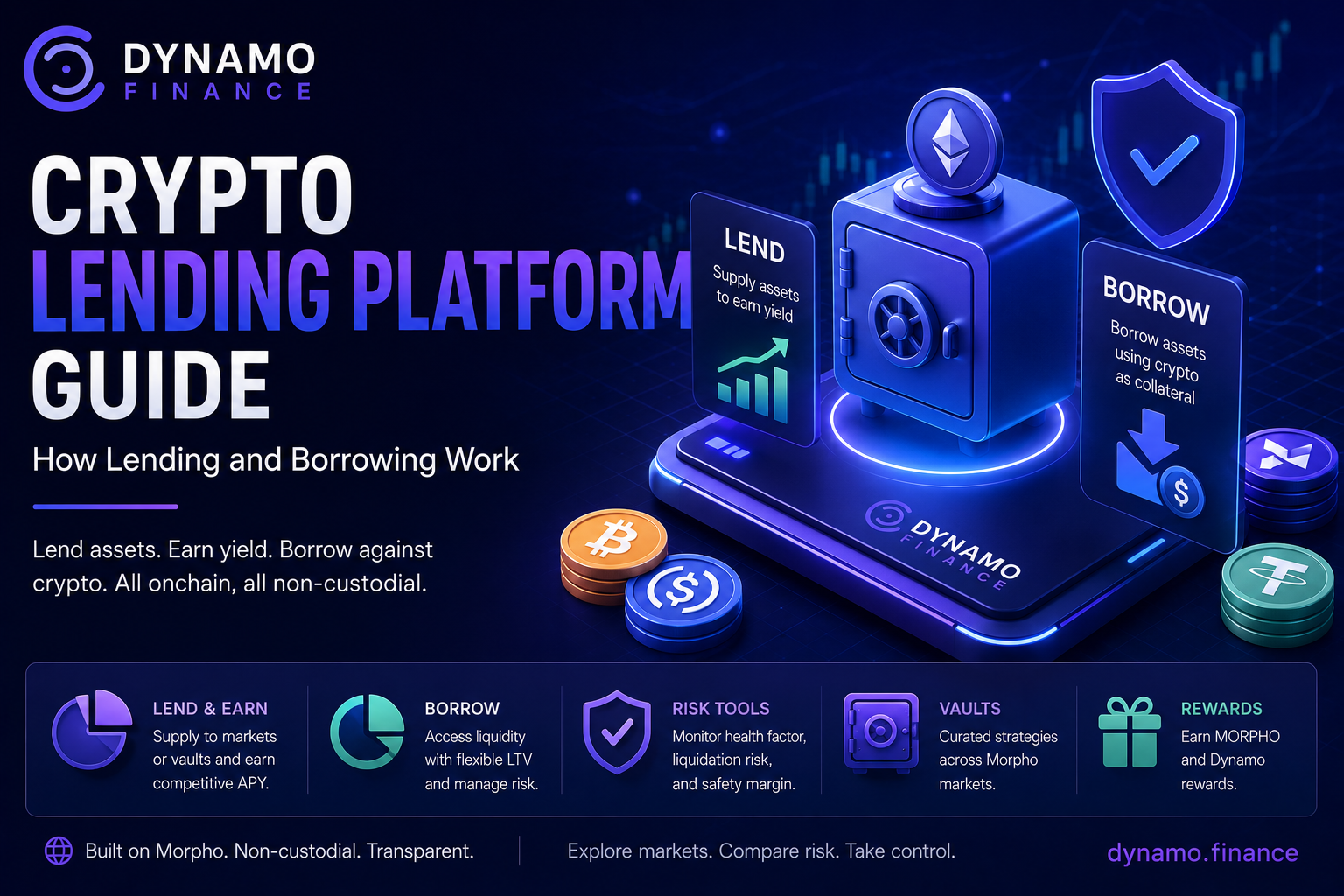
Dynamo Finance is a non-custodial, permissionless Web3 lending market built on Morpho smart contracts. Users can supply assets, borrow against collateral, deposit into vaults, compare markets, evaluate risk, earn rewards, and participate in governance from one interface.
Dynamo does not custody user funds. Assets are held by Morpho smart contracts, while Dynamo adds discovery, analytics, position management, risk tooling, automation, rewards, and SubDAO governance participation.
This makes Dynamo relevant for users who understand the Coinbase loan concept but want to evaluate DeFi borrowing more directly. Instead of only viewing a simplified loan screen, users can compare market-level data such as borrow APY, available liquidity, collateral asset, loan asset, utilization, oracle, and LLTV.
For borrowers researching a morpho crypto loan, Dynamo helps turn the hidden mechanics of DeFi lending into visible decision-making inputs.
Dynamo Markets: Direct Morpho Borrowing Context
Dynamo markets are isolated lending pools. Each market has one collateral asset, one loan asset, one oracle, and one liquidation loan-to-value threshold. That structure helps borrowers understand exactly which rules apply to their position.
Users can review live market data before borrowing. Important metrics include borrow APY, supply APY, utilization, available liquidity, collateral type, loan asset, risk tier, and verification status.
This is a major difference from a simplified loan product. The borrower can inspect the market rather than only accepting the product wrapper.
Users who want to compare live borrowing opportunities can explore Dynamo markets and evaluate the loan asset, collateral asset, APY, utilization, liquidity, oracle, and LLTV before taking action.
Safety Margin: Borrowing Below the Danger Zone
Dynamo’s Safety Margin feature is designed to help borrowers operate more conservatively than Morpho’s liquidation threshold. Morpho markets enforce LLTV, while Dynamo lets users set a synthetic target LTV to create a configurable buffer.
This is important because borrowers often focus on maximum borrowing power. Maximum borrowing power is not the same as prudent borrowing size.
A Safety Margin helps users avoid opening a position too close to liquidation. That can be especially useful in volatile markets, where collateral prices can fall quickly.
For users comparing crypto backed loans, Safety Margin is a practical risk-control feature because it encourages borrowing with a plan rather than borrowing to the limit.
Liquidation Risk Views
Dynamo’s Liquidation Risk view helps borrowers understand how much room they have before liquidation becomes likely. It displays borrower-focused metrics such as current health factor, price-drop tolerance, and liquidation price.
These metrics are easier to act on than abstract loan terminology. A borrower can see how far collateral can fall and decide whether the position is still comfortable.
If the buffer becomes too small, the user can repay part of the debt, add collateral, or reduce exposure. Taking action early is usually better than reacting after the position is already at risk.
Users who already understand Coinbase crypto loans may find these DeFi-native risk views helpful because they reveal the mechanics that drive collateralized borrowing across Morpho markets.
Coinbase Crypto Loans vs. Dynamo Finance
Dynamo and Coinbase serve different borrower needs. Coinbase emphasizes a familiar account-based experience. Dynamo emphasizes non-custodial DeFi market comparison and risk visibility.
| Category | Coinbase Crypto Loans | Dynamo Finance |
|---|---|---|
| Primary use | Borrow USDC through Coinbase’s Morpho integration | Access and compare Morpho-based markets and vaults directly |
| Interface style | Coinbase app and web loan management | DeFi-native lending interface |
| Custody model | Collateral is moved onchain to Morpho through Coinbase’s flow | Users interact with Morpho smart contracts from a Web3 wallet |
| Risk tools | Loan health, liquidation alerts, and loan protection where available | Risk ratings, Safety Margin, Liquidation Risk views, market data, vault allocation, and rewards |
| Best fit | Users who want an embedded Coinbase loan experience | Users who want DeFi-native control, market comparison, and advanced risk visibility |
The point is not that one path is always better. Coinbase may be simpler for users already inside Coinbase. Dynamo may be better for users who want more direct visibility into Morpho markets, rates, collateral, and risk.
Borrower Checklist Before Taking a Coinbase Crypto Loan
Before opening a Coinbase crypto loan, borrowers should move through a structured checklist. This reduces the chance of misunderstanding fees, collateral movement, or liquidation risk.
- Confirm that crypto-backed loans are available in your region and account.
- Review the supported collateral asset and whether any wrapping or conversion occurs.
- Check the loan amount, starting LTV, and LLTV shown on the loan review screen.
- Review the current variable interest rate.
- Understand the processing fee and how it affects starting principal.
- Check the liquidation threshold and liquidation penalty.
- Decide how much collateral price decline your position can tolerate.
- Plan whether you will repay, add collateral, or close the loan if LTV rises.
- Understand loan protection rules and limitations if you enable it.
- Keep records for tax, accounting, and portfolio tracking.
This checklist is intentionally conservative. Borrowing against crypto works best when the borrower understands the downside before receiving the USDC.
How to Think About Borrow Size
Borrow size should be based on risk tolerance, not only borrowing limit. A user who borrows near the maximum available amount may have little room for volatility.
A safer approach is to choose a target LTV that can survive a meaningful collateral drawdown. For volatile assets such as BTC and ETH, many borrowers prefer to leave a wide buffer.
Suppose a borrower posts $50,000 of collateral and borrows $20,000. The starting LTV is 40%. If collateral falls to $35,000, LTV rises to about 57%. That may still be manageable depending on the market, but the borrower has lost a large part of the buffer.
Borrowing less can feel inefficient, but it can make the loan much easier to manage during volatility.
When Coinbase Crypto Loans May Make Sense
A Coinbase crypto loan may make sense when a borrower needs USDC liquidity, wants to keep crypto exposure, understands the collateral mechanics, and has a repayment plan.
Good use cases often include short-term liquidity needs, planned expenses, temporary portfolio rebalancing, or avoiding an unwanted sale. The common thread is that the borrower knows why the loan exists and how it will be repaid.
Borrowing may also make sense for users who prefer the Coinbase interface and do not want to manage a DeFi wallet directly. That convenience has value, especially for users who are new to onchain borrowing.
Even then, borrowers should understand that convenience does not eliminate liquidation risk. The position still needs monitoring.
When Selling May Be Better Than Borrowing
Selling may be better if you do not want to manage a loan, if rates are too high, if collateral is too volatile, or if your repayment plan is unclear.
A loan adds complexity. You must track collateral price, interest accrual, LTV, liquidation threshold, and repayment. Selling a smaller amount may be simpler if the liquidity need is permanent.
Borrowing can also create stress during market drawdowns. If you would panic during a 20% collateral drop, the loan may be too large or unnecessary.
The right choice is not always borrowing. Sometimes reducing exposure is cleaner than adding debt against it.
Coinbase Crypto Loans and Taxes
Many users consider borrowing because selling crypto can create taxable events. A loan may avoid an immediate sale in some situations, but tax treatment depends on jurisdiction and transaction details.
Collateral transfers, BTC-to-cbBTC conversion, liquidation, repayment, interest, and fees may each have different reporting implications. This is especially important when collateral is wrapped or moved onchain.
Borrowers should keep records of loan creation, collateral movement, fees, interest, repayments, liquidations, and any conversions. Do not rely on a simple assumption that every step is tax-neutral.
This article is educational, not tax advice. A qualified tax professional can help determine how your specific loan should be treated.
Stablecoin Risk: Borrowing USDC Is Not the Same as Borrowing Dollars
Coinbase crypto loans generally disburse USDC, not physical dollars. USDC is a regulated dollar-backed stablecoin, but it is still a crypto asset with its own issuer, network, and operational dependencies.
For many users, USDC is practical because it can be used onchain, transferred, or converted. Still, stablecoins carry risks, including issuer risk, depeg risk, network risk, and regulatory risk.
Borrowers should understand what they intend to do with the USDC after receiving it. If the goal is offchain spending, conversion and withdrawal steps may matter. If the goal is DeFi activity, smart contract and market risk can stack on top of loan risk.
USDC liquidity is useful, but it should still be managed as part of a broader risk plan.
Common Mistakes Borrowers Make
The first mistake is borrowing too close to the liquidation threshold. This gives the loan little room to absorb normal market volatility.
The second mistake is ignoring the processing fee. Since the fee can be added to principal, the starting debt may be higher than the amount received.
The third mistake is assuming the interest rate is fixed. Morpho-based rates are variable and can move with market conditions.
The fourth mistake is treating loan protection as a guarantee. It can help, but it may not execute in every stress scenario.
The fifth mistake is failing to compare alternatives. Coinbase may be convenient, but DeFi-native users may want to compare direct Morpho markets through tools such as Dynamo.
How DeFi Borrowers Compare Alternatives
Experienced DeFi borrowers do not look only at the borrow button. They compare the market behind the loan.
For a direct borrowing market, the key variables are collateral asset, loan asset, borrow APY, utilization, available liquidity, oracle, LLTV, market age, risk rating, and total supply. A lower rate is attractive only if the collateral and oracle setup are acceptable.
Dynamo helps users compare these inputs through its Morpho-based market interface. That can be useful for borrowers who want to move beyond an embedded product and examine market-level conditions directly.
Users researching morpho vaults should also remember that vaults matter to borrowers indirectly. Vaults supply liquidity into markets, and changes in supplier allocation can affect available liquidity and rates.
What Lenders Should Understand About Coinbase Crypto Loans
Borrowers are only one side of the market. Coinbase also offers USDC lending through Morpho-powered vaults in supported regions, which means some users approach the same ecosystem from the lender side.
Coinbase’s crypto-backed lending introduction describes USDC lending through Morpho-powered vaults, where funds are sent to lending markets and borrowers post collateral to take out loans.
This connection matters because borrower rates and lender yields are two sides of the same system. Borrowers pay interest. Lenders earn yield. Utilization, collateral demand, and market liquidity influence both sides.
For users interested in lending cryptocurrency, the key lesson is the same: understand where yield comes from, what collateral backs borrowers, and how liquidity behaves under stress.
How Dynamo Helps Users Learn the Full Lending Stack
Dynamo is useful because it exposes the market mechanics that embedded loan products can abstract away. Users can inspect markets, compare APYs, review risk tiers, monitor liquidation risk, and evaluate vault exposure.
This does not mean every Coinbase user needs to become a DeFi power user. It means borrowers benefit from understanding the infrastructure underneath the loan.
Learning how Morpho markets work can help users make better choices even if they keep using Coinbase. A borrower who understands LTV, LLTV, utilization, collateral quality, oracle risk, and variable rates is less likely to overborrow.
For a structured overview of markets, vaults, risk ratings, Safety Margin, Liquidation Risk, rewards, fees, and governance, review the Dynamo Finance protocol guide.
Security Checklist Before Borrowing
Security matters because crypto loan activity involves collateral, smart contracts, and account access. A mistake can be expensive.
- Use the official Coinbase app or verified Coinbase website when using Coinbase crypto loans.
- Review the live loan screen before borrowing because terms, rates, fees, and supported collateral can change.
- Understand whether collateral is being converted, wrapped, or moved onchain.
- Enable security features such as two-factor authentication and withdrawal protections where available.
- Keep records of collateral movement, fees, interest, repayments, and any liquidation events.
- Do not use borrowed funds for strategies you do not understand.
- If using DeFi directly, verify URLs, contract interactions, token approvals, wallet permissions, and network selection.
Borrowing is a financial action and a security action. Treat both seriously.
Practical Example: A Conservative Coinbase Crypto Loan
Assume a user has $100,000 worth of BTC and wants $25,000 of USDC liquidity. The starting LTV is roughly 25% before considering fees and interest.
This position has a wider buffer than a loan that starts at 60% or 70% LTV. If BTC falls by 30%, collateral value drops to $70,000 and the loan becomes more risky, but the borrower still has more room than a highly leveraged position.
The borrower should still monitor interest, LTV, and alerts. If BTC falls further, they may repay part of the debt or add collateral.
This type of conservative structure is how many experienced borrowers think: the loan exists to solve a liquidity need, not to maximize leverage.
Practical Example: An Aggressive Loan That Becomes Risky
Now assume a borrower uses a much higher initial LTV. The loan may provide more USDC upfront, but the liquidation buffer is smaller.
If the collateral falls quickly, LTV rises. If interest also accrues and market conditions are volatile, the borrower may be forced to act quickly. In a sharp selloff, liquidation can happen before the borrower has time to react.
High-LTV borrowing can look efficient during calm markets. It becomes dangerous when volatility returns.
Most users are better served by borrowing less and keeping a larger collateral cushion.
Practical Example: Comparing Coinbase With Dynamo
A Coinbase user may prefer the app because it is familiar and convenient. They can borrow USDC without manually selecting DeFi markets.
A DeFi-native user may want to compare Morpho markets through Dynamo. They might inspect borrow APY, collateral options, available liquidity, utilization, oracle design, and risk tiers before choosing a market.
Neither path is universally better. Coinbase simplifies the experience. Dynamo provides deeper visibility and control.
For users comparing a loan crypto strategy with direct DeFi alternatives, the best choice depends on how much control, transparency, and responsibility they want.
Before You Borrow: Ask These Questions
A good borrower makes the decision before emotion enters the picture. Ask these questions before opening a loan:
- Why do I need this USDC?
- How will I repay the loan?
- What happens if my collateral falls 20%, 30%, or 40%?
- What is my starting LTV after fees?
- What is the liquidation threshold and penalty?
- Can the borrow rate change?
- Do I understand where my collateral goes?
- What alerts or monitoring process will I use?
- Would selling a smaller amount be simpler?
- Have I compared DeFi-native alternatives?
If you cannot answer these questions clearly, the loan may be premature.
How to Build a Safer Borrowing Strategy
A safer borrowing strategy starts with a clear purpose. Borrowing for short-term liquidity with a known repayment source is different from borrowing to increase leverage.
Next, choose a conservative starting LTV. The more volatile the collateral, the larger the buffer should be. Borrowers should avoid using the liquidation threshold as a planning target.
After opening the loan, set a monitoring routine. Track LTV, collateral price, borrow APY, loan balance, and alerts. If the position becomes less comfortable, act early.
Finally, compare tools. Coinbase provides a guided loan experience. Dynamo offers DeFi-native market comparison, Safety Margin, Liquidation Risk views, and risk ratings for users who want more direct control.
Where to Stay Updated
Crypto lending markets move quickly. Coinbase product availability, collateral support, Morpho market conditions, interest rates, and DeFi risk tools can all change over time.
Borrowers should review Coinbase’s live loan screens for current product terms and use official support pages for operational details. DeFi users should also monitor market data before opening or managing positions.
For Dynamo product updates, governance news, risk tooling, and market context, follow Dynamo Finance updates.
Strong borrowers are not just users of lending products. They are managers of risk.
Conclusion
Coinbase crypto loans make crypto-backed borrowing easier to access by combining Coinbase’s interface with Morpho’s onchain lending infrastructure on Base. For eligible users, the product can unlock USDC liquidity without selling supported crypto collateral.
The borrower’s job is to understand the trade-off. These loans involve variable rates, processing fees, collateral movement, LTV, LLTV, liquidation penalties, smart contract exposure, and market volatility. Convenience can help with access, but it does not remove the need for risk management.
Dynamo Finance gives DeFi-native users a deeper way to evaluate Morpho-based borrowing. With market data, risk ratings, Safety Margin, Liquidation Risk views, vault context, rewards, and non-custodial access, Dynamo helps borrowers compare opportunities before taking on collateralized debt.
Explore Dynamo Finance to compare Morpho markets, review borrowing conditions, and build a more disciplined approach to crypto-backed loans before putting your collateral at risk.
FAQ
What are Coinbase crypto loans?
Coinbase crypto loans are USDC loans that eligible users can take by using supported crypto assets as collateral. Borrowing is enabled by the Morpho onchain lending protocol on Base, while Coinbase provides the user interface.
How does Morpho Coinbase borrowing work?
In the Morpho Coinbase loan flow, supported crypto collateral is moved onchain to Morpho to secure the loan. For Bitcoin-backed borrowing, Coinbase states that BTC is converted to cbBTC and transferred to a Morpho smart contract as collateral.
What happens if my Coinbase crypto loan is liquidated?
If your loan reaches the liquidation threshold, collateral can be liquidated automatically to repay the loan, accrued interest, and applicable penalty. Coinbase’s collateral materials state that the LLTV threshold is 86% and that a penalty is included when collateral is liquidated.
Are Coinbase crypto loan rates fixed?
No. Coinbase crypto loan rates are variable because they are calculated by Morpho based on market conditions. Borrowers should monitor rates after opening a loan because interest costs can change over time.
How does Dynamo Finance relate to Coinbase crypto loans?
Dynamo Finance is not Coinbase. The connection is Morpho: Coinbase uses Morpho for its embedded crypto-backed loan flow, while Dynamo gives DeFi users direct tools to compare Morpho-based markets, risk ratings, Safety Margin, Liquidation Risk data, and vault opportunities.