
Stablecoins are no longer just a place to park capital between trades. In modern DeFi, they are used for savings products, lending markets, token rewards, fixed-yield strategies, vaults, and collateralized borrowing. That is why more crypto users are searching for skymoney and trying to understand how Sky Money fits into the broader stablecoin yield landscape.
The challenge is that the naming can be confusing. Users may type “SkyMoney,” “sky money,” “Sky Protocol,” “USDS,” “sUSDS,” or “MakerDAO rebrand” and end up looking at related but different parts of the same ecosystem. Some users are trying to understand the stablecoin. Others want to know how yield works. More advanced investors want to compare Sky Money vaults, Morpho-based lending markets, and curated stablecoin strategies.
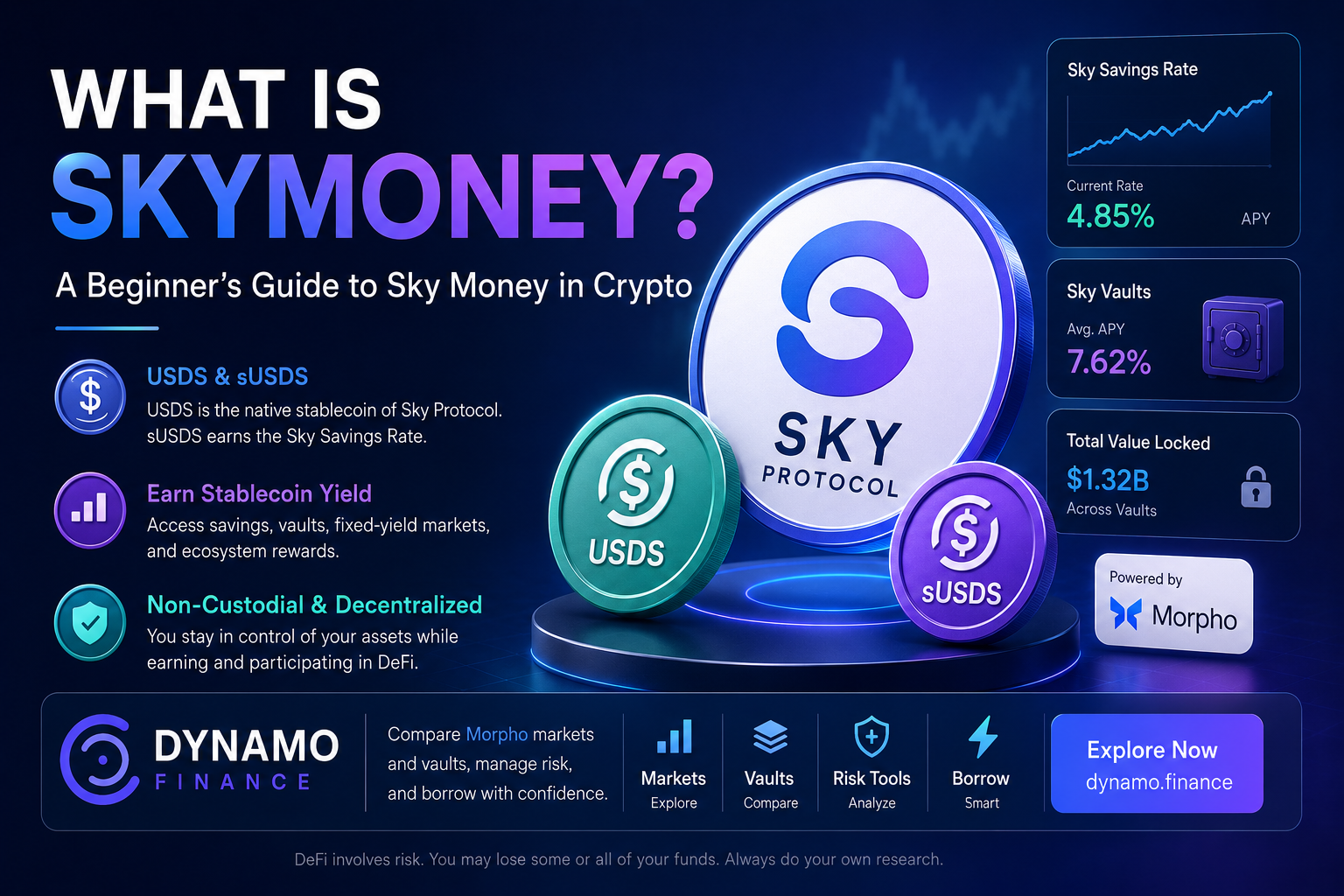
Sky.money is a non-custodial front-end interface for accessing products connected to the decentralized Sky Protocol, including USDS, sUSDS, Sky Savings Rate exposure, Sky Vaults, fixed-yield integrations, and ecosystem rewards. Sky Protocol is the evolution of MakerDAO, the long-running DeFi system historically associated with DAI.
This guide explains what SkyMoney means in crypto, how Sky Money relates to Sky Protocol, how USDS and sUSDS work, what risks investors should understand, and how to compare Sky-related stablecoin yield with Morpho-based opportunities through Dynamo Finance.
Key Takeaways
- Sky Money usually refers to sky.money, the non-custodial interface that lets eligible users access Sky Protocol products.
- USDS is the native stablecoin of Sky Protocol, while sUSDS is the yield-generating version used to access the Sky Savings Rate.
- Sky.money includes multiple yield paths, including sUSDS, Sky Vaults, fixed-yield integrations, stUSDS, and ecosystem rewards, each with different risks.
- Sky Vaults are third-party strategies currently associated with Morpho infrastructure and variable market-driven returns.
- Dynamo Finance is relevant because it helps users compare Morpho-based markets and vaults with risk ratings, liquidation-risk tools, and a non-custodial workflow.
What Is SkyMoney in Crypto?
Sky.money gives users access to stablecoin yield products, USDS conversion tools, SKY participation, and other DeFi features while users retain control of their own wallets.
The more precise brand name is Sky.money. It is separate from the underlying Sky Protocol, just as a DeFi interface can be separate from the smart contracts it helps users access. That distinction matters because a front end can make DeFi easier to use, but the actual transactions still depend on smart contracts, governance decisions, and onchain market conditions.
Sky Protocol is the successor to MakerDAO’s stablecoin system. MakerDAO was one of DeFi’s earliest and most important lending and stablecoin protocols, known for DAI, overcollateralized vaults, and governance-driven risk parameters. Sky builds on that legacy with USDS, SKY, savings products, and expanded stablecoin yield access.
For a beginner, the simplest way to think about Sky.money is this: it is a non-custodial interface for putting stablecoins to work through Sky Protocol-related products. For a DeFi investor, the more important question is whether each product’s yield source, risk profile, liquidity, and governance model fit your portfolio.
Sky.money vs. Sky Protocol vs. USDS
Crypto naming often blurs product, protocol, token, and interface. With Sky, it helps to separate the layers.
| Term | What It Means | Why It Matters |
|---|---|---|
| Sky.money | A non-custodial interface for accessing Sky Protocol-related products | This is what many users mean when they search for SkyMoney or sky money |
| Sky Protocol | The decentralized protocol ecosystem that evolved from MakerDAO | It governs USDS, SKY, savings parameters, and protocol-level mechanics |
| USDS | The native stablecoin of Sky Protocol | It is the main dollar-denominated asset used across Sky products |
| sUSDS | The yield-generating version of USDS used to access the Sky Savings Rate | It lets users earn variable protocol-driven yield while holding a transferable token |
| SKY | The governance token of Sky Protocol | It is used for protocol participation and governance-related functions |
| Sky Vaults | Third-party yield strategies facilitated through Sky.money | They can offer stablecoin yield through strategy-driven DeFi deployments, including Morpho-based infrastructure |
This distinction prevents a common mistake. A user may say “I’m using SkyMoney,” but they may actually be converting into USDS, holding sUSDS, accessing a vault, using a third-party fixed-yield integration, or evaluating SKY governance exposure. Each action has different mechanics and risks.
How sky.money Evolved From MakerDAO
MakerDAO was one of DeFi’s foundational protocols. It introduced a decentralized stablecoin model where users could generate DAI against collateral, while governance adjusted parameters such as collateral types, stability fees, debt ceilings, and risk settings.
Sky Protocol represents the next stage of that system. The ecosystem introduced USDS as a newer stablecoin asset and SKY as the governance token associated with the Sky ecosystem. DAI and MKR did not simply vanish from crypto markets, but sky.money emphasizes the newer USDS and SKY-centered experience.
For investors, the important point is continuity and change. Sky carries the heritage of MakerDAO, but the product experience is different. Users now see a broader suite of stablecoin yield products, including savings, rewards, vaults, fixed-yield integrations, and staking-related tools.
The rebrand also reflects a broader DeFi trend. Protocols are moving from single-purpose products into financial ecosystems. A stablecoin is no longer only a payment or trading asset. It can become the base layer for savings, credit, collateral, institutional yield, governance, and distribution through other DeFi protocols.
What Is USDS?
USDS is the native stablecoin of Sky Protocol. It is designed to function as a dollar-denominated crypto asset backed by protocol collateral and governed through the Sky ecosystem. Users can access USDS through sky.money and other supported venues.
USDS is central because it powers several sky.money products. Users may convert supported stablecoins into USDS, use USDS to access sUSDS, supply USDS into ecosystem rewards modules, or deploy stablecoins into vault strategies depending on availability and jurisdiction.
The peg mechanism and collateral backing are important. Stablecoins can look simple because they are designed to trade near $1, but the strength of a stablecoin depends on reserves, liquidity, market confidence, redemption mechanics, risk controls, governance, and the quality of assets backing the system.
For DeFi users, USDS should be evaluated as part of a larger protocol design. It is not the same as holding cash in a bank account. It is an onchain asset governed by smart contracts, collateral frameworks, and decentralized governance decisions.
What Is sUSDS?
sUSDS is the yield-generating version of USDS. When users supply USDS into the Sky Savings Rate module, they receive sUSDS, which represents exposure to the Sky Savings Rate. The value of sUSDS relative to USDS can increase as yield accrues.
This design is similar to other yield-bearing tokens in DeFi. Instead of receiving yield as a separate manual payment, the token itself reflects accrued value. That can make sUSDS easier to integrate across DeFi because it remains transferable while representing a claim on yield-bearing USDS.
The Sky Savings Rate is set through Sky governance and can change over time. It is not the same as a fixed bank interest rate, and it is not guaranteed by sky.money. The rate depends on protocol revenue capacity, governance decisions, market conditions, and broader strategy performance.
For a beginner, sUSDS is often the most straightforward sky.money product to understand: hold USDS, convert it into sUSDS, and receive exposure to the Sky Savings Rate. The simplicity of the interface should not obscure the risks. Smart contract, governance, peg, market, liquidity, and regulatory risks still apply.
How the Sky Savings Rate Works
The Sky Savings Rate, often shortened to SSR, is the rate users access through sUSDS. It is designed to give stablecoin holders a way to earn protocol-driven yield without manually managing lending positions.
The SSR is different from a standard DeFi lending market. In a typical lending market, supply and borrow rates usually move with utilization. When many borrowers draw liquidity, rates rise. When borrower demand falls, rates compress. The SSR is governance-set and tied to Sky Protocol’s revenue and capital allocation model rather than being purely utilization-driven.
That distinction is important. A governance-set rate can feel smoother than a live lending market rate, but it also depends on governance decisions. The rate can be changed, reduced, or eliminated if conditions change.
A practical way to think about the SSR is that it converts protocol-level income into a savings-like stablecoin product. It is useful for users who want stablecoin yield without choosing individual lending markets. It is not risk-free, and users should still monitor protocol updates, eligibility, and the current rate.
What Are Sky Vaults?
Sky Vaults are curated stablecoin yield strategies made available through sky.money. They are separate from sUSDS and the governance-set Sky Savings Rate. Instead, Sky Vault returns are strategy-driven and depend on market conditions inside the underlying deployments.
Current Sky Vault positioning is closely connected to Morpho infrastructure. Sky.money describes Sky Vaults as third-party yield strategies deployed by Morpho and facilitated through sky.money. These vaults can accept assets such as USDS, USDC, or USDT depending on the specific vault, and each vault has its own strategy and risk profile.
This is where sky.money connects naturally to morpho vaults. Morpho-based vaults allocate capital into lending markets, while curators or strategy managers define how assets are deployed. The user sees a vault; under the surface, the strategy may depend on collateral markets, utilization, liquidity, oracles, and borrower demand.
Sky Vaults can offer attractive yield, but they are structurally different from sUSDS. The Sky Savings Rate is governance-set. Vault returns are market-driven and strategy-specific. That means a vault can outperform sUSDS during favorable conditions and underperform when market demand, utilization, or liquidity changes.
How Sky Vaults Differ From sUSDS
Beginners often group all stablecoin yield products together. That can lead to poor decisions because two products can both show APY while exposing users to very different mechanics.
| Feature | sUSDS | Sky Vaults |
|---|---|---|
| Primary mechanism | Accesses the Sky Savings Rate | Deploys capital into strategy-driven DeFi vaults |
| Rate source | Governance-set protocol rate | Market-driven strategy performance |
| Main yield driver | Sky Protocol revenue and governance decisions | Underlying vault strategy, borrower demand, utilization, and liquidity |
| Complexity | Generally simpler for beginners | Requires more review of strategy, assets, and risk |
| Risk profile | Protocol, governance, stablecoin, smart contract, and regulatory risk | All sUSDS-style risks where relevant, plus strategy, market, curator, and liquidity risk |
The right choice depends on the user’s goal. A user who wants simple stablecoin savings exposure may prefer sUSDS. A user seeking potentially higher or more specialized yield may evaluate vaults, but should spend more time reviewing how the strategy works.
Why Sky Money Matters for DeFi Investors
Sky Money matters because it sits at the center of several major DeFi themes: stablecoin yield, MakerDAO’s evolution, governance-set savings rates, tokenized yield-bearing assets, and Morpho-based vault strategies.
Stablecoins are one of the most important asset categories in crypto. They give investors a dollar-denominated unit of account, liquidity for trading, collateral for borrowing, and a base asset for yield strategies. Any product that changes how stablecoins earn yield can influence behavior across DeFi.
Sky.money also reflects the growing separation between protocol infrastructure and user experience. Sky Protocol governs core mechanics. Sky.money gives users an interface. Morpho provides lending and vault infrastructure for certain strategy deployments. Other integrations may add fixed-yield or rewards features.
That layered structure gives users more options, but it also creates more due diligence. The right question is not only “What APY is shown?” The better question is “Which system generates the yield, and what risks am I taking to receive it?”
How Sky Money Relates to Dynamo Finance
Sky.money and Dynamo Finance are not the same product. They occupy different roles in the DeFi stack. Sky.money is focused on access to Sky Protocol-related stablecoin products. Dynamo Finance is a non-custodial, permissionless Web3 lending market built on Morpho smart contracts, with markets, vaults, risk tools, automation, rewards, and governance participation.
The connection is Morpho and stablecoin yield. Sky Vaults currently involve third-party strategies deployed by Morpho and facilitated through Sky.money. Dynamo helps users understand and interact with Morpho-based lending markets and vaults more directly.
For a user researching morpho lending, this relationship matters. Sky.money may package a curated stablecoin product into a simplified interface. Dynamo gives DeFi-native users a clearer way to explore markets and vaults, inspect risk signals, compare yield opportunities, and manage borrow or supply positions.
In practical terms, sky.money can introduce users to stablecoin yield concepts, while Dynamo can help users go deeper into how Morpho-based lending works. If you want to compare isolated markets, vault allocation, liquidation parameters, and risk tiers, Dynamo provides a workflow designed for that type of analysis.
What Dynamo Finance Adds for Yield Seekers
Dynamo Finance is built for users who want to supply assets, borrow against collateral, deposit into vaults, compare opportunities, and manage positions in a non-custodial environment. User funds are held by Morpho smart contracts rather than by Dynamo as a custodian.
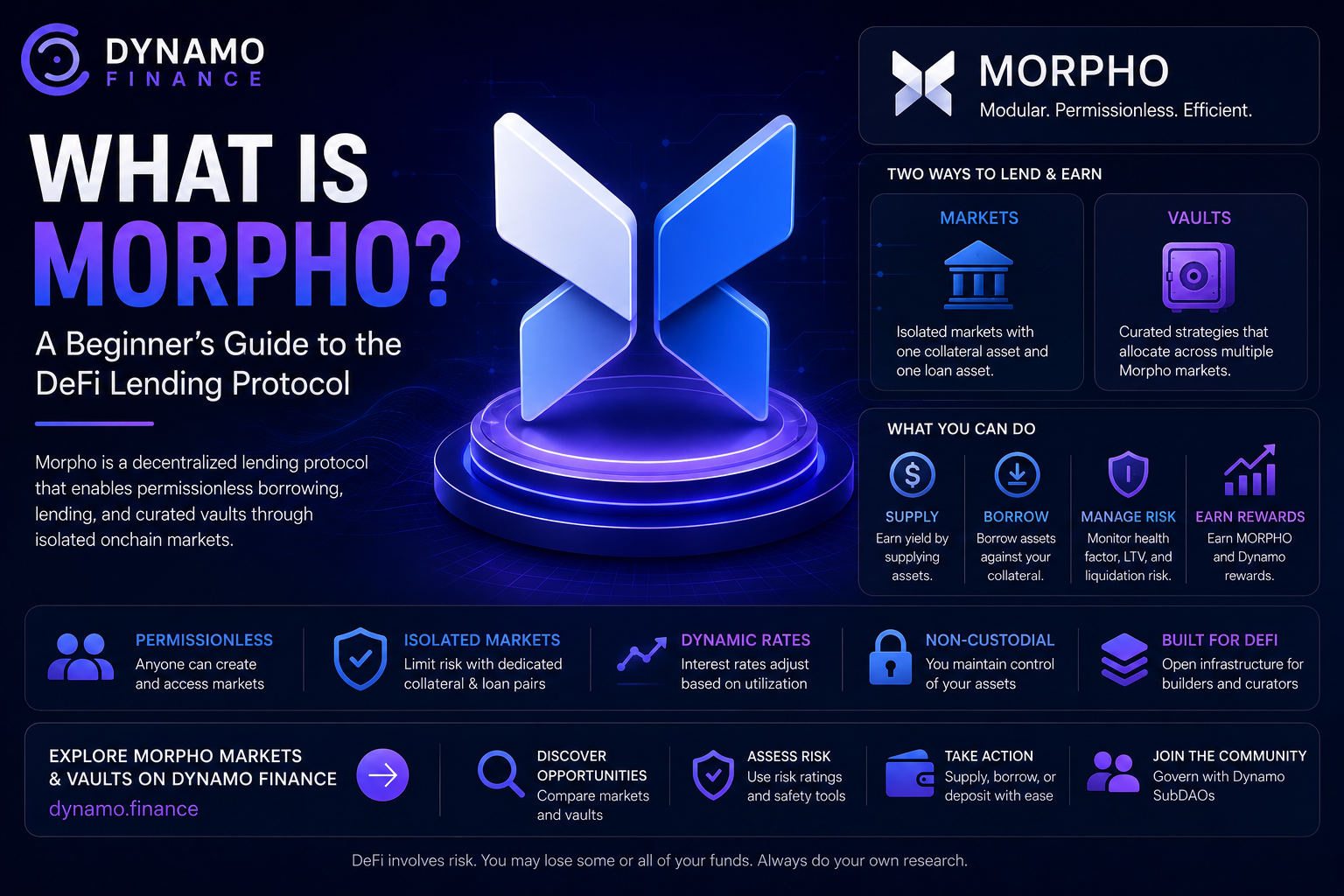
Dynamo markets are isolated lending pools. Each market is dedicated to one loan asset and one collateral asset, with its own oracle, interest-rate model, and liquidation loan-to-value threshold. This isolation helps users understand exactly which market risks apply to their position.
Dynamo vaults are built on the MetaMorpho vault standard. Instead of choosing one market manually, a user can deposit into a vault where a curator allocates capital across selected markets. This can simplify yield access, but the user still needs to evaluate the curator, allocations, liquidity, fees, and risk tier.
Dynamo also adds risk-oriented tools. Its risk rating system categorizes markets and vaults into Low, Medium, and High risk tiers based on objective onchain inputs. Borrowers can use safety-margin and liquidation-risk views to monitor how close they are to liquidation.
Sky Money and Morpho-Based Stablecoin Yield
Sky.money’s vault products help show why Morpho has become important in DeFi lending. Morpho allows more modular lending strategies, where markets and vaults can be built around specific assets, collateral types, and yield objectives.
For stablecoin investors, that flexibility can be attractive. A vault may deploy stablecoin capital into a market where borrowers post high-quality collateral. Another strategy may involve sUSDS or other stablecoin-related collateral. A different vault may target higher returns through more specialized exposures.
The challenge is that flexibility increases the need for risk evaluation. A vault may accept a familiar deposit asset like USDC or USDT, but the underlying strategy may expose the user to specific collateral, utilization, oracle, and liquidity conditions.
This is why a platform like Dynamo is useful for investors learning about cryptocurrency loans. It trains users to look beneath APY and inspect market structure. That skill applies whether you are reviewing Sky Vaults, MetaMorpho vaults, or direct DeFi lending markets.
How DeFi Lending Markets Generate Yield
To understand Sky Money and Dynamo, it helps to understand where DeFi lending yield usually comes from. In a lending market, suppliers deposit a loan asset. Borrowers post collateral and borrow that loan asset. Borrowers pay interest, and suppliers receive yield.
The rate usually depends on utilization. If most supplied liquidity is borrowed, utilization is high and rates often rise. If liquidity sits unused, rates tend to fall. This is how many lending markets balance supply and demand automatically.
In a vault, the process is one level removed. Users deposit into a vault, and the vault allocates across one or more lending markets. The user receives a blended yield based on the vault’s allocations, fees, and market performance.
This differs from sUSDS, where the rate is set through Sky governance rather than purely by market utilization. Understanding that distinction helps users compare products more intelligently.
How to Evaluate Sky Money Products Before Using Them
Before using any sky.money product, start by identifying the exact product and mechanism. Do not treat all stablecoin APYs as interchangeable.
- Identify the asset you will hold: USDS, sUSDS, SKY, stUSDS, a vault share, or another token.
- Understand the yield source: governance-set savings rate, lending market interest, vault strategy returns, fixed-yield market pricing, or ecosystem rewards.
- Review liquidity: Can you exit immediately, or does liquidity depend on an underlying market?
- Check whether the rate is fixed, variable, governance-set, market-driven, or incentive-based.
- Consider jurisdiction and availability, since some products may not be available in every region.
- Review smart contract, stablecoin, oracle, liquidity, governance, and regulatory risks.
- Start with a small position until you understand the workflow and redemption mechanics.
This process is simple but powerful. It prevents the most common yield mistake: choosing the highest number without understanding why the number exists.
How to Compare Sky Money With Dynamo Finance
Sky.money and Dynamo Finance can both be relevant to stablecoin yield seekers, but they serve different investor needs.
| Topic | Sky.money | Dynamo Finance |
|---|---|---|
| Main focus | Access to Sky Protocol-related stablecoin products | Access to Morpho-based lending markets, borrowing, vaults, risk tools, and rewards |
| Core assets | USDS, sUSDS, SKY, and related stablecoin yield products | Morpho market and vault assets shown in the Dynamo interface |
| Yield style | Governance-set savings rate, vaults, fixed-yield integrations, rewards, and staking-related products | Borrower-paid market yield, curator-managed vault yield, rewards, and market-based APYs |
| User profile | Stablecoin users looking for Sky Protocol access | DeFi users who want to compare and manage Morpho-based lending and borrowing strategies |
| Risk workflow | Product-specific risk disclosures and user risk materials | Risk ratings, market data, safety margin, liquidation-risk views, and vault allocation visibility |
A beginner may start with sky.money to understand USDS and sUSDS. A more active DeFi investor may use Dynamo to evaluate broader defi lending opportunities, compare markets, and manage collateralized positions.
What Are the Main Risks of SkyMoney?
Sky.money products carry real DeFi risks. Non-custodial access means you remain in control of your wallet, but it also means you are responsible for understanding transactions, securing private keys, and accepting smart contract risk.
- Smart contract risk: Bugs, vulnerabilities, or unexpected contract behavior can cause losses.
- Stablecoin risk: USDS is designed to hold a dollar peg, but peg stability can be affected by market pressure, collateral issues, or confidence shocks.
- Governance risk: Sky Protocol parameters, including the Sky Savings Rate, can change through governance.
- Liquidity risk: Some strategies may be harder to exit during periods of high utilization or market stress.
- Oracle risk: DeFi systems that depend on price feeds can be affected by delayed, incorrect, or manipulated data.
- Third-party integration risk: Fixed-yield products, vaults, bridges, or external protocols add additional dependencies.
- Regulatory risk: Access, availability, and product treatment can change across jurisdictions.
- User error risk: Signing the wrong transaction, using a fake site, or misunderstanding a product can cause irreversible losses.
These risks do not mean users should avoid DeFi entirely. They mean position sizing, product selection, and due diligence matter. A stablecoin strategy should be evaluated with the same seriousness as any other financial allocation.
What Are the Main Risks of Dynamo Markets and Vaults?
Dynamo’s design helps users see more data, but it cannot remove market risk. Users who supply to a market or vault still face smart contract, oracle, liquidation, liquidity, and strategy risks.
In direct markets, the key variables are collateral asset, loan asset, oracle, LLTV, utilization, total supply, total borrow, and available liquidity. A high APY market may be attractive, but if utilization is very high, immediate withdrawals may be harder. If collateral is volatile, liquidation events can increase market stress.
In vaults, users rely on a curator or allocation strategy. A vault may reduce the burden of choosing markets manually, but users still need to understand where the vault deploys funds, how concentrated it is, what fees apply, and how withdrawals depend on the underlying markets.
Borrowers face liquidation risk. If collateral value falls or debt grows enough to breach the market’s liquidation threshold, liquidation can occur. Dynamo’s safety-margin and liquidation-risk tools help borrowers monitor that risk, but users must still act when conditions change.
Stablecoin Yield: What Beginners Often Miss
Stablecoin yield can feel safer than volatile crypto yield because the principal asset is designed to stay near $1. That feeling can be misleading. The volatility of the token price is only one risk.
A stablecoin vault can still lose money if the underlying protocol fails, collateral collapses, an oracle breaks, governance changes parameters, liquidity dries up, or a user signs a malicious transaction. Stablecoins reduce directional price exposure, but they do not eliminate DeFi risk.
Another common misunderstanding is assuming that all APYs are comparable. A governance-set savings rate, a lending-market APY, a fixed-yield maturity rate, a rewards estimate, and a vault APY are different mechanisms. Each should be compared based on source, duration, liquidity, and downside risk.
For serious yield seekers, stablecoin allocation should be treated like portfolio construction. Some capital may belong in more liquid, lower-complexity products or be allocated to higher-yield vault strategies. Some may be held idle for opportunities or risk management.
Practical Example: Comparing sUSDS and a Morpho-Based Vault
Imagine a user has USDC and wants to earn stablecoin yield. One option is to convert into USDS and access sUSDS through Sky.money. Another option is to evaluate a Morpho-based vault through a DeFi interface.
The sUSDS route may appeal to a user who wants exposure to the Sky Savings Rate and prefers a simpler stablecoin yield mechanism. The user should still understand that the rate is variable, governance-set, and dependent on Sky Protocol conditions.
The vault route may appeal to a user who wants market-driven yield and is willing to review a strategy. The user should inspect accepted deposit assets, underlying markets, collateral types, utilization, available liquidity, curator process, and fees.
Neither option is automatically better. The better choice depends on risk tolerance, time horizon, liquidity needs, and how actively the user wants to monitor the position.
Practical Example: Borrowing Against Crypto Instead of Selling
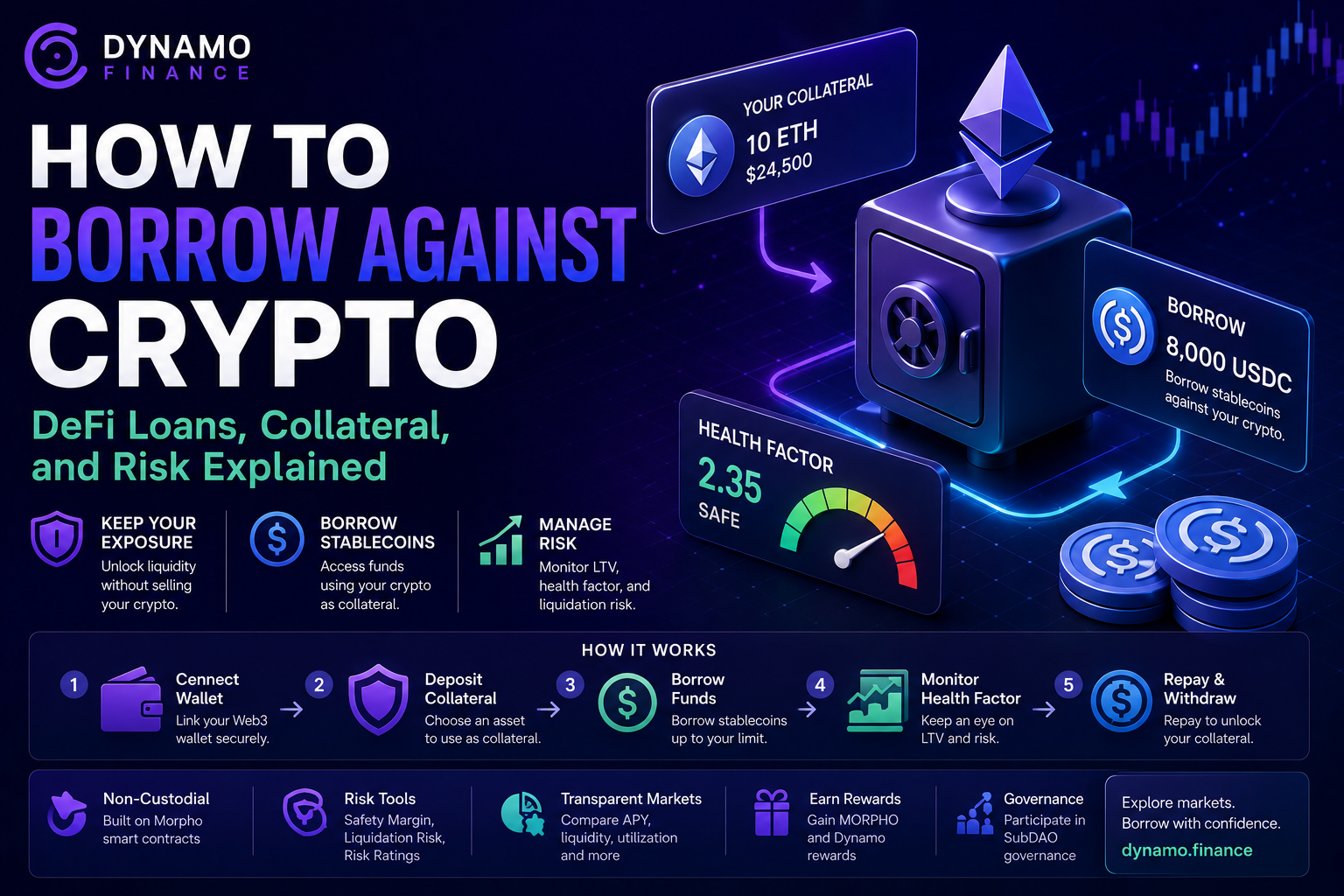
A DeFi user who holds ETH or another supported collateral asset may want stablecoin liquidity without selling. In a lending market, the user can post collateral and borrow a loan asset. This is a common use case for users researching a crypto loan.
The benefit is that the user can unlock liquidity while keeping exposure to the collateral asset. The trade-off is liquidation risk. If collateral falls in value or debt grows too much, the position can be liquidated.
On Dynamo, borrowers can review LTV, LLTV, health factor, safety margin, and liquidation-risk information before and after borrowing. That workflow is useful because borrow positions are dynamic. A safe position today can become risky after a sharp market move.
Beginners should avoid borrowing near the maximum allowed level. A conservative safety buffer is often more valuable than maximum capital efficiency, especially during volatile markets.
Why Morpho Matters in the SkyMoney Conversation
Morpho matters because it has become one of the key infrastructures for DeFi lending and vault strategies. Its isolated-market model allows lending opportunities to be created around specific loan assets, collateral assets, oracles, and liquidation thresholds.
That market design creates flexibility for stablecoin strategies. A vault can allocate capital to markets that match a specific risk-return profile. Curators can choose markets, adjust allocations, and respond to utilization or liquidity changes.
For users, this creates more choice but also more responsibility. A vault powered by Morpho infrastructure can be conservative or aggressive depending on its strategy. The word “vault” alone does not tell you enough.
This is why understanding morpho crypto is useful even if your first entry point is Sky.money. If a yield product uses Morpho-based infrastructure, you should know how Morpho markets, vaults, utilization, and liquidity work.
How Dynamo’s Risk Framework Helps DeFi Investors
Dynamo’s risk framework is designed to help users compare opportunities before depositing or borrowing. Markets and vaults are assigned Low, Medium, or High risk tiers using objective onchain inputs rather than vague marketing language.
For markets, relevant inputs include factors such as LLTV, market TVL, and how long the market has been live. For vaults, relevant inputs include total supplied value, market exposure, and live history. These are not guarantees, but they help users avoid making decisions based only on APY.
Dynamo also provides borrower-focused risk tools. Safety Margin gives borrowers a more conservative target LTV than the underlying liquidation threshold. Liquidation Risk views help users understand how far collateral can fall before liquidation becomes likely.
Users who want to go deeper can review the Dynamo Finance documentation for concepts such as markets, vaults, interest rates, collateral, LTV, liquidations, risk ratings, rewards, security, and fees.
How to Build a Risk-First Stablecoin Yield Strategy
A risk-first strategy starts with your objective. Are you trying to preserve liquidity, earn conservative yield, take more active DeFi exposure, borrow against collateral, or diversify across several stablecoin products?
Once the objective is clear, choose the mechanism. sUSDS may fit a user who wants Sky Savings Rate exposure. A Morpho-based vault may fit a user seeking curated market-driven yield. A direct lending market may fit an advanced user who wants precise control. A borrow position may fit a user who wants liquidity without selling collateral.
Then size the position properly. Stablecoin yield should not be treated as risk-free income. A reasonable approach is to start small, test deposits and withdrawals, monitor APY changes, review risk data, and increase exposure only when you understand the product.
Finally, diversify by mechanism rather than only by brand. Holding several products that all depend on the same collateral type, oracle, protocol, or liquidity source may be less diversified than it looks.
Common Mistakes to Avoid With SkyMoney
The first mistake is using the wrong site. DeFi phishing is common. Always verify URLs, avoid sponsored links from unknown sources, and never enter seed phrases into a website.
The second mistake is assuming sUSDS is the same as a bank savings account. sUSDS is an onchain yield-bearing stablecoin product. It has smart contract, governance, peg, and regulatory risks.
The third mistake is treating Sky Vaults as identical to the Sky Savings Rate. Vaults have strategy-specific risk and market-driven returns. They can perform differently from sUSDS.
The fourth mistake is focusing only on APY. A higher APY may come from higher utilization, lower liquidity, riskier collateral, temporary rewards, or more complex strategy design.
The fifth mistake is ignoring availability restrictions. Some Sky.money products may be unavailable in certain jurisdictions, including the United States, depending on the product and current interface rules.
Common Mistakes to Avoid With DeFi Lending
DeFi lending has its own failure patterns. The first is borrowing too aggressively. When users borrow near liquidation thresholds, even normal volatility can become dangerous.
The second is supplying to a high-yield market without checking withdrawal liquidity. A market with high utilization may show attractive supply APY but have less immediately available liquidity.
The third is assuming a verified or curated vault is risk-free. Verification and curation can improve quality control, but they cannot eliminate smart contract, liquidity, oracle, or market risks.
The fourth is ignoring fees. Vault fees, market fees, gas costs, and incentive changes can affect net returns. Investors should compare net yield, not just headline APY.
The fifth is failing to monitor positions. DeFi markets run continuously. Risk can change while you sleep, during a governance update, or after a sudden market move.
Checklist Before Using Sky.money or Dynamo
Use this checklist before putting stablecoins or collateral to work:
- Confirm the official website and avoid phishing links.
- Identify whether you are using a savings product, vault, direct market, rewards module, or borrow position.
- Understand the asset you will receive, such as USDS, sUSDS, vault shares, or borrowed tokens.
- Separate base yield from incentives, rewards, or temporary APY boosts.
- Review liquidity and withdrawal conditions.
- Check whether the rate is governance-set, fixed to maturity, utilization-driven, or strategy-driven.
- Evaluate smart contract, oracle, peg, governance, liquidation, and regulatory risks.
- Start small and test the full entry and exit workflow.
- For borrowing, set a liquidation-response plan before taking the loan.
- Monitor the position after deposit or borrow, especially during market volatility.
Where to Learn More
For primary information about Sky products, users can review Sky.money, the Sky.money guide to USDS, the Sky.money guide to sUSDS, and the Sky Vaults overview. Ethereum.org also lists Sky/Maker USDS as a non-custodial gateway to the decentralized Sky Protocol centered around USDS.
For Dynamo-related updates, users can follow Dynamo Finance on X. For risk-first market review, the Dynamo risk dashboard is the most relevant internal resource to explore.
Conclusion
SkyMoney is best understood as a user search term for Sky.money, the non-custodial interface connected to Sky Protocol’s stablecoin ecosystem. It brings together USDS, sUSDS, the Sky Savings Rate, vaults, fixed-yield integrations, rewards, and SKY participation into a broader stablecoin yield experience.
For DeFi investors, the opportunity is clear. Stablecoins can do more than sit idle. They can earn yield, support borrowing, participate in vault strategies, and move across protocols. The risk is also clear. Every product has a mechanism, and every mechanism has trade-offs.
Dynamo Finance is valuable in this context because it helps users apply a more analytical approach to Morpho-based lending and vault opportunities. By comparing markets, vaults, APYs, liquidity, risk tiers, and liquidation data, users can move beyond headline yield and make more informed decisions.
Explore Dynamo Finance to compare Morpho-based markets and vaults, review risk data, and build a more disciplined stablecoin and DeFi lending strategy before allocating capital.
FAQ
What is SkyMoney in crypto?
SkyMoney usually refers to sky.money, a non-custodial interface for accessing Sky Protocol products such as USDS, sUSDS, Sky Savings Rate exposure, Sky Vaults, fixed-yield integrations, and ecosystem rewards.
Is Sky.money the same as MakerDAO?
Sky Protocol is the evolution of MakerDAO, while sky.money is a front-end interface for accessing Sky-related products. MakerDAO’s legacy is important, but sky.money focuses on the newer USDS, sUSDS, SKY, and stablecoin yield experience.
What is the difference between USDS and sUSDS?
USDS is the native stablecoin of Sky Protocol. sUSDS is the yield-generating version of USDS that gives users exposure to the Sky Savings Rate. Users receive sUSDS when they supply USDS into the savings module.
Are Sky Vaults the same as the Sky Savings Rate?
No. The Sky Savings Rate is governance-set and accessed through sUSDS. Sky Vaults are strategy-driven third-party yield products, currently associated with Morpho deployments, and their returns depend on market utilization and strategy performance.
How does Dynamo Finance relate to SkyMoney?
Dynamo Finance is not sky.money. The connection is that both are relevant to stablecoin yield seekers, and Sky Vaults currently involve Morpho-based strategies. Dynamo helps users explore Morpho-based markets and vaults with risk ratings, market data, vault information, and liquidation-risk tools.