
Stablecoins are the working capital of DeFi. Traders use them to move between positions, lenders use them to earn yield, borrowers use them as loan assets, and protocols use them as the base layer for onchain credit. That is why USDS crypto has become an important topic for DeFi investors who already know USDC, USDT, and DAI but want to understand Sky’s newer stablecoin ecosystem.
USDS is not just another ticker with a dollar peg. It is the native stablecoin of Sky Protocol, the successor ecosystem to MakerDAO, designed to function as a dollar-denominated asset for onchain finance. It can be used for transfers, DeFi liquidity, savings products, lending markets, and yield strategies depending on where it is supported.
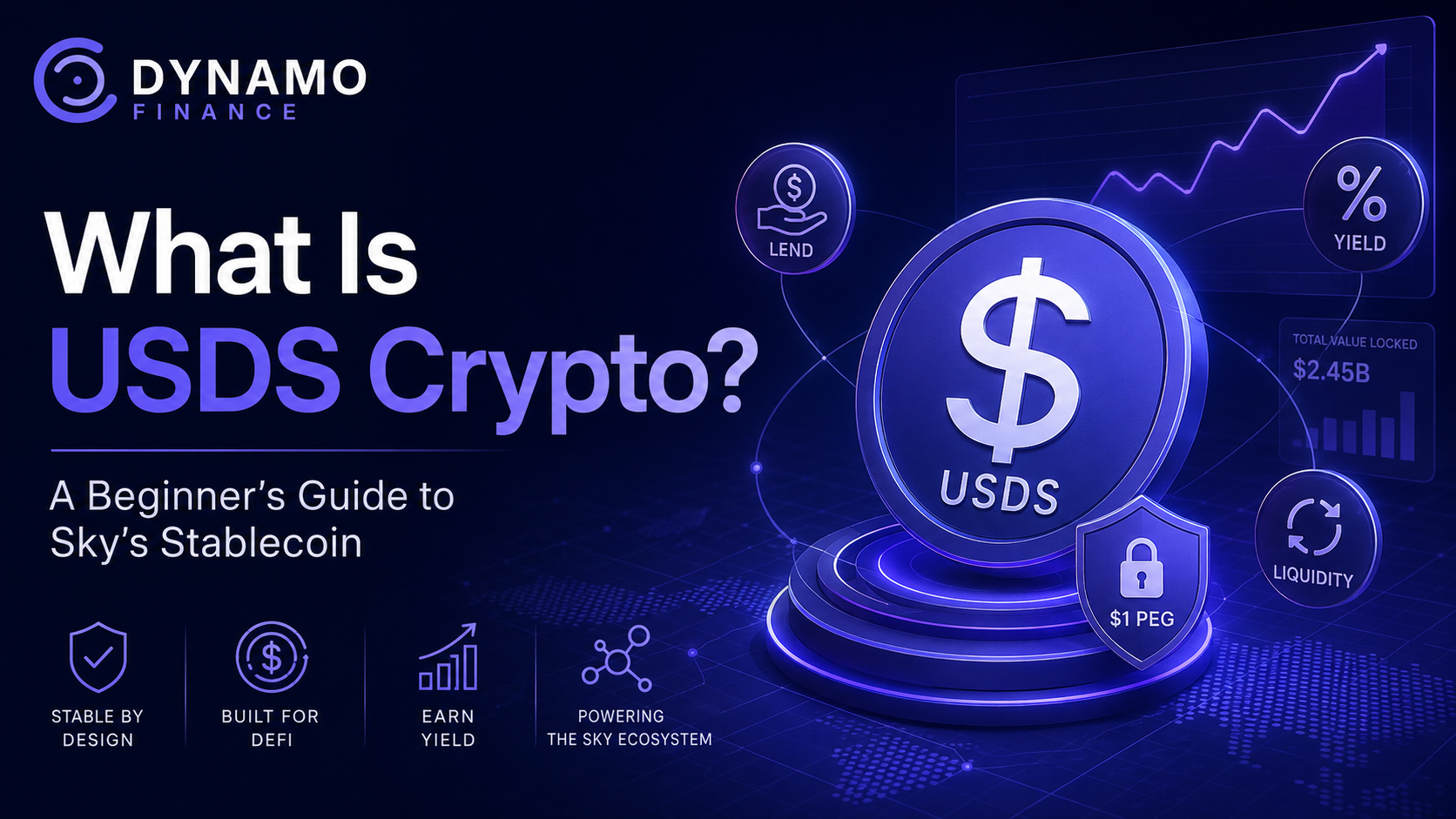
USDS crypto is Sky Protocol’s native stablecoin, designed to track the value of one U.S. dollar. It is issued through Sky Protocol, backed by protocol collateral, governed by SKY token holders, and used as the base asset for Sky ecosystem products such as sUSDS, the Sky Savings Rate, rewards modules, and Morpho-based Sky Vaults.
This guide explains how USDS works, how it relates to DAI and Sky, what makes it different from USDC and USDT, how sUSDS and the Sky Savings Rate fit in, what risks stablecoin users should understand, and how Dynamo Finance helps users compare Morpho-based stablecoin lending markets and vaults with clearer risk context.
Key Takeaways
- USDS is the native stablecoin of Sky Protocol and is designed to maintain a dollar target.
- USDS does not automatically generate yield by itself; users typically access Sky Savings Rate yield by converting or depositing into products such as sUSDS.
- Sky uses mechanisms such as collateral backing, governance, and peg-stability infrastructure to support USDS stability.
- USDS differs from USDC and USDT because it is part of a DeFi-native protocol system rather than a centralized issuer model.
- Dynamo Finance gives users another way to evaluate stablecoin yield through Morpho-based markets, vaults, risk ratings, rewards, and borrowing tools.
What Is USDS Crypto?
USDS is a dollar-targeted stablecoin issued through Sky Protocol. It is part of the Sky ecosystem, which grew out of MakerDAO and the long-running DAI stablecoin system. Many users describe USDS as the upgraded stablecoin in the Sky ecosystem, while DAI remains familiar to long-time DeFi users.
Sky presents USDS as the native stablecoin of its protocol, backed by protocol collateral and governed through SKY token holder governance. Users can learn more from Sky’s official overview of what USDS is, including how the peg, collateral backing, and Sky ecosystem products connect.
The most important beginner distinction is simple. USDS is the base stablecoin. sUSDS is the yield-generating savings token that represents exposure to the Sky Savings Rate. Holding USDS alone is not the same thing as earning the Sky Savings Rate.
For DeFi investors, USDS matters because stablecoins are no longer only used for parking value. They are also used as inputs for lending, vault strategies, collateral management, structured yield, and onchain credit markets.
How USDS Relates to DAI and MakerDAO
MakerDAO was one of the earliest and most important DeFi protocols, best known for DAI. Sky is the evolved ecosystem that introduced USDS and SKY as part of a broader upgrade path from the Maker and DAI model.
DAI and USDS are closely related because users can upgrade DAI into USDS through the Sky ecosystem. This upgrade path has helped bridge the long-standing DeFi stablecoin user base into Sky’s newer product suite.
That does not mean every user must abandon DAI immediately or treat DAI and USDS as identical in every context. Liquidity, exchange support, integrations, DeFi markets, jurisdictional availability, and product access can vary. Users should always check the specific app or protocol they plan to use.
For beginners, the clean mental model is this: DAI is the legacy MakerDAO stablecoin; USDS is Sky Protocol’s native stablecoin for the newer Sky ecosystem.
Why USDS Exists
USDS exists because DeFi stablecoins need to do more than simply sit in wallets. Users want stable value, but they also want transparent backing, liquidity, savings options, rewards, and DeFi composability.
Sky’s product suite is built around that idea. USDS can be used as a stable asset, while related products such as sUSDS, stUSDS, ecosystem rewards, and Sky Vaults create different ways to put stablecoins to work.
The broader goal is to make stablecoin capital more productive while keeping the user experience simple. Instead of requiring every stablecoin holder to manually compare dozens of yield products, Sky routes users toward protocol-native options with different risk profiles.
That goal is similar to why DeFi vaults exist in other ecosystems. Users want yield, but they also want fewer manual decisions and clearer risk information.
How USDS Holds Its Dollar Peg
USDS is designed to target one U.S. dollar. Like every stablecoin, the peg depends on market incentives, collateral confidence, liquidity, and redemption or conversion mechanisms.
Sky uses peg-stability infrastructure to support USDS. A key concept is the Peg Stability Module, which enables conversions between supported stablecoins and USDS under defined conditions. Sky’s public materials describe a 1:1 USDC-to-USDS conversion flow through Sky.money, with users able to swap in both directions, though users should always confirm current fees and availability inside the live app.
Collateral backing also matters. USDS is backed by protocol collateral, and Sky provides a financial dashboard where users can review system-level backing data. That transparency is important because stablecoin users should know what supports the asset they hold.
A peg is not magic. It is a system of incentives, collateral, liquidity, governance, and market confidence. Users should evaluate all of those factors before relying on any stablecoin as a core portfolio asset.
USDS vs. USDC vs. USDT vs. DAI
Stablecoins can all target one dollar, but they do not all work the same way. USDS, USDC, USDT, and DAI have different issuer structures, governance models, collateral designs, and DeFi use cases.
| Stablecoin | Primary Model | Common Use Case | Main Risk Questions |
|---|---|---|---|
| USDS | Sky Protocol native stablecoin backed by protocol collateral | Sky ecosystem access, sUSDS, rewards, DeFi liquidity, vault strategies | Collateral composition, governance decisions, peg liquidity, product availability |
| USDC | Centralized issuer stablecoin backed by reserves | Trading, payments, DeFi lending, exchange settlement, institutional rails | Issuer risk, reserve transparency, regulatory exposure, blacklist controls |
| USDT | Centralized issuer stablecoin backed by reserves | Global crypto liquidity, exchange trading, payments, cross-market settlement | Issuer risk, reserve quality, regulatory exposure, redemption assumptions |
| DAI | Legacy MakerDAO stablecoin linked to Sky’s upgrade path | DeFi lending, trading, collateral, legacy integrations | Migration path, liquidity, protocol changes, integration support |
USDC and USDT are widely used because they have deep liquidity and broad exchange support. USDS is more specifically tied to Sky Protocol and its DeFi-native yield and governance ecosystem.
That makes USDS interesting for users who want more than a basic stablecoin balance. It also means users need to understand Sky-specific mechanics before treating USDS like a simple bank-dollar equivalent.
Does USDS Generate Yield?
USDS itself is the stablecoin. It does not automatically generate yield just because it is held in a wallet. Yield typically comes when USDS is supplied into another Sky product, DeFi market, vault, or lending strategy.
The most important Sky product for yield seekers is sUSDS. When users access sUSDS, they gain exposure to the Sky Savings Rate. Sky’s sUSDS page describes sUSDS as a yield-generating savings token that accrues the Sky Savings Rate and can be converted back to USDS, subject to current product availability and conditions.
This distinction prevents a common beginner mistake. USDS is not the yield product by itself. sUSDS is the savings token. Sky Vaults, stUSDS, and ecosystem rewards can represent additional product categories with different risks.
When comparing stablecoin options, always ask where the yield comes from. If the answer is unclear, do not deposit until you understand the mechanism.
What Is sUSDS?
sUSDS is the yield-generating savings token of Sky Protocol. Users supply USDS and receive sUSDS, which represents exposure to the Sky Savings Rate. The value relationship between sUSDS and USDS changes as the Sky Savings Rate accrues.
The appeal is simplicity. Instead of manually managing lending markets, a user can access a protocol-native savings product. Sky positions sUSDS as liquid, auto-compounding, and designed for stablecoin yield.
The risk is that the rate is not guaranteed. Sky’s public disclaimers make clear that rates are governed by decentralized governance and can change. Product availability can also vary by location.
For users, sUSDS should be evaluated as a DeFi savings product, not as a risk-free bank account. It may be useful, but it still depends on protocol governance, collateral backing, smart contracts, and market conditions.
What Is the Sky Savings Rate?
The Sky Savings Rate, often shortened to SSR, is the rate that accrues to sUSDS holders. It is set through Sky governance and funded by protocol revenue sources rather than a simple utilization-only lending market.
Sky’s materials explain that the Sky Savings Rate is connected to protocol revenue and the Sky Agent Network, where capital allocators deploy protocol liquidity into approved strategies and pay back into the system. Governance then calibrates the rate based on protocol conditions.
This makes the SSR different from a typical DeFi lending APY. A standard lending market rate usually rises and falls with borrower demand and utilization. The SSR is governance-set and tied to Sky’s revenue and reserve framework.
Users should still treat it as variable. A governance-set rate can go up, down, or be eliminated depending on protocol decisions and revenue capacity.
What Are Sky Agents?
Sky Agents are independent capital allocators within the Sky ecosystem. They access USDS liquidity from Sky Protocol and deploy capital into approved yield-generating strategies. Their performance contributes to the protocol revenue base that supports Sky’s yield products.
This structure gives USDS a broader role than simple payment stablecoins. USDS becomes capital that can flow through an ecosystem of allocators, savings products, rewards modules, and vault strategies.
That does not mean every strategy has the same risk. Some strategies may involve short-duration assets, structured credit, onchain capital markets, lending, or other approved sources. Users should understand that yield can come from multiple underlying activities.
Diversification can help reduce reliance on one source of return, but it does not eliminate risk. Protocol revenue depends on real market activity, allocation quality, collateral management, and governance decisions.
What Are Sky Vaults?
Sky Vaults are yield strategies connected to the Sky ecosystem. Sky’s public materials describe Morpho as integrating Sky Protocol infrastructure to deploy Sky Vaults, expanding stablecoin yield options beyond the benchmark Sky Savings Rate.
This is where USDS crypto connects naturally to the Morpho ecosystem. Morpho-based vaults can allocate capital into lending strategies, while curators manage the approach. Returns can be dynamic and depend on the specific strategy, market utilization, and risk profile.
That is important because a Sky Vault is not the same as sUSDS. sUSDS is tied to the Sky Savings Rate. Sky Vaults can involve strategy-specific market risk and may produce returns above or below the SSR depending on conditions.
Users should compare vaults the same way they compare other curated DeFi strategies: asset, curator, APY, TVL, allocation, liquidity, fees, and risk.
How USDS Fits Into DeFi Lending
Stablecoins are the most important loan assets in DeFi lending. Borrowers often want dollar-denominated liquidity, while lenders want stablecoin yield. USDS can fit into this market if lending protocols and vaults support it with sufficient liquidity.
In a lending market, suppliers provide the loan asset and borrowers post collateral. If USDS is the loan asset, suppliers may earn yield from borrowers who pay interest to borrow USDS. If USDS is collateral in a supported market, borrowers may use it to access another asset.
Users comparing morpho markets should remember that every market is specific. A market’s risk depends on the loan asset, collateral asset, oracle, liquidation threshold, utilization, and available liquidity.
This is why USDS research should not stop at the stablecoin itself. A stablecoin can be sound, but a lending market using that stablecoin can still be risky if collateral, liquidity, or oracle assumptions are weak.
How Dynamo Finance Relates to USDS Crypto
Dynamo Finance is a non-custodial, permissionless Web3 lending market built on Morpho smart contracts. It gives users access to markets, vaults, borrowing, lending, analytics, rewards, and governance participation from one interface.
Dynamo does not issue USDS. It is not Sky Protocol. The connection is that Dynamo helps users evaluate DeFi lending and vault opportunities, including stablecoin strategies, through Morpho-based infrastructure. That is useful for anyone comparing USDS, sUSDS, Sky Vaults, USDC lending, and broader stablecoin yield options.
Dynamo surfaces key data such as supply APY, borrow APY, utilization, available liquidity, collateral assets, loan assets, vault curators, risk tiers, rewards, and position risk. These inputs help users compare opportunities beyond headline APY.
For users considering stablecoin lending, Dynamo can act as a research and execution layer for Morpho-based stablecoin markets and vaults.
Dynamo Markets: Stablecoin Lending With Market-Level Data
Dynamo markets are isolated lending pools built on Morpho infrastructure. Each market is dedicated to one collateral asset and one loan asset. That isolation helps users see exactly what they are exposed to.
A lending market on Dynamo shows supply APY, borrow APY, utilization, available liquidity, collateral, loan asset, oracle, and LLTV. These metrics matter for stablecoin lenders because the asset you supply is only one side of the risk.
If you supply a stablecoin, borrower collateral still matters. A USDC, USDT, or USDS-style loan market can become risky if collateral is volatile, poorly priced, or difficult to liquidate during stress.
Users can compare current opportunities through Dynamo markets and review the details before supplying or borrowing.
Dynamo Vaults: Curated Stablecoin Yield
Dynamo vaults are built on the MetaMorpho standard. A vault lets users deposit once while a curator allocates capital across selected Morpho markets.
This can be attractive for stablecoin holders who want yield but do not want to manually select every market. The curator handles allocation, rebalancing, and market selection according to the vault’s strategy.
Vaults can help simplify morpho vault exposure, but users still need to evaluate the curator, underlying markets, APY stability, fees, TVL, liquidity, and risk tier. A vault is a strategy, not a guarantee.
Stablecoin users should also compare vault yield with products such as sUSDS. The yield sources are different, so the risks are different.
USDS Yield vs. DeFi Lending Yield
USDS-related yield and DeFi lending yield can look similar on a dashboard, but they often come from different sources. That distinction matters when comparing returns.
| Yield Option | Primary Yield Source | Key Risk Questions |
|---|---|---|
| sUSDS | Sky Savings Rate set by Sky governance and funded through protocol revenue | How is the rate set, what backs the protocol, and can the rate change? |
| Sky Vaults | Strategy-specific yield, including Morpho-based vault strategies | Who curates the vault, what markets are used, and how liquid is the strategy? |
| Direct lending markets | Borrower-paid interest in a specific lending market | What collateral backs borrowers, what is utilization, and what is available liquidity? |
| Curated Morpho vaults | Blended borrower-paid yield across selected markets | How diversified is the vault, what are the fees, and what is the curator’s track record? |
The best choice depends on what risk you want to take. Some users may prefer Sky’s governance-set savings product. Others may prefer direct market exposure or curated vaults. Advanced users may compare all of them and allocate across several approaches.
For users pursuing USDC yield, the same principle applies: compare the source of yield, not just the number displayed beside the asset.
How to Evaluate USDS as a Stablecoin
Before holding or using any stablecoin, evaluate its design. Do not assume every dollar-pegged token has the same risk.
- Identify who issues the stablecoin and what protocol or entity governs it.
- Review the collateral backing and whether it is visible onchain or through public reports.
- Understand the peg mechanism and how users can convert or redeem.
- Check liquidity across wallets, exchanges, DeFi protocols, and bridges.
- Review whether the stablecoin is available in your jurisdiction.
- Understand how governance can change parameters, rates, fees, and access.
- Check whether yield comes from the stablecoin itself or from a separate product.
- Review smart contract, oracle, bridge, and counterparty dependencies.
- Start with a smaller amount before making it a core portfolio asset.
- Monitor peg performance, collateral composition, and ecosystem updates over time.
This process is especially important for DeFi users who treat stablecoins as low-risk capital. Stablecoins reduce price volatility relative to crypto assets, but they do not remove protocol, liquidity, governance, or regulatory risk.
Key Risks of USDS Crypto
USDS can be useful, but it is not risk-free. Users should understand the major risk categories before holding, lending, borrowing, or converting into related products.
- Peg risk: USDS is designed to target one dollar, but market conditions can create temporary deviations.
- Collateral risk: The stability of USDS depends partly on the quality, diversification, and management of protocol collateral.
- Governance risk: Sky governance can adjust important parameters, including rates and product settings.
- Smart contract risk: USDS and related products depend on smart contracts that can contain vulnerabilities.
- Liquidity risk: Some venues may have less USDS liquidity than USDC or USDT.
- Integration risk: Not every DeFi protocol, wallet, exchange, or bridge supports USDS equally.
- Regulatory risk: Stablecoins remain a major area of policy attention globally.
- Yield risk: sUSDS, Sky Vaults, rewards, and DeFi lending products have different yield sources and different risks.
A stablecoin can be stable most of the time and still carry meaningful tail risk. Good DeFi investors evaluate both normal conditions and stress scenarios.
USDS and Peg Risk
Peg risk is the risk that a stablecoin trades below or above its target value. A small deviation may be normal in secondary markets, but a larger or persistent deviation can create losses for users who need to exit quickly.
USDS uses Sky’s peg infrastructure and collateral system to support its dollar target. The ability to convert through official mechanisms can help market participants arbitrage deviations, but that depends on available liquidity, access, and system confidence.
Users should monitor the USDS price across major markets and check whether the peg holds during volatile periods. A stablecoin’s behavior during stress is more informative than its behavior during calm markets.
For large allocations, liquidity depth matters. A stablecoin can show a one-dollar price in small size while still having limited liquidity for larger trades.
USDS and Collateral Risk
Collateral risk is central to any collateral-backed stablecoin. If backing assets lose value, become illiquid, or face legal or operational issues, confidence in the stablecoin can weaken.
Sky provides public resources where users can inspect system collateral and backing data. That transparency is useful, but users still need to interpret the composition. Stablecoins, crypto lending exposure, real-world assets, and other structures can each introduce different risks.
Diversification can reduce dependence on one asset type, but it can also make the system harder to understand. A simple stablecoin may be easier to analyze; a diversified stablecoin may be more resilient but require deeper research.
Stablecoin users should know what backs the asset they hold. “Dollar-pegged” is not the same as “risk-free.”
USDS and Governance Risk
Sky governance matters because token holders can influence parameters that affect the system. Governance can adjust rates, risk settings, product terms, and other protocol decisions within the scope of the protocol.
This can be a strength because governance can adapt to changing market conditions. It can also be a risk because decisions may change the yield, collateral strategy, or user experience.
Users who rely on sUSDS or other Sky products should monitor governance changes. A rate that looks attractive today may not remain the same next month.
Governance-set yield is not guaranteed yield. Treat it as a variable protocol parameter.
USDS and Regulatory Risk
Stablecoins are under increasing regulatory scrutiny around the world. Rules can affect issuers, interfaces, exchanges, DeFi protocols, wallets, and user access.
Regulatory exposure can also differ by stablecoin model. Centralized stablecoins face issuer and reserve regulation. DeFi-native stablecoins face questions around governance, collateral, access, frontends, and protocol responsibility.
Users should check whether USDS-related products are available in their region. Some Sky products may not be available to U.S. users or may have other jurisdictional restrictions depending on the interface and current rules.
Do not build a strategy around a product without confirming access, terms, and legal availability for your situation.
USDS in Lending and Borrowing
Stablecoins are useful in borrowing because they reduce repayment uncertainty compared with volatile assets. Borrowers often prefer borrowing stablecoins while posting volatile collateral such as ETH, BTC-related assets, or other supported tokens.
If USDS becomes widely supported in lending markets, it can function as a loan asset similar to USDC or DAI. Suppliers could earn interest from borrowers, and borrowers could access USDS liquidity without selling collateral.
Users interested in borrow crypto strategies should remember that borrowing against collateral creates liquidation risk. Stable loan assets do not make collateral risk disappear.
Borrowers should watch LTV, LLTV, health factor, borrow APY, collateral price, and liquidation price before opening any stablecoin-denominated loan.
USDS and Morpho-Based Vault Strategies
Morpho-based vaults can make stablecoin lending more accessible by letting curators allocate deposits across markets. This is relevant because Sky Vaults and other DeFi products may use Morpho infrastructure for strategy design.
In a Morpho vault, depositors provide one asset and receive vault shares. The curator allocates across approved markets. Borrowers pay interest in those markets, and the vault’s APY reflects a blended return from its allocations.
Users comparing morpho crypto vault opportunities should review the vault’s underlying asset, curator, fees, market allocations, TVL, APY history, rewards, and risk tier.
Vaults can be convenient, but they add curator and allocation risk. A vault’s quality depends on what it does after the user deposits.
How Dynamo Helps Compare Stablecoin Yield
Dynamo can help stablecoin users avoid one of the most common mistakes in DeFi: comparing APYs without comparing risk. A 6% yield from one product can carry a very different risk profile from a 6% yield elsewhere.
Dynamo’s interface shows markets, vaults, APYs, utilization, available liquidity, collateral, loan assets, curators, risk ratings, rewards, and borrowing metrics. This makes it easier to understand why a yield exists.
For users researching defi lending, this is useful because stablecoin yield often comes from borrower demand. If borrower demand falls, APY can compress. If utilization rises too high, withdrawals may become harder.
A stablecoin strategy should be built around risk-adjusted yield, not the highest number on the screen.
Dynamo Risk Ratings
Dynamo assigns Low, Medium, and High risk tiers to markets and vaults using objective onchain inputs. For markets, inputs include factors such as LLTV, TVL, and live history. For vaults, inputs include total supplied value, market exposure, and live history.
Risk ratings are not guarantees. A Low-risk market can still experience smart contract issues, oracle problems, collateral stress, or liquidity constraints. The rating is a research starting point.
For stablecoin users, risk tiers are useful because stablecoin deposits can feel safer than they really are. The supplied asset may be stable, but the strategy behind the yield can still be risky.
Users can go deeper through the Dynamo Finance DeFi lending docs, which cover markets, vaults, interest rates, collateral, liquidations, rewards, fees, risk ratings, Safety Margin, and Liquidation Risk.
Dynamo Safety Margin and Liquidation Risk
Stablecoin borrowing is common in DeFi. A user may deposit ETH or BTC-related collateral and borrow a stablecoin. The benefit is liquidity without selling. The risk is liquidation.
Dynamo’s Safety Margin feature helps borrowers set a more conservative target LTV than the market’s liquidation threshold. This gives users a buffer instead of encouraging maximum borrowing.
Dynamo’s Liquidation Risk view shows health factor, price-drop tolerance, and liquidation price. These metrics help borrowers understand how close a position is to liquidation.
Stablecoin borrowers should care about these tools because a stable debt asset does not protect against falling collateral. A safer borrowing strategy starts with conservative LTV and active monitoring.
Practical Example: Holding USDS vs. Converting to sUSDS
Imagine a user holds USDS because they want dollar-denominated crypto liquidity. Holding USDS keeps the asset liquid for transfers, swaps, and DeFi activity. It does not automatically earn the Sky Savings Rate.
If the user wants Sky Savings Rate exposure, they may convert USDS to sUSDS through a supported interface, subject to availability and terms. The user then receives a yield-generating token rather than simply holding base USDS.
The trade-off is product exposure. Holding USDS is simpler. Holding sUSDS adds yield mechanics, smart contract exposure, governance-set rate risk, and interface or jurisdiction considerations.
A cautious user may start with a smaller allocation, test conversion and redemption, and monitor the rate before relying on sUSDS as a core stablecoin position.
Practical Example: Comparing sUSDS With a Morpho Vault
Suppose a stablecoin holder is comparing sUSDS with a Morpho-based vault. Both may offer stablecoin yield, but the mechanisms differ.
sUSDS gives exposure to the Sky Savings Rate. A Morpho vault gives exposure to curated lending markets where borrowers pay interest. The vault may also include rewards, depending on the campaign and interface.
The user should compare APY, liquidity, fees, collateral exposure, curator quality, and rate stability. A vault may offer higher yield at times, but it may also have more market-specific risk. sUSDS may be simpler, but its rate is still variable and governance-set.
There is no universal winner. The best choice depends on whether the user prefers governance-set savings yield or market-driven lending yield.
Practical Example: Lending Stablecoins Through Dynamo
A stablecoin user may want to compare lending markets rather than using a protocol-native savings product. On Dynamo, the user can review markets and vaults built on Morpho infrastructure.
In a direct market, the user supplies the loan asset and earns interest from borrowers. In a vault, the user deposits once and relies on a curator to allocate across markets.
The user should compare supply APY, utilization, available liquidity, collateral, oracle, LLTV, risk tier, and rewards. A high APY may be attractive, but it should be matched against the underlying risk.
For users pursuing crypto lending, this kind of market-level review is essential. Stablecoin yield is only as strong as the market structure behind it.
Common Mistakes Beginners Make With USDS
The first mistake is assuming USDS and sUSDS are the same. USDS is the stablecoin. sUSDS is the yield-bearing savings token.
The second mistake is assuming every dollar-pegged stablecoin has the same risk. USDS, USDC, USDT, and DAI use different structures and should be evaluated separately.
The third mistake is ignoring product availability. Some Sky products may be unavailable in certain jurisdictions or through certain interfaces.
The fourth mistake is comparing yield without understanding the source. Sky Savings Rate yield, vault yield, lending yield, and token rewards are not the same thing.
The fifth mistake is treating stablecoin strategies as risk-free. Stablecoins can reduce volatility, but they still carry peg, collateral, governance, smart contract, liquidity, and regulatory risk.
How to Build a Stablecoin Strategy With USDS
A good stablecoin strategy starts with purpose. Are you holding stablecoins for trading liquidity, yield, borrowing, treasury management, or risk reduction?
If your goal is liquidity, holding base USDS or another deep stablecoin may make sense. If your goal is savings-style yield, sUSDS may be relevant. If your goal is market-driven DeFi yield, lending markets and vaults may be more appropriate.
Next, diversify across mechanisms if the allocation is large. A user might hold some stablecoins as pure liquidity, some in savings products, and some in lending markets or vaults. Each bucket should have its own risk budget.
Finally, review the strategy regularly. Stablecoin yields, collateral backing, governance rates, vault allocations, and market liquidity can change.
How to Compare USDS With Other Stablecoin Yield Options
Use a structured process when comparing stablecoin yield. The highest APY is not always the best option.
- Identify the stablecoin you will hold or deposit.
- Confirm whether the product is a savings token, lending market, vault, rewards pool, or borrowing strategy.
- Determine the source of yield.
- Check whether the rate is fixed, variable, governance-set, utilization-driven, or reward-driven.
- Review fees, lockups, redemption rules, and withdrawal liquidity.
- Evaluate collateral, oracle, and smart contract dependencies.
- Check product availability in your jurisdiction.
- Compare base yield separately from token incentives.
- Start with a smaller allocation and test exit mechanics.
- Monitor changes in APY, governance, liquidity, and risk over time.
This framework works for USDS, sUSDS, USDC lending, Morpho vaults, Sky Vaults, and most other stablecoin yield products.
What Experienced DeFi Investors Watch
Experienced DeFi investors ask where yield comes from before they ask how high it is. They also check whether the product is liquid, collateralized, governance-controlled, or market-driven.
Stablecoin users pay special attention to peg performance. They watch whether the stablecoin trades close to one dollar during volatility and whether large redemptions or conversions remain functional.
Vault users look at curators, allocations, TVL, fees, rewards, and withdrawal liquidity. Borrowers focus on collateral, LTV, LLTV, health factor, and liquidation price.
Good stablecoin research is practical. It combines protocol understanding with live market data and a clear exit plan.
External Resources for Further Research
For Sky-specific stablecoin mechanics, start with Sky’s official guide to USDS crypto. It explains USDS, peg design, collateral backing, and its role inside Sky Protocol.
For yield mechanics, review sUSDS and the Sky Savings Rate. That page explains how USDS can be supplied to receive sUSDS, how yield accrues, and why the rate is variable.
For the broader Sky interface and product suite, read Sky.money’s overview, which covers sUSDS, stUSDS, ecosystem rewards, and Sky Vaults.
For Morpho-based lending mechanics, review Morpho’s variable-rate market documentation. It explains isolated lending markets, loan assets, collateral assets, oracles, interest-rate models, and liquidation thresholds.
For Dynamo updates, market context, and product announcements, follow Dynamo Finance on X.
Final Checklist Before Using USDS Crypto
Use this checklist before holding USDS, converting to sUSDS, entering a Sky Vault, or comparing DeFi stablecoin yield:
- Confirm whether you are holding USDS, sUSDS, stUSDS, or another related token.
- Review how USDS maintains its peg and what conversion routes are available.
- Check collateral backing and system-level transparency resources.
- Understand whether your chosen product generates yield or only holds stable value.
- Compare Sky Savings Rate yield with lending market and vault yield.
- Review product availability in your jurisdiction.
- Check fees, liquidity, redemption paths, and smart contract exposure.
- Separate base yield from incentives or rewards.
- Start small and test conversion or withdrawal before scaling.
- Monitor governance, APY, collateral, and liquidity over time.
Conclusion
USDS crypto is Sky Protocol’s native stablecoin and an important successor to the MakerDAO and DAI ecosystem. It is designed to track one U.S. dollar, operate within a collateral-backed DeFi system, and unlock access to Sky products such as sUSDS, the Sky Savings Rate, ecosystem rewards, and Morpho-based Sky Vaults.
The opportunity is clear: stablecoins can do more than sit idle. The risk is also clear: USDS, sUSDS, vaults, rewards, and DeFi lending products each have different mechanics. Users should evaluate peg design, collateral backing, governance, liquidity, smart contracts, jurisdictional availability, and yield source before allocating capital.
Dynamo Finance helps stablecoin users compare another important part of the onchain yield landscape: Morpho-based markets and vaults. With market-level APY, utilization, liquidity, collateral data, risk ratings, rewards, Safety Margin, Liquidation Risk views, and non-custodial access, Dynamo gives users a clearer way to evaluate DeFi lending opportunities.
Explore Dynamo Finance to compare stablecoin markets and vaults, review risk data, and build a more disciplined approach to USDS, stablecoin yield, and onchain lending.
FAQ
What is USDS crypto?
USDS crypto is the native stablecoin of Sky Protocol. It is designed to track the value of one U.S. dollar, is backed by protocol collateral, and is used across Sky ecosystem products such as sUSDS, rewards modules, and Sky Vaults.
Is USDS the same as DAI?
No. USDS is part of Sky Protocol’s newer stablecoin ecosystem, while DAI is the legacy MakerDAO stablecoin. They are closely related through Sky’s upgrade path, but users should treat them as distinct assets with different integrations and product access.
Does USDS earn yield automatically?
No. Holding USDS alone does not automatically generate yield. Users typically access Sky Savings Rate yield by converting or supplying USDS into sUSDS, subject to current product availability, terms, and risks.
What is the difference between USDS and sUSDS?
USDS is the base stablecoin. sUSDS is the yield-generating savings token that represents exposure to the Sky Savings Rate. Users who want yield should understand the conversion, liquidity, rate, and smart contract risks before using sUSDS.
How does Dynamo Finance relate to USDS stablecoin yield?
Dynamo Finance does not issue USDS. It helps users compare Morpho-based DeFi lending markets and vaults, including stablecoin yield opportunities, by showing APY, utilization, available liquidity, collateral, risk ratings, rewards, Safety Margin, and Liquidation Risk data.