Choosing a DeFi vault by APY alone is one of the easiest ways to misunderstand an investment. The displayed rate tells you what a strategy has recently earned, but it does not reveal who selects the underlying markets, how concentrated the exposure is, whether withdrawals can be processed during stress, or what happens when collateral quality deteriorates.
KPK addresses that portfolio-management layer. Formerly known as karpatkey, the firm applies institutional-style risk processes, automation, and onchain execution to treasury mandates, tokenized funds, and curated lending vaults.
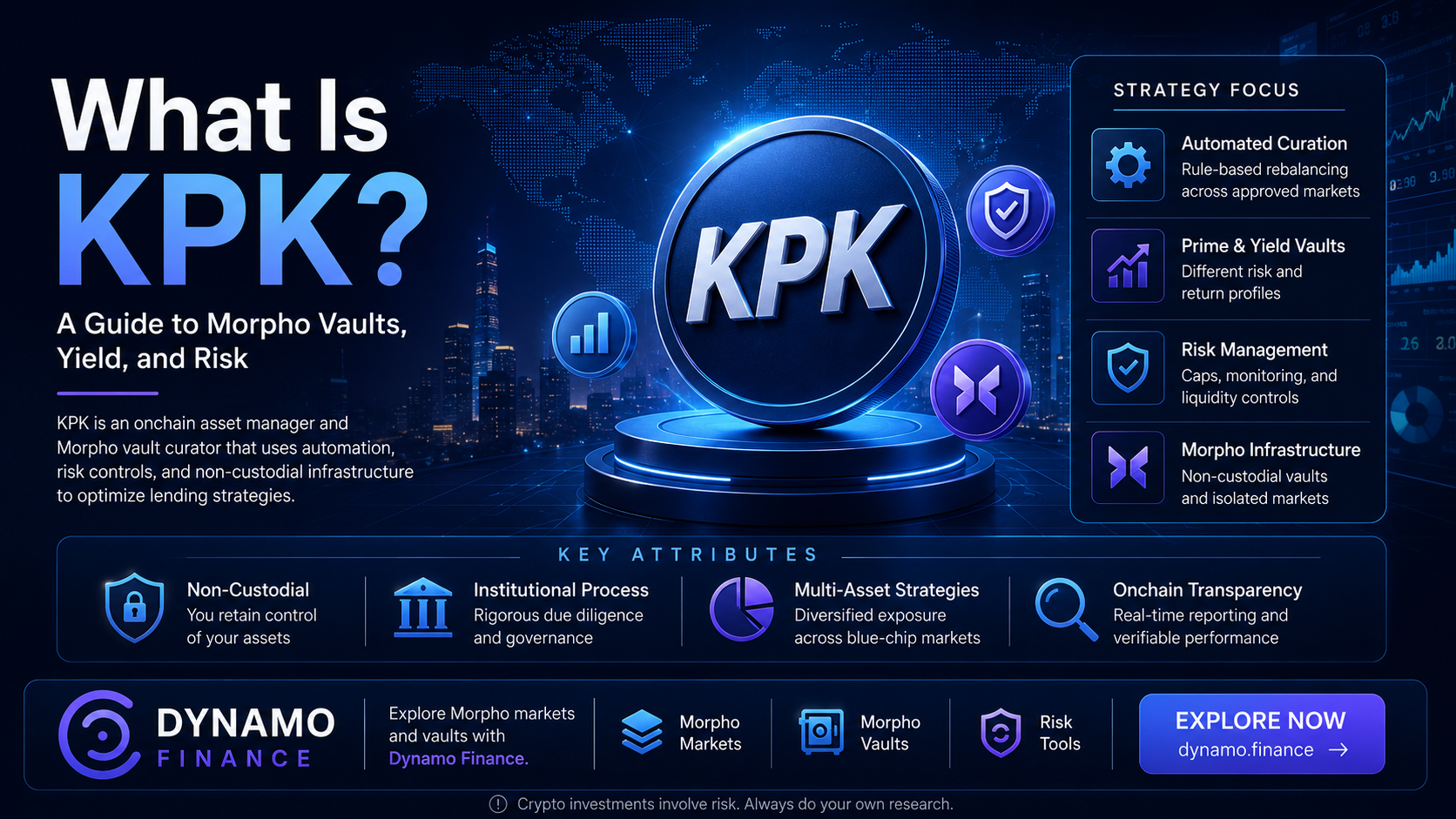
KPK is a non-custodial onchain asset manager and Morpho vault curator that selects lending markets, assigns risk limits, manages liquidity, and automatically reallocates deposited assets within predefined policies. Users can deposit supported assets into a KPK-curated vault and receive exposure to a managed group of overcollateralized lending markets.
This guide explains what KPK does, how its Prime and Yield vaults differ, where depositor returns come from, and how its automation system responds to changing market conditions. It also shows how Dynamo Finance can help users compare curated vaults with direct Morpho lending opportunities before committing capital.
Key Takeaways
- KPK is the current name of the onchain asset manager formerly known as karpatkey, which expanded from treasury management into permissionless vault products.
- KPK curates Morpho vaults with different deposit assets, networks, collateral policies, and risk mandates.
- Prime vaults emphasize established collateral and withdrawal liquidity, while Yield vaults accept a broader opportunity set in pursuit of higher returns.
- KPK uses rule-based rebalancing and risk-response systems that operate within restricted onchain permissions.
- Dynamo lets users compare vault APY, TVL, allocations, fees, liquidity, and market risk while retaining non-custodial access to Morpho positions.
What Is KPK in Crypto?
KPK is an onchain asset-management organization that began as karpatkey. The business developed its early operating model by helping decentralized organizations and large onchain treasuries deploy capital, manage liquidity, and control protocol exposure.
As the market for permissionless asset management expanded, KPK moved beyond bespoke treasury mandates. Its broader product model now includes automated vaults, tokenized strategies, and portfolio-management services designed for institutions, decentralized organizations, and individual DeFi users.
The organization’s activities can be grouped into three broad categories:
- Tokenized funds that package diversified DeFi strategies
- Automated vaults offering curated exposure to lending and yield markets
- Bespoke treasury mandates for organizations managing onchain capital
KPK is not a blockchain or a standalone lending protocol. It does not replace Morpho or the smart contracts through which borrowers and lenders interact.
Instead, KPK acts as an asset manager and risk curator. Its role is to determine how capital can be deployed, establish exposure limits, monitor relevant risks, and execute permitted actions through non-custodial vault infrastructure.
That distinction matters because users do not deposit assets into a conventional KPK corporate account when they enter a Morpho vault. Assets remain in onchain contracts, while KPK receives defined permissions to manage the strategy within the vault’s rules.
What Does Non-Custodial Asset Management Mean?
Traditional asset managers usually operate through funds, custodians, or managed accounts. Non-custodial onchain management separates possession of the assets from strategy permissions.
A smart contract holds and accounts for the assets. The manager can perform specified actions, such as reallocating between approved markets, but it cannot necessarily transfer funds to arbitrary destinations.
This structure can improve transparency and reduce some custody risks. It does not remove smart-contract risk, governance risk, manager error, or the possibility of losses in the underlying markets.
How KPK Relates to Morpho
Morpho supplies the underlying lending and vault architecture. KPK supplies the portfolio construction, market selection, monitoring, and allocation logic for the vaults it curates.
Each isolated Morpho market combines several fixed components:
- A loan asset that suppliers deposit and borrowers receive
- A collateral asset borrowers must post
- An oracle used to value that collateral
- An interest-rate model
- A liquidation loan-to-value threshold, commonly called LLTV
A direct lender selects one market and accepts that specific combination of collateral, oracle, LLTV, utilization, and liquidity. A vault depositor delegates market selection to a curator and receives exposure to a portfolio of approved markets.
Morpho vaults accept a single deposit asset and can allocate it across isolated markets. KPK decides which markets qualify, assigns per-market limits, maintains liquidity buffers, and changes allocations when rates or risk conditions move.
Users researching morpho vaults should therefore separate protocol risk from curator risk. Morpho controls the base smart-contract rules, while KPK controls important portfolio decisions within the permissions granted to it.
How a KPK Morpho Vault Works
A KPK vault turns several isolated lending positions into one tokenized strategy. The depositor interacts with a single contract rather than supplying assets to each market manually.
- The user chooses a vault. The decision begins with the deposit asset, network, strategy mandate, curator, fees, and current portfolio.
- The user deposits the accepted asset. Depending on the strategy, the vault may accept a stablecoin, WETH, or another supported token.
- The vault issues tokenized shares. These shares represent the depositor’s proportional ownership of the vault’s underlying assets.
- Capital is allocated across approved markets. KPK’s strategy can distribute liquidity according to market tiers, caps, utilization, and withdrawal requirements.
- Borrowers pay interest. Borrower payments increase the amount of assets controlled by the vault.
- Automation monitors conditions. Restricted systems evaluate rates, utilization, oracle health, price divergence, and available liquidity.
- The vault rebalances when appropriate. Capital can move among enabled markets without requiring every depositor to approve each adjustment.
- Depositors redeem their shares. Withdrawals depend on the value of the shares and liquidity available from the underlying portfolio.
The vault’s APY represents a blended annualized rate. It changes as allocations, borrowing demand, incentives, utilization, and fees change.
Why Tokenized Vault Shares Matter
Tokenized vault standards create a common accounting model for deposits, withdrawals, assets, and shares. The approach makes vault positions easier for wallets, portfolio trackers, and other DeFi applications to integrate.
A depositor does not necessarily receive separate interest payments into the wallet. Yield generally increases the amount of underlying assets represented by each vault share.
Standardized vault accounting improves composability, but it does not establish the quality of the strategy. Two tokenized vaults can carry very different collateral, liquidity, oracle, and management risks.
KPK’s Morpho Vault Strategies
KPK’s Morpho strategies can differ by deposit asset, network, collateral mandate, liquidity target, and risk tolerance. Users may encounter stablecoin-denominated vaults, ETH-denominated strategies, and products designed around different levels of complexity.
| Strategy Type | Typical Deposit Asset | Primary Objective | Main Risk Considerations |
|---|---|---|---|
| KPK Stablecoin Prime | USDC, USDT, or another supported stablecoin | Risk-adjusted lending focused on selected established collateral markets | Stablecoin issuer risk, collateral volatility, oracle integrity, liquidations, and utilization |
| KPK ETH Prime | WETH | Generate additional ETH-denominated yield through selected lending markets | ETH price exposure, collateral correlation, staking-token dependencies, and withdrawal liquidity |
| KPK Stablecoin Yield | USDC, EURC, or another supported stablecoin | Pursue a higher return through a broader set of yield-bearing or structured collateral markets | Prime risks plus protocol dependencies, depeg risk, maturity mechanics, and thinner liquidity |
| KPK ETH Yield | WETH | Seek higher WETH-denominated yield through more complex ETH-related collateral | Wrapper risk, restaking exposure, correlated liquidations, oracle complexity, and external protocol risk |
The live lineup can change as new contracts launch, strategies migrate, or older products are deprecated. Users should always verify the network, vault version, deposit token, curator, and contract address before signing a transaction.
KPK Prime vs. KPK Yield Vaults
The most important choice is often not the deposit token itself, but the difference between the Prime and Yield mandates.
Prime strategies focus on established collateral markets and place greater emphasis on liquidity and capital preservation. Yield strategies expand the eligible collateral set to include interest-bearing assets, structured products, and more complex integrations.
| Feature | KPK Prime Vaults | KPK Yield Vaults |
|---|---|---|
| Primary objective | Conservative risk-adjusted lending within the KPK lineup | Higher potential yield within broader risk limits |
| Collateral emphasis | Selected blue-chip or established collateral markets | Yield-bearing, incentive-rich, and structured collateral markets |
| Complexity | Generally lower | Generally higher |
| Withdrawal liquidity | Typically prioritized more heavily | May accept lower immediate liquidity in exchange for additional yield |
| Potential return | Typically lower than the corresponding Yield strategy | Designed to offer higher yield than the corresponding Prime strategy |
| Additional dependencies | Wrappers, issuers, oracles, and liquidators | Prime risks plus structured assets, external protocols, maturity mechanics, and thinner liquidity |
These labels describe relative positioning within KPK’s product range. A Prime vault is not risk-free, and a Yield vault is not automatically unsuitable.
The correct choice depends on whether the incremental expected return compensates the depositor for the additional collateral, liquidity, oracle, and protocol dependencies.
KPK Stablecoin Prime
A KPK stablecoin Prime strategy supplies assets such as USDC or USDT across selected Morpho markets backed by collateral that meets the strategy’s risk standards. Markets can receive different exposure caps based on liquidity, issuer quality, oracle selection, protocol maturity, and liquidation resilience.
The strategy is intended to represent relatively conservative stablecoin exposure within KPK’s range. That positioning does not make it equivalent to holding cash or an insured bank deposit.
Depositors remain exposed to the deposit asset, Morpho contracts, collateral wrappers, issuers, oracles, liquidation execution, and KPK’s allocation decisions.
KPK ETH Prime
KPK ETH Prime accepts WETH and supplies it to approved ETH-denominated markets. Borrowers may post liquid-staking tokens, wrapped Bitcoin assets, or other approved collateral to access the WETH.
Returns accrue in WETH terms. A depositor can earn additional WETH while the dollar value of the position falls because ETH declines.
This makes token-denominated performance important. Someone comparing ETH yield opportunities should distinguish growth in ETH units from performance measured in dollars.
KPK Stablecoin Yield
KPK stablecoin Yield strategies use a wider selection of collateral and structured assets than their Prime counterparts. Eligible markets may include interest-bearing stablecoin assets, protocol receipt tokens, principal tokens, and other yield-oriented collateral.
That broader mandate can capture borrowing demand unavailable to a blue-chip-only strategy. It also adds dependencies involving redemption processes, maturity dates, external protocols, liquidity venues, and custom oracle systems.
The higher expected return is compensation for those additional risks. It should not be interpreted as a universally superior version of Prime.
KPK ETH Yield
KPK ETH Yield applies the higher-yield mandate to WETH. Eligible markets can include ETH-related collateral whose value depends on staking, restaking, protocol rewards, or tokenized yield.
The strategy may generate more WETH than ETH Prime when borrowing demand is strong. It can also face greater depeg, wrapper, smart-contract, and liquidity risk.
KPK Euro-Denominated Yield
A euro-denominated strategy can be relevant to users who measure liabilities or portfolio performance in euros rather than dollars. Returns may accrue in an asset such as EURC, depending on the live vault.
Euro-linked stablecoins still carry issuer, reserve, banking, and redemption risks. A euro deposit asset also does not remove collateral, oracle, liquidity, smart-contract, or curator exposure.
How KPK’s Vault Architecture Works
Vault architecture can include more than one contract layer. One layer may perform the underlying market allocations, while another wrapper adds extensibility, incentives, governance controls, or compatibility with additional adapters.
This design creates flexibility, but it also means users must verify which contract they are entering. Two vault tokens can provide related exposure while using different addresses, permissions, fee settings, and upgrade paths.
Why Multiple Vault Layers May Exist
The strategy layer holds assets and moves liquidity among approved Morpho markets. A wrapper layer can add function-specific permissions, incentives, integrations, or additional controls.
A newer wrapper may become the preferred user entry point even when it allocates into an older strategy vault underneath. This does not make the two contract addresses interchangeable.
Depositors should identify the full path from their vault shares to the underlying lending markets. The extra layer may improve functionality, but it also creates another smart-contract dependency.
Governance Timelocks
Actions that can materially expand risk may be delayed through timelocks. Examples include enabling new markets, increasing certain exposure limits, adding adapters, or changing important permissions.
Defensive actions can sometimes execute more quickly when they remain within approved boundaries. Moving liquidity to idle assets, reducing exposure, or disabling a market may need to happen before a standard governance delay expires.
Timelocks give observers time to evaluate risk-increasing changes. Immediate defensive permissions help the manager react when waiting would make a developing incident worse.
KPK’s Automated Allocation Systems
One of KPK’s most distinctive features is its use of automated execution. The term can sound like an artificial-intelligence system making unrestricted investment decisions, but the relevant systems are better understood as rule-based programs with limited permissions.
Two automated functions are especially important:
- Rebalancing systems: Redistribute liquidity among approved markets according to rates, utilization, risk tiers, caps, and liquidity requirements.
- Exit systems: Respond to risk signals by reducing exposure, increasing idle liquidity, or disabling a market within permitted boundaries.
The systems can monitor factors such as utilization, liquidity depth, APY changes, oracle status, collateral price divergence, and available withdrawal capacity.
How Automated Rebalancing Works
- The monitoring system observes onchain conditions and relevant security signals.
- It retrieves data for the markets used by the vault.
- The system estimates rates, utilization, liquidity, and feasible allocations.
- It calculates a potential allocation within existing risk boundaries.
- The system checks whether the expected improvement or risk reduction exceeds a predefined threshold.
- When the conditions are satisfied, it submits the permitted onchain transactions.
This model can react faster than a committee preparing and signing every routine rebalance manually. It may also reduce inconsistent decision-making during normal market conditions.
Automation introduces its own risks. Incorrect data, flawed rules, compromised permissions, faulty alerts, or unexpected contract behavior could produce an unwanted transaction.
The key control is permission restriction. An automated system designed to rebalance among approved markets should not have unrestricted authority to transfer vault assets anywhere.
KPK’s Risk Framework
KPK applies a structured review before approving an asset, market, or strategy. A credible curation process must cover more than historical APY and token-market capitalization.
Onchain Assessment
Onchain analysis can review contract behavior, upgrade permissions, oracle construction, external dependencies, liquidity depth, peg design, market concentration, and historical price behavior.
This step helps identify risks hidden behind a familiar token symbol. An asset that appears stable may depend on a bridge, custodian, redemption queue, upgradeable contract, or governance multisignature wallet.
Offchain Validation
Some important risks cannot be measured from contract code alone. A complete review should also consider governance structure, administrative-key security, emergency procedures, legal entities, operational resilience, audits, incident history, and response capabilities.
This is especially relevant for stablecoins, wrapped assets, and real-world asset tokens. Their value can depend partly or entirely on companies, custodians, banks, legal agreements, or offchain reserves.
External Risk Signals
Independent risk providers can supply useful signals about protocol health, collateral behavior, liquidity, or systemic exposure. These assessments should supplement internal work rather than replace it.
A high external score cannot guarantee that an asset will remain liquid, solvent, or redeemable. Risk models depend on available data and can miss unprecedented failure modes.
Risk Tiers and Allocation Caps
Approved assets and markets can receive risk tiers. Higher-quality markets may receive larger allocation limits, while less mature or more complex exposures receive tighter caps.
Caps help prevent a high-yield market from dominating the vault. However, several capped markets can still share the same underlying issuer, stablecoin, protocol, bridge, or collateral dependency.
Effective diversification requires examining common failure points rather than merely counting the number of markets.
Where Does KPK Vault Yield Come From?
The primary return source is interest paid by borrowers. Borrowers post collateral and pay to access assets supplied by the vault.
When borrowing demand rises relative to available liquidity, utilization increases. The interest-rate model may then raise borrowing costs and supplier returns.
When borrowers repay or new suppliers enter, utilization can fall. Supply APY generally declines because more capital is available relative to demand.
Dynamo presents this activity across morpho markets, allowing users to examine the rate and utilization of individual positions underneath a curated vault.
Base Lending Yield
Base yield comes from borrower interest. It is usually the most important indicator of whether a strategy’s return reflects durable borrowing demand.
A market generating 5% from borrowers has a different economic profile from one generating 2% from interest and another 5% from temporary token rewards.
Token Incentives
Some vaults and markets may receive MORPHO or other ecosystem incentives. Incentives can improve depositor returns but depend on distribution rules, token value, campaign duration, and eligibility.
Reward yield should be separated from base yield during analysis. The combined APY may fall sharply when an incentive ends, even if borrower activity remains unchanged.
Rebalancing Gains
Automated rebalancing does not create yield by itself. It attempts to place capital in eligible markets where the expected return is stronger without violating risk and liquidity rules.
Faster allocation can improve realized performance when interest rates move frequently. Transaction costs, withdrawal constraints, supply caps, and market liquidity can limit the benefit.
How KPK Relates to Dynamo Finance
KPK and Dynamo occupy different layers of the same DeFi workflow.
KPK curates vaults. It selects markets, assigns caps, operates allocation systems, and manages strategy exposure.
Dynamo is a non-custodial lending interface and feature layer built around Morpho smart contracts. It allows users to explore markets, compare vaults, supply assets, borrow against collateral, and monitor risk from a unified interface.
When a user accesses a compatible KPK vault through Dynamo, KPK remains the curator. Dynamo does not take over the strategy or custody the deposited assets.
What Dynamo Helps Users Evaluate
Dynamo can surface important vault-level information, including:
- The asset accepted by the vault
- Current annualized yield
- Total value supplied
- Curator identity
- Underlying market allocations
- Management and performance fees
- Market and vault risk classifications
Users can move from a vault view to the underlying markets and examine the collateral, LLTV, utilization, and liquidity supporting the strategy.
This workflow is useful for anyone researching earn yield on usdc opportunities. A depositor can compare KPK Prime and Yield strategies with other curators and with direct lending before deciding which risks to accept.
Dynamo’s Risk Rating
Dynamo assigns risk categories using observable onchain variables such as LLTV, market TVL, and the length of time a market has been active. Vault analysis can also consider size, age, and exposure to underlying markets.
These ratings complement a curator’s framework rather than replacing it. KPK can consider broader collateral, issuer, oracle, governance, and operational factors, while Dynamo provides a standardized screening layer across markets and vaults.
A lower-risk classification should not be interpreted as a guarantee. Quantitative ratings cannot account perfectly for unknown contract vulnerabilities or sudden offchain failures.
KPK Vault vs. Direct Morpho Lending
| Consideration | KPK-Curated Vault | Direct Morpho Market |
|---|---|---|
| Market selection | Managed by KPK within the vault mandate | Selected by the user |
| Rebalancing | Performed across approved markets | User must withdraw and redeploy manually |
| Portfolio exposure | Can change as KPK reallocates capital | Remains tied to one chosen market |
| Diversification | May span several markets and collateral assets | One market per direct position |
| Curator risk | Present | Not present in the same form |
| Automation risk | Present through restricted allocation systems | User controls all movements manually |
| Research burden | Lower, but not eliminated | Higher because the user evaluates every market directly |
| Fees | Vault-level fees may apply | No curator-level vault fee |
A vault may be more practical for users who want professional monitoring and automatic allocation. Direct supply may appeal to advanced lenders with a strong view on a particular collateral and oracle setup.
Dynamo supports both workflows. Users can enter curated strategies or borrow crypto and supply assets through individual Morpho markets.
Major Risks of KPK Vaults
1. Smart-Contract Risk
A KPK Morpho position can depend on vault contracts, lending-market contracts, collateral tokens, oracles, adapters, wrappers, and external protocols. A flaw in any critical dependency could cause losses or interrupt withdrawals.
Audits and formal verification reduce the likelihood of some failures. They cannot prove that every component will behave correctly under all future conditions.
2. Curator Risk
Depositors rely on KPK to approve appropriate markets, set prudent caps, maintain liquidity, and react to incidents. A bad assumption or operational mistake can affect the whole vault.
Non-custodial controls can limit what the curator is technically allowed to do. They do not guarantee that every permitted decision will be profitable or safe.
3. Automation Risk
Restricted systems can respond quickly, but speed can amplify an error. Faulty data, misconfigured thresholds, or unexpected market behavior could trigger an unnecessary or poorly timed rebalance.
Users should understand that automated does not mean infallible. The system follows coded rules and depends on reliable data, alerting, permissions, and transaction execution.
4. Collateral Risk
Suppliers depend on borrower collateral retaining enough value to repay the debt. A sharp price fall or loss of liquidity can make liquidation proceeds insufficient.
Wrapped and interest-bearing assets add dependency layers. Their value may rely on a custodian, staking provider, bridge, issuer, redemption process, or external protocol.
5. Oracle Risk
An oracle establishes the collateral’s value relative to the loan asset. Stale, manipulated, or inaccurate pricing can trigger wrongful liquidations or allow insolvent positions to remain open.
Structured collateral can be particularly difficult to price. Principal tokens, yield-bearing assets, and receipt tokens may require assumptions about maturity or redemption that fail during market stress.
6. Bad-Debt Risk
Bad debt occurs when liquidated collateral cannot cover the borrower’s obligation. This can follow a sudden price gap, oracle malfunction, limited liquidator participation, or an illiquid collateral market.
Market isolation limits direct contagion across unrelated Morpho markets. A vault allocated to the affected market still bears its share of the loss.
7. Utilization and Withdrawal Risk
Depositors can request withdrawals, but successful execution requires available liquidity. When most of a market’s assets are borrowed, the vault may need repayments or new deposits before it can redeem every share immediately.
KPK can maintain liquidity targets and buffers, yet these are not promises of instant withdrawal under all conditions.
8. Stablecoin Risk
Stablecoins depend on issuers, reserve assets, banking relationships, redemption systems, and legal structures. A depeg can affect both the vault asset and the behavior of underlying borrowers.
A stablecoin vault should not automatically be classified as cash-equivalent. Its risk includes the stablecoin itself plus the complete lending strategy.
9. ETH Price Risk
KPK ETH vaults generate returns in WETH. The number of WETH represented by a depositor’s shares may grow while the dollar value falls during an ETH sell-off.
Users should decide whether they measure performance in ETH or in fiat currency. Those objectives can produce different conclusions about the same result.
10. Concentration Risk
A vault may list many enabled markets but allocate most of its capital to a small number of them. Several markets may also depend on the same issuer, protocol, bridge, or asset.
Effective diversification requires examining common dependencies, not merely counting the number of positions.
11. Governance and Key Risk
Critical strategy changes may pass through multisignature accounts and timelocks. Compromised signers, governance failures, or poorly reviewed changes could still affect the vault.
Timelocks provide an observation period for some actions. Depositors must monitor pending changes to benefit from that transparency.
12. Real-World Asset Risk
Some yield-oriented strategies may include collateral tied to offchain credit or tokenized real-world assets. The token’s existence onchain does not guarantee that the underlying claim is enforceable, liquid, correctly valued, or recoverable.
Users should investigate the issuer, custodian, legal structure, reserve assets, redemption process, jurisdiction, and secondary-market liquidity of any tokenized offchain exposure.
13. Regulatory and Interface Risk
Stablecoin, DeFi, sanctions, tax, and digital-asset rules continue to evolve. A website can restrict access even while the underlying contracts remain deployed.
Each user must determine whether a strategy is legally available in their jurisdiction and how deposits, vault shares, rewards, and withdrawals are taxed.
A Practical KPK Due-Diligence Checklist
- Verify the vault contract. Match the full address across KPK, Morpho, and the interface you intend to use.
- Confirm the vault version. Determine whether you are entering the underlying strategy vault or a wrapper.
- Check the deposit asset. Verify that the vault accepts the intended token on the correct network.
- Identify the strategy mandate. Understand whether the vault is Prime, Yield, or another specialized product.
- Review the current allocation. Look at actual deployed weights rather than only the list of eligible markets.
- Examine risk tiers and caps. Determine how much exposure the vault can take to lower-tier markets.
- Inspect the main collateral assets. Review issuers, redemption mechanisms, liquidity, smart contracts, and external dependencies.
- Study the oracles. Learn how collateral is priced and what happens if the feed becomes stale or diverges from tradable prices.
- Measure utilization. Higher utilization can increase APY while reducing immediately withdrawable liquidity.
- Separate base and reward yield. Estimate the rate that may remain if token incentives stop.
- Confirm fees. Read the live performance and management fee settings before depositing.
- Review pending changes. Check timelocked market additions, cap increases, adapter changes, and fee updates.
- Consider network costs. Gas fees can materially affect small deposits and short holding periods.
- Size the position conservatively. Allocate based on possible loss and withdrawal delay, not only expected APY.
The Dynamo Finance protocol guide provides additional context on isolated markets, vaults, interest rates, collateral, liquidations, fees, and wallet permissions.
How to Analyze KPK Vault APY
APY is useful only when paired with an explanation of its source. The highest displayed rate may come from sustainable borrowing demand, temporary incentives, high utilization, or riskier collateral.
Break the headline number into four questions:
- How much comes from borrower interest?
- How much comes from MORPHO or other rewards?
- Which markets contribute most of the current return?
- What risks explain the difference between Prime and Yield?
Suppose a stablecoin Prime strategy shows a lower APY than a corresponding Yield vault. The difference may reflect structured collateral, thinner liquidity, or additional protocol dependencies in the Yield portfolio.
A user seeking crypto passive income should not interpret automation as the absence of work or risk. The vault performs routine allocation, but depositors still need to monitor the strategy and decide when the risk profile no longer fits their objectives.
Fees and Net Returns
Morpho vaults can charge performance and management fees. A performance fee is taken from generated yield, while a management fee accrues against assets under management.
Fee rates differ by vault and curator. Applicable costs should be checked on the live vault page rather than inferred from another KPK product.
Consider a simplified example. A vault generating 7% before fees with a 10% performance fee would leave approximately 6.3% before management fees, gas costs, or other adjustments.
Gas costs should also be included in net-return calculations. A strong annualized rate can be uneconomic for a small Ethereum position held for only a few weeks.
Practical KPK Allocation Examples
Example 1: A Conservative USDC Holder
A depositor holds $30,000 in USDC and wants lending yield without manually monitoring several markets. A KPK Prime strategy appears more aligned with that goal than a Yield strategy because it emphasizes established collateral and withdrawal liquidity.
The user still reviews the vault’s current market weights and discovers meaningful exposure to wrapped Bitcoin and staked ETH collateral. They deposit only the portion of their USDC portfolio that they can tolerate losing or accessing late.
Example 2: A DeFi-Native Yield Seeker
An experienced allocator understands principal tokens, receipt assets, stablecoin wrappers, and custom oracle systems. They compare a Yield strategy with Prime and decide that the additional return adequately compensates for a limited satellite position.
The investor keeps the majority of the portfolio in less complex strategies. This approach avoids treating a higher-risk vault as the default destination for all stablecoin liquidity.
Example 3: An ETH-Native Investor
An ETH holder measures long-term wealth in ETH rather than dollars. A KPK ETH strategy can generate additional WETH without requiring a conversion into stablecoins.
The investor compares Prime and Yield mandates and chooses Prime because they do not want as much exposure to structured ETH collateral. They accept that the fiat value can still decline sharply.
Example 4: A Direct Lender
An advanced user likes one market in the KPK portfolio but does not want the vault’s broader allocation. They use Dynamo to supply directly to that isolated Morpho market.
Direct exposure removes KPK’s rebalancing layer but increases the user’s monitoring burden. The lender must decide when to exit and cannot rely on KPK’s allocation systems to move the capital.
Example 5: A Borrower
Another user does not want supply yield. They want a crypto loan that allows them to post collateral and borrow liquidity.
Dynamo allows the borrower to compare LLTV, borrow APY, health factor, and liquidation price. This is the opposite side of the economic activity generating returns for vault suppliers.
Dynamo Tools for Borrowers
Dynamo’s Safety Margin feature lets borrowers choose a more conservative operating loan-to-value level below the market’s fixed LLTV. The feature does not alter the underlying liquidation threshold; it helps users target a larger personal buffer.
The Liquidation Risk view can show health factor, liquidation price, and the percentage decline the collateral can absorb before the position becomes eligible for liquidation.
These tools are designed for borrowers rather than KPK vault depositors. They illustrate how Dynamo adds decision-support features to the base Morpho experience.
Who May Find KPK Vaults Useful?
KPK vaults may appeal to users who want managed lending exposure without selecting and rebalancing every market manually. The strategies can also suit treasuries and professional allocators that value policy-based execution and transparent onchain controls.
Prime vaults may be more appropriate for depositors prioritizing established collateral and withdrawal liquidity. Yield vaults may suit experienced users who understand structured collateral and accept more complex dependencies.
ETH-denominated strategies can appeal to users seeking to accumulate WETH, while stablecoin vaults may better suit investors targeting dollar- or euro-linked returns.
Who Should Avoid KPK Vaults?
KPK vaults are unsuitable for anyone who requires insured principal, guaranteed APY, or unconditional instant withdrawals. They should not replace emergency cash.
Users who cannot understand the main collateral assets or monitor allocation changes should consider simpler exposure. Delegating rebalancing does not eliminate the need to understand what the vault owns.
A depositor who would panic during a temporary withdrawal delay or stablecoin depeg may be taking more risk than the headline APY justifies.
KPK Vaults vs. a Crypto Savings Account
A KPK vault can resemble a savings account because the user deposits an asset and sees an APY. The economic and legal structures are very different.
A bank account may include regulated custody and deposit insurance within defined limits. A KPK vault represents ownership of a smart-contract strategy exposed to borrowers, collateral, oracles, liquidators, and external protocols.
The APY is variable rather than promised. Principal can be lost, and withdrawals depend on underlying market liquidity.
Position sizing should reflect those differences. A DeFi vault belongs in a risk-bearing investment allocation rather than a category automatically treated as cash.
How to Research KPK Through Dynamo
- Open Dynamo and navigate to its vault or market interface.
- Filter by the asset you intend to deposit.
- Locate the relevant KPK strategy where supported.
- Verify the curator, network, vault version, and contract address.
- Review APY, TVL, fees, allocation weights, and available liquidity.
- Open the largest underlying markets and examine their collateral, oracle, LLTV, utilization, and age.
- Compare the KPK vault with direct supply and strategies managed by other curators.
- Approve only the required token and confirm every wallet transaction before signing.
- Continue monitoring allocations, incentives, and governance changes after depositing.
A useful starting point is Dynamo’s live vault explorer, where users can compare curated strategies before deciding whether delegated management is worth the additional strategy layer.
Why KPK Matters for the Future of DeFi
KPK reflects a broader shift from simple lending pools toward layered onchain asset management. Protocols provide neutral infrastructure, while curators compete on portfolio construction, risk controls, automation, and operational execution.
This model can make DeFi easier to use. A depositor gains access to a changing portfolio without managing every transaction manually.
Curated infrastructure also creates a new trust surface. Users must evaluate the manager’s incentives, permissions, risk framework, automation, and incident response alongside the base protocol.
Dynamo can help make that layered structure more transparent. By connecting vault-level information to underlying market data, it enables users to evaluate whether the strategy’s actual exposure matches its label.
Final Thoughts on KPK
KPK combines its background in onchain treasury management with automated, non-custodial vault curation. Its Morpho strategies can cover stablecoins, ETH, Prime mandates, and higher-yield portfolios across supported networks.
The core value proposition is delegated execution. KPK selects eligible markets, applies risk tiers and caps, monitors conditions, and uses restricted systems to rebalance or reduce exposure.
None of those controls eliminates loss risk. Depositors remain exposed to Morpho contracts, collateral assets, oracles, stablecoins, utilization, liquidators, governance, automation, and KPK’s strategy decisions.
Use Dynamo to examine the complete position rather than relying on the KPK name or headline APY. Compare Prime and Yield strategies, open their underlying markets, verify fees and contracts, and choose a position size that reflects the possibility of permanent loss.
Explore available vaults and markets through Dynamo, and follow Dynamo Finance on X for new tools, product changes, and Morpho ecosystem developments.
Frequently Asked Questions
What is KPK in DeFi?
KPK, formerly karpatkey, is a non-custodial onchain asset manager and vault curator. It manages lending strategies by selecting approved markets, setting exposure limits, monitoring risk, and reallocating capital within predefined permissions.
How do KPK Morpho vaults earn yield?
KPK vaults supply assets to approved Morpho lending markets. Borrowers post collateral and pay interest to access that liquidity, while incentives may supplement the base lending return when available.
What is the difference between KPK Prime and Yield vaults?
Prime vaults focus on selected established collateral and stronger liquidity controls. Yield vaults use a broader set of interest-bearing and structured collateral in pursuit of higher returns, creating additional liquidity and dependency risks.
Are KPK vaults safe?
No DeFi vault is risk-free. KPK can use due diligence, caps, buffers, timelocks, monitoring, and restricted automation, but users can still lose assets through contract exploits, collateral failures, oracle errors, bad debt, illiquidity, stablecoin events, or management mistakes.
How can I compare KPK vaults on Dynamo Finance?
Use Dynamo to review compatible vault APY, TVL, curator identity, fees, current allocations, and risk ratings. Open the underlying markets to inspect collateral, oracle, LLTV, utilization, market age, and withdrawal liquidity before depositing.