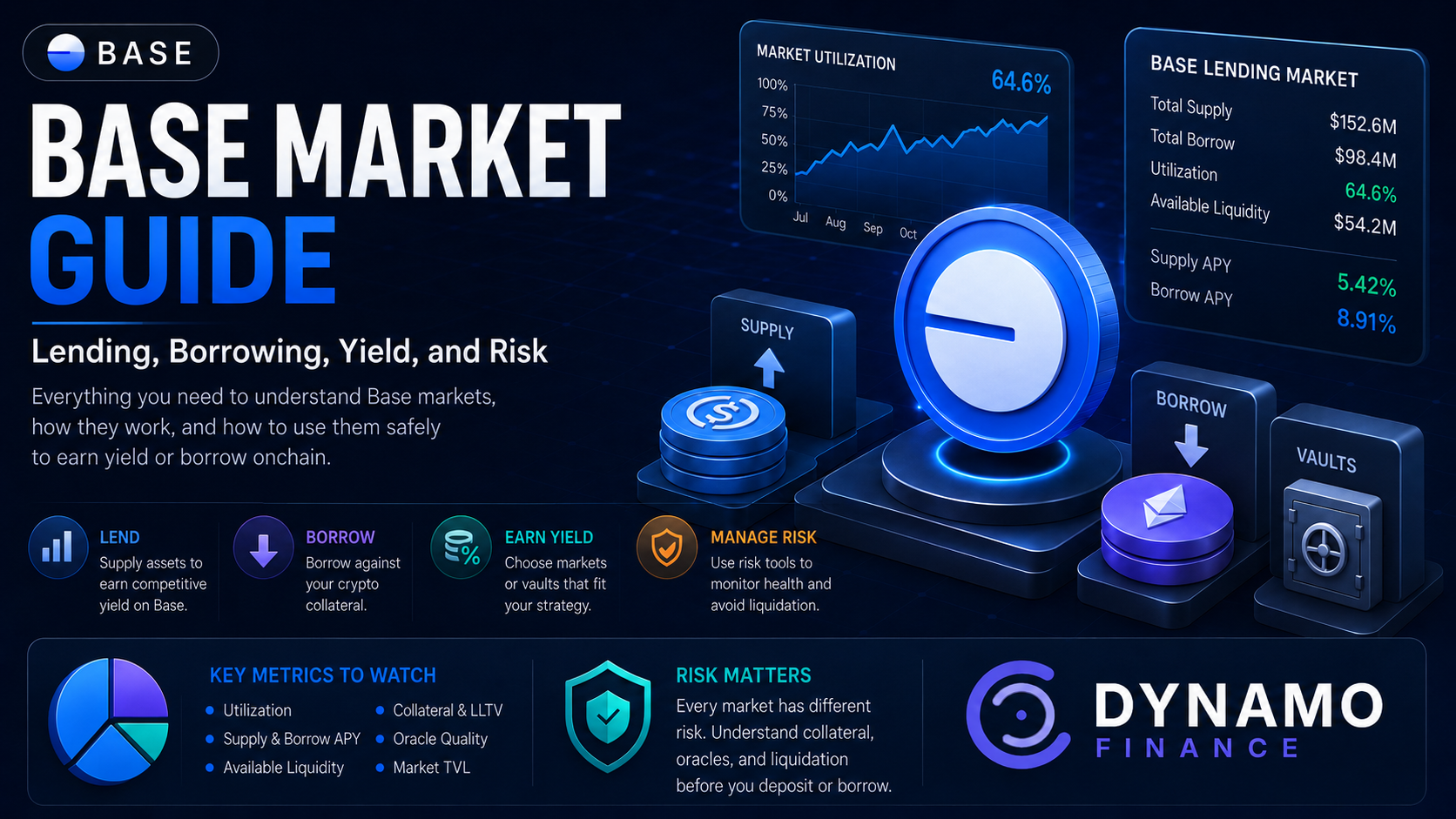
Base has become one of the most important networks for onchain finance because it combines Ethereum-aligned infrastructure, lower transaction costs, Coinbase distribution, and a fast-growing DeFi ecosystem. For lenders, borrowers, and yield seekers, that makes the phrase “base market” more than a casual search term. It points to a practical question: how do lending and borrowing markets work on Base, and how should users evaluate the risk before depositing capital?
A base market is a DeFi lending or borrowing market deployed on the Base network, usually pairing one loan asset with one collateral asset. In a Morpho-style market, lenders supply the loan asset to earn interest, borrowers post collateral to borrow, and market parameters such as utilization, oracle, interest rate model, and liquidation loan-to-value determine the risk-return profile.
This guide explains what a base market means, why Base matters for DeFi, how lending markets work, how vaults fit into the ecosystem, what yield seekers should watch, and how Dynamo Finance helps users compare Morpho-based markets and vaults with a more disciplined risk framework.
Key Takeaways
- A base market usually refers to a DeFi market deployed on Base, especially a lending market where users can supply assets, borrow against collateral, or access yield strategies.
- Base is an Ethereum Layer 2 network incubated by Coinbase and built using the OP Stack, designed to make onchain activity faster and less expensive than Ethereum mainnet.
- Base lending markets can offer attractive yield and liquidity, but users still need to evaluate collateral, oracle quality, utilization, available liquidity, liquidation risk, and smart contract exposure.
- Morpho-based markets are isolated, meaning each market has its own loan asset, collateral asset, oracle, interest rate model, and liquidation threshold.
- Dynamo Finance gives users a non-custodial way to compare markets, vaults, APYs, liquidity, risk ratings, Safety Margin, Liquidation Risk views, rewards, and governance participation.
What Is Base?
Base is an Ethereum Layer 2 network incubated by Coinbase. It is designed to support faster and lower-cost onchain transactions while remaining connected to the Ethereum ecosystem. Coinbase describes Base as a secure, low-cost, developer-friendly Ethereum L2, and Base’s own materials position it as infrastructure for onchain apps, payments, trading, and DeFi. Readers can review the official Base documentation for the network overview.
Layer 2 networks exist because Ethereum mainnet can become expensive during periods of high demand. By moving activity to a rollup-based environment, users can interact with apps at lower cost while still benefiting from Ethereum-aligned settlement assumptions.
Base is also closely watched because of Coinbase’s distribution. Coinbase can introduce millions of users to onchain products, and Base gives builders a network where those products can operate with lower fees than mainnet.
For DeFi users, Base matters because cheaper transactions can make lending, borrowing, swapping, vault deposits, repayments, and portfolio management more practical. A user can manage smaller positions more efficiently when transaction costs are lower.
What Does “Base Market” Mean in Crypto?
The phrase “base market” can have more than one meaning depending on context. In trading, a “base” asset may refer to the asset being priced in a pair. In DeFi, however, users often use “base market” to mean a lending, borrowing, or yield market deployed on the Base network.
For this article, a base market means a DeFi market on Base where users can supply assets, borrow against collateral, deposit into vaults, or compare yield opportunities. The most relevant example for Dynamo users is a Morpho-style lending market accessible through a DeFi interface.
A lending market is not the same thing as a whole protocol. A protocol can host many markets. Each market can have different collateral, different liquidity, different APY, different liquidation rules, and different risk.
That distinction matters. Asking whether Base DeFi is attractive is too broad. The better question is whether a specific base market has the right collateral, liquidity, APY, utilization, oracle, and risk profile for your strategy.
Why Base Markets Matter for DeFi Investors
Base markets matter because they combine onchain liquidity with lower transaction friction. For lenders, this can mean more opportunities to earn yield. For borrowers, it can mean faster access to crypto-backed liquidity. For vault users, it can mean curated strategies that allocate across lending opportunities on Base and other supported ecosystems.
The growth of Base has also attracted major DeFi infrastructure, including lending protocols, decentralized exchanges, stablecoin products, wallets, bridges, and analytics platforms. DefiLlama’s Base chain dashboard is a useful way to monitor TVL, stablecoins, fees, app activity, and broader DeFi metrics on the network.
Lower fees can also change user behavior. On Ethereum mainnet, a small adjustment to a borrow position may feel too expensive when gas fees are high. On Base, active position management can be more accessible for smaller portfolios.
Still, lower cost does not mean lower risk. A cheap transaction can still enter a risky market. Users must evaluate the market itself, not just the chain it runs on.
How Base Lending Markets Work
A Base lending market connects suppliers and borrowers. Suppliers deposit the loan asset, such as a stablecoin or supported crypto asset. Borrowers post collateral and borrow from that supplied liquidity.
Interest rates are usually variable. When more of the supplied liquidity is borrowed, utilization rises. Higher utilization often increases borrow rates and can raise supplier APY. Lower utilization usually reduces borrow costs and may reduce supplier yield.
In Morpho-style lending, each market is isolated. Morpho’s market materials define a variable-rate market as a primitive lending pool with one loan asset, one collateral asset, one oracle, one interest-rate model, and one liquidation loan-to-value threshold. The Morpho market guide is useful for understanding this structure.
For users, isolation makes risk more specific. Instead of supplying into one broad pool with many assets, a supplier can evaluate the exact collateral and loan asset pair behind a market.
The Core Parts of a Base Lending Market
Every serious lending market should be evaluated through its components. APY is only the surface layer. The mechanics underneath determine whether the yield is worth the risk.
- Loan asset: The asset suppliers deposit and borrowers borrow.
- Collateral asset: The asset borrowers post to secure the loan.
- Oracle: The price feed used to value collateral against the loan asset.
- LLTV: The liquidation loan-to-value threshold where a borrow position becomes liquidatable.
- Utilization: The percentage of supplied liquidity currently borrowed.
- Available liquidity: The amount that can be borrowed or withdrawn immediately.
- Supply APY: The current yield earned by suppliers.
- Borrow APY: The current cost paid by borrowers.
- Market TVL: The total value supplied to the market.
- Verification status: Whether an interface has reviewed the market’s key parameters and displays it as verified.
A base market can look attractive because it has a strong APY, but that APY may be driven by high utilization, thin liquidity, specialized collateral, temporary incentives, or elevated risk.
Base Market vs. Ethereum Mainnet Market
Base and Ethereum mainnet can support similar DeFi activities, but the user experience and risk considerations differ. The network changes transaction cost, speed, liquidity routes, bridge assumptions, and user behavior.
| Feature | Base Market | Ethereum Mainnet Market |
|---|---|---|
| Transaction cost | Usually lower, making smaller actions more practical | Often higher, especially during congestion |
| User experience | Designed for faster, lower-cost onchain activity | More expensive but deeply established |
| Liquidity profile | Fast-growing, but varies significantly by asset and market | Often deeper for mature assets and established DeFi protocols |
| Risk considerations | Market risk plus Layer 2, bridge, sequencer, and ecosystem-specific assumptions | Market risk plus Ethereum mainnet execution cost and smart contract risk |
| Best fit | Users who want lower-cost DeFi activity, lending, borrowing, and active position management | Users prioritizing mainnet liquidity, protocol maturity, and direct Ethereum settlement |
Base markets can be attractive, but they should not be treated as automatically better than mainnet markets. The right choice depends on asset depth, borrowing needs, withdrawal liquidity, gas sensitivity, and the specific protocol stack.
Base Market vs. Base Token Confusion
Some beginners search for “base market” expecting a Base token market. That can create confusion because Base does not currently have a native network token. Coinbase’s Base support materials state that Coinbase did not plan to issue a new network token for Base, and users should be careful around tokens pretending to be official Base assets.
This matters because scammers often exploit popular network names. A token using “Base” in its name is not automatically associated with the Base network, Coinbase, or any legitimate DeFi market.
A base market is better understood as a market deployed on Base, not a market for an official Base coin. Always verify the asset, contract address, network, and official app URL before interacting.
For lending users, the asset pair is what matters. A USDC market on Base, for example, should be evaluated by its loan asset, collateral asset, oracle, utilization, liquidity, and liquidation parameters.
How Morpho Fits Into Base Markets
Morpho is important because it provides lending infrastructure that can be deployed across EVM networks, including Base. Its isolated-market design makes it useful for creating specific lending markets with defined collateral and loan assets.
In a Morpho market, lenders know the exact collateral backing borrower demand. Borrowers know the exact loan asset, oracle, and liquidation threshold. Curators can build vaults on top of those markets, routing capital across opportunities.
This creates a flexible base market structure. Instead of one broad lending pool, users can evaluate many isolated lending opportunities. That is powerful, but it also requires better analysis.
Users exploring morpho lending should focus on the market level. The chain matters, the protocol matters, and the exact market matters most.
Where Dynamo Finance Fits Into Base Market Research
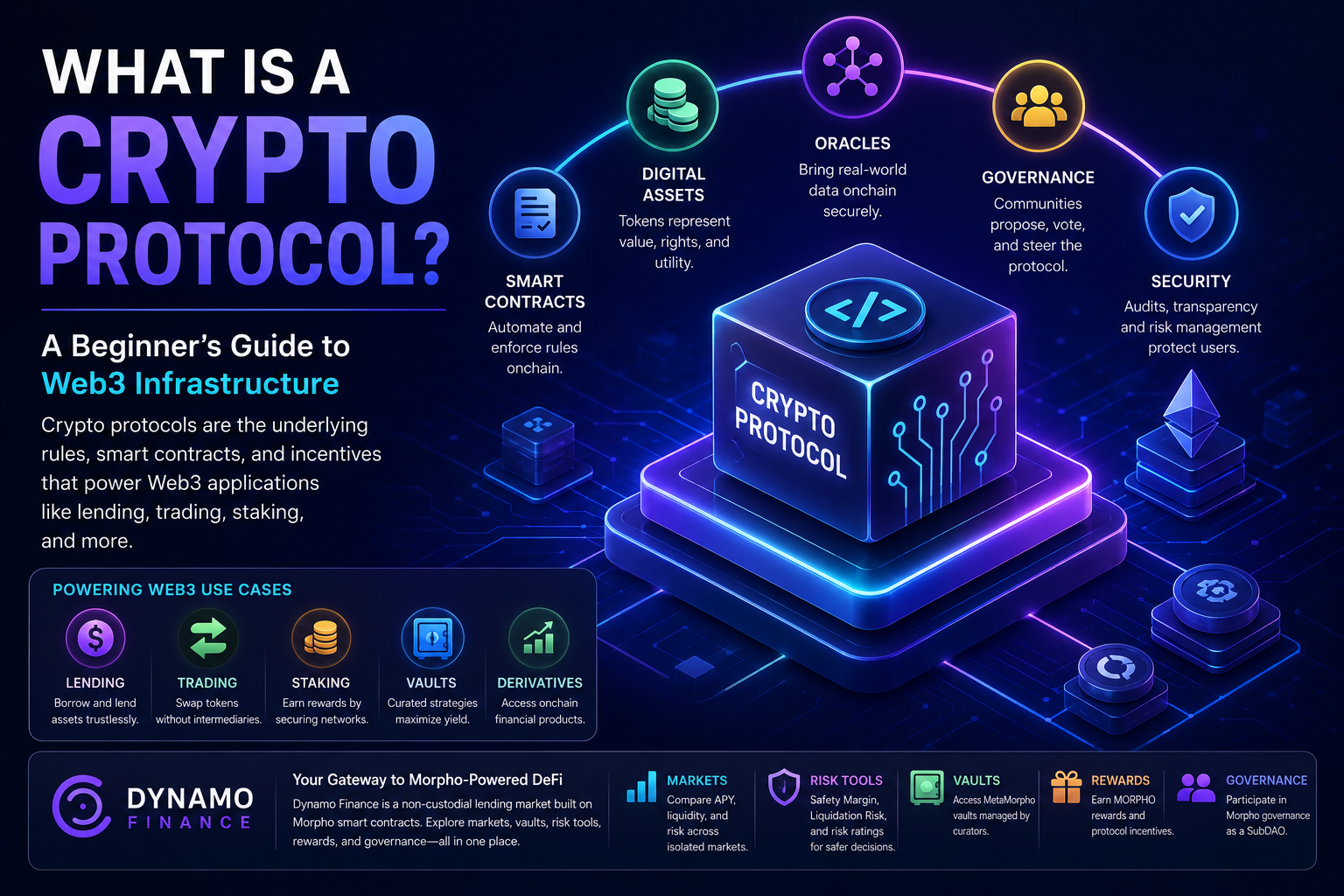
Dynamo Finance is a non-custodial, permissionless Web3 lending market built on Morpho smart contracts. It helps users supply assets, borrow against collateral, deposit into vaults, compare markets, evaluate risk, earn rewards, and participate in governance through one interface.
Dynamo does not custody user funds. Assets are held by Morpho smart contracts, while Dynamo adds market discovery, analytics, risk tooling, position management, rewards, automation, and SubDAO governance participation.
This makes Dynamo useful for users researching base market opportunities because the strongest decision is rarely based on APY alone. A user needs market-level data: collateral, loan asset, utilization, liquidity, borrow APY, supply APY, oracle, LLTV, and risk tier.
For DeFi users who want more context before using morpho vaults or direct markets, Dynamo turns raw lending infrastructure into a clearer workflow.
Dynamo Markets: What Users Can Compare
Dynamo markets are isolated lending pools. Each market is dedicated to one collateral asset and one loan asset. This structure allows users to evaluate specific risk rather than relying on broad protocol assumptions.
On Dynamo, users can compare live market data such as supply APY, borrow APY, utilization, available liquidity, collateral asset, loan asset, oracle, LLTV, and market verification status. Those variables are essential for evaluating any base market.
A high-yield market may be attractive for a small allocation but inappropriate for capital that needs easy withdrawal access. A lower-yield market with deep liquidity and conservative collateral may be better for a core position.
Users who want to compare live opportunities can start with Dynamo markets and review each market’s parameters before supplying or borrowing.
Dynamo Vaults and Base Yield Strategies
Vaults simplify lending by letting users deposit once while a curator allocates capital across underlying markets. In a Morpho-based ecosystem, vaults can help users avoid manually selecting and rebalancing every lending market.
Dynamo vaults are built on the MetaMorpho standard. The vault holds deposits, the curator allocates across lending markets, borrowers pay interest in those markets, and depositors receive a blended yield through vault shares.
Vaults can be useful for users who want a more hands-off strategy, but they introduce curator and allocation risk. A vault’s APY depends on its underlying markets, fees, liquidity, utilization, and rebalancing decisions.
For a base market investor, vaults can be a bridge between convenience and DeFi complexity. They reduce manual work, but users should still review the underlying market exposure.
Base Market Yield: Where Does APY Come From?
In lending markets, yield usually comes from borrowers paying interest. Suppliers deposit assets, borrowers use those assets, and the interest paid by borrowers creates supplier APY.
APY can also include incentives. Some markets or vaults may offer MORPHO emissions, Dynamo-specific incentives, or third-party curator rewards depending on active campaigns and eligibility.
Users should separate base lending APY from reward-driven yield. Base APY reflects borrower demand and utilization. Rewards may be temporary and can change as campaigns start, end, or shift allocation.
This distinction matters for crypto lending. A market with modest base yield and strong temporary rewards may look attractive today but become less competitive after incentives change.
Utilization: The Metric Every Base Market User Should Understand
Utilization measures how much supplied liquidity is currently borrowed. If a market has $10 million supplied and $7 million borrowed, utilization is 70%.
Higher utilization can raise supply APY because more capital is actively earning interest from borrowers. It can also reduce available liquidity because less capital remains idle for withdrawals or new borrowing.
Lower utilization usually means more liquidity is available, but suppliers may earn less because fewer borrowers are paying interest. There is no universally ideal utilization number; the right level depends on the user’s goals.
Yield seekers may prefer higher utilization. Users who value easy exits may prefer moderate utilization and deeper available liquidity.
Available Liquidity: The Exit Question
Available liquidity tells you how much capital can be withdrawn or borrowed right now. It is one of the most practical metrics in any base market.
A market can show a large total supply, but if most of it is borrowed, immediate liquidity may be limited. That can matter if you need to withdraw quickly, repay a position, or borrow a meaningful amount.
Vault users should also care about available liquidity. A vault may hold deposits across several markets, but withdrawal speed depends on liquidity in the underlying markets.
Before depositing into a base market or vault, ask the exit question: can I withdraw when I need to, and what happens if utilization rises?
Collateral Quality: The Risk Behind the Yield
Collateral quality is one of the biggest drivers of lending market risk. Borrowers post collateral to secure loans. If that collateral falls sharply, becomes illiquid, or cannot be priced reliably, suppliers may face increased risk.
High-quality collateral is generally liquid, widely traded, easier to price, and supported by reliable oracle infrastructure. More specialized collateral may offer higher yields but require deeper analysis.
Do not judge a base market only by the asset you supply. If you supply USDC, the risk still depends heavily on what borrowers use as collateral.
Suppliers should ask: what asset protects me if borrowers cannot repay, and can that asset be liquidated efficiently during market stress?
Oracle Risk in Base Markets
Oracles provide price data to lending protocols. They are critical because collateral value determines borrowing power and liquidation thresholds.
If an oracle is wrong, delayed, manipulated, or poorly designed, a market can become dangerous. Borrowers may be liquidated incorrectly, or lenders may be left underprotected if collateral is overvalued.
Oracle risk is especially important for newer assets, thinly traded tokens, yield-bearing assets, and tokenized products. A high APY does not compensate for weak pricing infrastructure unless the user fully understands the risk.
When reviewing a base market, always identify the oracle and understand how collateral is valued against the loan asset.
Borrowing in a Base Market
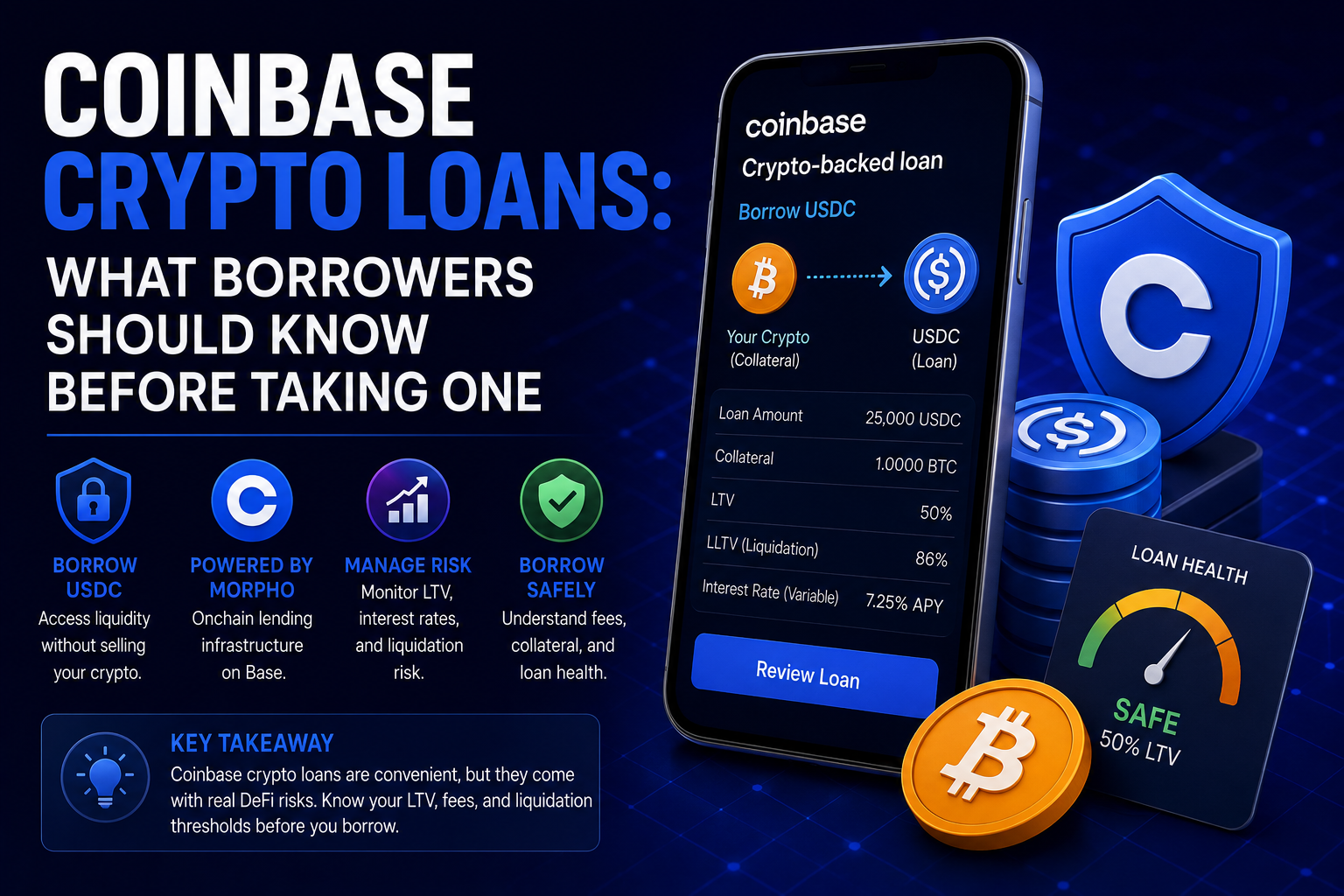
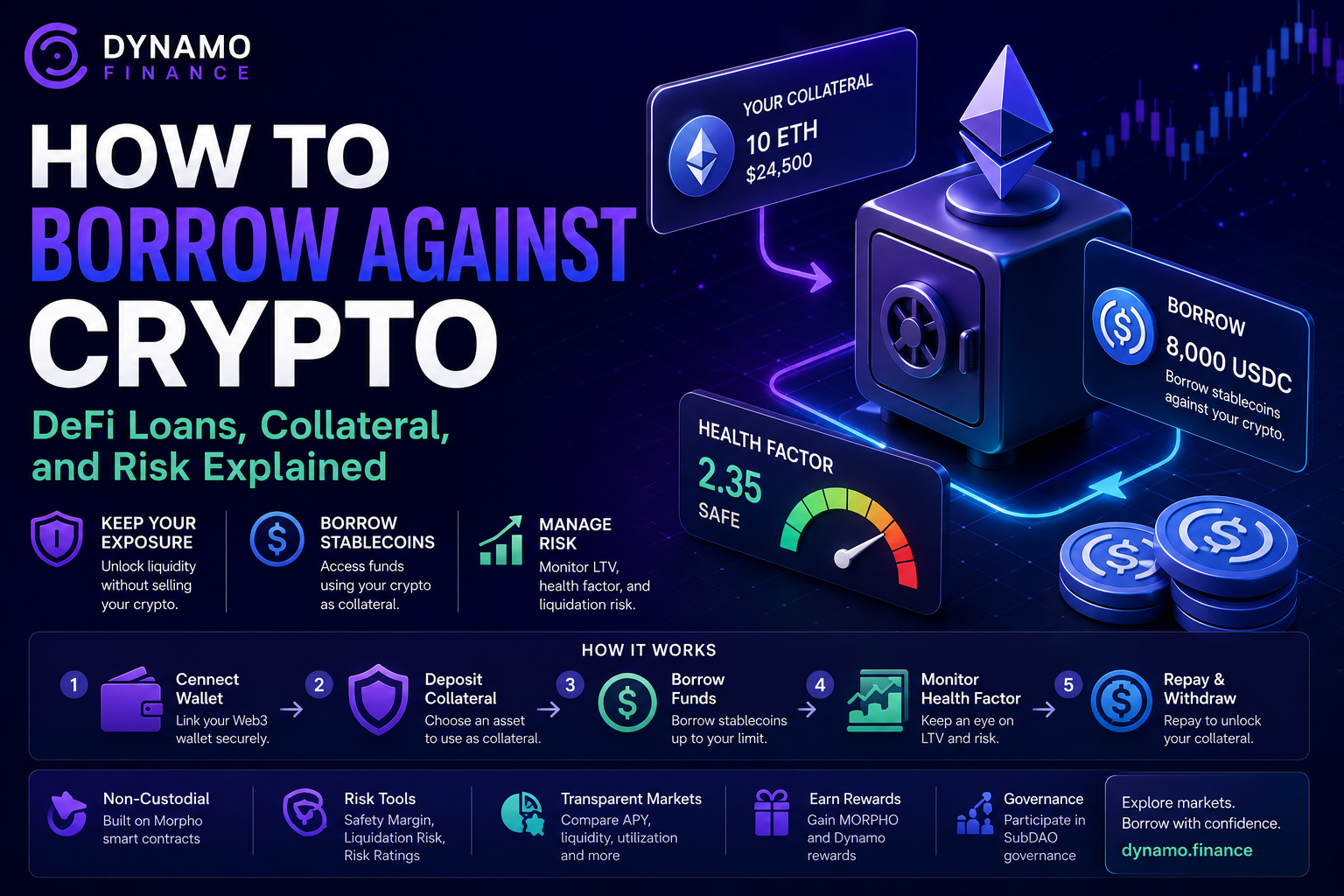
Borrowing through a base market means posting collateral and drawing a loan asset. This can help users access stablecoin liquidity without selling their crypto.
For example, a user may post ETH or another supported collateral asset and borrow USDC. The user keeps exposure to the collateral asset while accessing liquidity. If the collateral price rises, the loan becomes safer. If it falls, liquidation risk increases.
Anyone considering crypto loans should focus on LTV, LLTV, borrow APY, health factor, liquidation price, collateral volatility, and available liquidity.
A borrow position is not passive. It needs monitoring because collateral prices, rates, and utilization can change quickly.
Understanding LTV and LLTV
LTV stands for loan-to-value. It measures the borrowed amount relative to collateral value. If a borrower posts $10,000 of collateral and borrows $4,000, the LTV is 40%.
LLTV stands for liquidation loan-to-value. It is the threshold where the position can become liquidatable. Borrowing close to LLTV leaves very little room for collateral price movement.
Dynamo’s collateral workflow helps users understand these concepts before borrowing. The platform shows loan-to-value and liquidation-related data so users can manage their positions more carefully.
Borrowers should treat LLTV as a danger line, not a target. Conservative borrowing starts well below the liquidation threshold.
Dynamo Safety Margin
Dynamo’s Safety Margin feature lets borrowers set a more conservative synthetic target LTV than Morpho’s underlying LLTV. This creates a buffer between the current position and the liquidation point.
That buffer matters because maximum borrowing power can be misleading. A user may be allowed to borrow a certain amount, but that does not mean the amount is prudent.
Safety Margin helps borrowers reduce liquidation risk, automate discipline, and choose how conservative they want to be. It is especially useful in volatile markets where collateral can move quickly.
For users comparing de.fi crypto lending interfaces, this type of borrower-focused risk tool can be more valuable than a slightly lower borrow rate.
Dynamo Liquidation Risk Views
Dynamo’s Liquidation Risk views show practical borrower metrics such as health factor, price-drop tolerance, and liquidation price. These numbers translate abstract collateral risk into actionable information.
Health factor shows distance from liquidation. Price-drop tolerance shows how far collateral can fall before the position becomes liquidatable. Liquidation price tells the borrower the approximate danger level for the collateral asset.
Borrowers can respond by repaying debt, adding collateral, or reducing exposure before the position becomes stressed. Acting early is usually better than waiting until the loan is at risk.
A good borrowing interface should help users avoid liquidation. It should not simply maximize debt.
Risk Ratings for Base Market Users
Dynamo assigns Low, Medium, and High risk tiers to markets and vaults using objective onchain inputs. For markets, the framework considers variables such as LLTV, market TVL, and live history. For vaults, it considers total supplied value, market exposure, and live history.
Risk ratings are not guarantees. A Low-risk market can still suffer from smart contract issues, oracle problems, liquidity stress, or extreme collateral moves. The rating is a structural starting point, not a prediction.
For base market users, risk tiers are useful because they help avoid sorting only by APY. A high APY in a High-risk market may still make sense for an advanced user, but it should not be confused with conservative yield.
Good DeFi research starts with risk, then compares return.
Base Market Fees and Network Costs
Base usually offers lower transaction costs than Ethereum mainnet, but users should still consider total cost. Deposits, withdrawals, borrowing, repayments, token approvals, swaps, bridge transactions, and vault interactions can all involve fees.
There may also be market or vault fees depending on the interface, curator, protocol, and active fee settings. Users should review live fee information before signing any transaction.
Network costs matter less when they are low, but they still affect strategy. A user frequently adjusting small positions should pay close attention to gas, approval costs, and bridging costs.
Lower fees are useful. They do not replace due diligence.
Base Market Risks
Base market risk has several layers. Some risks come from DeFi lending itself. Others come from operating on a Layer 2 network.
- Smart contract risk: Lending markets and vaults rely on code that can contain bugs or vulnerabilities.
- Oracle risk: Incorrect or delayed price data can affect collateral valuation and liquidation outcomes.
- Liquidation risk: Borrowers can lose collateral if LTV reaches the market’s liquidation threshold.
- Liquidity risk: Suppliers may face withdrawal delays if utilization is high.
- Collateral risk: Borrower collateral can become volatile, illiquid, or hard to price.
- Vault curator risk: Vault performance depends on market selection, allocation, and rebalancing decisions.
- Layer 2 risk: Base users should understand bridge, sequencer, and network-specific assumptions.
- User error risk: Wrong networks, fake apps, bad approvals, or misunderstood transactions can cause losses.
- Incentive risk: Reward-driven APY can change quickly when campaigns end or token prices move.
A base market can be useful and still risky. The goal is not to eliminate all risk, but to understand whether the expected return compensates for it.
How to Evaluate a Base Market Before Supplying
Suppliers should evaluate a base market as a lending position, not as a passive savings product. The supplied asset, collateral asset, liquidity, utilization, and oracle all matter.
- Confirm the official app URL and network.
- Identify the loan asset you will supply.
- Review the collateral asset borrowers use in the market.
- Check supply APY, borrow APY, utilization, and available liquidity.
- Review market TVL and how long the market has been live.
- Understand the oracle used to value collateral.
- Review LLTV and liquidation mechanics.
- Check whether the market is verified in the interface you use.
- Separate base APY from rewards or temporary incentives.
- Decide whether the yield is worth the risk before depositing.
This checklist is slower than chasing the highest APY, but it is how serious DeFi users protect capital.
How to Evaluate a Base Market Before Borrowing
Borrowers need a different process. The main objective is to access liquidity without getting liquidated.
- Choose the collateral asset you want to post.
- Choose the loan asset you want to borrow.
- Review borrow APY and whether the rate is variable.
- Check available liquidity and utilization.
- Review LLTV and choose a conservative starting LTV.
- Study oracle design and collateral volatility.
- Check health factor, liquidation price, and price-drop tolerance.
- Plan when you will repay debt or add collateral.
- Avoid borrowing near the maximum available amount.
- Monitor the position after borrowing because market conditions can change.
A good borrow position starts with an exit plan. If you do not know how you will repay, reduce the loan size or do not borrow.
How to Evaluate Base Vaults
Vaults are useful for users who want curated lending exposure without manually selecting every market. A vault can allocate deposits across multiple markets to pursue a blended yield.
However, vaults need due diligence. Review the curator, deposit asset, market allocation, APY stability, fees, TVL, withdrawal liquidity, risk tier, and underlying market exposure.
A vault with high TVL may be more established, but its risk still depends on where it allocates capital. A vault with high APY may be attractive, but the yield may come from higher-risk markets or temporary conditions.
For base market users, vaults can reduce manual rebalancing. They do not remove smart contract, liquidity, market, or curator risk.
Practical Example: Supplying USDC on Base
Imagine a user has USDC on Base and wants to earn yield. They compare two markets. Market A offers moderate APY, deeper liquidity, established collateral, and lower utilization. Market B offers higher APY, higher utilization, and newer collateral.
A beginner might choose Market B because the APY is higher. A more experienced user asks why the APY is higher. Is borrower demand sustainable? Is the collateral liquid? Is the oracle reliable? Could withdrawals become difficult if utilization stays high?
Market B may still fit a smaller, higher-risk allocation. Market A may fit capital that needs more predictable exits.
This is how to think about base market yield: APY is an invitation to research, not a decision by itself.
Practical Example: Borrowing Against ETH on Base
Suppose a user holds ETH on Base and wants USDC liquidity. They can look for a market that accepts ETH or a supported ETH-like asset as collateral and allows USDC borrowing.
The user should not borrow the maximum amount available. A conservative LTV gives the position room to absorb volatility. If ETH falls, the borrower can repay part of the debt, add collateral, or close the loan before liquidation risk becomes severe.
Dynamo’s Safety Margin and Liquidation Risk views can help users structure this type of position more carefully. They show whether the loan has enough room before reaching the liquidation threshold.
Borrowing is most useful when it solves a liquidity problem. It becomes dangerous when it turns into unchecked leverage.
Practical Example: Choosing Between a Market and a Vault
A stablecoin holder may choose between supplying directly to a Base lending market or depositing into a vault. Direct supply gives the user exact exposure to one market. A vault gives curated exposure across several markets.
Direct markets are better when the user wants control over collateral, oracle, LLTV, and utilization. Vaults are better when the user wants less manual management and is comfortable relying on a curator.
Neither option is automatically safer. A conservative direct market can be lower risk than an aggressive vault. A diversified vault can be easier to manage than chasing individual markets manually.
The right choice depends on portfolio role, risk tolerance, time horizon, and how actively the user wants to monitor positions.
Common Mistakes With Base Markets
The first mistake is assuming Base equals low risk. Base can lower transaction costs, but market-level lending risk remains.
The second mistake is chasing the highest APY. High yield can reflect high utilization, temporary rewards, scarce liquidity, or risky collateral.
The third mistake is ignoring available liquidity. A market can have strong TVL and still be hard to exit if most liquidity is borrowed.
The fourth mistake is borrowing too close to liquidation. Lower fees make position management easier, but they do not protect an overleveraged loan.
The fifth mistake is using unofficial links or tokens. Base’s popularity attracts scams, fake tokens, and phishing pages.
What Experienced DeFi Investors Watch
Experienced investors start with market structure. They identify the loan asset, collateral asset, oracle, LLTV, utilization, and liquidity before considering yield.
They also compare APY quality. A moderate APY from borrower demand may be more sustainable than a high APY driven mainly by incentives.
Borrowers focus on risk buffers. They monitor health factor, liquidation price, collateral volatility, borrow APY, and available liquidity.
Vault users evaluate curators. They look at allocation diversity, fees, live history, market exposure, and whether the strategy fits the portfolio.
Base Market Strategy for Beginners
Beginners should start with education and small test transactions. Learn how the network works, how to bridge assets safely, how token approvals function, and how lending markets display risk.
A simple first strategy is to observe markets before depositing. Compare APYs, utilization, liquidity, and collateral. Notice how markets with higher yield often have different risk characteristics.
If supplying, start with an amount that lets you test deposit and withdrawal behavior. If borrowing, start with a conservative LTV and repay part of the loan to understand the workflow.
Learning the mechanics with a small position is often more valuable than rushing into the highest-yielding market.
How Dynamo Supports a Risk-First Workflow
Dynamo’s value is not just access. It is the combination of access and decision support. Users can compare markets and vaults while seeing the risk inputs that matter.
The platform’s market views help suppliers evaluate yield, utilization, liquidity, and collateral. Borrowers can review loan terms, risk metrics, Safety Margin, and Liquidation Risk views. Vault users can compare curators, allocations, APY, TVL, and risk tiers.
This makes Dynamo useful for Base market research even when users are comparing multiple chains or DeFi strategies. The goal is to make DeFi lending decisions based on structure, not hype.
For full product education, users can review the Dynamo Finance documentation, which covers markets, vaults, interest rates, collateral, liquidations, risk ratings, Safety Margin, Liquidation Risk, rewards, fees, and governance.
External Resources for Further Research
For the Base network itself, start with the official Base documentation and Coinbase’s Base support overview. These resources explain Base’s role as an Ethereum Layer 2, its Coinbase connection, and user-facing network basics.
For lending market mechanics, review the Morpho variable-rate market documentation. It explains isolated markets, loan assets, collateral assets, oracles, interest-rate models, and LLTV.
For ecosystem metrics, use the DefiLlama Base dashboard to track DeFi activity, TVL, stablecoins, fees, and network-level trends. For broader Layer 2 context, Coinbase’s Ethereum Layer 2 explainer is a useful beginner resource.
For Dynamo product updates, governance context, and market announcements, follow Dynamo Finance on X/Twitter.
Final Checklist Before Using a Base Market
Use this checklist before supplying, borrowing, or depositing into a vault on Base:
- Verify the official app URL and confirm you are on the Base network.
- Identify whether you are using a direct market or a vault.
- Review the loan asset, collateral asset, oracle, LLTV, and interest-rate model.
- Check supply APY, borrow APY, utilization, available liquidity, and market TVL.
- Separate base lending yield from token rewards or temporary incentives.
- For borrowing, choose a conservative LTV and review liquidation price.
- For vaults, inspect curator, allocation, fees, risk tier, and withdrawal liquidity.
- Consider Layer 2 assumptions, bridge risk, and network-specific execution risk.
- Start small and test deposits, withdrawals, borrowing, and repayment.
- Monitor the position regularly because APY, utilization, liquidity, and collateral prices change.
Conclusion
A base market can be a powerful entry point into DeFi lending, borrowing, and yield. Base lowers transaction friction and gives users access to a fast-growing onchain ecosystem. Morpho-style isolated markets make lending more precise by separating risk across specific loan and collateral pairs.
The opportunity is real, but the analysis must be specific. Users should evaluate each market by collateral, loan asset, oracle, LLTV, utilization, available liquidity, APY, rewards, market history, and risk tier. Vault users should also review curator quality, allocation, fees, and withdrawal conditions.
Dynamo Finance helps users approach Base market opportunities with more structure. Built on Morpho smart contracts, Dynamo gives users non-custodial access to markets and vaults, plus risk ratings, Safety Margin, Liquidation Risk views, rewards, analytics, and SubDAO governance participation.
Explore Dynamo Finance to compare Morpho-based markets and vaults, review risk data, and build a more disciplined approach to Base DeFi lending, borrowing, and yield.
FAQ
What is a base market in DeFi?
A base market usually means a DeFi lending, borrowing, or yield market deployed on the Base network. In a Morpho-style lending market, users supply a loan asset, borrowers post collateral, and rates adjust based on market utilization.
Is Base the same as Coinbase?
No. Base is an Ethereum Layer 2 network incubated by Coinbase. Coinbase helped launch and distribute Base, but Base is a blockchain network where many apps and protocols can operate.
Are Base markets safe?
No DeFi market is risk-free. Base markets can carry smart contract, oracle, collateral, liquidity, liquidation, vault curator, bridge, sequencer, and user-error risks. Users should evaluate each market before depositing or borrowing.
How do lenders earn yield in a base market?
Lenders earn yield from borrowers who pay interest to borrow the supplied asset. Yield can also include rewards or incentives, but users should separate base borrower-paid APY from temporary token rewards.
How does Dynamo Finance help with Base market research?
Dynamo Finance helps users compare Morpho-based markets and vaults by showing APY, utilization, available liquidity, collateral, loan assets, risk ratings, Safety Margin, Liquidation Risk data, rewards, and vault allocation context in one non-custodial workflow.