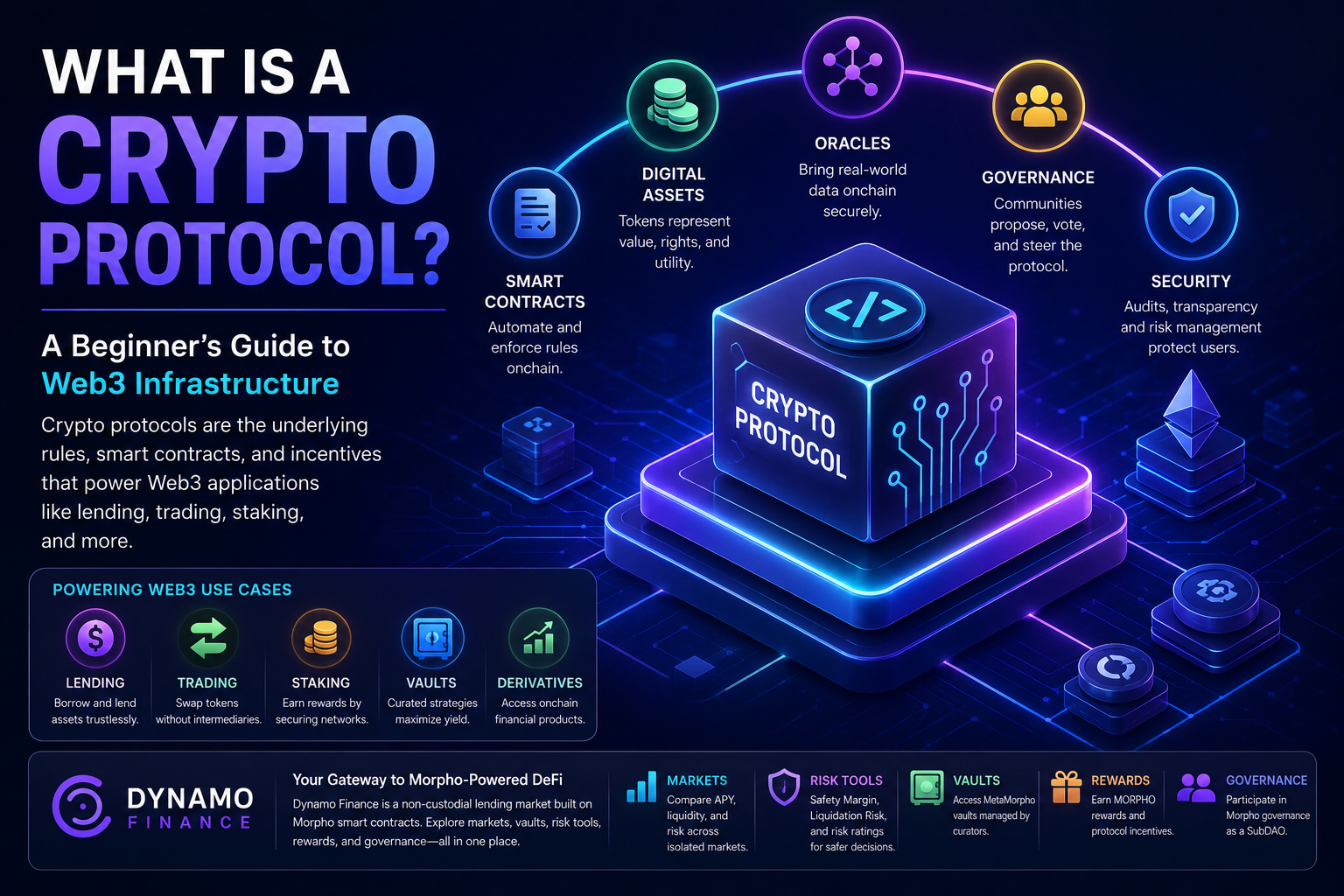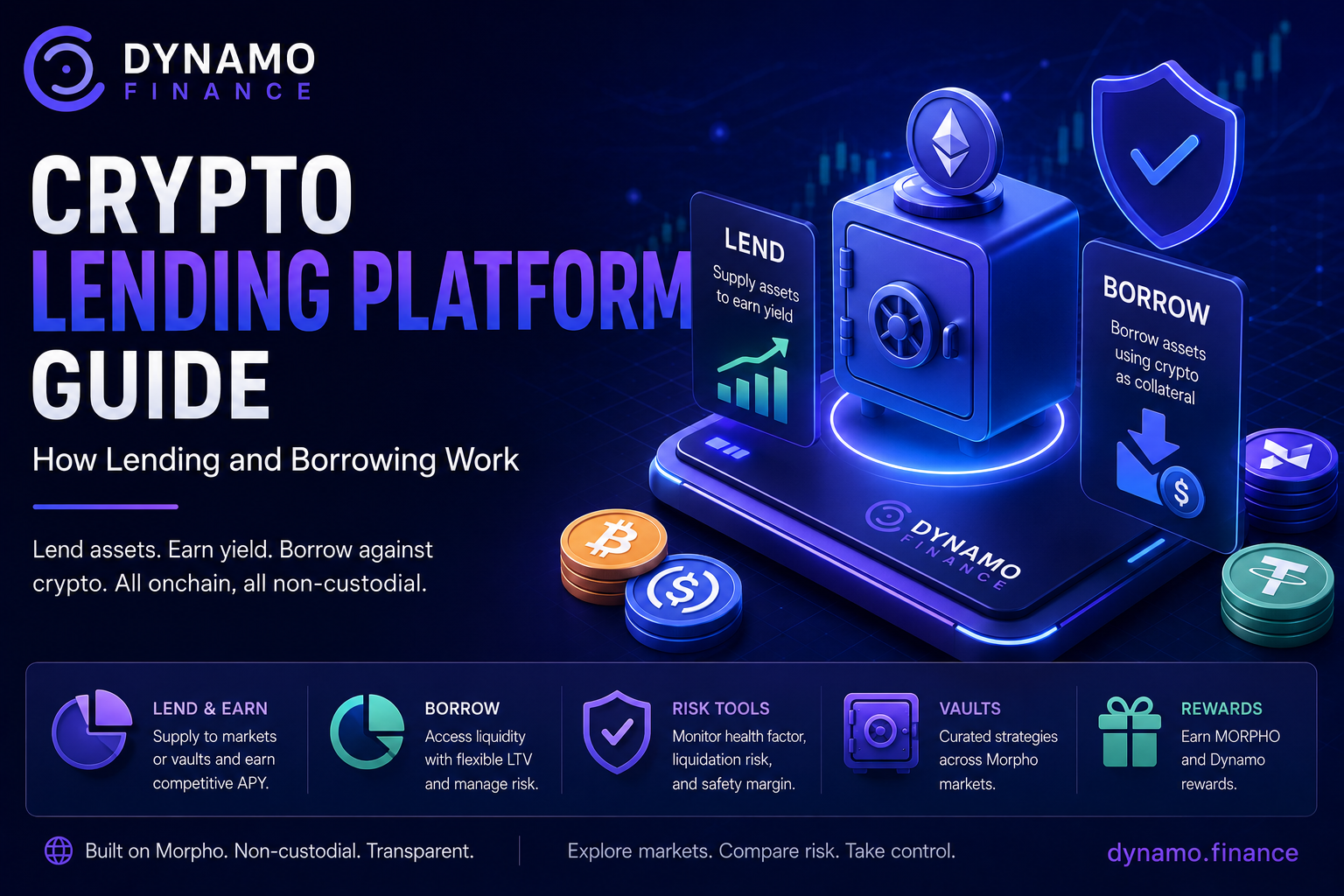


Crypto lending turns idle digital assets into productive capital. Instead of holding Bitcoin, Ethereum, stablecoins, or other tokens without using them, crypto holders can supply assets to lending markets and earn interest. Borrowers can use crypto as collateral to access liquidity without immediately selling their holdings.
That is why crypto lending has become one of the core use cases in decentralized finance. A stablecoin holder may want yield. An ETH holder may want to borrow USDC while keeping long-term exposure to ETH. A DeFi investor may want transparent, on-chain lending markets instead of relying on a centralized company.
Crypto lending is the process of supplying digital assets to a lending market so borrowers can use those assets, usually after posting collateral. In return, lenders earn interest paid by borrowers, while borrowers gain liquidity without selling their crypto.
This guide explains how crypto lending works, how crypto-backed loans are collateralized, how DeFi lending compares with CeFi lending, how crypto lending differs from staking, and what risks beginners should understand. It also explains where Dynamo Finance fits for users who want a non-custodial way to explore lending markets, vaults, borrowing, and risk tools.
Key Takeaways
- Crypto lending allows users to earn interest on crypto by supplying assets to lending markets or vaults.
- Crypto borrowing allows users to access liquidity by posting crypto collateral instead of selling their holdings.
- DeFi lending is typically non-custodial and smart-contract based, while CeFi lending depends on a centralized company.
- Crypto lending rates are usually variable and depend on utilization, liquidity, supply, demand, and market risk.
- Dynamo Finance gives users access to Morpho-based markets, MetaMorpho vaults, borrowing tools, and risk analytics.
How Crypto Lending Works
Most crypto lending platforms follow the same basic structure. Lenders supply assets, borrowers post collateral, interest accrues over time, and smart contracts or platform rules manage repayment and liquidation.
- A lender supplies a loan asset such as USDC, ETH, BTC, or another supported token into a lending market or vault.
- A borrower deposits crypto collateral into a market.
- The borrower draws a loan up to the limit allowed by the collateral parameters.
- Borrowers pay interest over time, and lenders earn yield from that interest.
- If the borrower’s collateral value falls too far, the position may become eligible for liquidation.
In DeFi lending, this process is coordinated by smart contracts. That creates transparency because market parameters, collateral ratios, liquidity, and rates can often be reviewed on-chain. It also means users must understand wallet approvals, transaction signing, smart contract risk, and liquidation mechanics.
For readers new to decentralized finance, Ethereum.org’s DeFi overview is a useful external primer on how smart contracts enable financial activities such as lending, borrowing, and trading without traditional intermediaries.
Crypto Lending: How to Earn Interest on Crypto
From a lender’s perspective, cryptocurrency lending is a way to earn interest on crypto without actively trading. Instead of trying to time the market, a user supplies an asset and earns a variable yield funded by borrower demand.
Stablecoin lending is one of the most common entry points. A user who supplies USDC, for example, is usually looking for yield with less price volatility than lending a highly volatile token. That does not make stablecoin lending risk-free. Stablecoins can carry issuer risk, depeg risk, smart contract risk, and liquidity risk.
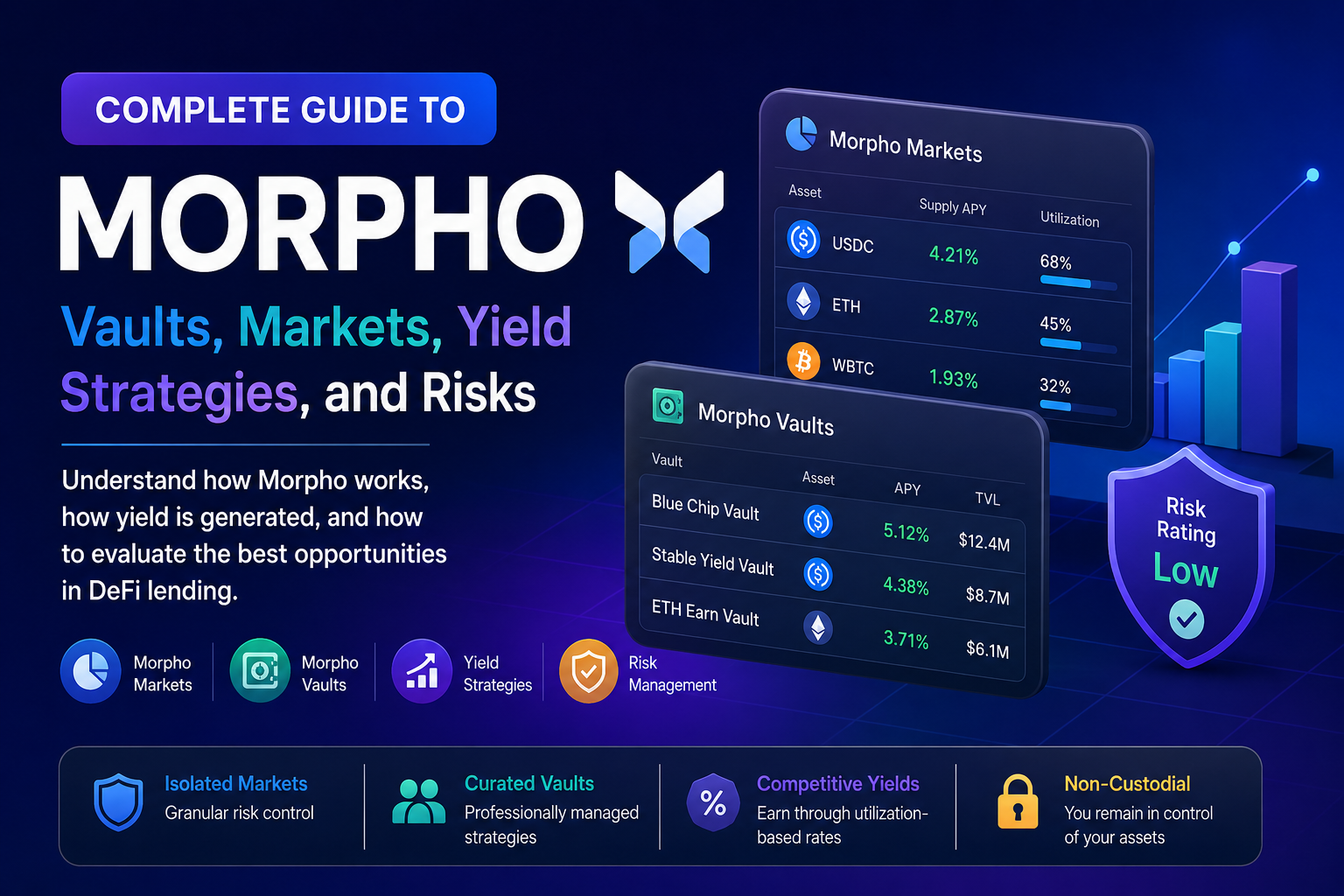
On Dynamo, users can review lending markets if they want direct exposure to a specific lending market. A market is useful when the user wants to choose the exact loan asset, collateral asset, utilization profile, available liquidity, supply APY, borrow APY, oracle, and LLTV.
Users who prefer a managed approach can review Morpho vaults. Dynamo vaults are built on MetaMorpho and designed to allocate deposits across lending markets according to curator-managed strategies. This can reduce the need for manual rebalancing, but it introduces a different decision: evaluating the curator, vault fees, market allocation, APY stability, and underlying risk.
Why Crypto Lending Rates Change
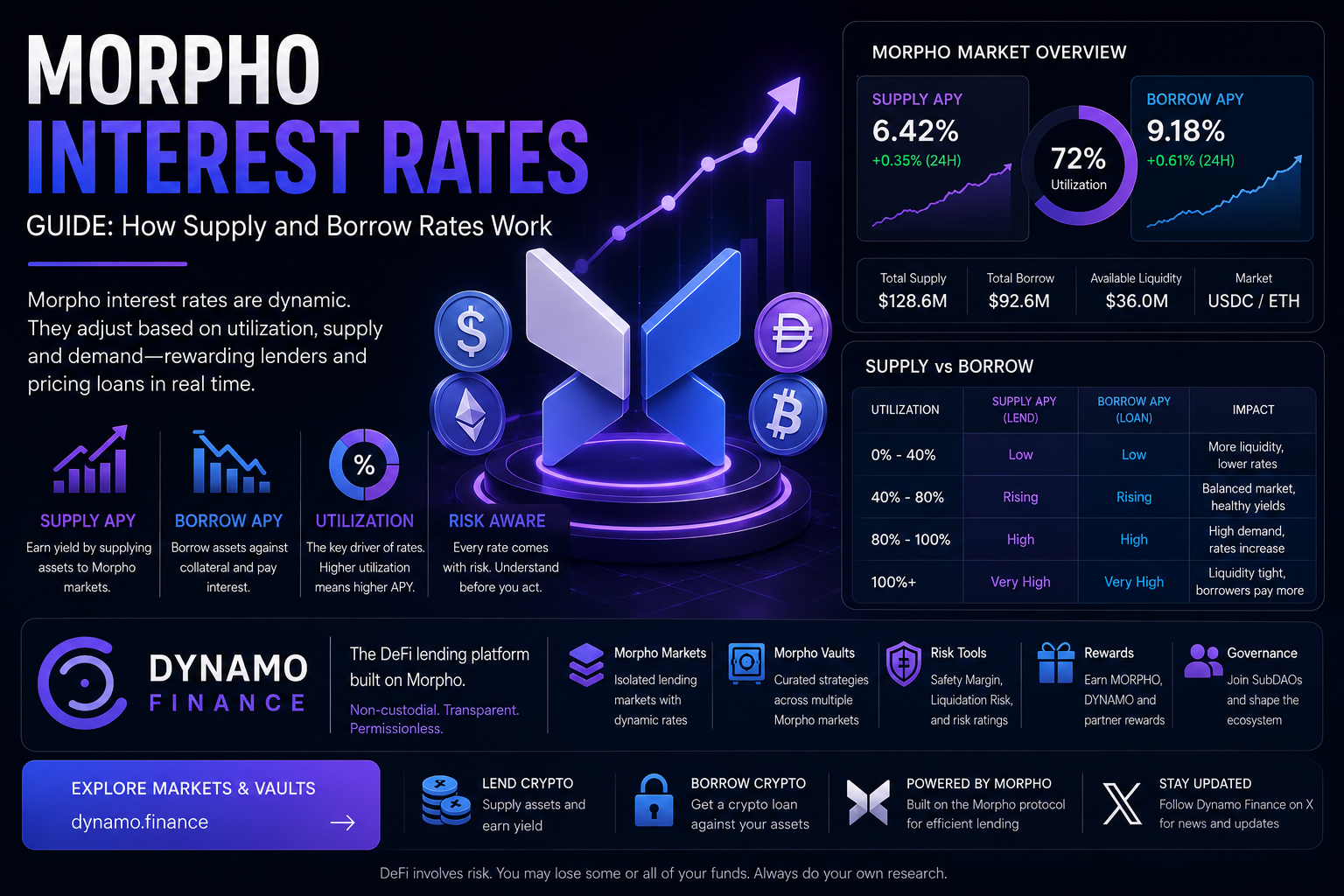
Crypto lending rates are not fixed bank savings rates. In DeFi lending, rates usually adjust based on utilization. Utilization measures how much supplied liquidity is currently borrowed.
When utilization is low, borrowing is cheaper and supply APY is usually lower because fewer borrowers are paying interest. When utilization rises, borrowing becomes more expensive and supply APY may increase because more interest is being paid into the market.
High utilization can look attractive for yield seekers, but it has a trade-off. If most liquidity is already borrowed, immediate withdrawals may be harder until borrowers repay or new suppliers add liquidity. For this reason, the best crypto lending rates are not always the best risk-adjusted opportunities.
Crypto Borrowing: How Crypto-Backed Loans Work
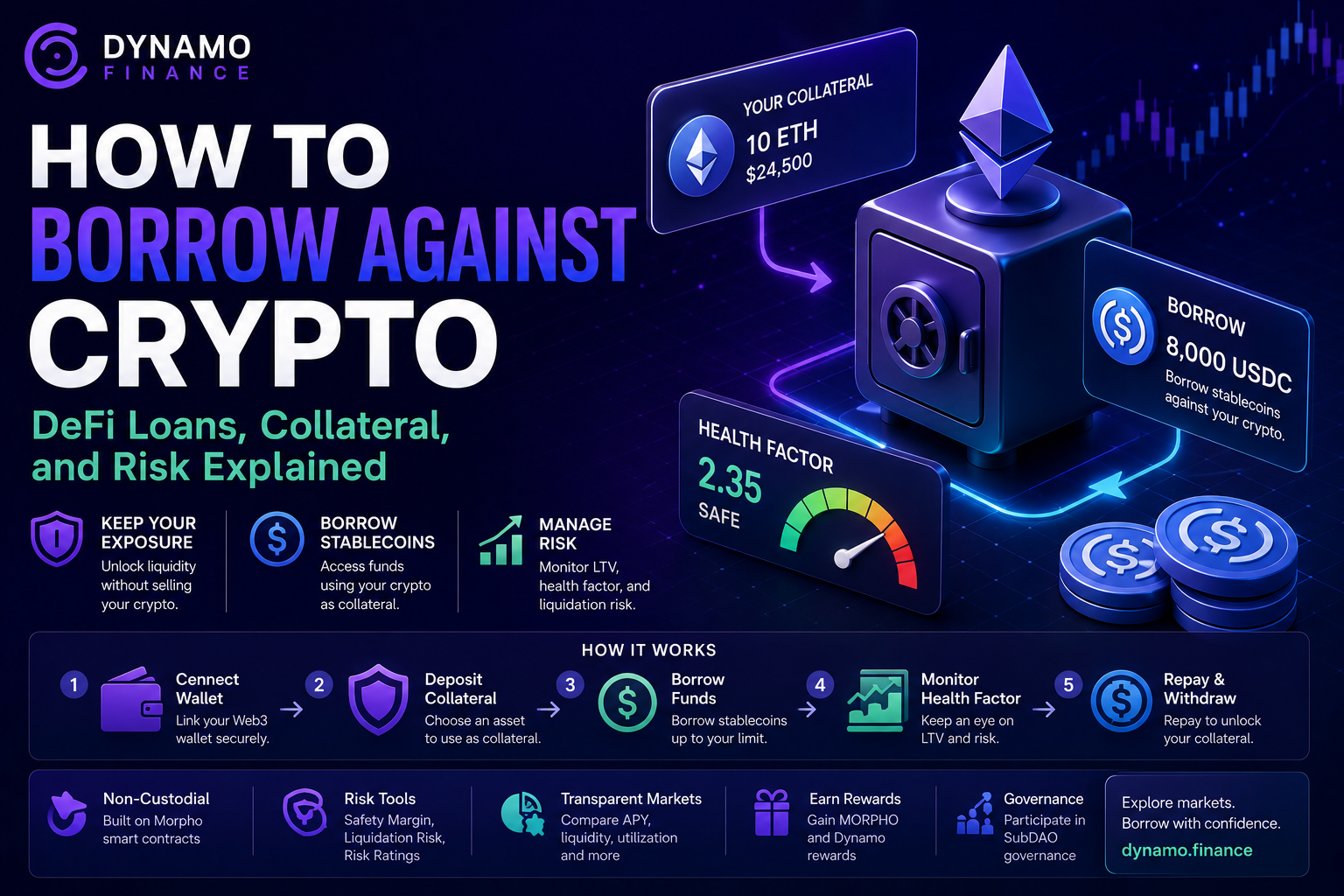
Crypto borrowing allows users to unlock liquidity from their assets. Instead of selling ETH, BTC, or another crypto asset, a borrower posts collateral and borrows a loan asset, often a stablecoin.
This is the core appeal of crypto-backed loans. A long-term ETH holder may need USDC liquidity but may not want to sell ETH and lose market exposure. By borrowing against crypto, the user can access liquidity while still holding the collateral asset.
The trade-off is liquidation risk. If the collateral asset falls in value, the loan becomes riskier. If the position crosses the liquidation threshold, a liquidator can repay part of the debt and receive a portion of the collateral. Liquidations are enforced automatically by smart contracts when a position becomes undercollateralized.
Bitcoin Loans and Ethereum Loans
Bitcoin loans usually refer to borrowing against BTC or wrapped BTC collateral. Ethereum loans usually refer to borrowing against ETH or WETH collateral. These strategies can be useful for holders who want liquidity but do not want to sell long-term positions.
The practical risk is straightforward. If ETH or BTC falls sharply while a user has borrowed against it, the loan-to-value ratio falls. A conservative borrower avoids using the maximum possible borrow amount and keeps enough buffer to survive volatility.
Dynamo’s Safety Margin feature is designed for this type of discipline. Safety Margin is a synthetic LTV that lets borrowers operate more conservatively than Morpho’s LLTV by reducing the amount borrowed relative to collateral.
Where Dynamo Finance Fits Into DeFi Lending
Dynamo Finance is built for users who want to participate in DeFi lending and borrowing through a non-custodial interface. Dynamo is permissionless and built on Morpho’s smart contracts, with tools for supplying assets, borrowing against collateral, depositing into curated vaults, and managing positions.
For lenders, Dynamo offers direct market access and vault access. For borrowers, it provides crypto borrowing against supported collateral with visible position data, and for risk-conscious users, Dynamo adds features such as Risk Rating, Safety Margin, Liquidation Risk views, and a risk dashboard.
This matters because crypto lending is not just about APY. Users need to understand where yield comes from, what collateral backs loans, how liquidations work, how much liquidity is available, whether markets are verified, and what fees apply.
Readers ready to explore can start at Dynamo’s get started page. Users who want to understand the underlying documentation can review Dynamo documentation.
Dynamo Markets vs Dynamo Vaults
Dynamo markets and Dynamo vaults serve different types of crypto lending users. Neither is automatically better. The right choice depends on how much control, automation, and market selection a user wants.
Dynamo Markets
A Dynamo market is an isolated lending pool. Each market has one loan asset, one collateral asset, one oracle, and one Liquidation Loan-to-Value ratio. Activity in one market does not spill over into another market.
This structure is useful for users who want direct control. A lender can choose a specific market based on supply APY, utilization, available liquidity, total supply, total borrow, and collateral quality. A borrower can review borrow APY, collateral requirements, LLTV, liquidation risk, and health factor before opening a loan.
Markets can be permissionlessly created, and users should only interact with verified markets. Verified markets are reviewed for factors such as oracle reliability, collateral parameters, and contract integrity before being added to the website.
Dynamo Vaults
A Dynamo vault is a managed strategy built on the MetaMorpho standard. Instead of choosing one market manually, a user deposits into a vault, receives vault shares, and the vault’s curator allocates liquidity across selected Morpho markets.
Vaults can be useful for users seeking passive income with crypto who do not want to manually rebalance between markets. Vault APY is a blended rate across the vault’s market allocations and can fluctuate as market conditions change.
Vault users should still perform due diligence. Before depositing, review the curator, underlying asset, APY, TVL, market allocation, risk tiers, performance fee, management fee, and liquidity conditions. There is no lock-up period for vault deposits, but withdrawals remain subject to available liquidity in the underlying markets.
Dynamo Finance vs Traditional Lending, CeFi Lending, and Other DeFi Approaches
| Option | How It Works | Best For | Main Trade-Off |
|---|---|---|---|
| Dynamo Finance | Non-custodial access to Morpho-based markets, MetaMorpho vaults, borrowing tools, and risk analytics. | DeFi users who want market choice, vault strategies, and visible risk controls. | Users remain responsible for wallet security, collateral monitoring, transaction approvals, and DeFi risk. |
| Traditional Lending | A bank or lender evaluates credit, manages accounts, and issues loans through centralized infrastructure. | Users who want regulated fiat products, customer support, and familiar financial processes. | Access may require credit checks, identity checks, approval delays, and custodial intermediaries. |
| CeFi Crypto Lending | A centralized company manages custody, loan operations, rates, and counterparty relationships. | Users who prefer a centralized account model and do not want to manage DeFi transactions. | Users take platform, custody, withdrawal, and balance-sheet risk. |
| Generic DeFi Lending | Users interact with smart contracts or protocol interfaces to supply and borrow crypto assets. | Experienced on-chain users who can assess protocol, oracle, liquidity, and collateral risk. | Risk tools, market curation, interface quality, and asset coverage vary widely by platform. |
Crypto Lending vs Staking
Crypto lending and staking are often grouped together because both can generate yield. They are not the same strategy.
Staking usually supports a proof-of-stake blockchain’s security or validation process. Users earn staking rewards for helping secure a network directly or through a validator, liquid staking protocol, or staking service.
Crypto lending earns yield from borrowers. A lender supplies assets to a lending market, and borrowers pay interest to use that liquidity. The lender’s return depends on utilization, borrower demand, fees, incentives, and market risk.
The risk profiles are different. Staking can involve validator risk, slashing risk, lockups, unstaking delays, and protocol-specific rules. Lending involves borrower demand, collateral quality, utilization, liquidity, smart contracts, oracle reliability, and liquidation design.
For yield seekers, the question is not simply “crypto lending vs staking: which is better?” The better question is which risk profile matches the asset, time horizon, liquidity needs, and user skill level.
Risks and Considerations
Crypto lending can be useful, but it is not risk-free. The best crypto lending platforms are not simply the ones showing the highest APY. They are the ones that make risks visible and help users make informed decisions.
Smart Contract Risk
DeFi lending relies on smart contracts. If a contract has a vulnerability, users can lose funds. Audits can reduce risk, but they do not eliminate it.
Market Risk
Crypto collateral can move quickly. If a borrower posts ETH, BTC, or another volatile asset and the market falls, the loan-to-value ratio falls. A position that looked conservative can become risky during a sharp sell-off.
Borrowers should avoid using their maximum borrow capacity. Keeping a lower LTV, adding collateral early, or repaying debt can reduce liquidation risk.
Liquidity Risk
Lenders should review utilization and available liquidity before depositing. A market with high utilization may pay better supply APY, but it can also mean less liquidity is immediately available for withdrawals.
Vaults can also face liquidity constraints. Vault withdrawals are available as long as liquidity exists in the underlying markets. If utilization is very high, a withdrawal delay may occur until liquidity frees up.
Oracle and Liquidation Risk
Lending markets rely on price data to value collateral. Oracle reliability matters because inaccurate or delayed pricing can affect borrowing power and liquidation outcomes.
Dynamo’s Liquidation Risk view is designed to show current health factor, price drop tolerance, and liquidation price for open borrow positions. This helps borrowers understand how much collateral price movement their position can absorb before becoming liquidatable.
User Responsibility
Non-custodial DeFi gives users control, but control comes with responsibility. Users must secure their wallets, verify URLs, understand approvals, monitor collateral, and know that blockchain transactions are generally final.
For broader investor education, FINRA’s crypto asset overview and the Investor.gov bulletin on crypto asset interest-bearing accounts are useful reminders that crypto yield products are not the same as insured bank deposits.
Risk Management Best Practices
- Start with a small position before depositing significant capital.
- Check whether a market is verified before interacting with it.
- Review supply APY, borrow APY, utilization, available liquidity, collateral, oracle, and LLTV.
- For borrowing, keep a conservative buffer and avoid borrowing near the liquidation threshold.
- For vaults, review curator reputation, APY stability, market allocation, fees, and liquidity.
- Use risk tools such as Dynamo’s Risk Rating, Safety Margin, Liquidation Risk views, and Risk Dashboard.
How to Evaluate Crypto Lending Platforms
Many users search for the best crypto lending platforms, but the better question is “best for which use case?” A stablecoin lender, an ETH borrower, and a DeFi yield strategist are not looking for the same thing.
A stablecoin lender may care most about net APY, liquidity, smart contract risk, and withdrawal flexibility. A borrower may care more about borrow APY, collateral requirements, liquidation thresholds, and how easily they can add collateral or repay. A DeFi-native user may care about isolated markets, transparent risk data, and vault curation.
Before using any crypto lending platform, ask these questions:
- Is the platform custodial or non-custodial?
- Where are user funds held?
- Are rates fixed or variable?
- How are crypto lending rates calculated?
- Which loan assets and collateral assets are supported?
- What fees apply to market deposits, vault strategies, withdrawals, borrowing, and gas?
- How transparent are liquidity, utilization, liquidation risk, and market parameters?
- What happens during high volatility or high utilization?
For Dynamo users, this evaluation usually starts with choosing between a direct market and a vault. Markets provide more control. Vaults provide more automation. Both require users to understand risk before depositing.
How to Get Started With Crypto Lending on Dynamo Finance
Dynamo’s workflow is built around a Web3 wallet. Users can browse markets and vaults, compare live opportunities, and decide whether they want to supply assets, borrow against collateral, or deposit into a vault strategy.
- Visit Dynamo Finance and connect a supported Web3 wallet.
- Review Dynamo markets if you want to supply or borrow in a specific isolated lending market.
- Review Dynamo vaults if you want a curator-managed lending strategy.
- Check APY, utilization, available liquidity, collateral asset, loan asset, oracle, LLTV, fees, and risk indicators.
- Approve the required token transaction and sign the deposit or borrow transaction in your wallet.
- Monitor supplied assets, borrows, vault deposits, and health factor from the Dynamo dashboard.
Beginners may prefer to start by observing live markets before making a deposit. Watch how utilization affects supply APY and borrow APY. Review how vault allocations differ from direct market deposits. Learn how liquidation risk is displayed before opening a borrow position.
Is Crypto Lending Worth It in 2026?
Crypto lending can be worth considering for users who understand the mechanics and accept the risks. It can help lenders earn interest on crypto, help borrowers access liquidity, and help DeFi investors deploy capital into transparent on-chain markets.
It is not suitable for users who need guaranteed returns, insured deposits, fixed rates, or hands-off risk management. Even conservative DeFi lending requires monitoring, especially when borrowing against volatile collateral.
In 2026, the strongest case for DeFi lending is not just yield. It is transparency, composability, and user control. Platforms such as Dynamo Finance are useful because they bring together market access, vault strategies, borrowing tools, and risk visibility in one interface.
Conclusion
Crypto lending is one of the most practical use cases in DeFi. It connects lenders who want yield with borrowers who want liquidity, using collateral, variable interest rates, smart contracts, and transparent market data.
The opportunity is real, but the risks are real as well. Smart contract vulnerabilities, market volatility, liquidity constraints, oracle issues, fees, and liquidation mechanics can all affect results. The right approach is not to chase the highest APY. It is to understand how the market works, choose the right risk level, and monitor your position.
Dynamo Finance gives users a non-custodial way to explore crypto lending, DeFi borrowing, crypto-backed loans, stablecoin lending, markets, vaults, and risk tools. To compare live opportunities, visit Dynamo Finance as it is based on Morpho.
FAQ
What is crypto lending for beginners?
Crypto lending is the process of supplying digital assets to a lending market so borrowers can take out a crypto loan and pay interest. Beginners should understand collateral, utilization, APY, liquidity, smart contract risk, and liquidation risk before depositing funds.
How does borrowing against crypto work?
Borrowing against crypto means depositing a crypto asset as collateral and borrowing another asset against it. If the collateral value falls too much, the position may become eligible for liquidation, so borrowers should keep a conservative buffer.
Is DeFi lending safer than CeFi lending?
DeFi lending and CeFi lending have different risks. DeFi lending can be more transparent and non-custodial, but it adds smart contract, oracle, wallet, and liquidation risks. CeFi lending may feel simpler, but users rely on a centralized company for custody, withdrawals, and risk management.
What is the difference between crypto lending and staking?
Crypto lending earns yield from borrowers who pay interest to use supplied liquidity. Staking earns rewards for helping secure a proof-of-stake network. Lending risk depends on markets, collateral, utilization, and liquidations, while staking risk depends on validator performance, lockups, slashing rules, and protocol design.
Can I get Bitcoin loans or Ethereum loans without selling my crypto?
Yes, crypto-backed loans can allow users to borrow against BTC, wrapped BTC, ETH, WETH, or other supported collateral without immediately selling. Availability depends on the specific market and platform. Borrowers should always check live collateral rules, borrow APY, liquidity, LLTV, and liquidation thresholds before opening a loan.