
Morpho has become one of the most important lending infrastructure layers in DeFi because it changes how users think about on-chain lending. Instead of relying only on large pooled markets where many assets share risk, Morpho uses isolated lending markets and curated vaults to give suppliers, borrowers, and vault curators more control.
That control is powerful, but it can also be confusing. New users often search for a guide to Morpho because they want to understand the difference between Morpho Markets, Morpho Vaults, Morpho Blue, MetaMorpho, vault curators, LLTV, APY, liquidation risk, and yield strategies before depositing funds.
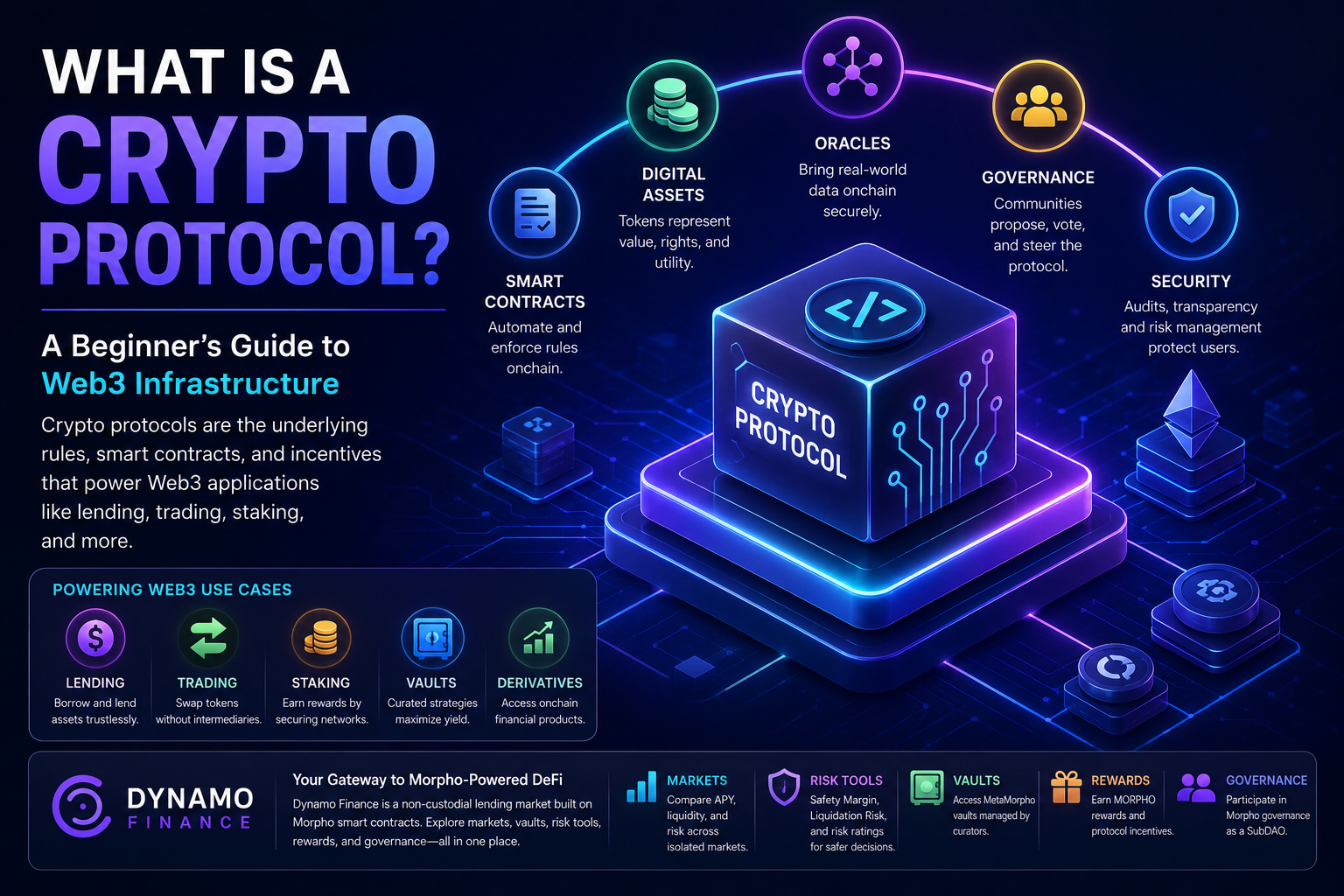
Morpho is a permissionless DeFi lending protocol that lets users supply assets, borrow against collateral, and access curated vault strategies built on top of isolated lending markets. In simple terms, Morpho separates lending infrastructure from lending strategy: markets define where borrowing and lending happen, while vaults help allocate capital across those markets.
This article breaks down how Morpho works, how Morpho vaults generate yield, how Morpho markets manage risk, how Morpho compares with Aave and Compound, and how Dynamo Finance helps users access Morpho-based markets and vaults through a non-custodial DeFi interface. For readers looking for a practical guide to Morpho, the goal is not to chase the highest APY. The goal is to understand the engine before using it.
Key Takeaways
- Morpho is a DeFi lending protocol built around isolated markets, where each market has its own crypto loan asset, collateral asset, oracle, interest rate model, and LLTV.
- Morpho Markets are best for users who want direct control over exactly where they supply or borrow.
- Morpho Vaults are curated strategies that allocate deposits across multiple Morpho markets to pursue risk-adjusted yield.
- Morpho yield usually comes from borrower interest, utilization-based lending rates, vault allocation strategy, and sometimes additional reward incentives.
- Dynamo Finance gives users a non-custodial way to explore Morpho lending, Morpho borrowing, vault strategies, market data, risk ratings, safety margin tools, and position management.
What Is Morpho?
Morpho is a decentralized lending protocol that provides on-chain infrastructure for lending and borrowing crypto assets. Users can supply assets to earn yield, post collateral, borrow supported assets, or deposit into vaults that allocate liquidity across lending markets.
The core idea behind Morpho is modularity. Morpho markets define specific lending relationships. Vaults sit above those markets and package allocation strategies for depositors who do not want to manage each market manually.
This matters because DeFi lending is not one single product. A user supplying USDC against ETH collateral has a different risk profile than a user supplying WBTC into a market backed by a newer collateral asset. Morpho’s design makes those differences more explicit by isolating each market.
For beginners, the simplest way to understand Morpho is to separate it into two layers:
- Morpho Markets: the base lending markets where supply, borrow, repay, withdraw, and liquidation actions happen.
- Morpho Vaults: curated strategies that pool deposits and allocate across selected markets.
Morpho’s own learning materials describe market creation as permissionless and built around isolated market parameters, including loan token, collateral token, oracle, interest rate model, and LLTV. Users who want the technical source can review the official Morpho market documentation.
Why Morpho Matters in DeFi Lending
DeFi lending protocols have historically leaned toward pooled liquidity. In a pooled model, many assets often sit inside a shared system, and risk can be connected across the broader protocol. This structure can be convenient, but it may reduce precision for users who want to choose a specific asset pair and risk profile.
Morpho takes a different approach. It emphasizes isolated markets, where each market has a specific loan asset, collateral asset, oracle, interest rate model, and liquidation loan-to-value. That makes each market easier to evaluate on its own terms.
This is useful for suppliers because they can look at a market and ask, “What asset am I lending, what collateral backs borrowers, what oracle prices collateral, what utilization drives rates, and what liquidation threshold applies?” It is also useful for borrowers because they can see the exact market conditions that govern their position.
For vault users, Morpho’s architecture creates a different benefit. Curators can build vaults that allocate across selected markets. Instead of forcing every depositor to choose one market manually, a vault can manage market selection and allocation strategy on behalf of depositors.
This separation between markets and vaults is one reason Morpho has become a major topic for yield seekers. It creates room for both direct market participation and curated Morpho yield strategies.
How Morpho Works
Morpho works by connecting suppliers and borrowers through smart contracts. Suppliers deposit a loan asset into a specific market. Borrowers deposit collateral into that market and borrow the loan asset up to the limit allowed by the market’s LLTV.
The process can be summarized in a few steps:
- A market is created with a loan asset, collateral asset, oracle, interest rate model, and LLTV.
- Suppliers deposit the loan asset into that market to earn interest.
- Borrowers deposit collateral and borrow the loan asset against it.
- Interest accrues based on utilization and the market’s interest rate model.
- If a borrower’s position exceeds the liquidation threshold, liquidators can repay debt and receive collateral at a discount.
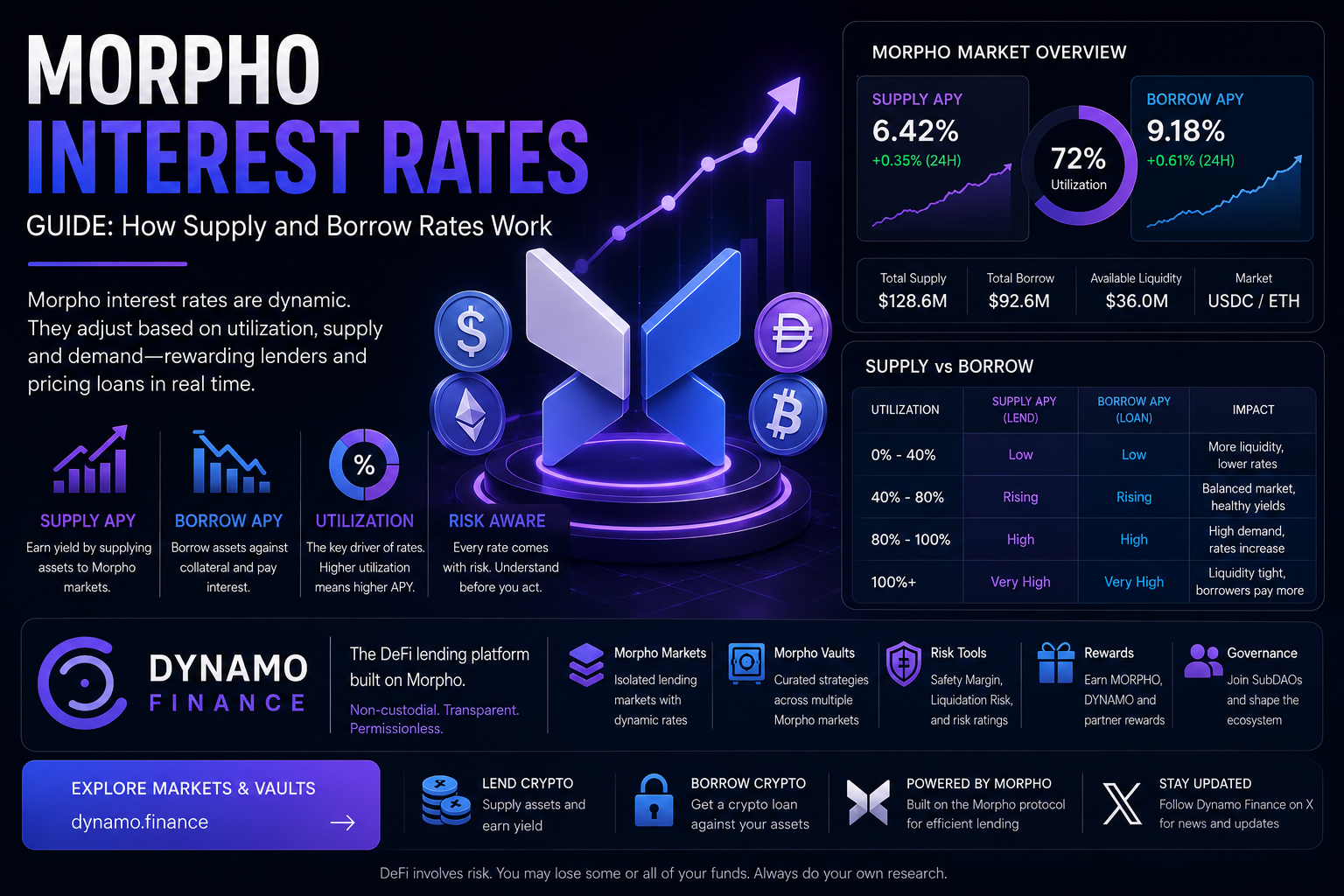
The critical concept is utilization. Utilization measures how much supplied liquidity is currently borrowed. If a market has 10 million USDC supplied and 7 million USDC borrowed, utilization is 70%.
When utilization rises, borrowing becomes more expensive because available liquidity is scarcer. When utilization falls, borrowing becomes cheaper because more liquidity is sitting unused. Supply APY usually follows borrower demand because suppliers earn the interest borrowers pay.
This is why Morpho APY and APR can change over time. A market with strong borrow demand may offer higher supplier yield, but high utilization can also reduce available liquidity for withdrawals. A market with low utilization may offer lower yield, but it may be easier to exit quickly.
Morpho Markets Explained
Morpho Markets are isolated lending pools. Each market is defined by a unique combination of parameters, including the loan asset, collateral asset, oracle, interest rate model, and LLTV.
A Morpho market is not simply “the ETH market” or “the USDC market.” A market is more specific. For example, a market may involve one loan asset such as USDC and one collateral asset such as WETH. Another market may also use USDC as the loan asset but have a different collateral asset, oracle, or LLTV.
This structure is important for risk management. If one market has a bad collateral asset, weak liquidity, or oracle issue, the problem is isolated to that market rather than automatically spreading across every other market.
The Main Parts of a Morpho Market
Every Morpho market should be evaluated by its underlying parameters. Beginners often focus only on APY, but APY is only one part of the decision.
- Loan asset: the asset suppliers deposit and borrowers receive.
- Collateral asset: the asset borrowers post to secure their loan.
- Oracle: the on-chain price source used to value collateral against the loan asset.
- IRM: the interest rate model that adjusts borrow and supply rates based on utilization.
- LLTV: the liquidation loan-to-value ratio that determines when a borrow position can be liquidated.
- Utilization: the share of supplied liquidity currently borrowed.
- Available liquidity: the amount suppliers can withdraw or borrowers can still access.
Lenders supply loan assets to earn interest, borrowers supply collateral to borrow loan assets, withdrawals require available liquidity, and liquidations can occur if a borrower’s position exceeds the LLTV. These core actions are the foundation of Morpho lending and borrowing.
Why Isolated Markets Matter
In a pooled lending system, risks may be shared across a broader protocol. In an isolated market structure, risk is easier to segment. Each market stands on its own.
This makes Morpho useful for users who want precision. A supplier can choose a specific asset pair. A borrower can choose a market with collateral and LLTV that match their risk tolerance. A vault curator can build a strategy around selected markets rather than accepting one protocol-wide risk basket.
The trade-off is that users must do more homework. Isolated markets provide more control, but they also require users to understand each market’s parameters. A high APY can be attractive, but it may reflect higher utilization, riskier collateral, lower liquidity, or newer market history.
Morpho Borrowing Explained
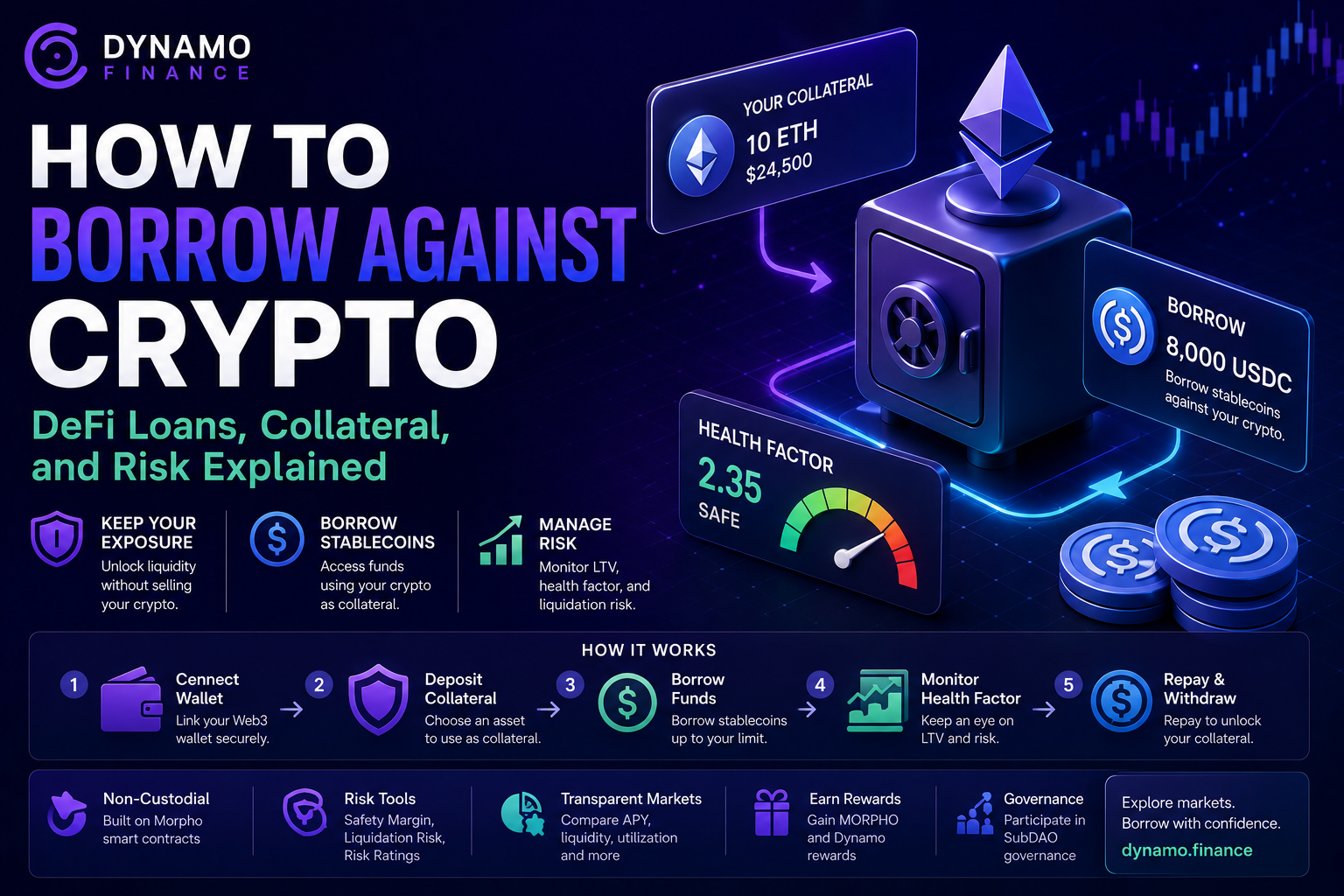
Morpho borrowing allows users to post collateral and borrow another asset. A common example is borrowing stablecoins against ETH, WBTC, or another crypto asset. The borrower keeps exposure to the collateral while accessing liquidity from the loan asset pool.
The key number for borrowers is loan-to-value. If a user posts $10,000 of collateral and borrows $5,000, the position has a 50% LTV. The LLTV is the threshold at which the position becomes liquidatable. If collateral falls in value or debt grows through interest, the position can move closer to liquidation.
Borrowers should not treat the maximum borrow amount as a target. A position close to LLTV has less room to absorb price moves, borrow rate spikes, or oracle updates. Conservative borrowers leave a buffer and actively monitor health factor.
Morpho Vaults Explained
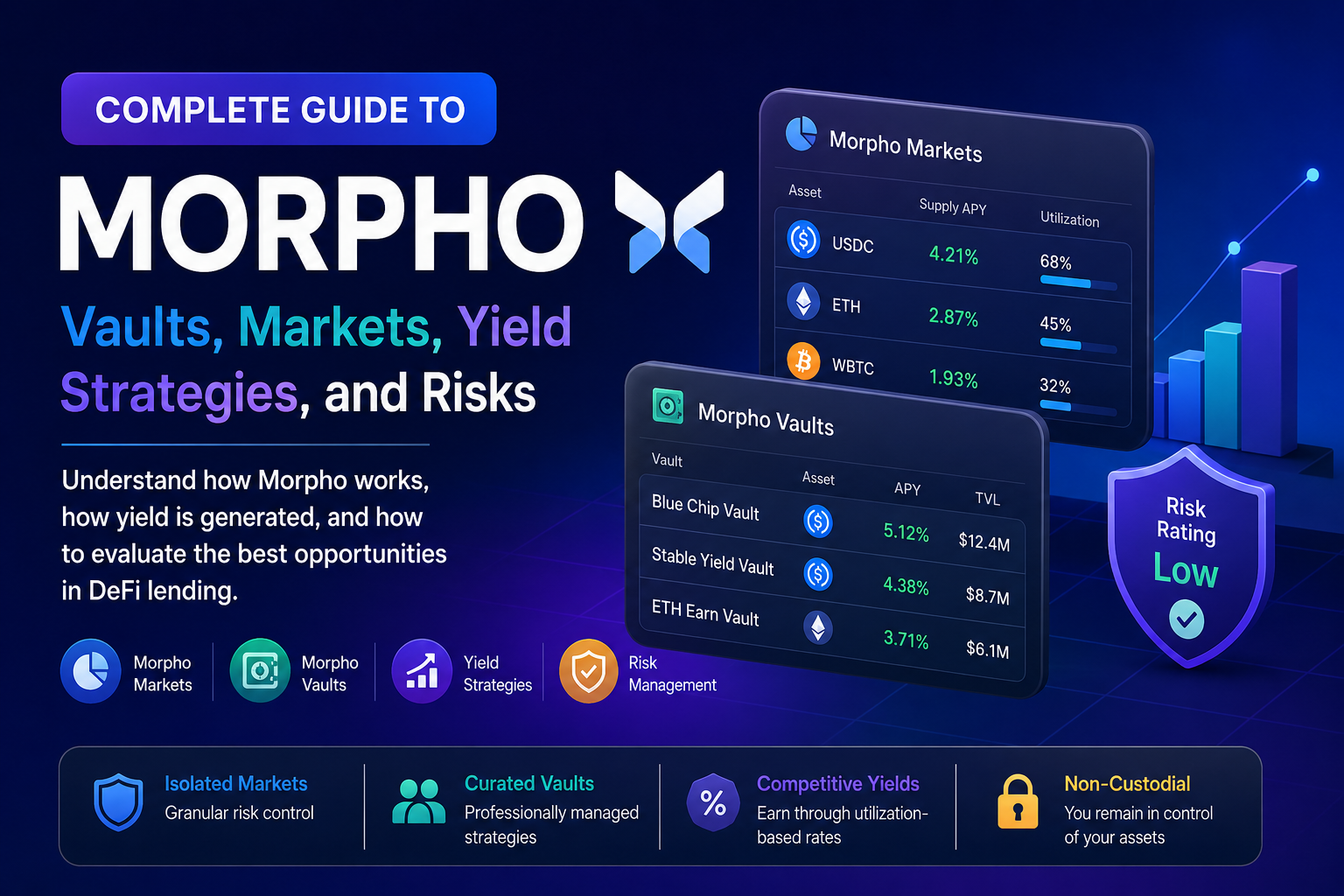
Morpho Vaults are curated strategies built on top of Morpho markets. Instead of asking every user to choose one market manually, a vault pools deposits and allocates capital across selected markets.
Vaults are designed for users who want exposure to Morpho lending without managing every allocation themselves. A depositor chooses a vault, deposits the vault’s underlying asset, receives vault shares, and earns a blended return based on the vault’s allocations.
Dynamo’s vault experience is built around the MetaMorpho standard. Vaults hold depositor assets in smart contracts, not with Dynamo or the curator. Curators manage strategy decisions, such as which markets to allocate to, how much exposure to assign, and when to rebalance.
How Morpho Vaults Work
A Morpho vault starts with an underlying asset, such as a stablecoin or crypto asset. Depositors provide that asset to the vault. The vault then allocates the pooled capital across Morpho markets selected by the curator.
The yield flows from underlying markets back into the vault. Borrowers pay interest in the markets where the vault has supplied capital. That interest increases the value of the vault over time. Depositors own vault shares that represent their proportional claim on the vault.
Vault APY is therefore a blended rate. It reflects the combined performance of the underlying markets, minus applicable vault fees. It can change as market utilization changes, borrowers repay, new suppliers enter, or the curator adjusts allocation.
Why Vaults Appeal to Yield Seekers
Vaults appeal to users who want Morpho passive income without manually tracking every market. If a stablecoin market’s APY falls because utilization drops, a curator may move capital toward another market with better risk-adjusted yield. If a market becomes too concentrated or too risky, the curator may reduce allocation.
This can make vaults more convenient than direct market deposits. However, convenience does not remove risk. Vault depositors take curator risk in addition to the underlying market risks. A curator may choose markets that become less attractive, too concentrated, or more risky than expected.
The strongest vault users evaluate both the vault and the markets beneath it. They do not deposit only because the APY looks high.
Morpho Blue vs MetaMorpho
Morpho Blue and MetaMorpho are closely related, but they are not the same thing.
Morpho Blue is the core lending primitive. It defines isolated markets and handles the base actions of supplying, borrowing, repaying, withdrawing, and liquidating. If markets are the engine of Morpho lending, Morpho Blue is the engine block.
MetaMorpho is the vault layer built on top of Morpho Blue. It gives curators a way to create vaults that allocate deposits across multiple Morpho markets. If Morpho Blue is the base market infrastructure, MetaMorpho is the strategy layer that packages those markets for depositors.
| Category | Morpho Blue | MetaMorpho |
|---|---|---|
| Primary role | Core lending market infrastructure. | Vault layer for curated lending strategies. |
| User action | Supply, borrow, repay, withdraw, or manage a specific market. | Deposit into a vault and receive vault shares. |
| Risk model | Risk is evaluated at the individual market level. | Risk depends on vault curator decisions and underlying market allocations. |
| Best for | Users who want precise control over market selection. | Users who prefer curated allocation and automated strategy management. |
| Yield source | Borrower interest in a specific lending market. | Blended yield from multiple underlying markets. |
Morpho Vault V2 expands this vault design with more flexible yield routing, real-time asset reporting, granular cap systems, role separation, and liquidity controls. Users who want the protocol-level details can review the official Morpho Vault V2 documentation.
Where Morpho Yield Comes From
Morpho yield is not created out of nowhere. It typically comes from borrowers who pay interest to use supplied liquidity. When a user supplies an asset to a Morpho market, borrowers can draw from that liquidity after posting collateral. The borrower pays interest, and suppliers earn yield.
In a vault, the same mechanism applies, but the vault may allocate across several markets. The vault’s APY reflects the blended yield from those markets. If one market has high utilization and another has moderate utilization, the vault’s yield will reflect its allocation to each.
Morpho yield can also include rewards or incentive campaigns, depending on the interface, market, vault, network, and campaign status. Users should separate base lending yield from temporary incentive yield. Base yield comes from borrower interest. Incentive yield may depend on rewards that can change or end.
When evaluating Morpho APY, ask these questions:
- Is the yield coming from borrower interest, rewards, or both?
- Is the APY net of vault fees?
- How much liquidity is available for withdrawals?
- How concentrated is the vault in one market?
- What collateral assets back the borrowers?
- How stable has utilization been over time?
These questions matter because a high APY may not be a better opportunity. It may simply be compensation for taking more liquidity, collateral, oracle, curator, or market risk.
Common Morpho Yield Strategies
Morpho yield strategies range from simple to advanced. The right strategy depends on the user’s risk tolerance, technical comfort, liquidity needs, and asset preference.
1. Direct Market Supply
The simplest Morpho lending strategy is direct market supply. A user chooses one market and supplies the loan asset. The user earns interest paid by borrowers in that market.
This strategy gives maximum clarity. You know the exact collateral asset, oracle, LLTV, utilization, and available liquidity. It is best for users who want to evaluate market risk themselves.
The downside is that the user must monitor the market. If utilization falls, APY may drop. If utilization rises too high, withdrawal liquidity may become constrained. If a better market appears, the user must move capital manually.
Unfortunately, Morpho.org does not allow this by default, in order to access direct market deposit please visit the Dynamo lending markets page.
2. Curated Vault Deposits
Curated vaults are designed for users who prefer a more passive experience. A user deposits into a vault, and the curator manages allocations across markets.
This strategy can help users avoid constant manual rebalancing. It is especially useful for stablecoin yield seekers who want exposure to multiple lending markets through one vault position.
The trade-off is curator risk. The depositor depends on the curator’s market selection, risk framework, rebalancing discipline, and fee structure.
3. Stablecoin Yield Strategies
Morpho stablecoin yield strategies typically involve supplying assets such as USDC, USDT, or DAI into lending markets or vaults. Borrowers may use volatile collateral to borrow stablecoin liquidity, and suppliers earn interest.
Stablecoin yield can feel lower-volatility because the supplied asset aims to track the dollar. That does not make it risk-free. Stablecoin depeg risk, smart contract risk, liquidity risk, oracle risk, and collateral risk still apply.
For beginners, stablecoin vaults or established stablecoin markets may be easier to understand than more complex leveraged strategies. Even then, users should check the underlying market exposure and withdrawal liquidity before depositing.
4. ETH and WBTC Lending
Morpho ETH lending and Morpho WBTC lending can appeal to holders who want yield while maintaining exposure to major crypto assets. Instead of selling ETH or WBTC, users may supply those assets into lending markets or vaults where borrower demand exists.
The trade-off is asset-specific risk. ETH and WBTC are volatile compared with stablecoins. If the supplied asset changes in price, the user’s portfolio value changes even if the lending position earns yield.
5. Borrowing Against Crypto
Morpho borrowing against crypto lets users post collateral and borrow another asset. A user might post ETH and borrow USDC, then use the USDC elsewhere. This can preserve exposure to ETH while unlocking liquidity.
This strategy requires active risk management. Borrowers must monitor LTV, health factor, borrow APY, collateral price, and liquidation risk. A falling collateral price or rising borrow rate can push a position closer to liquidation.
6. Leveraged Yield and Looping
Advanced users sometimes borrow, redeposit, and repeat the process to increase exposure. This is often called looping or leveraged yield.
Looping can increase returns when conditions are favorable, but it can also increase liquidation risk, rate risk, gas costs, and position complexity. Beginners should avoid leveraged strategies until they fully understand plain lending, borrowing, and vault mechanics.
Best Morpho Vaults: How to Evaluate Them
Many users search for the best Morpho vaults, but the best vault depends on the user. A vault with the highest APY may not be best if the yield comes from thin liquidity, concentrated exposure, aggressive collateral, or temporary incentives.
Use a risk-first framework instead of an APY-first framework.
Evaluate the Curator
A vault curator chooses market allocations and manages risk parameters. Review who the curator is, how transparent the strategy is, and whether the vault has a meaningful track record.
Curator quality matters because a vault depositor is outsourcing market selection. A strong curator can improve allocation discipline. A weak or inactive curator can create unnecessary exposure.
Review Market Allocation
Look at where the vault actually deploys assets. A vault concentrated in one market behaves differently from a vault spread across several markets.
Concentration can be acceptable if the underlying market is strong, liquid, and well understood. But users should know when they are effectively taking one-market risk through a vault that appears diversified at first glance.
Compare APY Stability
Do not evaluate a vault only by today’s APY. Consider whether the yield has been stable, whether it depends on temporary rewards, and whether utilization in the underlying markets is sustainable.
A lower but more stable APY may be preferable to a high APY that disappears when incentives end or when borrowers repay.
Check Liquidity
Vault withdrawals depend on available liquidity in the underlying markets. If too much vault capital is deployed into highly utilized markets, withdrawals may take longer or require liquidity to free up.
Liquidity is especially important for users who may need to exit quickly. A vault with slightly lower yield and stronger liquidity can be more useful than a higher-yielding vault with tight withdrawal conditions.
Understand Fees
Morpho vaults and Morpho-based vault interfaces may include performance fees, management fees, or other costs depending on the curator and platform. Fees reduce net returns.
On Dynamo, vault fees can include performance fees taken from yield and management fees accrued against assets under management. Fee rates vary by vault and curator, so the vault detail page should be reviewed before depositing.
Morpho Markets vs Morpho Vaults
Morpho Markets and Morpho Vaults solve different problems. Markets give users precision. Vaults give users convenience and curated allocation.
| Feature | Morpho Markets | Morpho Vaults |
|---|---|---|
| Control | High. You choose the exact market. | Medium. The curator manages allocation. |
| Complexity | Higher. You must evaluate market parameters yourself. | Lower. The vault packages multiple markets into one position. |
| Yield | Based on one market’s utilization and borrower demand. | Blended across the vault’s allocations. |
| Risk | Specific to the selected market. | Depends on the curator and underlying markets. |
| Best for | Advanced users who want full control. | Users who want curated Morpho yield strategies. |
A user who wants to supply USDC into one specific market may prefer direct market supply. A user who wants passive exposure to a stablecoin strategy may prefer a vault. A borrower who wants to post collateral and draw liquidity will interact with markets directly.
The best approach is not universal. It depends on whether the user values control, simplicity, liquidity, APY, or risk diversification most.
Morpho vs Aave vs Compound
Morpho is often compared with Aave and Compound because all three are major DeFi lending protocols. The comparison is useful, but users should understand that the designs differ.
Aave is a large DeFi liquidity protocol with lending, borrowing, collateral, risk parameters, and broader protocol-level markets. Compound is another foundational lending protocol with its own market and governance design. Morpho focuses on isolated markets and vault-based curation.
Users can review the official Aave documentation and Compound documentation for protocol-specific mechanics. The most important difference for this article is that Morpho gives users and curators a more granular market architecture.
| Protocol | Core Design | Strength | Trade-Off |
|---|---|---|---|
| Morpho | Isolated markets plus curated vaults. | Granular risk selection, permissionless market creation, and vault curation. | Users must understand market-specific parameters and curator decisions. |
| Aave | Large lending protocol with established pooled liquidity markets. | Deep liquidity, broad ecosystem presence, and mature risk framework. | Risk structure differs from isolated Morpho markets. |
| Compound | Foundational DeFi lending protocol with money market design. | Long-standing protocol history and simple lend/borrow model. | Less focused on the isolated market plus vault-curator model. |
Morpho is not automatically better for every user. Aave may be preferable for users who prioritize deep established liquidity in certain markets. Compound may appeal to users who prefer a familiar DeFi lending model. Morpho may appeal to users who want more precise market selection or curated vault strategies.
How Dynamo Finance Helps Users Access Morpho
Dynamo Finance is a non-custodial, permissionless Web3 lending interface built on Morpho’s smart contracts. It is designed to help users supply assets, borrow against collateral, deposit into vaults, manage positions, and evaluate risk from one interface.
Dynamo does not custody user funds. Positions interact with Morpho’s on-chain contracts. This is important because users remain in control of their wallets and can verify that markets and vaults are part of Morpho’s lending infrastructure.
Where Dynamo adds value is the user experience around Morpho. It brings markets, vaults, risk data, position tracking, and governance-related tooling into a more approachable interface.
Direct Market Access
Dynamo lets users review and deposit into individual Morpho markets through the markets page. This is useful for users who want to supply a loan asset directly into a specific market instead of using a vault.
Market-level data helps users compare supply APY, borrow APY, utilization, available liquidity, collateral asset, loan asset, oracle, and LLTV. That makes the platform useful for users who want a more hands-on Morpho lending experience.
Vault Access
The vaults page helps users compare curated MetaMorpho vaults. A vault can be useful for users who want exposure to Morpho yield strategies but do not want to manually rebalance between markets.
Vault users should still review the underlying asset, curator, APY, TVL, market allocation, liquidity, and fees. Vaults simplify market selection, but they do not eliminate market risk.
Risk Tools
Dynamo’s risk dashboard and risk tooling help users think beyond APY. Risk Rating assigns Low, Medium, and High tiers to markets and vaults based on objective on-chain parameters. Safety Margin helps borrowers operate more conservatively than the underlying LLTV. Liquidation Risk views show health factor, price drop tolerance, and liquidation price for borrow positions.
These tools are useful because Morpho is precise but not beginner-proof. Users still need to understand market parameters, collateral risk, utilization, and liquidation mechanics before deploying capital.
Position Management
Dynamo’s workflow includes wallet connection, market or vault selection, token approval, deposit or borrow transactions, and dashboard monitoring. The get started page is the best place for new users to begin.
Users who want product and risk details can also read the Dynamo documentation or follow Dynamo Finance on X for updates.
Risks and Considerations
Morpho can be powerful, but every DeFi lending strategy carries risk. A risk-first user should evaluate smart contracts, markets, collateral, liquidity, oracles, vault curators, and user behavior before depositing funds.
Smart Contract Risk
Morpho and Dynamo rely on smart contracts. Even audited smart contracts can contain bugs or behave unexpectedly under extreme conditions. Users should never assume that a protocol is risk-free because it is popular or audited.
Smart contract risk can affect suppliers, borrowers, and vault depositors. If a vulnerability is exploited, losses may happen quickly and transactions may not be reversible.
Market Risk
Each Morpho market has its own risk profile. A market’s risk depends on the collateral asset, loan asset, oracle, LLTV, utilization, liquidity, and market history.
High APY can be a warning sign as much as an opportunity. It may reflect strong borrower demand, but it may also reflect tight liquidity, newer market conditions, aggressive parameters, or higher perceived risk.
Oracle Risk
Oracles provide price data for collateral and loan assets. If an oracle fails, is manipulated, or delivers stale prices, borrowers may be liquidated incorrectly or bad debt may occur.
Users should review the oracle tied to a market before supplying or borrowing. This is especially important in markets with less established collateral assets.
Liquidation Risk
Borrowers face liquidation when collateral value falls too far relative to debt. A health factor near 1.0 signals danger. Liquidation can occur through permissionless actors who repay debt and receive collateral at a discount.
Borrowers should maintain a conservative buffer, monitor positions, and understand how collateral price moves affect liquidation risk. Tools such as Safety Margin and Liquidation Risk views can help, but no tool removes the need to monitor positions.
Liquidity Risk
Suppliers can withdraw when liquidity is available. If utilization is high, much of the supplied liquidity may be borrowed. This can make immediate withdrawal harder.
Vault liquidity depends on the underlying markets. If a vault allocates heavily to high-utilization markets, withdrawals may be delayed until liquidity becomes available.
Curator Risk
Vault users depend on curators. A curator chooses markets, sets allocations, and manages strategy. Poor decisions, inactivity, or excessive concentration can hurt depositors.
This is why the “best Morpho vaults” should be evaluated by curator quality, risk controls, allocation transparency, fees, liquidity, and APY stability rather than yield alone.
Stablecoin and Asset Risk
Stablecoin yield is common on Morpho, but stablecoins can depeg. Crypto collateral can also fall sharply. Wrapped assets may introduce bridge, custodian, or issuer risk depending on the asset.
Users should understand every token involved in a market. A market is only as strong as its collateral, loan asset, oracle, and liquidation design.
User Responsibility
Non-custodial DeFi gives users control. It also gives users responsibility. Wallet security, phishing protection, transaction review, gas management, and position monitoring are all part of using Morpho safely.
Ethereum’s DeFi overview is a useful primer for users who want broader context on smart contracts, self-custody, and decentralized applications before interacting with lending protocols.
How to Get Started with Morpho Through Dynamo Finance
Users who want to access Morpho through Dynamo can follow a simple workflow. The exact markets, vaults, rates, and supported assets change over time, so always check live app data before signing a transaction.
- Visit Dynamo’s get started page and review the basic workflow.
- Connect a supported Web3 wallet and confirm you are on the correct network.
- Open the markets page if you want direct Morpho market exposure.
- Open the vaults page if you want a curator-managed Morpho yield strategy.
- Review supply APY, borrow APY, utilization, available liquidity, collateral, oracle, LLTV, risk rating, fees, and vault allocations.
- Start with a smaller position to understand approvals, gas, deposits, withdrawals, and dashboard tracking.
- Monitor your position over time, especially if you borrow against collateral.
A beginner who wants Morpho lending for beginners may start by observing markets before depositing. Watch how utilization affects APY. Compare a direct market with a vault. Review what collateral backs the lending activity. Then deploy capital only when the mechanics are clear.
An advanced user may compare multiple markets, evaluate risk tiers, monitor utilization trends, and choose between direct market supply and vault allocations. Borrowers should pay extra attention to health factor and liquidation price.
Practical Example: Choosing Between a Morpho Market and a Vault
Imagine a user holds USDC and wants to earn yield. They have two options: supply directly to a Morpho market or deposit into a Morpho vault.
If they supply directly to one market, they can inspect the collateral asset, oracle, LLTV, utilization, supply APY, borrow APY, total supply, total borrow, and available liquidity. This gives them clarity, but they must monitor that market themselves.
If they deposit into a vault, they receive exposure to a curator-managed allocation across markets. This may reduce manual work and provide a blended APY, but the user now depends on the curator’s allocation decisions and fee structure.
The better choice depends on the user. A hands-on DeFi investor may prefer direct market supply. A yield seeker who wants a simpler workflow may prefer a vault. A risk-conscious user may compare both and choose the option with stronger liquidity, transparent exposure, and a return that makes sense after fees.
Conclusion
Morpho is one of the most important lending infrastructure layers in DeFi because it gives users and curators more control over market design, collateral exposure, yield strategies, and risk segmentation. Morpho Markets provide direct lending and borrowing through isolated pools. Morpho Vaults package those markets into curated strategies for users who want a more passive experience.
The opportunity is meaningful, but so are the risks. Smart contract bugs, oracle issues, collateral volatility, liquidation risk, liquidity constraints, curator decisions, and user mistakes can all affect outcomes. The best Morpho strategy is not the one with the highest APY. It is the one where the yield source is understandable, the risks are visible, and the user knows how to exit or manage the position.
Dynamo Finance helps users explore Morpho through a non-custodial interface with market access, vault access, risk ratings, liquidation risk views, safety margin tools, and position management. To compare live Morpho opportunities, visit Dynamo Finance, review the markets and vaults, and start with a risk level that matches your experience.
FAQ
What is Morpho in DeFi?
Morpho is a DeFi lending protocol that supports isolated lending markets and curated vault strategies. Users can supply assets, borrow against collateral, or deposit into vaults that allocate across Morpho markets.
How do Morpho vaults work?
Morpho vaults pool user deposits and allocate them across selected Morpho markets. A curator manages the allocation strategy, and depositors receive vault shares representing their proportional ownership of the vault.
What are Morpho markets?
Morpho markets are isolated lending pools defined by a loan asset, collateral asset, oracle, interest rate model, and liquidation loan-to-value. Suppliers earn interest from borrowers, and borrowers can access liquidity by posting collateral.
Are Morpho vaults safe?
Morpho vaults are not risk-free. They carry smart contract risk, curator risk, market risk, liquidity risk, oracle risk, and asset risk. Users should evaluate the curator, underlying markets, APY stability, fees, and liquidity before depositing.
How is Morpho different from Aave or Compound?
Morpho emphasizes isolated lending markets and curated vault strategies. Aave and Compound are also major DeFi lending protocols, but their market structures and risk frameworks differ. Morpho may appeal to users who want more granular market selection and vault-based curation.