
Stablecoins are often treated as “cash on-chain,” but cash sitting idle in a wallet does not earn anything. That is why stablecoin yield has become one of the most searched topics in crypto: investors want to know how to earn passive income with stablecoins without taking the same price volatility risk they would take with Bitcoin, Ethereum, or altcoins.
The appeal is easy to understand. A crypto user holding USDC, USDT, DAI, or another stablecoin may not want to trade. They may be waiting for a buying opportunity, managing treasury funds, or simply looking for a lower-volatility DeFi strategy. Stablecoin yield can put those assets to work through lending markets, vaults, liquidity pools, and other on-chain strategies.
Stablecoin yield is the return earned by depositing stablecoins into a lending market, vault, liquidity pool, or yield strategy where the stablecoins are used by borrowers, traders, or protocols. The yield may come from borrower interest, trading fees, incentives, or a combination of sources.
This guide explains how stablecoin yield works, where stablecoin interest comes from, how USDC yield compares with USDT yield, what stablecoin yield risks matter most, and how to evaluate stablecoin yield opportunities without chasing unsustainable APYs. It also shows how Dynamo Finance fits into the stablecoin lending stack for users who want a non-custodial DeFi platform with markets, vaults, and risk tools.
Key Takeaways
- Stablecoin yield lets users earn interest or rewards on assets such as USDC, USDT, DAI, and other stablecoins, but it is not risk-free.
- The most common sources of stablecoin yield are borrower interest, DeFi lending demand, vault allocation strategies, liquidity pool fees, and protocol incentives.
- Stablecoin APY can change quickly because rates are influenced by utilization, liquidity, borrower demand, market incentives, and risk conditions.
- The best stablecoin yield opportunity is not always the highest advertised APY; risk-adjusted yield matters more than headline returns.
- Dynamo Finance gives DeFi users a non-custodial way to review lending markets, vaults, risk ratings, utilization-based rates, and position data before deploying stablecoins.
What Is Stablecoin Yield?
Stablecoin yield is the return a user earns by putting stablecoins to work in crypto financial markets. Instead of holding USDC, USDT, DAI, or another stablecoin in a wallet, the user supplies it to a strategy that generates income.
In DeFi, that income usually comes from market activity. Borrowers may pay interest to access stablecoin liquidity. Traders may pay fees to swap through liquidity pools. Protocols may distribute incentives to attract deposits. Vault curators may move funds across lending markets to seek better risk-adjusted returns.
Stablecoin yield is popular because stablecoins are designed to track a reference asset, most commonly the U.S. dollar. That makes stablecoin yield feel more predictable than yield on volatile crypto assets. However, “stable” does not mean “risk-free.” Stablecoins can depeg, smart contracts can fail, lending markets can become illiquid, and yields can fall when demand dries up.
A practical way to think about stablecoin yield is this: you are not being paid simply because the token exists. You are being paid because your stablecoin is being used somewhere. The first question should always be, “Who is paying this yield, and why?”
How Stablecoin Yield Works
Stablecoin yield works by matching users who have stablecoins with users, traders, or protocols that need stablecoin liquidity. The depositor provides capital. The borrower or market participant pays for access to that capital. The protocol handles accounting, interest accrual, collateral rules, and withdrawals.
In a stablecoin lending market, the process is usually straightforward:
- A user supplies a stablecoin such as USDC into a lending market.
- Borrowers deposit collateral and borrow from the stablecoin pool.
- Borrowers pay interest for as long as they keep the loan open.
- Interest is distributed to suppliers according to the protocol’s rate model.
- The supplier can withdraw when liquidity is available, subject to the rules of the market or vault.
In a stablecoin vault, the user experience can be even simpler. A vault pools deposits and allocates them across multiple lending markets or strategies. Instead of choosing one market manually, the depositor receives vault shares and earns a blended return from the vault’s underlying allocations.
In a liquidity pool, the user may supply stablecoins to support trading. Yield can come from swap fees and incentives, but liquidity pools may introduce risks that differ from pure lending, including pool imbalance, smart contract exposure, and strategy complexity.
The important point is that stablecoin yield is not magic. It comes from economic activity. If the source of yield is not clear, the opportunity deserves extra caution.
Where Stablecoin Yield Comes From
Stablecoin yield can come from several sources. Understanding the source helps separate sustainable stablecoin yield strategies from speculative yield farming.
Borrower Interest
The cleanest source of stablecoin yield is borrower interest. A user deposits USDC into a lending market. Another user borrows that USDC after posting collateral. The borrower pays interest, and suppliers earn a share of that interest.
This model is common in DeFi lending. It is also the model most closely related to traditional credit markets. The difference is that DeFi lending is usually overcollateralized, transparent, and managed by smart contracts instead of a bank loan officer.
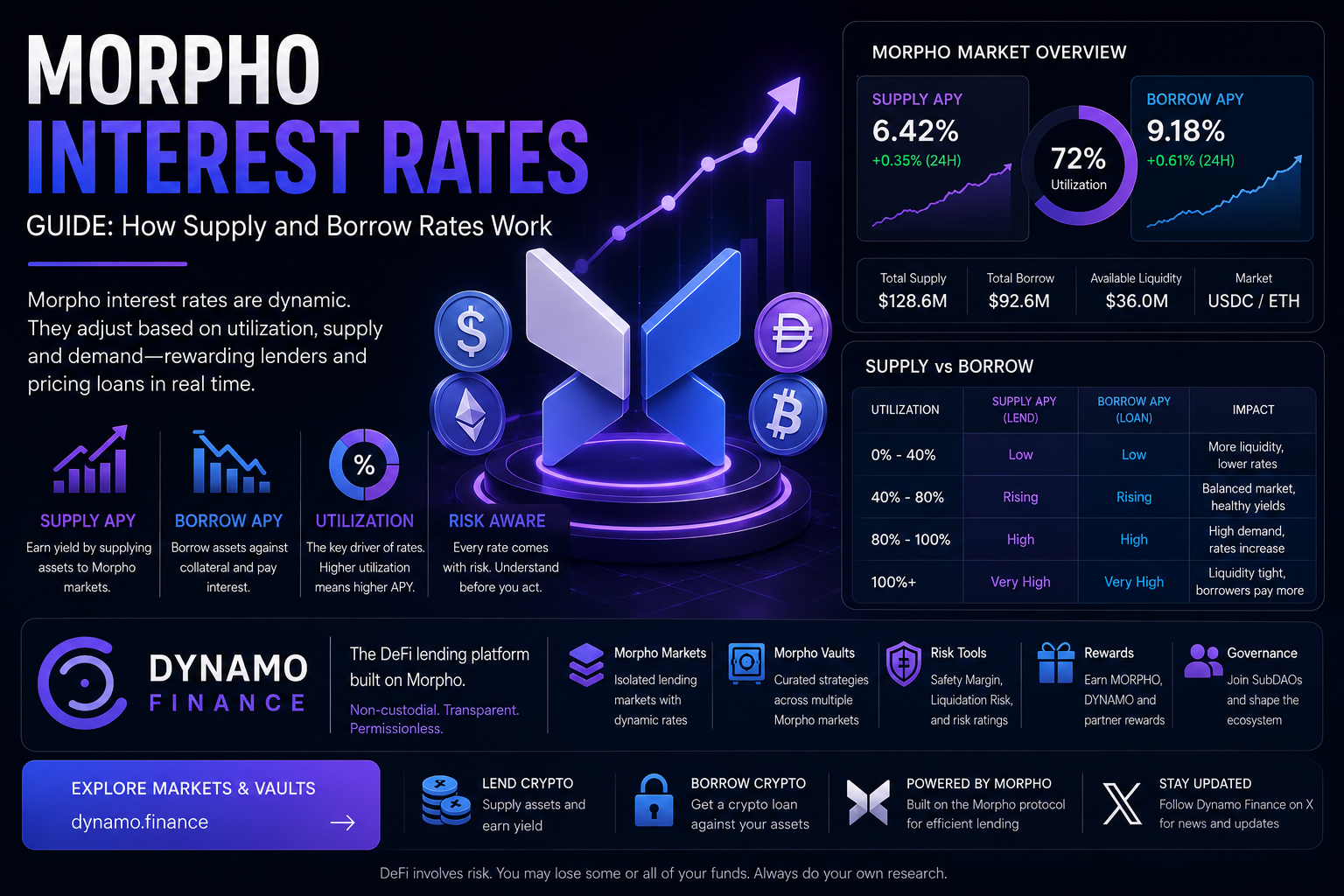
On Dynamo, lending markets use utilization-based interest rates. Utilization measures how much supplied liquidity is currently borrowed. When utilization rises, borrowing becomes more expensive and supply APY may increase. When utilization falls, borrow demand is weaker and supply APY may decline.
Vault Allocation Strategies
Stablecoin vaults can generate yield by allocating deposits across multiple markets. A vault may move capital toward markets with stronger demand, better risk-adjusted APY, or more attractive liquidity conditions.
Dynamo vaults are built on the MetaMorpho standard. A vault curator manages the strategy, including which markets the vault allocates to, how weights are assigned, and when rebalancing occurs. This can be useful for users who want passive income with stablecoins but do not want to manually monitor every market.
Vaults are not automatically safer than direct markets. They reduce some operational work, but users still need to review curator quality, market allocation, vault fees, liquidity, APY stability, and underlying risk tiers.
Liquidity Pool Fees
Some stablecoin yield opportunities come from decentralized exchanges. Users provide stablecoins to liquidity pools, and traders pay fees when they swap assets through the pool.
Stablecoin-to-stablecoin pools can have lower price volatility than volatile asset pools, but they still carry risks. If one stablecoin depegs or liquidity becomes imbalanced, the pool may not behave like a simple savings product.
Protocol Incentives
Some platforms distribute token rewards to attract deposits. These incentives can boost advertised stablecoin APY, sometimes significantly.
Incentives can be useful, but they can also disappear. A yield that looks attractive because of temporary rewards may fall when a campaign ends or when reward token prices decline. For this reason, users should separate base yield from incentive yield when comparing stablecoin yield opportunities.
Real-World Asset and Treasury-Linked Strategies
Some stablecoin yield strategies connect to tokenized treasury bills, money market-style products, or other real-world asset structures. These can introduce different risks, including issuer risk, regulatory risk, redemption risk, and counterparty risk.
These strategies may be useful for sophisticated users, but they should not be treated as identical to DeFi lending markets. Always understand whether the yield is generated on-chain, off-chain, or through a hybrid structure.
Stablecoin Yield APY vs APR: What the Numbers Mean
Stablecoin yield platforms often display APY or APR, but the difference matters.
APR stands for annual percentage rate. It represents the simple annualized rate without compounding. APY stands for annual percentage yield. It includes the effect of compounding, assuming yield is reinvested over time.
For example, a vault that compounds automatically may show APY because earned interest increases the value of the user’s position. A lending market may show annualized supply APY based on current utilization, but that number can change as supply and borrow activity change.
Users should treat stablecoin APY as a current estimate, not a promise. A market showing 9% today may show 5% tomorrow if new suppliers enter, borrowers repay, or utilization falls. A vault showing a blended APY may rebalance over time as underlying market rates change.
The best way to compare stablecoin interest rates is to look beyond the headline number. Consider:
- Base yield versus incentive yield
- Utilization and available liquidity
- Underlying collateral and borrower demand
- Smart contract and protocol risk
- Fees, including performance fees, management fees, deposit fees, and gas
- Withdrawal conditions and market liquidity
Common Stablecoin Yield Strategies
There are several ways to earn yield on stablecoins. Each has a different risk profile, level of complexity, and source of return.
1. Stablecoin Lending
Stablecoin lending is one of the most direct yield strategies. Users supply stablecoins to a lending market and earn interest from borrowers.
This strategy is often easier for beginners to understand than complex yield farming. The main variables are the loan asset, collateral asset, utilization, available liquidity, supply APY, borrow APY, oracle, liquidation rules, and smart contract risk.
On Dynamo, users can review Dynamo markets to compare live market data. Because Dynamo markets are isolated, each market has its own loan asset, collateral asset, oracle, and liquidation loan-to-value ratio. That structure helps users evaluate risk market by market instead of assuming all deposits share the same exposure.
2. Stablecoin Vaults
Stablecoin vaults are designed for users who want a more hands-off approach. A vault pools deposits and allocates capital across lending markets according to a curator-managed strategy.
This can be useful when stablecoin rates change frequently. Instead of manually moving USDC between markets, a user can deposit into a vault that seeks a blended yield across selected markets.
On Dynamo, users can explore Dynamo vaults to review current APY, total value supplied, curator, underlying asset, market allocations, and vault details. Vaults may charge performance fees or management fees, and those fees vary by vault and curator. Users should review the vault detail page before depositing.
3. Stablecoin Yield Farming
Stablecoin yield farming usually involves depositing stablecoins into DeFi protocols to earn trading fees, lending interest, rewards, or a combination of these. The strategy may involve liquidity pools, LP tokens, automated strategies, or incentive campaigns.
Yield farming can produce higher returns than simple lending, but it often introduces additional complexity. Users may need to understand pool composition, reward tokens, impermanent loss, smart contract dependencies, and strategy execution.
Stablecoin yield farming is not automatically safer because the deposited assets are stablecoins. A stablecoin pool can still suffer from depeg events, contract exploits, oracle problems, or incentive collapse.
4. CeFi Stablecoin Interest Accounts
Centralized finance platforms may offer stablecoin interest accounts. These products can feel simple because users deposit into an account and receive a quoted rate.
The trade-off is counterparty risk. Users rely on the company’s custody, lending practices, risk controls, financial health, and withdrawal processes. The U.S. Investor.gov bulletin on crypto asset interest-bearing accounts is a useful reminder that these products are not the same as insured bank deposits.
5. Stablecoin Borrowing and Looping Strategies
Some advanced users borrow stablecoins against collateral, redeploy them into yield strategies, and attempt to capture a spread between borrowing costs and earned yield. This is sometimes called looping or leveraged yield.
This strategy is much riskier than simple stablecoin lending. Borrow APY can rise, supply APY can fall, collateral can lose value, and liquidation risk can increase quickly. Beginners should understand plain lending and vault deposits before considering leveraged strategies.
USDC Yield Guide: What to Know Before Depositing
USDC is one of the most widely used stablecoins in DeFi. Many stablecoin yield strategies use USDC because it has deep liquidity across major DeFi protocols, centralized exchanges, and blockchain networks.
Circle states that USDC is designed to be fully backed by highly liquid cash and cash-equivalent assets, and Circle publishes reserve transparency information on its website. Users evaluating USDC yield should still understand that using USDC in DeFi adds risks beyond the stablecoin itself, including smart contract risk, liquidity risk, and lending market risk. Circle’s USDC transparency resources can help users understand issuer-level disclosures.
USDC yield can come from lending markets, vaults, liquidity pools, or incentive programs. In a lending context, USDC suppliers usually earn interest because borrowers want dollar-denominated liquidity. Borrowers may use crypto collateral such as ETH, BTC, or other assets to borrow USDC without selling their holdings.
For a beginner-friendly USDC yield guide, focus on four questions:
- Where is the USDC deposited?
- Who is paying the yield?
- What risks could reduce or prevent withdrawals?
- What happens if market conditions change?
Dynamo users should check the live markets and vaults pages to confirm which USDC opportunities are currently available, what the current supply APY is, how much liquidity exists, and what risk rating applies.
USDT Yield Guide: What to Know Before Depositing
USDT is another major stablecoin used across crypto markets. It has broad exchange liquidity and deep presence across multiple blockchains. Many users search for USDT yield because they already hold USDT or use it as a base asset for trading.
Tether publishes reserve and token circulation information through its transparency page. Users evaluating USDT yield should review issuer disclosures, supported networks, redemption assumptions, and the specific DeFi protocol where USDT is deposited.
USDT yield can come from lending, trading liquidity, or reward programs. The risk profile depends on the platform and strategy. A USDT lending market with strong liquidity and conservative collateral may have a very different risk profile from a high-APY farming pool with multiple smart contract dependencies.
Do not assume USDT yield and USDC yield are interchangeable. They may differ in liquidity, issuer structure, market demand, available DeFi integrations, and supported chains. When comparing USDC yield and USDT yield, evaluate the actual opportunity, not just the ticker.
USDC Yield vs USDT Yield: Which Is Better?
There is no universal answer to whether USDC yield or USDT yield is better. The better choice depends on the user’s risk tolerance, wallet holdings, target chain, available markets, liquidity depth, and trust in the stablecoin issuer.
USDC is often favored by users who prioritize issuer transparency and regulated infrastructure. USDT is often favored by users who prioritize deep global crypto trading liquidity. Both can be used in DeFi, but availability and risk vary by protocol, chain, and strategy.
When comparing USDC yield vs USDT yield, use this framework:
| Factor | USDC Yield | USDT Yield | What to Check |
|---|---|---|---|
| Issuer transparency | Circle publishes reserve and transparency materials. | Tether publishes reserve and circulation information. | Review issuer disclosures before depositing. |
| DeFi availability | Common across DeFi lending and vault strategies. | Common across exchanges and many DeFi ecosystems. | Check the specific chain, market, and protocol. |
| Yield source | Often borrower interest, vault allocation, fees, or incentives. | Often borrower interest, trading liquidity, fees, or incentives. | Identify who pays the yield and why. |
| Risk profile | Depends on issuer risk, protocol risk, liquidity, and market design. | Depends on issuer risk, protocol risk, liquidity, and market design. | Do not judge risk by APY alone. |
| Best fit | Users who prefer USDC liquidity and Circle disclosures. | Users who already hold USDT or need USDT liquidity. | Match the stablecoin to your portfolio and exit plan. |
The practical takeaway is simple: compare stablecoin yield opportunities one market at a time. A lower APY in a transparent, liquid, well-understood market may be more attractive than a high APY with unclear yield sources or weak liquidity.
Stablecoin Yield in DeFi vs CeFi vs Traditional Finance
Stablecoin yield competes with several alternatives: DeFi lending, CeFi interest accounts, bank savings accounts, money market funds, and treasury-linked products. They may all appear to offer “yield,” but they are not the same.
| Option | How Yield Is Generated | Advantages | Main Risks |
|---|---|---|---|
| Dynamo Finance | Users can supply assets into Morpho-based lending markets or deposit into MetaMorpho vault strategies. | Non-custodial access, live market data, vault strategies, utilization-based rates, and risk tools. | Smart contract risk, market risk, liquidity risk, stablecoin risk, and user responsibility. |
| Other DeFi lending platforms | Borrowers pay interest to use supplied liquidity, usually with crypto collateral. | Transparent on-chain activity and wallet-based access. | Protocol design, oracle risk, collateral risk, and liquidity vary by platform. |
| Stablecoin yield farming | Trading fees, incentives, liquidity rewards, or complex strategy returns. | Potential for higher APY and broader strategy choice. | Higher complexity, reward volatility, contract dependencies, and depeg risk. |
| CeFi stablecoin accounts | A centralized company lends, invests, or otherwise deploys customer assets. | Simple user experience and account-based interface. | Custody risk, withdrawal risk, counterparty risk, and limited transparency. |
| Traditional savings or money market products | Banks, brokerages, or fund managers deploy cash into regulated financial markets. | Regulated infrastructure and familiar reporting. | Lower crypto-native flexibility and different access, settlement, and custody model. |
DeFi stablecoin yield is attractive because it is transparent and accessible through a Web3 wallet. Ethereum.org’s DeFi overview is a useful primer on how decentralized applications can support lending, borrowing, trading, and other financial activity through smart contracts.
CeFi may be simpler, but users rely on a company. Traditional products may offer stronger regulatory protections, but they do not provide the same on-chain composability. Stablecoin yield sits between these worlds, which is why risk evaluation matters.
How Dynamo Finance Fits Into Stablecoin Yield
Dynamo Finance is positioned for users who want to explore stablecoin yield through non-custodial DeFi lending markets and vaults. The platform is built around Morpho smart contracts and adds an interface layer for markets, vaults, position management, risk analytics, and rewards.
For stablecoin holders, the most relevant Dynamo features are direct lending markets and vault strategies. A user can review lending markets to understand current supply APY, borrow APY, utilization, available liquidity, collateral asset, oracle, and liquidation loan-to-value. A user can also review vaults to compare curator-managed strategies that allocate across markets.
Dynamo’s structure matters because stablecoin yield is not just about finding a number. Users need to know where their funds go, what risks are attached, how rates change, and what liquidity exists if they want to withdraw.
For readers who want to compare live opportunities, the Stablecoin Yield page experience begins by reviewing active markets and vaults on Dynamo. Because live supported assets and APYs change, users should always confirm the current asset list, fee status, risk rating, utilization, and market liquidity inside the app before depositing.
Markets on Dynamo
Dynamo markets are isolated lending pools. Each market has one loan asset, one collateral asset, one oracle, and one Liquidation Loan-to-Value ratio. If a user supplies a stablecoin as the loan asset, the yield comes from borrowers paying interest in that market.
Isolation makes risk easier to analyze. A user can evaluate a stablecoin lending market based on its own parameters rather than assuming that every market shares the same collateral or risk profile. This is useful for stablecoin holders who want to understand exactly which market they are entering.
Vaults on Dynamo
Dynamo vaults are built on the MetaMorpho standard. Vaults pool deposits and allocate them across lending markets according to curator-managed strategies. Depositors receive vault shares that represent their proportional stake.
Vaults can be useful for stablecoin holders who want passive income with stablecoins without manually moving capital between markets. The trade-off is that users must evaluate the curator, market allocation, fee structure, total supplied, APY stability, and liquidity.
Risk Tools on Dynamo
Dynamo provides risk tooling designed to make DeFi lending easier to evaluate. Risk Rating assigns Low, Medium, or High tiers to markets and vaults based on objective on-chain parameters. Safety Margin helps borrowers operate more conservatively than the underlying liquidation threshold. Liquidation Risk views show health factor, price drop tolerance, and liquidation price for borrow positions.
Stablecoin lenders may not face the same liquidation risk as borrowers, but they still care about market risk, collateral quality, utilization, and liquidity. The risk dashboard is useful because stablecoin yield decisions should be based on risk-adjusted returns, not only APY.
Stablecoin Yield Risks and Considerations
Stablecoin yield can be lower-volatility than many crypto strategies, but it is not low-risk by default. The biggest losses in yield markets often happen when users confuse “stable asset” with “safe strategy.”
Stablecoin Depeg Risk
A stablecoin can trade below or above its intended peg. Depegs can happen because of reserve concerns, market stress, redemption issues, technical failures, regulatory events, or liquidity shortages.
If a stablecoin depegs while it is deposited in a lending market, vault, or liquidity pool, users may face losses or withdrawal issues. Stablecoin depeg risk is especially important in strategies that use multiple stablecoins or rely on a specific stablecoin maintaining tight parity.
Smart Contract Risk
DeFi yield depends on code. Smart contract bugs, oracle issues, bridge failures, or integration problems can result in loss of funds.
Audits reduce risk, but they do not eliminate it. Users should prefer protocols with transparent contracts, a clear security history, reputable audits, and conservative design. Morpho’s own documentation is a useful resource for understanding the lending infrastructure Dynamo is built around.
Market and Utilization Risk
Stablecoin lending rates are often driven by utilization. High utilization can improve supply APY, but it also means more of the pool is borrowed. If a lender needs immediate liquidity, a highly utilized market may be less attractive than it appears.
Utilization can also change quickly. If new suppliers enter a high-yield market, supply APY may fall. If borrowers repay, yield may drop, but if they rush in, rates may rise, but withdrawal liquidity can tighten.
Collateral Risk
In a lending market, stablecoin suppliers are exposed to the quality of borrower collateral and the liquidation system. If collateral prices fall sharply or an oracle fails, losses can become possible.
This is why market-level details matter. Before supplying stablecoins, review the collateral asset, oracle, LLTV, total supply, total borrow, utilization, liquidity, and risk rating.
Liquidity Risk
Stablecoin yield is only useful if users can exit when they need to. In lending markets, withdrawals depend on available liquidity. In vaults, withdrawals depend on liquidity in the underlying markets.
A vault or market can be technically open for withdrawals but still constrained if too much liquidity is borrowed. Users who need instant access should prioritize liquidity depth and moderate utilization over maximum APY.
Fee Risk
Fees reduce net yield. Dynamo lists market-level and vault-level fee considerations. A loan-asset deposit fee may apply when supplying loan assets through the Dynamo interface, depending on governance status and the market detail page. Vaults may charge performance fees or management fees, and those rates vary by vault and curator.
Gas fees also matter. Every on-chain deposit, withdrawal, borrow, or repay transaction requires network gas. Smaller deposits can be more affected by gas costs, especially on higher-cost networks.
CeFi Counterparty Risk
If a user earns stablecoin yield through a centralized platform, they take custody and counterparty risk. The platform controls assets, lending activity, withdrawal processes, and risk management. Users may not have full visibility into how funds are deployed.
FINRA’s crypto asset overview is a helpful reminder that crypto assets and crypto yield products carry risks that differ from traditional financial accounts.
How to Evaluate the Best Stablecoin Yield Opportunities
The best stablecoin yield opportunities are the ones that match your risk tolerance, liquidity needs, and level of DeFi experience. A high APY is not enough.
Use this checklist before depositing:
- Identify the source of yield: borrower interest, trading fees, incentives, vault allocation, or off-chain return.
- Check whether the strategy is custodial or non-custodial.
- Review the stablecoin issuer and reserve transparency.
- Evaluate smart contract risk and protocol security.
- Check utilization, available liquidity, total supplied, and total borrowed.
- Review collateral assets, oracle design, LLTV, and liquidation mechanics.
- Separate base APY from temporary incentive APY.
- Confirm all fees before depositing.
- Make sure the withdrawal process fits your liquidity needs.
- Start with a smaller amount before scaling into a larger position.
For Dynamo users, this evaluation can begin on the live markets and vaults pages. The goal is not to find the highest number. The goal is to find a stablecoin strategy where the return makes sense after accounting for market risk, fees, liquidity, and user responsibility.
Stablecoin Yield for Beginners: A Practical Example
Imagine a user holds 10,000 USDC and wants to earn yield while waiting for future investment opportunities. They do not want to buy volatile assets today, and they do not want to trade actively.
A beginner might compare three options. First, they could keep USDC idle in a wallet. That has no DeFi smart contract risk, but it produces no yield. Second, they could supply USDC to a lending market and earn a variable APY from borrowers. Third, they could deposit into a USDC vault that allocates across multiple markets.
The direct market gives more control. The user chooses the exact market and understands the collateral, utilization, APY, and liquidity. The vault gives more automation. The curator handles allocation and rebalancing, but the user must trust the strategy and review fees.
A cautious beginner might start with a small deposit, monitor the position for a few weeks, and learn how APY changes with utilization. They might also compare the vault’s blended APY with direct market APYs. This builds experience without committing the full balance immediately.
Stablecoin Yield vs Staking
Stablecoin yield and staking are often compared because both can generate crypto income. They are different strategies.
Staking usually involves helping secure a proof-of-stake network or participating through a validator, liquid staking token, or staking service. Yield comes from network rewards, not borrower interest.
Stablecoin yield usually comes from lending, trading fees, vault strategies, incentives, or other market activity. It does not require exposure to the price of a staking asset, but it does require exposure to stablecoin and strategy-specific risks.
| Category | Stablecoin Yield | Staking |
|---|---|---|
| Yield source | Borrower interest, fees, vault strategies, or incentives. | Network rewards or validator economics. |
| Main asset type | USDC, USDT, DAI, or other stablecoins. | Proof-of-stake assets such as ETH or other network tokens. |
| Primary risks | Stablecoin depeg, smart contract, liquidity, collateral, and platform risk. | Validator risk, slashing risk, lockups, price volatility, and protocol risk. |
| Best for | Users seeking lower-volatility crypto income strategies. | Users who want exposure to a proof-of-stake asset and its network rewards. |
Neither strategy is automatically better. Stablecoin yield may fit users who want dollar-denominated exposure and DeFi lending returns. Staking may fit users who want to hold a proof-of-stake asset long term and earn native rewards.
Stablecoin Yield vs Savings Accounts and Money Market Funds
Stablecoin yield is sometimes compared with savings accounts and money market funds because all three can produce income on cash-like assets. The comparison is useful, but the products are fundamentally different.
A bank savings account is part of the regulated banking system. A money market fund is an investment product that usually holds high-quality short-term instruments. A stablecoin yield strategy is a crypto strategy that may involve smart contracts, collateralized lending, vaults, or liquidity pools.
Stablecoin yield may offer flexibility and on-chain transparency, but it does not automatically provide the regulatory protections or insurance associated with traditional financial accounts. Users should not treat DeFi stablecoin yield as a bank deposit substitute.
The better comparison is risk-adjusted return. If a stablecoin strategy offers only slightly more yield than a traditional alternative but carries much higher complexity, the extra yield may not be worth it for every user. If the user values on-chain liquidity, composability, and self-custody, DeFi stablecoin yield may be more compelling.
How to Get Started with Stablecoin Yield on Dynamo Finance
Dynamo’s workflow is designed for users who want to connect a wallet, review markets or vaults, and make informed on-chain decisions. No need for a traditional account, email, or KYC to access the core Web3 workflow.
- Open the get started page and review the basic workflow.
- Connect a supported Web3 wallet and make sure you are using the correct network.
- Visit the markets page to compare stablecoin lending markets, if available.
- Visit the vaults page to compare stablecoin vault strategies, if available.
- Review APY, utilization, liquidity, loan asset, collateral asset, oracle, LLTV, risk rating, fees, and vault allocation.
- Start with a small deposit to understand wallet approvals, gas fees, and position tracking.
- Monitor your supplied assets, vault deposits, and any borrow positions from the Dynamo dashboard.
Users who want deeper product details can review the Dynamo documentation. Users who want platform updates can also follow Dynamo Finance updates.
The most important step is preparation. Before depositing, confirm live rates and supported assets in the app. Stablecoin yield opportunities change as market conditions change.
Advanced Stablecoin Yield Considerations
Experienced DeFi users often look beyond the headline APY. They evaluate capital efficiency, liquidity depth, rate volatility, collateral correlation, incentive sustainability, and vault concentration.
Net APY After Fees
Gross APY is not the same as net APY. A vault with a higher gross APY may produce a lower net return after performance and management fees. A market with a deposit fee may require enough time in the position to make the fee worthwhile.
Dynamo’s fee pages are useful because they separate market fee considerations from vault fee considerations. For vaults, performance fees are taken from yield and management fees accrue from assets under management. Fee rates vary by vault and curator, so the vault detail page should always be reviewed.
Liquidity Depth
A high APY in a small market can be fragile. Small markets can change quickly when a large depositor enters or exits. They may also have less historical performance during volatility.
For stablecoin yield, liquidity depth often matters more than a few extra basis points of APY. A market with moderate APY, strong liquidity, and transparent collateral can be more attractive than a thin market with a temporary high rate.
Collateral Correlation
Stablecoin lenders should review what borrowers are posting as collateral. If a market’s collateral is volatile or thinly traded, liquidation risk may be higher. If collateral is highly correlated with broader crypto market stress, risk can rise during sharp sell-offs.
Stablecoin lenders do not need to predict every market move, but they should understand what backs the loans that generate their yield.
Vault Concentration
A vault may look diversified, but the allocation breakdown matters. A stablecoin vault concentrated in one market carries more exposure to that market’s utilization, collateral, and oracle risks. A more diversified vault may reduce single-market concentration but can introduce broader exposure across several markets.
Before depositing into a stablecoin vault, review the allocation breakdown and ask whether the vault’s yield depends on one dominant market or several balanced markets.
Conclusion
Stablecoin yield can be a powerful tool for crypto investors who want to earn passive income with stablecoins. It can help USDC, USDT, DAI, and other stablecoin holders put idle assets to work through lending markets, vaults, liquidity pools, and other DeFi strategies.
The opportunity is real, but the safest approach is not to chase the highest APY. Stablecoin yield risks include depegs, smart contract bugs, liquidity constraints, collateral failures, oracle issues, temporary incentives, and fees. The best stablecoin yield strategy is the one where the return is understandable, the risks are visible, and the exit path is clear.
Dynamo Finance gives users a non-custodial way to explore stablecoin lending opportunities through markets, vaults, utilization-based rates, risk ratings, and position tools. To compare live opportunities, review Dynamo’s markets and vaults, check the risk dashboard, and start with a position size that matches your experience level.
FAQ
What is stablecoin yield?
Stablecoin yield is the return earned by depositing stablecoins such as USDC, USDT, or DAI into lending markets, vaults, liquidity pools, or other yield strategies. The yield usually comes from borrower interest, trading fees, incentives, or vault allocation strategies.
How can I earn yield on USDC?
You can earn USDC yield by supplying USDC to a DeFi lending market, depositing into a USDC vault, providing liquidity to a stablecoin pool, or using a centralized yield platform. Before depositing, check the yield source, fees, liquidity, smart contract risk, and withdrawal conditions.
Is USDT yield safe?
USDT yield is not risk-free. The risk depends on the issuer, the chain, the protocol, the strategy, liquidity conditions, and the source of yield. Review Tether’s transparency information, protocol security, APY source, and withdrawal terms before using a USDT yield strategy.
What are the biggest stablecoin yield risks?
The biggest stablecoin yield risks include stablecoin depeg risk, smart contract risk, liquidity risk, collateral risk, oracle risk, fee risk, and counterparty risk when using centralized platforms. A stablecoin can reduce price volatility, but it does not remove strategy risk.
Is stablecoin yield better than staking?
Stablecoin yield and staking serve different goals. Stablecoin yield is usually better for users seeking dollar-denominated DeFi income with lower asset price volatility. Staking is usually better for users who want exposure to a proof-of-stake asset and its network rewards. The better choice depends on risk tolerance, asset preference, and liquidity needs.