
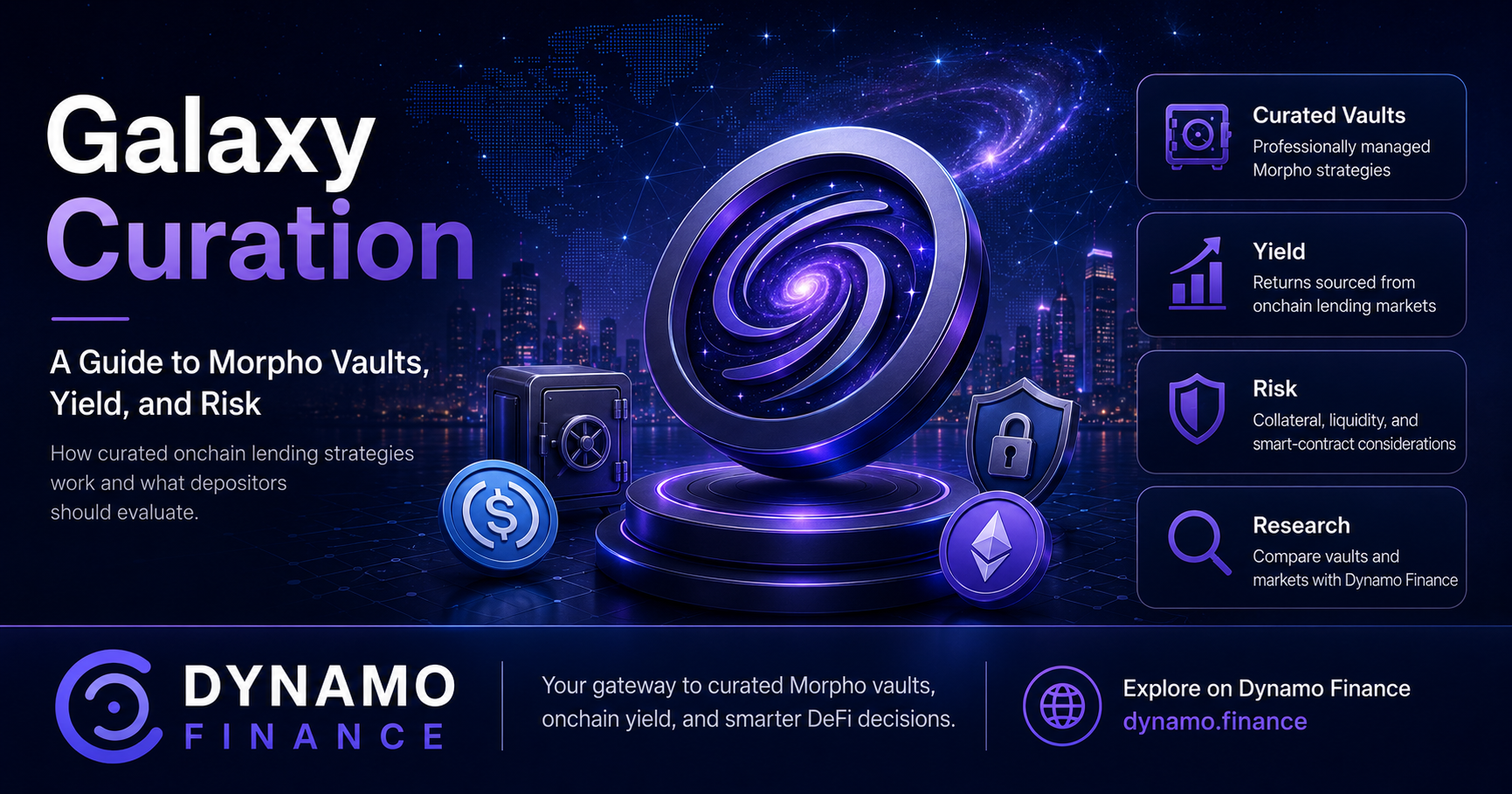
Finding attractive onchain yield is easy. Determining what generates that yield, which risks support it, and who controls the allocation strategy is considerably harder.
Galaxy Curation enters that gap as an institutional vault curator within the Morpho ecosystem. Instead of requiring depositors to compare dozens of isolated lending markets, Galaxy packages selected markets into managed vaults designed around defined risk and return objectives.
Galaxy Curation is Galaxy’s onchain vault-curation business, responsible for selecting, monitoring, and reallocating capital across Morpho lending markets. Depositors supply an asset such as USDC, USDT, or WETH to a vault, receive vault shares, and earn a blended return generated by borrowers in the markets chosen by the curator.
This guide examines how Galaxy Curation works, what separates its Quality and Enhanced strategies, where vault returns come from, and which risks depositors must evaluate. It also explains how Dynamo Finance can help users compare vaults, inspect underlying Morpho markets, and act on live onchain data.
Key Takeaways
- Galaxy Curation manages non-custodial Morpho vaults that allocate depositor assets across selected lending markets.
- Galaxy’s Quality vaults emphasize collateral quality, liquidity depth, liquidation resilience, and capital preservation ahead of maximum yield.
- Galaxy’s Enhanced strategy expands the eligible market set to include higher-yielding opportunities, which can introduce additional collateral and liquidity risks.
- Vault APY comes primarily from interest paid by borrowers and can change rapidly as utilization, allocations, incentives, and market demand evolve.
- Dynamo lets users compare vaults and individual Morpho markets while reviewing APY, TVL, allocations, fees, liquidity, and risk indicators.
What Is Galaxy Curation?
Galaxy Curation is a product of Galaxy, a publicly listed digital-asset company with operations spanning trading, asset management, advisory services, staking, custody technology, and tokenization infrastructure.
Its role in DeFi is different from that of a lending protocol. Galaxy does not replace Morpho’s smart contracts or create a separate lending system for each vault. It acts as a curator that decides which Morpho markets a vault may use, how much capital can be allocated to each market, and when liquidity should be rebalanced.
A curator typically performs several connected functions:
- Evaluating collateral assets and their market liquidity
- Reviewing oracle design and price-feed reliability
- Setting exposure caps for approved markets
- Monitoring utilization and withdrawal liquidity
- Assessing whether liquidators can sell collateral during stress
- Reallocating capital when rates or risk conditions change
- Removing or reducing exposure to markets that no longer fit the mandate
Morpho describes curators as independent entities that design and manage onchain vaults rather than components of the base protocol itself. This separation allows multiple curators to build different portfolios on the same infrastructure, as outlined in Morpho’s guide to how vault curators work.
The result resembles delegated portfolio management, but with important onchain differences. Vault allocations, contract addresses, market parameters, and many strategy changes can be inspected publicly. Depositor assets remain in smart contracts rather than being transferred to a curator’s conventional operating account.
How Galaxy Curation Works
Galaxy Curation connects three groups: depositors seeking yield, borrowers seeking liquidity, and Morpho markets that bring the two sides together.
A depositor begins with the asset accepted by a Galaxy vault. The vault pools that asset with deposits from other users and allocates the combined liquidity across eligible Morpho markets.
Borrowers in those markets post collateral before drawing the loan asset. Interest paid by borrowers accrues to suppliers, including the vault. As the vault’s assets increase, the economic value represented by each depositor’s vault shares increases as well.
The curator does not set a permanent fixed interest rate. Supply returns depend on the live borrowing conditions of the markets receiving capital.
The Deposit Asset Is Not the Same as the Collateral Asset
This distinction is essential for beginners. In a Galaxy USDC vault, the depositor supplies USDC. Borrowers may post assets such as wrapped Bitcoin, staked Ether, or another approved token as collateral to borrow that USDC.
The depositor does not receive the borrower’s collateral unless liquidation mechanics are triggered through the market. However, the collateral’s quality directly affects the lender because it must retain enough value and liquidity to cover the outstanding debt during stress.
A WETH vault follows the same broad model with WETH as the supplied loan asset. Borrowers post eligible collateral to access WETH liquidity, and the vault earns WETH-denominated interest from those positions.
The Role of Market Caps
A curator can approve a market without allowing unlimited exposure to it. Supply caps restrict how much of the vault may be allocated to a particular market.
Caps are one of the most important risk controls in a curated portfolio. A higher-yielding market may be acceptable at a small weight but unsuitable as the vault’s dominant exposure.
Depositors should examine actual allocations as well as maximum permitted allocations. A market with a 20% cap may currently hold 2% of the vault, while another approved market may be close to its limit.
Why Rebalancing Matters
Borrowing demand changes continuously. A market paying an attractive rate today may offer a much lower rate after borrowers repay or new suppliers enter.
Risk conditions also evolve. Collateral liquidity can weaken, a token can deviate from its expected price, or an oracle dependency can become less reliable. Active curation allows capital to move when the expected return no longer compensates for those risks.
Galaxy Curation Vaults
At the time of review in July 2026, Galaxy’s public curation portfolio highlighted three Quality vaults on Ethereum: Galaxy USDC Quality, Galaxy USDT Quality, and Galaxy WETH Quality. Galaxy’s Morpho curator profile also surfaced an Enhanced USDC strategy.
Vault availability, allocations, APY, TVL, and fee settings can change. Readers should verify the live vault page and contract address rather than treating any static article as a transaction interface.
| Vault | Deposit Asset | General Mandate | Main Risk Considerations |
|---|---|---|---|
| Galaxy USDC Quality | USDC | Allocate across selected Morpho markets backed by blue-chip collateral, with capital preservation prioritized over maximum yield | USDC issuer risk, collateral volatility, oracle risk, liquidation performance, utilization, and smart-contract risk |
| Galaxy USDT Quality | USDT | Apply the Quality framework to USDT lending markets using selected blue-chip collateral | USDT issuer risk, collateral liquidity, market concentration, oracle design, and withdrawal liquidity |
| Galaxy WETH Quality | WETH | Allocate WETH across markets using blue-chip assets and liquid ETH variants as collateral | ETH price exposure, staking-wrapper dependencies, collateral correlation, liquidation depth, and contract risk |
| Galaxy USDC Enhanced | USDC | Combine blue-chip markets with selected higher-yielding opportunities | All Quality-vault risks plus potentially greater collateral complexity, liquidity risk, protocol dependencies, and loss severity |
Galaxy USDC Quality
Galaxy USDC Quality is designed for depositors whose primary objective is capital preservation, with yield treated as a secondary consideration. Galaxy selects markets based on collateral quality, liquidity depth, and the robustness of the liquidation process.
The vault allocates USDC to Morpho markets collateralized by assets that Galaxy classifies within its blue-chip mandate. Its published allocation history shows that weights can move materially between markets as the strategy responds to available yield and liquidity.
This is not equivalent to holding idle USDC. Depositors accept exposure to Morpho contracts, the USDC issuer, the approved collateral, relevant oracles, borrowers, and liquidators.
Galaxy USDT Quality
Galaxy USDT Quality applies a similar capital-preservation orientation using USDT as the deposit asset. The return is generated when borrowers pay to access USDT liquidity in the underlying Morpho markets.
Choosing between USDC and USDT vaults is not only an APY decision. Each stablecoin has a different issuer, reserve structure, redemption process, banking network, compliance framework, and history of secondary-market liquidity.
A depositor who already holds USDT may prefer to avoid converting assets solely to enter another vault. Conversely, a user who does not want USDT issuer exposure should not select the vault simply because its current APY happens to be higher.
Galaxy WETH Quality
Galaxy WETH Quality is denominated in WETH rather than a dollar-linked stablecoin. Its objective is to generate additional WETH by supplying liquidity to selected markets involving established assets and liquid ETH variants.
This distinction changes how performance should be measured. A depositor may earn more WETH while the dollar value of the position falls because ETH declines. Alternatively, the depositor can benefit from both vault yield and an increase in ETH’s market price.
Users comparing ETH lending opportunities should therefore separate token-denominated performance from fiat-denominated performance. A 3% WETH return means approximately 3% more WETH before fees and other adjustments, not a guaranteed 3% dollar return.
Galaxy USDC Enhanced
Galaxy USDC Enhanced expands beyond a blue-chip-only mandate by admitting selected higher-yielding markets. The broader opportunity set may improve return potential when specialist collateral or newer credit structures command higher borrowing rates.
Additional yield rarely appears without an additional risk source. Enhanced markets may involve thinner liquidity, more complex wrappers, newer smart contracts, external protocol dependencies, greater oracle complexity, or collateral that has not experienced a full market cycle.
The appropriate comparison is not “Quality APY versus Enhanced APY” in isolation. Depositors should ask whether the incremental yield adequately compensates for the incremental probability and severity of loss.
Quality vs. Enhanced: What the Labels Really Mean
Quality and Enhanced are strategy mandates, not guarantees. A Quality vault can still suffer bad debt, experience delayed withdrawals, or lose funds following a smart-contract failure.
Enhanced does not necessarily mean reckless. It means the curator has permission to consider a wider set of opportunities than a strategy restricted to the most established collateral categories.
The labels are most useful when treated as starting points for due diligence:
- Quality: Prioritizes established collateral, deep liquidity, and resilient liquidations, accepting that the resulting yield may be lower.
- Enhanced: Pursues a broader opportunity set where higher rates may compensate for added complexity or risk.
- Neither category: Guarantees principal, a minimum APY, immediate withdrawals, or protection from protocol failure.
Experienced allocators compare the live market composition of each vault. The name describes the mandate, but current allocations determine the exposure a depositor actually owns.
Where Does Galaxy Curation Yield Come From?
The primary economic source is borrower interest. A borrower wants liquidity without selling an existing asset, so they post collateral and pay an interest rate to access USDC, USDT, WETH, or another loan asset.
That interest flows to suppliers after applicable fees. When a Galaxy vault supplies the liquidity, the return accrues to the vault and is reflected in the value of its shares.
Incentive programs may supplement base lending yield in some markets. Such rewards can make a displayed APY look more attractive, but they may be temporary and can disappear when a campaign ends.
Galaxy Research’s analysis of onchain yield sources and risks emphasizes that headline returns should be evaluated against both risk and operational complexity. Lending yield is ultimately compensation for supplying capital to borrowers, not a risk-free token distribution.
Utilization Drives Interest Rates
Utilization is the percentage of supplied liquidity that borrowers have taken from a market. A pool containing $20 million of supplied USDC and $16 million of outstanding loans has 80% utilization.
Rates generally rise when utilization increases. Higher borrowing costs encourage repayment and attract additional suppliers, while lower rates encourage more borrowing when liquidity is abundant.
High utilization can improve supplier APY, but it also means less liquidity remains available for withdrawals. This trade-off is central to every lending vault.
Vault APY Is a Blended Rate
A vault allocated across multiple markets earns a weighted combination of their supply rates. If half of a vault earns 4%, one quarter earns 6%, and one quarter remains idle, the blended return will be lower than the highest market rate.
The calculation becomes more dynamic as allocations, utilization, fees, and incentives change. The displayed APY should be interpreted as an annualized estimate based on current or recent conditions, not a contractual annual return.
Why APY Can Change Quickly
A large borrower repayment can reduce utilization and lower rates within minutes. An influx of new supply can have a similar effect because more liquidity is competing for the same borrowing demand.
Curator rebalancing also changes the blended return. Capital may be deliberately moved from a high-yield market to a lower-yield one when risk rises or available withdrawal liquidity becomes inadequate.
That decision can reduce the headline APY while improving the portfolio’s expected resilience. Lower short-term yield is sometimes evidence of prudent risk management rather than weak performance.
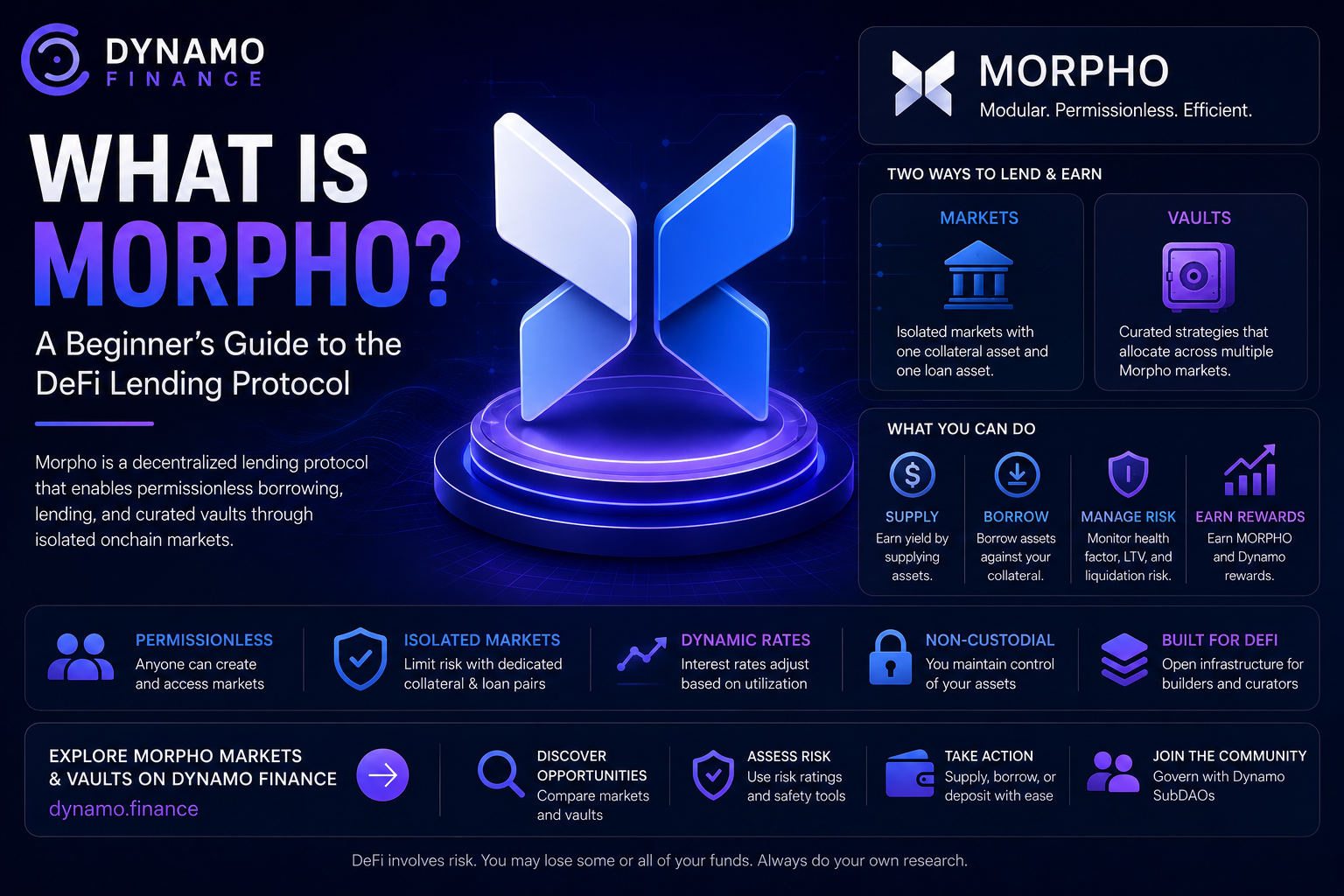
Galaxy Curation and Morpho
Morpho provides the base lending and vault infrastructure. Galaxy provides the strategy, market selection, exposure limits, and ongoing oversight.
Every isolated Morpho market is defined by a loan asset, a collateral asset, an oracle, an interest-rate model, and an LLTV threshold. These parameters determine how suppliers earn interest and when borrowers become eligible for liquidation.
The underlying architecture is important because Galaxy cannot make an unsafe market safe merely by including it in a professionally curated vault. Curation can reduce risk through selection, sizing, diversification, and monitoring, but it cannot remove the dependencies built into the market.
Readers who want to examine the technical components can consult the official Morpho technical resources.
Why Isolated Markets Matter
Morpho markets isolate one lending configuration from another. A market using WBTC collateral and USDC loans has separate accounting from a market using a staked Ether token as collateral.
This structure helps limit direct contagion at the protocol level. Bad debt in one isolated market does not automatically become debt in every other Morpho market.
A vault can still allocate to several markets, however. The depositor’s exposure becomes the weighted combination of the markets selected by the curator.
Why Curator Quality Matters
Permissionless vault infrastructure allows many entities to create strategies. The smart contract can enforce roles and limits, but it cannot determine whether a curator’s economic assumptions are sensible.
Curator evaluation should include experience, transparency, risk methodology, monitoring capabilities, conflicts of interest, incident response, and allocation history. A well-known institutional name can strengthen confidence, but brand recognition should not replace market-level analysis.
How Galaxy Curation Relates to Dynamo Finance
Galaxy Curation and Dynamo serve different functions within the same broader ecosystem.
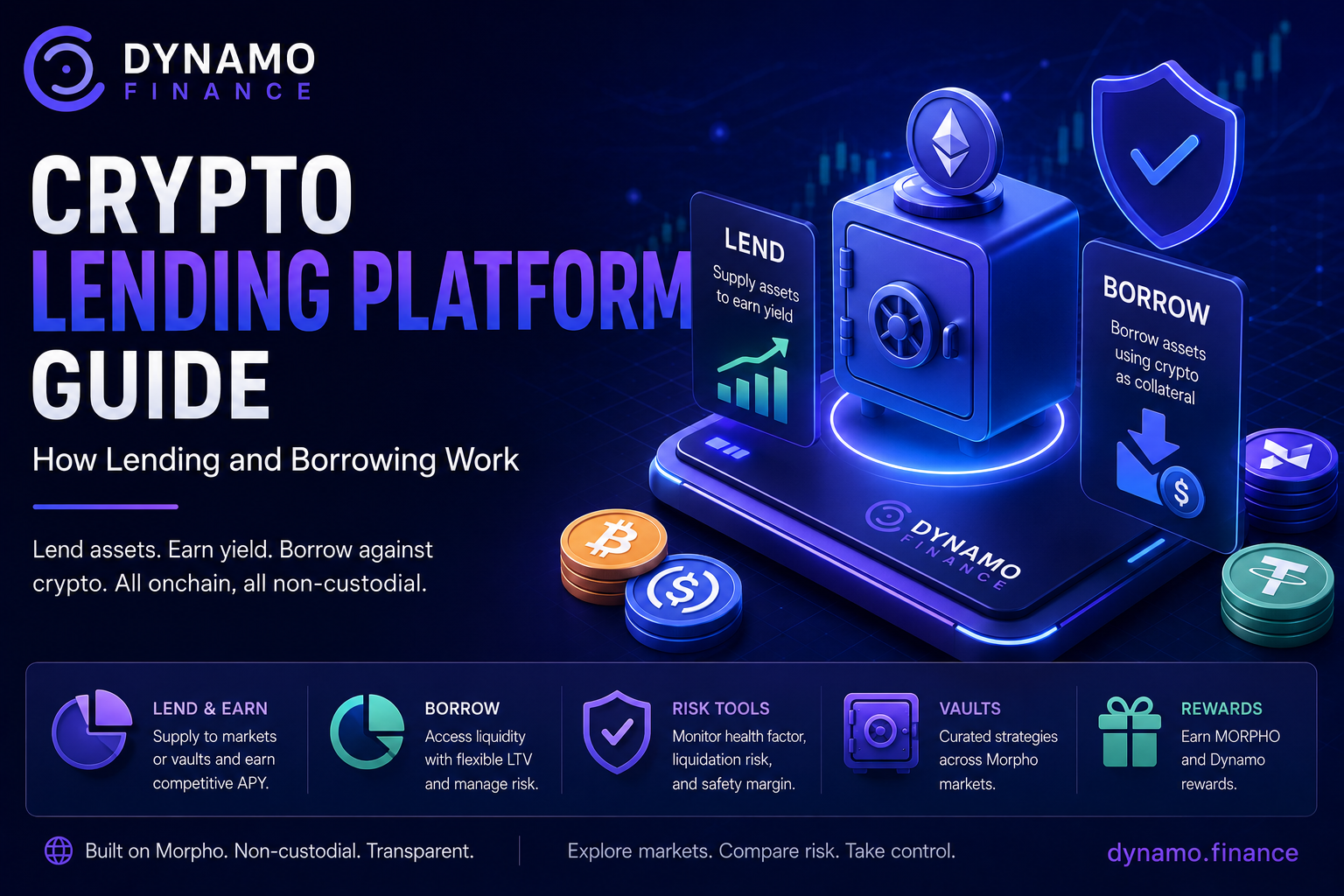
Galaxy designs and manages vault strategies. Dynamo is a non-custodial, permissionless interface and feature layer built on Morpho smart contracts. It allows users to explore markets, compare vaults, supply assets, borrow against collateral, and manage positions from one interface.
When a compatible Galaxy vault appears on Dynamo, the underlying strategy remains curated by Galaxy. Dynamo does not take over its allocations or custody the deposited funds.
This distinction makes Dynamo useful for researching multiple curators without treating every vault as an isolated product page. Users exploring morpho lending can compare Galaxy strategies with other vaults and direct market positions using a consistent set of data.
What Dynamo Adds to the Research Process
Dynamo surfaces active Morpho markets and vaults with information such as deposit asset, curator, APY, TVL, market composition, and available liquidity. Its interface also supports direct deposits into individual markets for users who prefer to choose their own exposure.
Risk ratings provide a screening layer based on observable onchain factors. Market ratings consider LLTV, market TVL, and how long the market has been live. Vault ratings consider total supplied value, exposure to lower-risk markets, and vault age.
These labels help narrow a large opportunity set, but they are not security guarantees or investment recommendations. A market can meet quantitative thresholds and still fail because of an oracle problem, collateral depeg, contract exploit, or liquidity shock.
Dynamo Tools for Borrowers
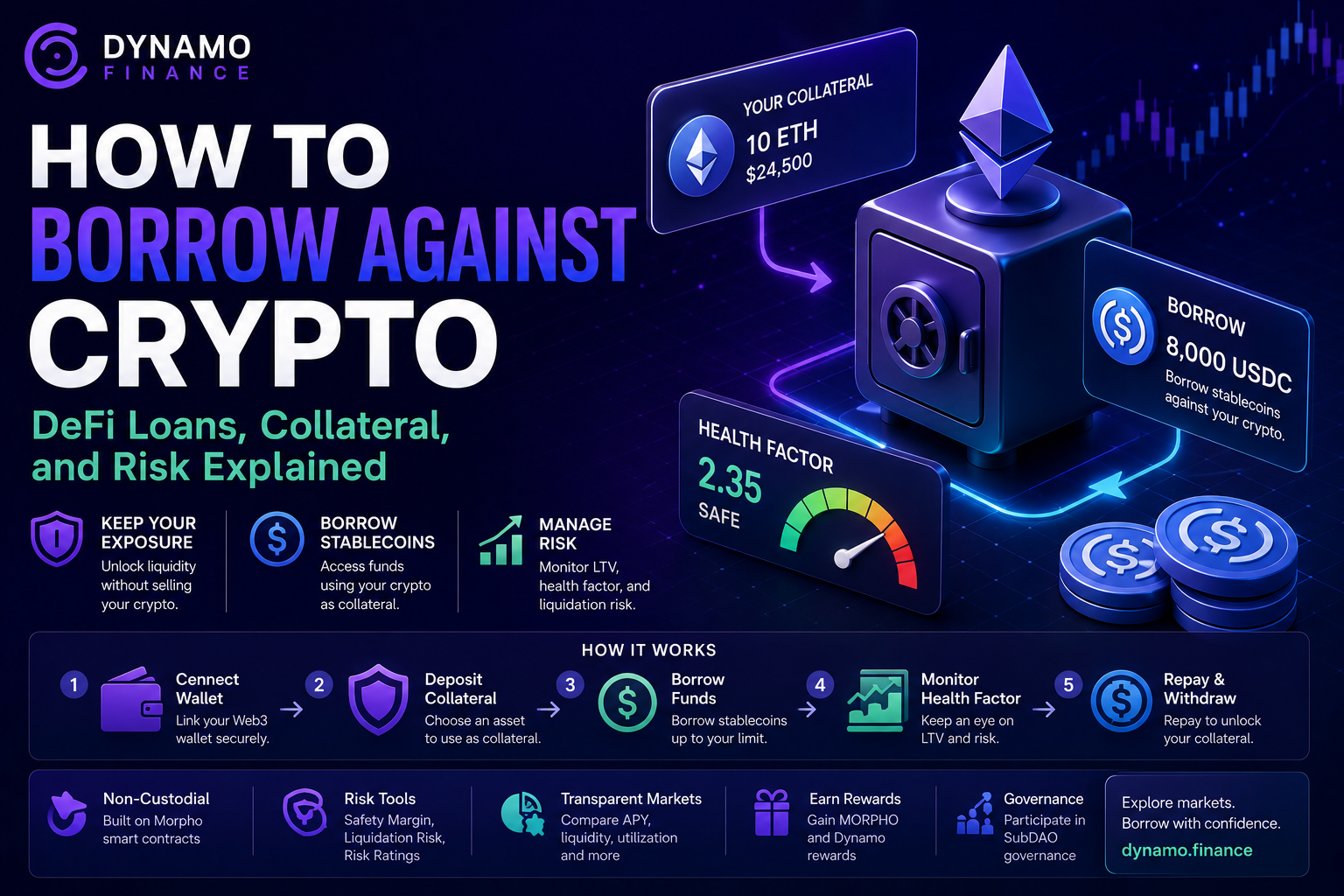
Galaxy vault depositors act as suppliers, but Dynamo also supports borrowers. A user can post collateral and take a loan crypto position through a compatible isolated Morpho market.
Dynamo’s Safety Margin lets borrowers choose a more conservative effective LTV below the market’s immutable liquidation threshold. Its liquidation-risk view displays health factor, liquidation price, and the amount the collateral price can fall before the position becomes eligible for liquidation.
These borrowing tools do not directly protect a Galaxy vault depositor. They improve the borrower’s risk management, which may indirectly support healthier market behavior when used responsibly.
Galaxy Vault vs. Direct Morpho Market
A curated vault is not the only way to supply assets on Morpho. Users can also lend directly to an individual market.
Direct supply gives the user precise control over the collateral, oracle, LLTV, and market receiving their assets. The cost of that control is the need to monitor the position and move liquidity manually when conditions change.
A Galaxy vault delegates those allocation decisions. The curator can diversify and rebalance the pooled capital, reducing the operational workload for the depositor.
| Consideration | Galaxy-Curated Vault | Direct Morpho Market |
|---|---|---|
| Market selection | Managed by Galaxy within the vault mandate | Selected entirely by the user |
| Rebalancing | Handled by the curator or authorized allocation process | Requires the user to withdraw and redeploy manually |
| Exposure | Can change as the vault reallocates | Remains tied to the chosen market until the user acts |
| Diversification | May span several approved markets | One market per direct supply position |
| Curator risk | Present | Not present in the same form |
| Research burden | Reduced but not eliminated | Higher because the user evaluates each parameter |
| Fee structure | May include vault management or performance fees | No curator-level vault fee, although market or interface fees may apply |
Neither model is universally better. Users comfortable with lending with morpho at the market level may prefer direct control, while investors seeking delegated allocation may find a curated vault more practical.
Major Risks of Galaxy Curation Vaults
Professional curation can improve market selection and monitoring, but it does not make a DeFi vault risk-free. Depositors should evaluate each risk layer separately.
1. Smart-Contract Risk
Galaxy vaults rely on Morpho market contracts, vault contracts, token contracts, oracle integrations, and any external systems supporting the collateral. A vulnerability in a critical dependency can produce losses or prevent normal withdrawals.
Audits reduce risk but cannot prove that software will behave correctly under every condition. New vault versions or integrations may also have less production history than older contracts.
2. Curator Risk
Galaxy controls important strategy decisions within the vault’s permission structure. Poor market selection, excessive concentration, slow reaction to warning signals, or an operational mistake could harm depositors.
Role separation and onchain transparency can limit some forms of abuse, but they do not eliminate errors in judgment. Depositors should monitor major allocation changes instead of assuming the original portfolio will remain unchanged.
3. Collateral Risk
The quality of a lending market depends heavily on the assets borrowers post. If collateral loses value rapidly or becomes difficult to sell, liquidators may recover less than the outstanding debt.
Wrapped and yield-bearing tokens add another layer. Their market value can depend on an issuer, custodian, staking provider, bridge, redemption queue, or external protocol.
4. Oracle Risk
An oracle tells the market how much the collateral is worth relative to the borrowed asset. An incorrect, stale, or manipulated price can cause premature liquidations or allow an insolvent position to remain open.
More complex collateral generally requires more complex valuation. A token representing staked assets, future yield, or a basket of strategies may not behave like a highly liquid spot asset during stress.
5. Liquidation Risk and Bad Debt
A borrower becomes liquidatable when their debt reaches the market’s LLTV threshold relative to collateral value. Liquidators repay debt and receive collateral at an incentive.
Bad debt can occur when collateral falls too quickly, the oracle updates unexpectedly, or available market liquidity is insufficient to sell the collateral. Vault suppliers ultimately bear the economic effect of unrecovered debt in markets to which the vault is exposed.
6. Utilization and Withdrawal Risk
A vault share may be redeemable without a fixed maturity, but that does not guarantee unlimited instant liquidity. If most supplied assets are currently borrowed, the vault may need borrower repayments or new supplier deposits before processing a large withdrawal.
High utilization is therefore both a return driver and a liquidity warning. Depositors should not treat “no lock-up” as identical to “cash available under every market condition.”
7. Stablecoin Risk
USDC and USDT are designed to track the U.S. dollar, but they are not riskless dollars. Each depends on reserves, banking relationships, redemption systems, operational controls, legal structures, and continued market confidence.
A stablecoin can temporarily trade below its target price even if the issuer remains solvent. In a severe event, the deposit asset itself can become the largest source of risk in a supposedly conservative vault.
8. WETH and ETH-Market Risk
WETH is designed to represent ETH in an ERC-20-compatible format. A WETH vault remains economically exposed to ETH price movements, even if its token-denominated balance grows.
Markets collateralized by staked or restaked ETH variants can also create correlated exposure. During an ETH sell-off, both the loan asset and collateral ecosystem may experience volatility and strained liquidity.
9. Concentration Risk
A vault with several approved markets is not necessarily diversified. Most deployed liquidity may sit in one or two markets because they offer the strongest demand or best current rates.
Concentration can be reasonable when the dominant markets are highly liquid and robust. It still means that one collateral or oracle failure could materially affect the vault.
10. Regulatory and Interface Risk
Rules governing DeFi, stablecoins, sanctions screening, digital-asset services, and taxation continue to evolve. Access to a website may become restricted even while the underlying contracts remain deployed.
Users should confirm that they are legally permitted to interact with a vault. They must also protect wallet credentials and verify URLs because neither Galaxy nor Dynamo can reverse a confirmed blockchain transaction.
How to Evaluate a Galaxy Curation Vault
A disciplined review starts below the headline APY. The following process works for Galaxy vaults and most other curator-managed lending strategies:
- Confirm the deposit asset and network. Make sure the wallet holds the correct token on the correct blockchain before approving any transaction.
- Verify the vault contract. Compare the address shown on the interface with Galaxy’s official portfolio page and the corresponding Morpho listing.
- Check the curator identity. Confirm that Galaxy Curation is listed as the active curator and review any other privileged roles.
- Read the strategy mandate. Determine whether the vault is a Quality or Enhanced strategy and what collateral categories it may use.
- Inspect actual allocations. Review current market weights, idle liquidity, supply caps, and concentration rather than relying on the vault name.
- Study each major market. Check the loan asset, collateral, oracle, LLTV, utilization, available liquidity, and market age.
- Identify external dependencies. Look for wrappers, bridges, staking systems, custodians, token issuers, or other protocols that could fail.
- Review APY composition. Separate base borrower interest from temporary rewards and note whether the recent rate is unusually high.
- Confirm fees. Check management and performance fees on the live vault page because settings can differ by strategy and change over time.
- Size the position conservatively. Begin with an amount that reflects smart-contract and liquidity risk rather than allocating solely according to expected return.
Dynamo’s compare live vaults interface can support this process by placing vault data and underlying market information in a consistent environment.
How Dynamo Helps Users Compare Galaxy Vaults
Dynamo is designed to make Morpho’s permissionless market structure easier to navigate. Users can explore vaults by deposit asset, curator, APY, TVL, and market composition.
The platform also allows users to open individual market views and examine the data behind a vault allocation. This is particularly useful when a Galaxy strategy has most of its liquidity concentrated in a small number of markets.
A practical comparison should cover:
- Current and historical yield conditions
- Total value supplied to the vault
- Current allocation by market
- Collateral and oracle dependencies
- Utilization and available liquidity
- Vault and market age
- Management and performance fees
- Dynamo’s market and vault risk categories
The APY displayed for a vault on Dynamo is presented after applicable vault fees. Users can therefore compare the displayed net rate without manually subtracting a listed performance or management charge.
Anyone researching the highest usdc yield should still resist sorting by APY alone. The highest rate can belong to a small, new, highly utilized, or complex market where the probability of loss is also higher.
Fees and Net Yield
Morpho vaults can charge a performance fee, a management fee, or both. A performance fee takes a percentage of generated yield, while a management fee accrues against assets under management.
Fee settings vary by curator and vault. The Galaxy USDC Quality listing showed 0% management and performance fees at the time of review, but users should confirm the current settings immediately before depositing.
Consider a simplified example. A vault generating 6% gross APY with a 10% performance fee would leave approximately 5.4% before any management fee, gas expense, or other adjustment.
A 1% annual management fee would reduce the result further. The economic effect depends on how the smart contract accrues fees and how long the user remains in the vault.
Practical Galaxy Curation Examples
Example 1: A USDC Holder Prioritizing Capital Preservation
A user holds $25,000 in USDC and wants an onchain return but does not want exposure to experimental collateral. Galaxy USDC Quality appears more aligned with that objective than an Enhanced strategy.
The user reviews the live allocation and discovers that most capital sits in three blue-chip-collateral markets. They check each oracle, utilization level, and available liquidity before depositing a limited portion of the portfolio.
This approach does not eliminate risk. It aligns the chosen mandate with the user’s ability to understand and monitor the exposure.
Example 2: A Yield Seeker Comparing Quality and Enhanced
Another investor notices that Galaxy USDC Enhanced offers a higher APY than Galaxy USDC Quality. Instead of treating the rate difference as free income, they open the allocation breakdown.
The Enhanced vault includes markets with more complex collateral and lower liquidity. The investor concludes that the added yield is attractive only for a smaller satellite allocation, while the majority of their USDC remains in more conservative strategies.
Example 3: An ETH Holder Who Measures Wealth in ETH
An ETH-native investor wants to increase their WETH balance without selling into stablecoins. Galaxy WETH Quality may match that objective because returns accrue in the same asset the investor already holds.
They understand that the dollar value can still fall sharply during an ETH drawdown. The relevant performance measure is the change in WETH holdings, adjusted for fees and risk, rather than a stable dollar return.
Example 4: A Borrower Who Does Not Need a Vault
A user wants stablecoin liquidity against an existing crypto position rather than yield on idle assets. A Galaxy vault is not the direct solution because it represents the supplier side of the market.
The borrower instead uses Dynamo to compare collateralized markets and reviews LLTV, borrow APY, health factor, and liquidation price. This illustrates how lending and borrowing are connected but require different workflows and risk controls.
Who May Find Galaxy Curation Useful?
Galaxy Curation may appeal to depositors who want delegated market selection backed by an institutional digital-asset organization. It can also suit users who lack the time or infrastructure to rebalance positions across Morpho markets manually.
Quality vaults may be more relevant to depositors who prioritize established collateral and liquidation depth. Enhanced strategies may suit users willing to accept greater complexity in pursuit of additional return.
WETH-denominated vaults can serve ETH-native investors, while stablecoin vaults may be more appropriate for users targeting dollar-denominated yield. In both cases, the investor must remain comfortable with smart-contract and liquidity risk.
Who Should Avoid Galaxy Curation Vaults?
These vaults are not suitable for anyone who requires insured principal, guaranteed APY, or immediate withdrawals under every condition. They also should not be treated as replacements for emergency cash held in a conventional bank account.
Users who cannot evaluate changing allocations may prefer a simpler position they understand more fully. Delegating execution does not eliminate the depositor’s responsibility to monitor the strategy.
Anyone seeking effortless crypto passive income should be especially cautious with that framing. Vault returns require borrowers, collateral, contracts, oracles, liquidators, and ongoing risk management; the process is automated, but the risk is real.
Galaxy Curation vs. a Crypto Savings Account
A curated Morpho vault may look similar to a savings product because a user deposits an asset and sees an APY. The legal and economic structure is fundamentally different.
A bank deposit may benefit from regulatory supervision and deposit insurance within applicable limits. A Galaxy-curated vault is an onchain smart-contract position with no guarantee that principal will be recovered after an exploit, collateral failure, or bad-debt event.
The return source also differs. Vault yield generally comes from onchain borrowers rather than a bank’s wider loan book or central-bank-linked balance-sheet activity.
This distinction should shape position sizing. A DeFi vault belongs in a risk portfolio, not in a category automatically assumed to be cash-equivalent.
Does Institutional Curation Make DeFi Safer?
Institutional involvement can improve process quality. Experienced firms may have stronger monitoring, market connectivity, research resources, operational controls, and liquidation expertise than an anonymous curator.
Those advantages can reduce some avoidable risks, especially poor diversification or slow responses to deteriorating liquidity. They cannot eliminate protocol bugs, oracle failures, stablecoin events, or extreme market gaps.
Institutional curation also introduces questions about incentives and conflicts. A curator may have business relationships with protocols, token issuers, borrowers, or other market participants represented in a vault.
Transparency is the appropriate response. Users should review allocations and risk parameters independently rather than assuming that institutional branding converts an onchain strategy into a guaranteed product.
The Broader Importance of Galaxy Curation
Galaxy Curation reflects a larger shift in DeFi. The industry is moving from simple, self-directed liquidity pools toward a layered model in which protocols supply infrastructure and curators compete on portfolio construction.
Morpho provides permissionless markets and vault contracts. Curators translate those building blocks into strategies with recognizable mandates, while interfaces such as Dynamo help users compare and access them.
This structure resembles asset management in some respects, but it remains more transparent and programmable. Allocations can be observed onchain, vault shares can integrate with other applications, and users retain the option to interact through different compatible interfaces.
The model may become increasingly important as tokenized collateral, private credit, staking assets, and institutional borrowers move onchain. Greater sophistication will create new yield sources, but it will also increase the number of dependencies depositors must understand.
How to Start Researching Galaxy Curation on Dynamo
Begin by selecting the asset you already own or intend to deploy. Avoid converting into a different stablecoin or wrapped asset solely because one vault displays a marginally higher rate.
Open Dynamo’s vault interface, filter by the relevant deposit asset, and locate Galaxy Curation where available. Confirm the curator, contract address, network, current APY, TVL, fees, and allocation breakdown.
Next, open the largest underlying markets. Examine collateral, oracle, LLTV, utilization, market age, and available liquidity.
Compare the vault with direct supply alternatives and strategies from other curators. The objective is not to find a universally superior vault but to identify the exposure that best fits your risk tolerance and monitoring ability.
The Dynamo Finance documentation offers additional explanations of Morpho markets, vaults, interest rates, collateral, liquidations, wallet permissions, fees, and risk tools.
Final Thoughts on Galaxy Curation
Galaxy Curation brings institutional portfolio management and risk oversight to Morpho’s non-custodial vault infrastructure. Its Quality strategies emphasize established collateral, liquidity, and liquidation resilience, while Enhanced strategies accept a wider opportunity set in pursuit of higher returns.
The curator’s reputation and operational resources are meaningful, but they do not replace due diligence. Depositors remain exposed to the underlying stablecoin or WETH, Morpho contracts, market collateral, oracles, utilization, liquidators, and Galaxy’s allocation decisions.
Dynamo provides a practical way to look beyond the vault name. Users can compare Galaxy strategies with other vaults, inspect individual markets, review risk indicators, and choose between curated allocation and direct supply.
Explore live opportunities through Dynamo, verify every contract and fee setting before signing, and follow Dynamo Finance Twitter/X for platform and ecosystem updates.
Frequently Asked Questions
What is Galaxy Curation in crypto?
Galaxy Curation is Galaxy’s onchain vault-curation business. It selects, monitors, and reallocates assets across Morpho lending markets to create managed vault strategies for depositors seeking DeFi yield.
How do Galaxy Curation vaults earn yield?
The vaults supply assets such as USDC, USDT, or WETH to approved Morpho markets. Borrowers pay interest to access that liquidity, and the resulting supply yield accrues to the vault’s depositors after applicable fees.
What is the difference between Galaxy Quality and Enhanced vaults?
Quality vaults prioritize established collateral, strong liquidity, and robust liquidation conditions. Enhanced vaults can include higher-yielding markets with additional collateral, liquidity, oracle, or protocol complexity.
Are Galaxy Curation vaults safe?
No DeFi vault is risk-free. Galaxy’s curation process may improve selection and monitoring, but depositors can still lose funds through smart-contract exploits, oracle failures, collateral losses, stablecoin events, bad debt, illiquidity, or curator errors.
How can I compare Galaxy Curation vaults on Dynamo Finance?
Connect or open Dynamo, navigate to its vault listings, and filter by asset or curator. Compare live APY, TVL, fees, allocations, risk ratings, utilization, collateral, and available liquidity before approving a deposit.